November 2, 1852

490px-William_Rufus_DeVane_King_1839_portrait

William R. King

(1786 – 1853)

Tuesday Nov 2d  Sewed on cambric sleeves for

Susan this forenoon very quietly with

Miss Alger  It has rained since Saturday

morn but this afternoon has cleared 

off Mrs Ames & self have been to Mr

Swains & called at Doct Wales & Augustus

Miss Alger & O Angier took tea in Olivers


Back from her quick day trip into Boston, Evelina spent the morning “very quietly” in her sitting room, sewing. The piano teacher, Miss Alger, was still visiting.  Outside, “it rain[ed] by spells […] wind north east it stormd all the forenoon and was cloudy about all day – there has bin one inch + a quarter of water fell since Sunday”*

After midday dinner, when the storm had stopped, Evelina and her sister-in-law, Sarah Lothrop Ames, went out to check on Ann and John Swain, whose infant son had died on Saturday. Evelina would have taken with her the mourning accoutrements she had purchased for Ann in the city. No doubt the Ames women continued to comfort the forlorn parents. From the Swains they paid other calls in North Easton, to the home of Ephraim and Maria Wales and to see Evelina’s nephew, Alson “Augustus” Gilmore and his wife Hannah. Hannah had lost her infant son Willie back in the summer. The women would have had much to talk about.

On the national scene, the day was momentous. As we have read previously in this blog, General Franklin Pierce, a Democrat, was elected President of the United States, defeating Whig candidate General Winfield Scott (incumbent Whig Millard Fillmore hadn’t been renominated) and Free Soil candidate John P. Hale. Easton historian William Chaffin writes: “In 1852 the vote for President was one hundred and seventy-one for Winfield Scott, one hundred and forty-three for John P. Hale, forty-nine for Franklin Pierce, and four for Daniel Webster, who was dead. This vote shows the political complexion of the town, and confirms the statement of the adoption of the Free Soil position by many Democrats.”**

The vice-president-elect was William R. King, a senator from Alabama who believed strongly in the Union. He had helped draft the Compromise of 1850. Unfortunately, King was suffering from tuberculosis and would soon die in office, one of the shortest-termed vice-presidents and the only Alabaman. He was also the only vice-president to take the oath of office on foreign soil; he was in Cuba taking the cure when he was inaugurated.


*Oliver Ames, Journal, Stonehill College Archives, Arnold Tofias Collection

**William L. Chaffin, History of Easton Massachusetts, 1886, p. 630
 

October 26, 1852


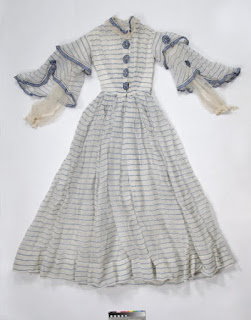
1860s blue striped muslin dress from St. Albans Museums

Dress with undersleeves, mid-19th c.*

Tuesday Oct 26  We have had a large washing

done to day and not finished untill

after dinner  Miss Alger & self spent

the afternoon in Olivers  Mr Ames

& all the children there to tea  Mr & Mrs 

Whitwell was there an hour or two

I made Susan a pair of undersleeves

and she is delighted with them


Because of all the company that had visited over the weekend, the servant girls were unable to launder clothes on Monday. Today, extra sheets and towels were added to the usual load and the washing went on into the afternoon. Not that Evelina rolled up her sleeves; after the midday meal, she and her remaining houseguest, Miss M. J. Alger, went next door to visit with Sarah Lothrop Ames and stayed for tea. All the family partook.

At various points during the day, Evelina had her work box open as she completed a pair of undersleeves for her daughter. Susie was “delighted” with them. Were they a peace offering from mother to daughter, perhaps to make up for Evelina’s insistence on Susan learning to play piano?

We’ve seen Evelina sewing undersleeves before. In the 1850’s and into the Civil War, undersleeves were an essential component of any woman’s dress, fitting independently but securely under the looser outer sleeve of the dress proper. Like the collars of the day, a good pair of undersleeves could be worn with different dresses. Susie must have felt rather grown-up with her new pair.

On the industrial side of American life, meanwhile, today was the 27th anniversary of the opening of the Erie Canal. The technological wonder of its day, it was already becoming obsolete. Railroads had arrived and, through their own capacity for moving freight, would soon obviate commercial use of the canal for many (though not all) industries. Shipping would change – was changing. The very word “shipping” derives from the fact that, initially, more goods moved by water than by land. This would no longer be true in this country or elsewhere in the developed world.

We should remember that Harriet Ames Mitchell, Old Oliver’s youngest daughter, was living in Erie at the time with her husband Asa and their three children.  Did they mark the day?


*Image of striped blue muslin dress with undersleeves courtesy of St. Albans Museum, England


October 22, 1852


F201308231348352569927452

Tibetan Sheep, 21st century

Friday Oct 22d Julia Mahoney was here to work

this forenoon on Susans Maroon Thibot

making a new waist and put a new yoke

and making over the waist to her dark

striped wool deLaine  Carried home the

waist to finish to her Thibot dress  I spent

the afternoon at Olivers with Hannah + Augustus

Mr Whitwell called


Julia Mahoney, a local dressmaker, worked at Evelina’s sewing at least two dresses for Susan Ames. Susie, who was ten-going-on-eleven, was growing taller and more mature. The dresses she had worn the previous winter needed to be altered, the waists expanded, the tucks let out, a new yoke put in. One of her dresses was made of delaine, a wool that Evelina sewed often for herself and her daughter. It was a popular, open-weave, light-weight wool that came in many patterns and colors; it may or may not have been imported.

The “Thibot” cloth that Evelina describes was more unusual. It was of “[w]ool material, worsted with soft and smooth plain-finished face; made from mountain sheep of Thibet, Asia*.” This textile was imported and would have been more expensive, suggesting that Susie’s little maroon dress may have been meant for “Sunday best.” It was special enough that the dressmaker took it home to work on.

In Boston at this time, sources for wool were both domestic and foreign.  There were approximately 15 wool merchants in the city, most of whom were prospering. According to an early 20th century history:

“The quantity of domestic wool showed a steady decrease for several years subsequent to the enactment of the tariff of 1846. The effect of the gold discoveries upon general commerce in 1849, stimulating the manufacturing industry, is reflected in the rapidly increased imports of home grown wools. The imports of foreign wools show considerable yearly fluctuation, corresponding in the main to the varying quantities of domestic wools.”**

Some years later, Susie would marry a wool merchant named Henry French. She and Evelina would then – presumably – have access to whatever wool they needed or wanted, foreign or domestic.

*Betty J. Mills, Calico Chronicle: Texas Women and Their Fashions, 1830-1910, Texas Tech University Press, 1988, p. 183

**Joseph T. Shaw, The Wool Trade of the United States: History of a Great Industry:Its Rise and Progress in Boston, Now the Second Market in the World, 1909, p. 52

October 19, 1852


Gentiana-crinita-Fringed-Gentian-plant

Fringed gentian (Gentiana Crinita)

Oct 19th Tuesday  Have been sewing on Susans

fall de Laine that I bought last summer

and it appears to me that it will never

be finished  I get along so slowly on it

Ann has ironed the coloured clothes

Catharine sewing

“[P]ritty fair,”* today was. Evelina spent much of the day – more time than she wished, in fact – working on a dress for her daughter Susan. The material was delaine, a light wool that should have been easy to sew, but for some reason Evelina was going along “so slowly” that she just couldn’t see the end of it. Perhaps she wished she could be outdoors, instead. Her servant Catharine Murphy was also sewing, most likely on a project that Evelina would have assigned her to do. Evelina occasionally gave material to her girls to sew their own aprons or simple dresses with.

Another diarist, not far away, definitely preferred to be outdoors. In Concord, Henry David Thoreau went for a walk and found the very last flowers of the season:

“I see the dandelion blossoms in the path. The buds of the skunk-cabbage already show themselves in the meadow […] I found the fringed gentian now somewhat stale and touched by frost […] It may have been in bloom a month. It has been cut off by the mower, and apparently has put out in consequence a mass of short branches full of flowers. This may make it later. I doubt if I can find one naturally grown. At this hour the blossoms are tightly rolled and twisted, and I see that the bees have gnawed round holes in their sides to come at the nectar. They have found them, though I had not. “Full many a flower is born to blush unseen” by man. An hour ago I doubted if fringed gentians were in Concord now, but, having found these, they as it were surrender […] It is too remarkable a flower not to be sought out and admired each year, however rare. It is one of the errands of the walker, as well as of the bees, for it yields him a more celestial nectar still. It is a very singular and agreeable surprise to come upon this conspicuous and handsome and withal blue flower at this season, when flowers have passed out of our minds and memories; the latest of all to begin to bloom, unless it be the witch-hazel, when, excepting the latter, flowers are reduced to the small Spartan cohort, hardy, but the most part unobserved, which linger till the snow buries them, and those interesting reappearing flowers which, though fair and fresh and tender, hardly delude us with the prospect of a new spring, and which we pass by indifferent, as if they only bloomed to die. Vide Bryant’s verses on the Fringed Gentian. […] It is remarkable how tightly the gentians roll and twist up at night, as if that were their constant state. Probably those bees were working late that found it necessary to perforate the flower.”**

Much as Evelina enjoyed flowers, we might doubt that she would have been as eloquent about seeing the late-blooming gentian in the meadow as Thoreau.

*Oliver Ames, Journal, Stonehill College Archives, Arnold Tofias Collection

*Henry David Thoreau, Journal, 1852, courtesy of http://hdt.typepad.com/henrys_blog/2010/10/october-19-1852.html

October 11, 1852

factory-steam-engine

Early factory steam engine

Monday Oct 11th  Catharine Middleton & Murphy washed

and I sat down quite early to my sewing

with Mother & Louisa  Mended stockings

This afternoon we spent at Augustus

Mother & Louisa are going to spend the 

night  Mr Torrey & Abby were there

Mr Ames & Oakes A went to West B

I have been sewing on the skirt of Susans

fall Delaine

This was a typical Monday as far as domestic matters were concerned. In the morning, the women washed clothes and mended stockings. In the afternoon, they went calling on relatives in the village. But it was a red-letter day at the shovel shop, as men arrived to install the a steam engine – the first – at the factory.

Old Oliver seemed excited: “this was a fair good day for the season the man came here to sett up the enjoin four of them.” The company’s first steam engine was placed in the new Long Shop by the Corliss Nightingale Company of Providence. It was a technological change that Oliver had resisted in the past, but had since come to accept. His son, Horatio, in particular, had urged the change for several years in order “to counter water supply limitations”* In January, 1847 he had written his father and his brother, Oliver Jr., on the topic.

To Old Oliver:

I shall think a steam engine […] of sufficient power to carry 3 hammers and carry all your polishing works shearing and punching and Bisbees works […] would be cheaper and better […] It is too bad that you do not keep nearer supplying the market with shovels when a comparatively small expense would do it in addition to your other works.”*

To Oliver Jr.:

I enclose you with […the] price and terms for a steam engine. It will do you no hurt to compare cost of this and water power. it will take about one ton of coal a day to drive it and the repairs will be no more than a water power if as much[…] You never need fail for water either too much or too little […] I am altogether in favor of this plan over water power in your situation.”*

Horatio was right, as it turned out. The new engine was the beginning of modernization for O. Ames and Sons.

Gregory Galer, Forging Ahead, MIT, 2002, p. 251.  Text of Horatio Ames correspondence from Stonehill College Archives, Arnold Tofias Collection

October 8, 1852

bushel-and-peck

Friday Oct 8th  Have been making barberry sauce

to day only 1 peck but a great many more apples

Julia was here and altered the skirt of my 

Delaine dress.  She scarcely got the skirt

right  Augusta has gone to her fathers this

afternoon to pass a week or so her father came after

her  I have sewed but very little again to day

Why is it that I cannot find more time to sew?


Evelina was spending so much time in the kitchen lately that she had “but very little” time for sewing. So it went during harvest season. Fruits and vegetables came piling into the kitchen in all manner of measures, and Evelina and her servants had to cook and store them, or lose them. She writes today of using up a peck of barberries for sauce and even more apples, though it’s unclear if the apples went into the barberry sauce or were used in something else. A year ago at this time, Evelina was doing exactly the same thing, cooking barberries and other fruit in her kitchen, except that at the time, she was ill with nettle rash.

We get pints, quarts, pecks and bushels from our English heritage. No metric system for them, or us. A peck is a dry measure equivalent to eight quarts; four pecks make up a bushel. Modern grocery shoppers don’t often see food sold in a quantity of one peck in a regular supermarket. This time of year, one can find displays of five-pound paper bags of fresh apples in the produce department; one of those bags is equivalent to half a peck. With that in mind, think of how many pounds of apples, barberries and more Evelina had to process in the fall. She had no choice, either. Even a family as wealthy as the Ameses needed that food for the winter.

A half-bushel, by the way, was once called a kenning.


September 28, 1852

Pillows

Tuesday Sept 28th  Have two girls and yet Im

about house a great deal of my time

I fear I do not manage right  To day

I have sewed but very little have been

preparing for the sewing circle and have

cut out 6 prs of pillow cases & put them

out to whiten and 5 sheets.  This evening

have written to Mr Norris about our piannos


Evelina struggled to manage the servant girls. Was it her fault or theirs? Was Evelina too lenient, or demanding, or unappreciative? Were the young women ill trained, or naturally inept, or uncertain about their responsibilities? Evelina was inclined to blame herself.

She needed their help today, too, as she was getting ready to host this month’s meeting of the Unitarian Sewing Circle. Evelina hadn’t held a meeting of the Circle at her house for nineteen months, since her unsuccessful attempt back on February 12, 1851. On that occasion, bad weather and disinclination or indifference on the part of other Circle members had resulted in a no show of anyone except the immediate family. She had given a party that no one came to. She had been mortified, but soon recovered.

Did the memory of that embarrassment surface today as she was cleaned house, prepared food, and cut out pillow cases to be sewn? She doesn’t say. She had moved on, perhaps, and was more interested in thinking about the new pianos to come than revisiting an old grievance.

But would her fellow needlewomen show up tomorrow?

September 6, 1852


OLYMPUS DIGITAL CAMERA

Floating Island


Monday Sept 6th  Hannah & Catharine washed

and I had to be about house most of the 

forenoon  made floating island &c &c Mr

Plymton & another man here from Walpole

to dine  Sewed some on shirts  Called

with Mrs S Ames & Mrs Stevens on Abby &

Hannah.  Called on Mrs Wales Sampson Holmes &c


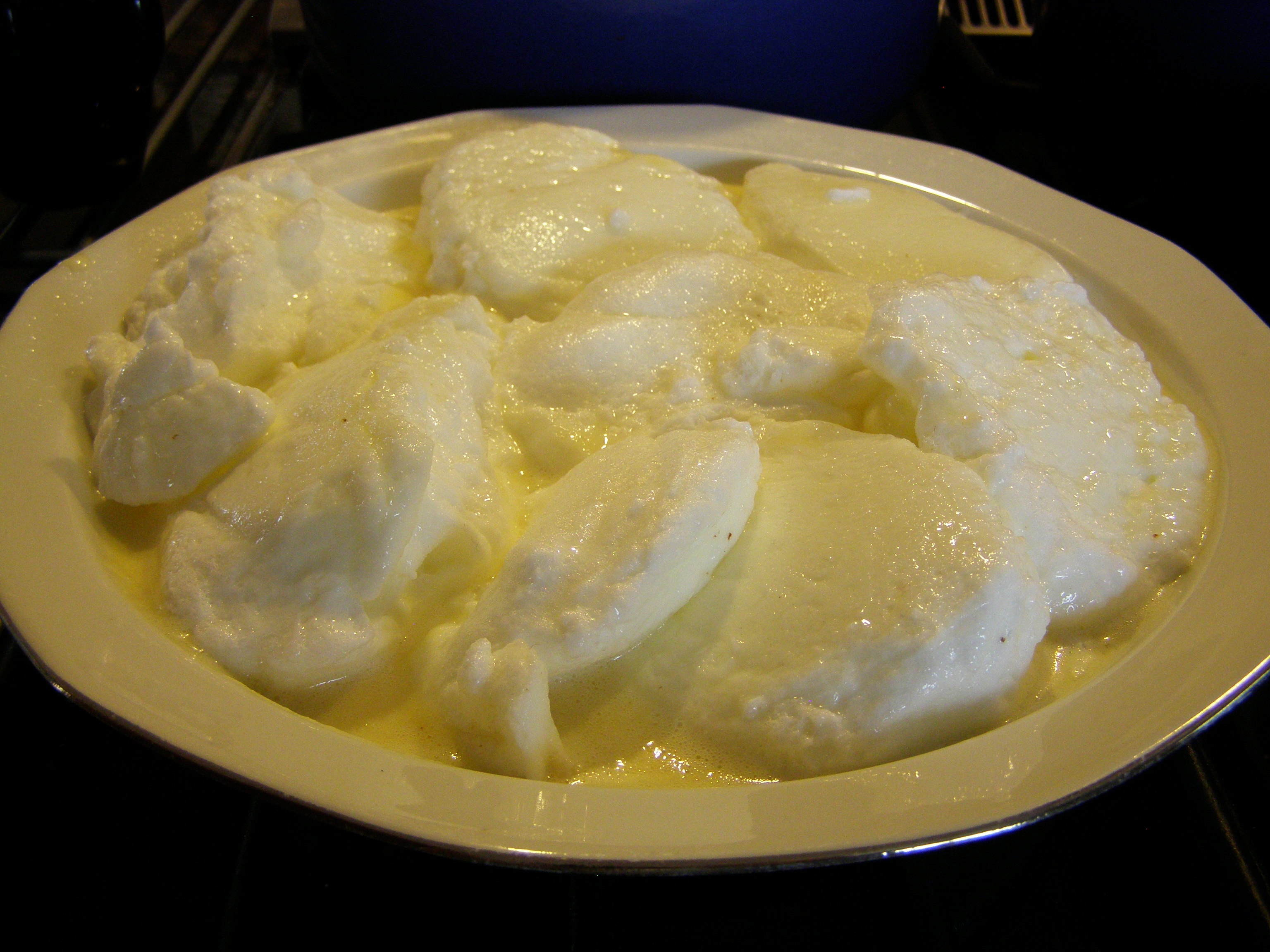
“Oeufs a la Neige” is the French name for this lovely dessert, but Americans took their floating island from its Italian name, “Ile flottante.” Whatever one might call it, the basic recipe for the soft custard filled with floating ovals of poached meringue requires milk or cream and eggs.  It would have been a special occasion for Evelina to serve it, which suggests that she wanted to impress the gentlemen from Walpole who came to dinner. It also tells us that she had eggs to spare in her kitchen, which was unusual.

Recipes for this dish are varied, as one might expect. One 19th century “receipt,” printed in the 1870’s in Godey’s Lady’s Book of Receipts and Household Hints*,  tells us that making the dish was quite time consuming, especially when we remember that all that beating, stirring and frothing was done by hand.

Take six eggs, separate them; beat the yolks, and stir into a quart of milk; sweeten to taste; flavor with lemon or nutmeg. Put this mixture in a pan. Put some water in a saucepan, and set it on fire. When boiling, put in your pan, which ought to be half immersed. Keep stirring it until the custard gets thick, which will be in about thirty minutes. Whip the whites of the eggs to a strong froth. When the custard is done, put into a deep dish, and heap the frothed eggs upon it. Serve cold.*

No doubt Evelina’s dessert was a success at the dinner table. She could spend the afternoon in peace of mind, sewing and socializing. She, her sister-in-law, Sarah Lothrop Ames, and her guest, Mrs. Stevens, made a number of calls.

* Godey’s Lady’s Book of Receipts and Household Hints, 1870s, Recorded by Sarah Annie Frost, p. 237


September 3, 1852

stock-illustration-20625662-woman-on-death-bed-friend-at-bedside-1862-magazine


Friday Sept 3d  Watched with Mrs Savage last night

She is very low but had a pretty comfortable

night I came home about 5 Oclock and

went to bed got up at nine  Went over to

Edwins to see how she was found her some

better  Have sewed on Shirts  Have

got six cut out and some partly made


Evelina was the nurse of the day, tending to two sick women in the neighborhood. She spent the night at the Savage’s home to watch over the ailing Hannah Savage. Hannah had been dying of tuberculosis for months and, in this final stage, many women in the neighborhood were taking turns keeping vigil at night. It wouldn’t be long now.

Getting home at dawn, Evelina was able to sleep in only until about nine, whereupon she rose and bustled right into her day.  She walked across the street to check on her young neighbor, Augusta Gilmore, who had been taken ill with cholera morbus the day before. Augusta was “some better,” which good news enabled Evelina to go home and attend to her sewing. In production was a big batch of shirts for husband Oakes and sons Oliver (3), Frank Morton and, probably, Oakes Angier, despite his absence.  Her preference seemed to be to sew many at once, rather than singly. Helping her, too, must have been at least one of the Irish maids who worked for her.

September 1, 1852

Men's Work Shirt, mid-19th c.

Men’s Work Shirt, mid-19th c.

Wednesday

Sept 1st 1852  Have been cutting out shirts & fixing

them for Catharine to sew  She does very

well at sewing but I have to get it ready for

her  Mrs James Mitchell & Catharine Hobart

came before noon at Olivers   And I have

been in there  Did not get ready to go

very early  Mr Ames has gone to the 

Whig convention at Worcester


Evelina had settled back into her sewing routine, the latest project being shirts for the men in her family. The last time she had sewn a large batch of shirts was back in March, 1851. It looks like the men had worn through the allotment and needed new ones. Evelina and her servant, Catharine, probably used the Bartlett sheeting mentioned two days earlier for material.

Next door, Sarah Lothrop Ames welcomed some visitors from Bridgewater: Harriet Lavinia Angier Mitchell (not to be confused with Harriet Ames Mitchell) and Catharine Hobart, the latter a classmate of her daughter, Helen.  In another three years, Catharine Hobart would later become a member of the family when she married Oakes Angier Ames. We might imagine that Catharine asked after him, perhaps expressing concern for his health. How much information did the family share about Oakes Angier’s lung condition?

While the women worked and socialized at home, the Ames men were out and about. Oakes Ames attended the Whig Convention in Worcester to help put together the Whigs’s slate for the fall election, and Old Oliver “went to quincey + Braintree to get stone for the foundation for the steam enjoin”.  The building of the new factory to replace the one that had burned down in the spring was not yet complete.