February 21, 1851

Bed

1851  Feb 21  Friday  It stormed so hard & so dark that Mr & Mrs

Whitwell spent last night with us & returned

home about 8 Oclock this morning  Lavinia &

myself have been sitting quietly sewing.

Susan is all engaged making Labels for the shop

has cut quite steady all day.  Helen brought her work in, and staid two

or three hours but I could not prevail on her to stop to tea

Bridget has hired a bed & bedstead

The family business, O Ames and Sons (as it had been known since 1844 when Old Oliver handed over two-thirds of the reins to his sons Oakes and Oliver Jr.) was just that: a family business.  The Ames men all had rolls to play in its operation, from manufacturing to sales to management.  On this day in 1851, it appears that an Ames female had a roll to play, too.  Little eight-year old Susie Ames spent the day making labels for the shop.  Presumably, this meant she was cutting out printed labels to be affixed to individual shovels.  Did she sit at a table in the kitchen or the dining room, paper and scissors in hand?  Was she paid for this effort, or was this just a rainy day game for her?  Who thought this up?

While Susie wielded scissors, the women wielded needles, of course.  Evelina and her niece, Lavinia Gilmore, kept each other company as they sewed and were joined for a few hours by Helen Ames from next door.  Although Lavinia, aged 19, lived in the country and Helen, aged 14, lived in town, the two young women, distantly related by marriage, were friends.

Lavinia was in town visiting her aunt Evelina.  Last night, Mr. and Mrs. Whitwell stayed over, unable to return home because of bad weather.  A new servant, Bridget, had just ordered a bed and bedstead for herself. In a two-family house already filled with ten people, not including servants, where did everybody sleep? People surely doubled up; Oakes Angier and Oliver (3), for instance, shared a bedroom and probably a bed. Although this practice, too, was disappearing, many houses of the period still kept beds in their parlors; apparently the Ames did this, so perhaps that was where the Whitwells spent the night.

The difference between a bed and a bedstead was simply that the former included only the mattress and linens (also known as bedding), while the latter was the frame on which to put the mattress.  This verbal distinction was beginning to disappear at the time, but it was still useful in an era when some people – servants, particularly – only had bedding on which to sleep.  A mattress could be rolled up and moved around, a wooden frame could not.  Bridget showed hope or confidence in her place in the household when she ordered a bedstead as well as a bed.

February 20, 1851


images-1

Feb 20th  Thursday  This morning sat down to sewing quite

early with Lavinia.  worked for Susan and she

sewed some with us  Sent George after Mr & Mrs

Whitwell about one Oclock.  Mr Whitwell attended 

the funeral of James Wells child  Commenced 

raining quite hard & this evening is very dark

The boys & Lavinia & Susan have gone to the 

dancing school at Lothrop Hall

The Thursday evening assemblies, or dancing school, continued. On this occasion, Oakes Angier, Oliver (3) and Frank Morton took their cousin, Lavinia Gilmore, and little sister, Susie, with them.  How exciting for Susan to go along to watch the young men and women dance; probably exciting for Lavinia, too.  She was at the marriageable age of nineteen and, in the manner of the day, was probably hoping to marry soon.  Getting off the farm for a week to stay with her aunt Evelina in the village of North Easton was an opportunity to socialize and perhaps meet someone special.  Did anyone ask her to dance?  Did her male cousins watch out for her?  Did she like what she wore?

Elsewhere in Easton life was not so light-hearted.  Reverend Whitwell officiated at a funeral for the infant son of James and Celia Wells.  James and his brother John, for whom the little boy was named, worked at the shovel factory.  They were originally from Maine.

And, being February, the weather took a dive for the worse.  The young people’s ride home from Lothrop Hall must have been disagreeably wet.  Mr. and Mrs. Whitwell, who had evidently stayed for tea after the funeral, were unable to get home and had to spend the night at the Ames’s house. Young George Witherell was spared the challenge of carrying them back to the parsonage in the dark, windy downpour.

February 18, 1851

yoke-of-oxen

Feb 18  Tuesday  After doing my usual mornings work sit

down to sewing on Susans work   She sewed with me

and counted stiches again  She will do pretty well

and keep quite steady when we count stiches

This afternoon went into Olivers to assist on Helens

quilt but found it most done.  Was called home

to see Mr Whitwell   Abby & Malvina Torrey & their 

cousin Mrs Fullerton  called  Pleasant

Sewing lessons for eight-year old Susie Ames continued today.  She seemed to be getting the hang of the needle as long as she counted her stitches.  This meant calculating and maintaining an equal number of stitches per inch of sewing. After the lesson was through, Evelina tripped next door to help with the making of a quilt. She discovered that the work was pretty well complete, however, which was just as well as she was called back home to sit with Reverend Whitwell, who came to visit.  More follow-up to the Sewing Circle meeting?

Outside, away from this cozy domesticity, Old Oliver was clomping around looking at oxen to buy.  He found a pair that he particularly admired and seemed pleased with his purchase:

“this was fair day  wind about west and not cold   I bought a yoke of oxen to day of a Mr Whitcom of East Randolph for $125-00 they are a handsom red + look a good deal alike.  he said they would be 6 years old this spring comeing   the off one girts 7 feet + 2 inches + the nigh one 7 feet   they weighed after drinking with yoke on 3220 lb.  the man  said he had them for twins”

And while Old Oliver dealt with the farming side of the Ames enterprises, Oakes and his three sons were no doubt busy at the shovel works, the young men continuing to learn the ins and outs of manufacturing, much as little Susie was learning to be domestic.   The futures of all four offspring were being lined up.

February 17, 1851

Hem

Feb 17th  Monday  Washed the dishes and worked about

house most of the forenoon  This afternoon cut out some

work for Susan & set her to hemming, counted

stiches with her.  Helen came home from

New bedford.  Spent the evening at Olivers with

Sarah W.  Worked on an apron of Susans but

had so much talking to do that […] I accomplished

but a little sewing  Pleasant but cold

Sewing was a necessity, but it was also a sociable occupation, which is perhaps one of the reasons that Evelina enjoyed it so. Her visit next door with her two sisters-in-law, Sarah Lothrop Ames and Sarah Witherell, turned into an evening of conversation with “but a little sewing,” which she didn’t seem to mind.  What did the women discuss?  Did they revisit the tender issue of the failed Sewing Circle meeting?  Or did they steer toward safer topics like Helen’s return from New Bedford? What had the fourteen-year-old been doing there?  Had she been in school? Why did she return home at the start of a week?  Susie Ames was home from school this week, too.  Was mid-February a typical time for schools to close?

At this time in our history, almost every woman knew how to sew. Sewing was a skill handed down from one generation to the next. Evelina, Sarah Ames and Sarah Witherell had each learned their stitches from their mothers or grandmothers; now it was Susie Ames’s turn to learn.  How could the women know that sewing was about to be transformed by the arrival of the domestic sewing machine, and that a forthcoming civil war would introduce mass-produced, “ready-made” clothing on an unimagined scale?  They, who in their youth had probably watched a elderly relative work a spinning wheel, would experience a dramatic trajectory in the making of apparel.  By the time Susie reached adulthood and became a housewife, some of what she was being taught would be obsolete.  But not all: hemming, mending, quilting, and neat hand-sewing would always have a place in the domestic arts, even though few women today practice the skills.

Young girls of the antebellum period like Susie and Helen and Emily Witherell  sat by their mothers’ sides and struggled to manage a needle and thread, basting or hemming or working cross stitches.  Some of them created the hand-wrought samplers that hang now in textile collections, featuring alphabets or numbers or biblical quotations with colorful, tiny stitches painstakingly wrought by stubby little fingers at age eight or twelve or fourteen. Sewing was a necessity, but it was an art form as well.

February 15, 1851

Chemise

Chemise

Sat Feb 15  This morning mended a pair of pants for Frank

and some other things.  Finished two chemise for Susan

made her a skirt out of an old quilted one of mine.

It has been a very stormy day.  the public school

finished this afternoon.  Oakes A, Mr Pratt, Davidson,

Barrows, R. Willis, Lillie & one or two others visited the 

school.  There were no ladies on account of the rain

Mr Ames went to Boston.  Brought Miss Eaton some maple sugar

While her husband went into Boston today despite poor weather, Evelina stayed in, mended clothes and completed two chemises for Susan. The chemise, a forerunner of today’s slip, was a standard undergarment for women and girls in the 19th century, worn right under the dress (and under the corset, when corsets were worn.)  As Evelina suggests, some undergarments were quilted for warmth, an essential consideration in cold New England. On stormy days like this one, women needed all the padding they could accommodate under their wide skirts.

Oakes Angier Ames visited the local schoolhouse today with men from the school’s superintending committee: Amos Pratt, a teacher; Thomas Davidson, the town’s postmaster; Joseph Barrows, a “shovelmaster” with legal training who lived in a house built by Old Oliver; Rufus Willis, a shoe manufacturer; and Daniel Lillie, another employee of O. Ames & Sons.  Daniel and Oakes Angier were in their early twenties, while the other men were older.  Daniel would be close to the Ames family over the years, and ultimately serve as a pallbearer at Oakes Ames’s funeral in 1873.  Today, however, in the rain, without their wives, the men appeared at the public school on the last day of this session.  Why was Oakes Angier along?  He wasn’t a member of the committee, but perhaps he was developing an interest in local politics.

Oakes Ames, meanwhile, returned from Boston in the evening, bringing with him a gift of maple sugar – a sign of spring – for the failing Miss Eaton.   He may also have returned with news of a serious incident in the city.  Shadrach Minkins, a fugitive slave living and working in Boston, was arrested today by federal marshals at a coffeehouse on Cornhill Street. Minkins would be taken to court, only to be rescued by an anti-slavery group, the Boston Vigilance Committee, who hid him and helped him escape to Montreal.  The controversial new Fugitive Slave Law was being tested.  Had Oakes witnessed any of this?

February 12, 1851

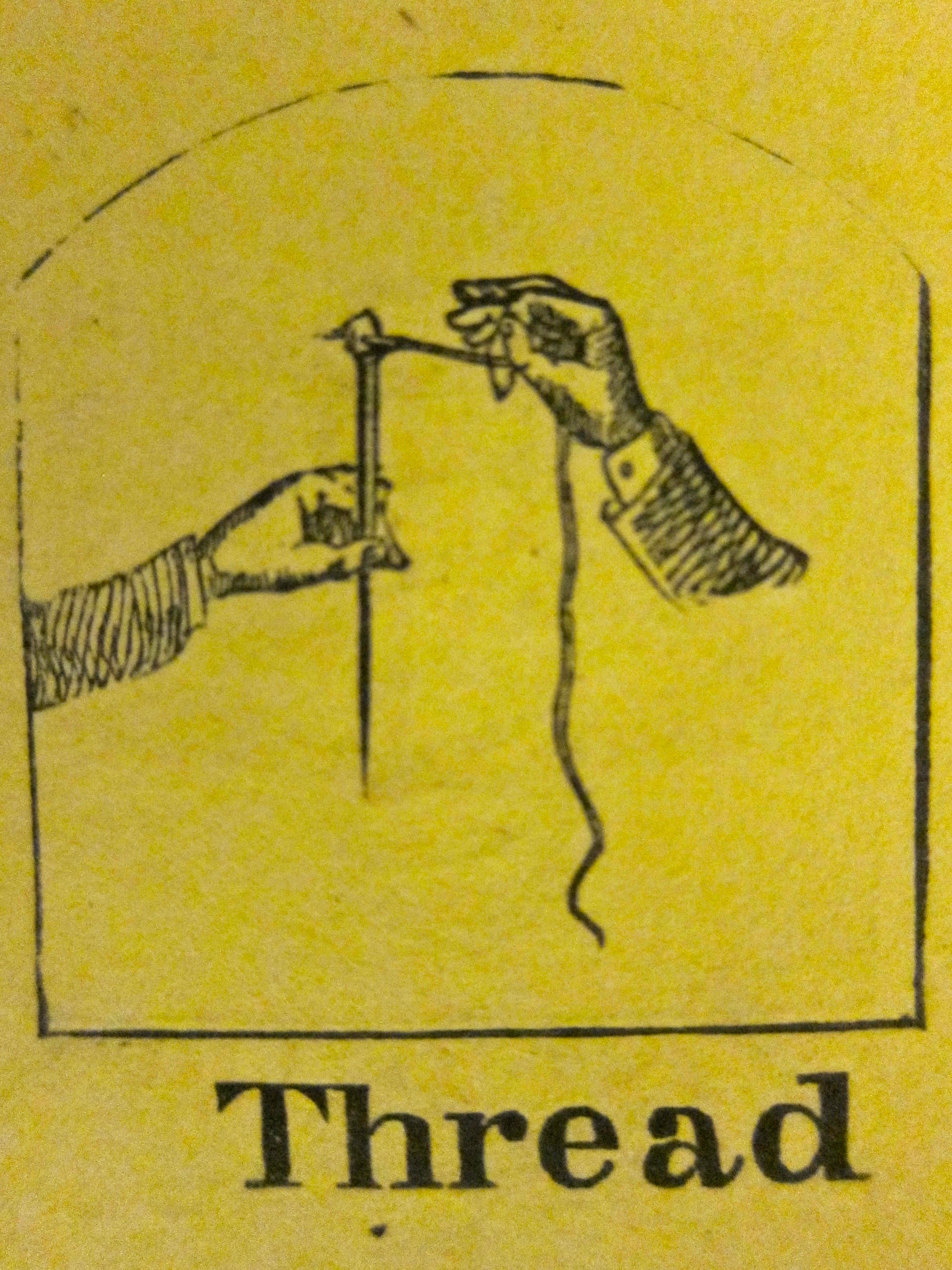
Thread

1851

Feb 12th This was the day for the sewing circle & what a crowded

house! Not one here except Mr Whitwell and our own

families  Father Ames came in to tea & Sarah W

George, Emily & Oliver & wife  Poldens boy was buried

to day  Isabell & Ann went to the funeral & took tea

with Jane after they came back.  I prepared enough

for 40 and think it is very provoking to have none

 of the members  It is a delightful day.  Letter from Miss Foss

No one came to Evelina’s party.

“Very provoking,” indeed.  Mortifying, even, that not a single member of the Sewing Circle attended today’s meeting, unless you count Reverend Whitwell.  All the preparations, the baking, the cleaning, the spools of thread from Boston, all in vain.

Evelina took the rejection with a lacing of humor: “What a crowded house!”  Although disappointed and upset, she must have been grateful for the way the Ames clan filed in to partake of the feast. From Old Oliver (who almost never came to tea) and all three Witherells to Oliver Jr and Sarah Lothrop Ames to her own children and husband, presumably, the family closed ranks around her and filled her parlor with warm bodies.  Even the Irish servant girls on their way home from a wake partook of the spread of food – in the kitchen with Jane McHanna, of course.

So what happened?  Evelina said the day was delightful but her father-in-law, a dependable chronicler of the daily weather, described “the going” that day as “rough + bad” even though the weather itself was “fair”.  After days of terrible weather that had swung from rain to ice and back again, some of the absentee members probably couldn’t drive their wagons out of their own yards.  Bad roads might account for some, if not all, of the truancy.

Nevertheless, the incident raises questions about Evelina’s popularity and social standing.  She was married to one of the most important men in town, and she and Oakes enjoyed the friendship of many.  Is it possible that some of the women in the Unitarian Circle resented her, or felt themselves superior to her?  Where were the women she had grown up with? Were they jealous of her? Did she fail socially in comparison to her sisters-in-law, each whom had a more refined upbringing? Sarah Ames and Sarah Witherell never failed to attract a lively turnout for their Sewing Circles.

All these possibilities must have swirled in her mind.  The true test would come when the Sewing Circle met again at Evelina’s, many months from this day, this awkward day that Evelina surely hoped to forget.

February 8, 1851

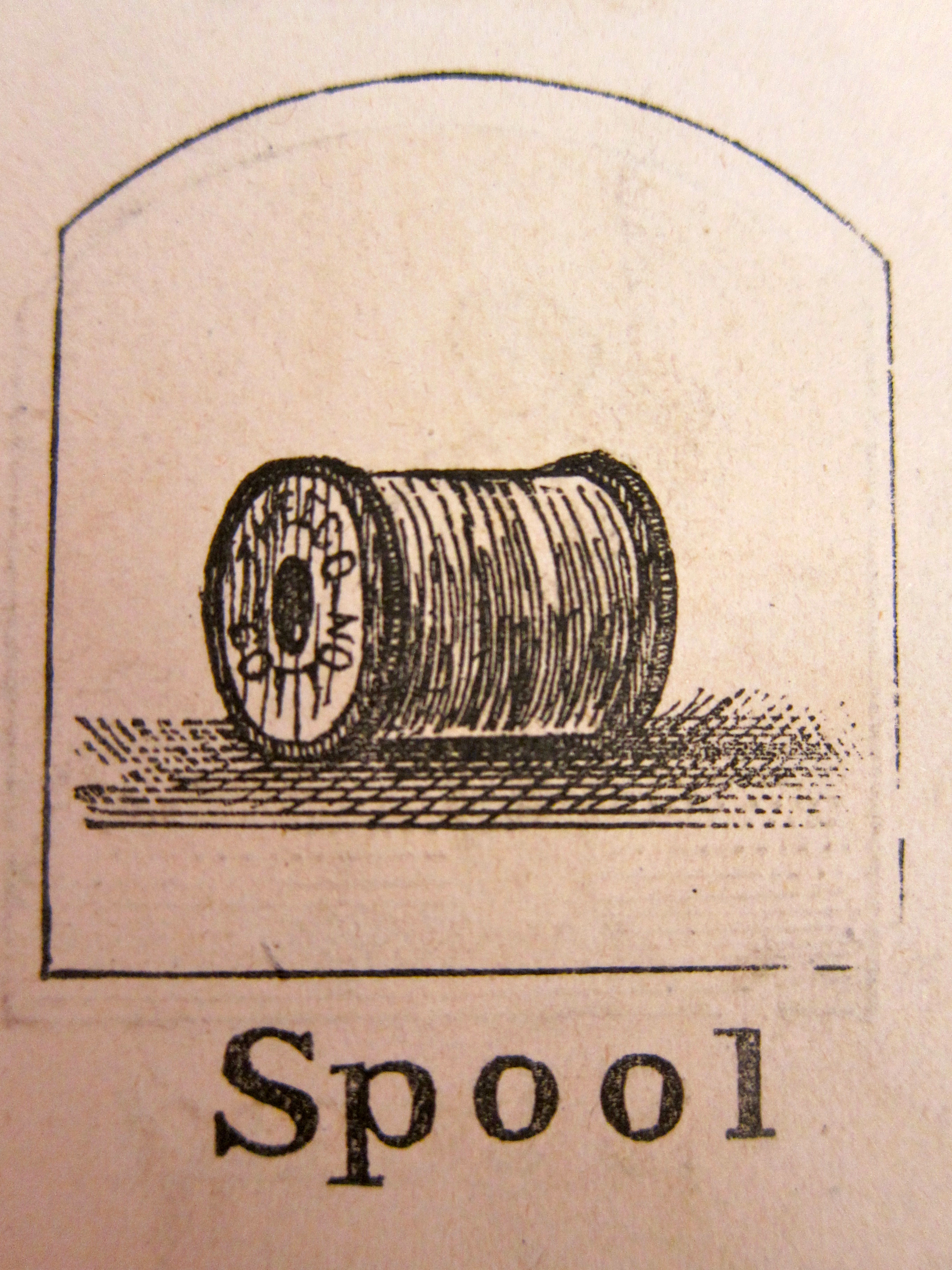
Spool

Feb 8th Saturday  Worked about house all the forenoon

sweeping & dusting.  Swept & dusted the parlor

ready for the Sewing Circle.  Put the closets in order &c.

Have a very bad cold and this afternoon took a warm

bath in hopes that it would benefit me but it is much

worse for it.  Mr Ames has been to Boston to day

and brought me a case of Scissors a present from Mr

Benson & 19 spools of Coats cotton  Very cold

Oakes Ames made his usual business trip into Boston today and brought home scissors and thread for his sewing wife.  Nineteen spools of Coats cotton thread, in fact, all of which Evelina could probably use, being an excellent and dedicated needlewoman. It’s just possible, though, that those nineteen spools of thread were intended for the Sewing Circle, whose next meeting was being held at the Ames house.

J & P Coats cotton thread was originally manufactured in Scotland, but the company began selling their merchandise in the United States around 1830, meaning that Evelina had spent most of her married life with Coats thread in her needle.  In the middle of the 20th century, the company merged with Clarks Thread to become Coats & Clarks and today, under the name of Coats PLC, is still a viable manufacturer.

Despite feeling under the weather, Evelina cleaned house this morning.  Their home being right on a busy road near the center of the village, dust and dirt from the street was apt to float into the house, or be brought in on the soles of family feet, even in the winter.  Sweeping and dusting were repeated tasks and even as Evelina wielded her broom across the floor, she probably knew she’d have to do it again before the Sewing Circle ladies gathered in her parlor.  She was determined to have the house look presentable.

After her morning of chores and an un-therapeutic bath, Evelina may have sat down to read the last bit of David Copperfield.  Given its length – and her various obligations – she had moved quickly through the book.  Like countless other Americans, she was a devoted reader of the novels of Charles Dickens, whose own personal favorite was reputed to be David Copperfield.  Ten years or so from this day, in a diary that has since been lost, Evelina confessed to shirking her housework in order to read Dicken’s “newest book” (probably Great Expectations. ) She loved his work.

February 7, 1851

images

Feb 7th Friday  Have been baking this forenoon  Heat the

brick oven twice.  Baked brown bread mince 

squash & Apple pies & cup cake & ginger snaps.

This afternoon have been cutting out stripped shirts

for sewing Circle  I partly cut them out at Mr 

Whitwells, the afternoon we met there  There are ten of them

This evening have finished the last of the 5 prs of pantiletts

for Susan & cut out two prs more  Very cold.

Baking today, lots of baking. Evelina shared a brick oven with her sister-in-law, Sarah Witherell.  It took so much concentrated fuel to keep the oven hot that they typically baked together, in weekly or bi-weekly batches, producing multiple goods to be served all week long. Yankee kitchen practice was to bake on Fridays and/or Saturdays, in preparation for the Sabbath day when no cooking was supposed to take place.  Sunday meals were taken traditionally from food that had been prepared the day before. That custom was fading by the 1850s, but the practical rationale for concentrated baking still held.

Even by this standard, though, today’s output was prodigious.    Three kinds of pie, brown bread, cake and ginger snaps suggests that more than family was going to be fed – and it was. Evelina’s turn to host the Sewing Circle was coming up, and she wanted to have plenty of goodies to offer her guests.

The afternoon sewing, too, was accomplished with the Sewing Circle in mind.  Evelina cut striped cloth to be made into shirts, something she had begun at the January meeting at the home of William and  Eliza Whitwell.  It was evening before Evelina turned to her own sewing, in this case underclothes for her daughter.

February 5, 1851

OLYMPUS DIGITAL CAMERA

Feb 5th Wednesday  This forenoon made a head dress trimmed

with cherry colour, ribbon & flowers.  Cannot say

much for my days work.  Have been doing a little

of everything & not much of any.  Jane has done

part of the ironing  Oakes Angier has been to Canton

to mark Iron  have been reading in David Copperfield

this evening.  I have been looking over my accounts

It is very warm for the season but cloudy

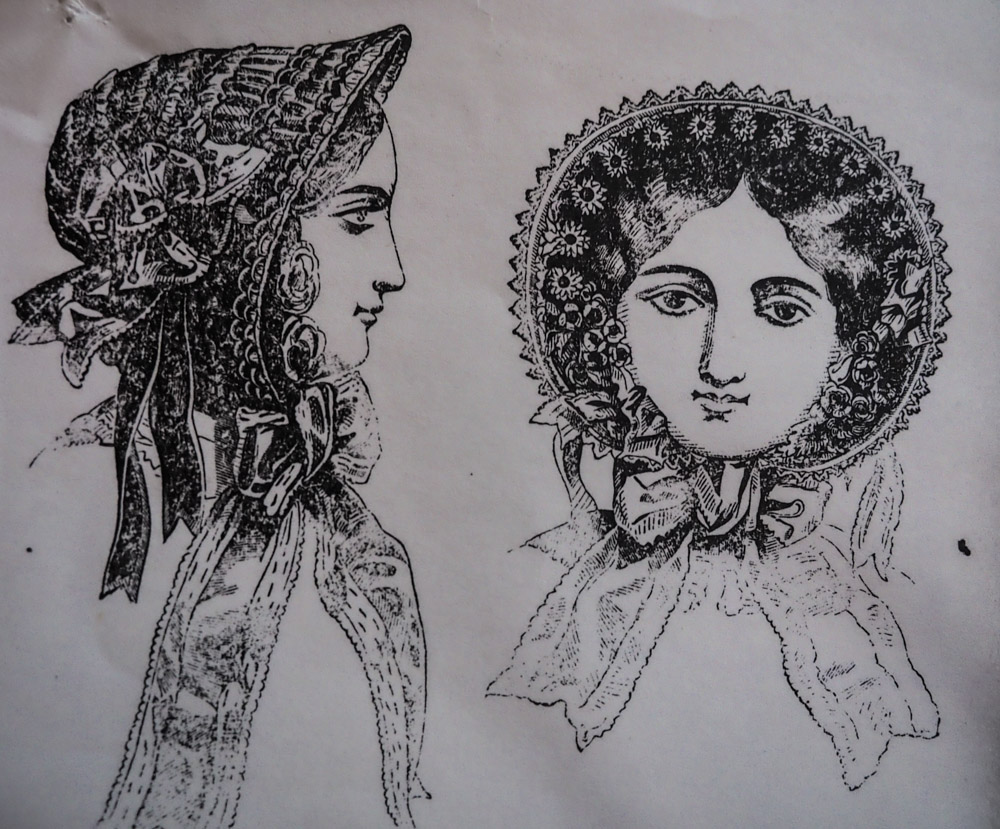
A ho-hum day for Evelina, warm but gray, and she still partly sidelined by a sore foot.  Small wonder that she chose a colorful project for the morning: trimming a head-dress, more commonly referred to as a bonnet.  She used red ribbons and fabricated flowers and although she deprecated her own handiwork, the task must have been a nice change of occupation.

In the 19th century, no lady’s outfit was complete without a bonnet; it played the accessorizing role that shoes and purses play today in women’s fashion.  Given that a woman’s form was covered from neck to toe by a voluminous dress or cloak, the bonnet was an inevitable point of interest atop the whole outfit.  Not only did it stand out like the star on a Christmas tree, it also served to cover hair that was seldom washed.  It rarely kept a head warm, however – that’s what cloaks with hoods were for.

Most women had at least two bonnets, one for winter and one for summer.  Winter bonnets were made of wool, silk or even horsehair, while bonnets for warm weather were typically made of straw or “chip,”  a fine wood splint.  As the 19th century progressed, the transition from winter to summer bonnet solidified around Easter, thus introducing the notion of the Easter bonnet and competition for the prettiest headdress on that important Sunday.

In other news of the day, Oakes Angier Ames rode to Canton on shovel business to “mark Iron.”  Does this mean he looked through a supply of smelted ingots to select the best for the Ames shovels? Anyone out there care to elaborate on what Oakes Angier did?  Was the Kinsley Iron Company the forge that he visited?  Certainly probable.

January 31, 1851

photo

Jan 31st Friday  This morning sat down with mother quite early

mended several articles. & altered the waist of Delaine Dress

Augustus came in the stage & dined here & carried mother

to Mr Torreys.  I went about two & passed the afternoon

Called on Mrs Lothrop at Dr Wales, Engaged the

school house for O Foss to keep a private school.

Came home quite early & wrote her a letter.  Sewed

on Susans panteletts.  Very cold but not quite as cold as yesterday

Evelina and her mother, Hannah Lothrop Gilmore, sat together and sewed this morning.  After mending several items – there was always mending to be done – Evelina reworked the waist on a delaine dress, “delaine” meaning “of wool” in French.  It was a popular and durable fabric in this era.  But altering the waist begs the question, did she have to take it in or let it out?  And had she begun to wear her sleeves in the new “pagoda” style?

Augustus Gilmore, Evelina’s nephew and Hannah’s grandson, soon arrived and, once Oakes and his sons came home from the factory at noon, they all dined together. Augustus was close to his Ames cousins, and worked for the company from time to time.  After dinner,  Augustus accompanied his grandmother to the Torrey house in the village, where Hannah’s granddaughters, Abby and Malvina, lived.  Evelina joined them there a bit later, and paid another call as well, on Mrs. Lothrop.  There were many Lothrops in Easton, so we can’t know just which one Evelina visited.

We can know that Evelina was somehow involved in the setting up of a private classroom.  A young woman named Orinthia Foss, with whom Evelina corresponded, was due to arrive in North Easton to teach.  The genesis of this arrangement is a mystery. Was Evelina doing this because of concerns about Susies’ schooling?  Who else was involved? And who was Orinthia Foss? How was she hired?

Whatever the back story was on this new little school, Evelina took a bold step today when she committed to renting a schoolhouse.  She promptly returned home to write Orinthia with the good news.