January 23, 1852


images-1

Currier & Ives, Winter in the Country: Getting the Ice1864

1852

Jan 23d Friday  Have had a hard days work.  Heat the

brick oven 4 times.  Baked mince & dried apple

pies brown bread cup cake & ginger snaps.

Had quite a fright about Oliver & Fred being

away at tea time was affraid they had got into the

pond where they had been cutting ice for the ice house

found them at Edwins.  Mrs S Ames went with me

about 8 Oclock into Edwins


There are few things scarier for a parent than having a child – whatever the age – not come home when expected. Evelina and her sister-in-law Sarah Lothrop Ames had “quite a fright” when their sons, Oliver (3) and Fred Ames, respectively, didn’t return home from a day spent outside, harvesting ice at a family pond. The pond was some distance from the family compound, out of earshot. At tea time, no one was able to report on their whereabouts. The boys might have fallen in.

The worried mothers went out after dark to search for their sons and found them practically next door. They were fine. Oliver and Fred had stopped to call on Oliver’s cousin, Edwin Gilmore, and were presumably unaware that their absence had alarmed anyone. How relieved Evelina and Sarah must have been.

For the young men, the day spent working outdoors in the cold sunshine must have been an invigorating change from their college studies, and for their grandfather, Old Oliver, their participation in the important annual harvest of ice must have been gratifying.
January 20, 1852

OLYMPUS DIGITAL CAMERA

Jan 20th Tuesday  Have made Susan two pr of fur cuffs

one pair for school and one for best.  Hannah called

for me to go with her to call upon Augusta, went

with her found Julia Pool there stoped but a few

moments. This evening Mrs Witherell Emily & Mrs

S Ames brought in their work and passed the evening

They say I never give them the credit of coming here

at all. I certainly will this time

In what Evelina considered to be a rare occurrence, her two sisters-in-law, Sarah Witherell and Sarah Ames, “passed the evening” at Evelina’s. The women brought their work boxes or baskets and sewed together, young Emily and perhaps young Susie with them. Usually, Evelina went over to one of their sitting rooms.

On this same date in 1865, when Evelina’s life had changed, and she and Oakes were in Washington, D.C. while Oakes served as U.S. Congressman from Massachusetts, Oakes was called to the White House.  Winthrop Ames, who once possessed the diary in which Evelina recorded her days in Washington, tells us that Evelina wrote “today Mr. Lincoln sent for Oakes to come to the White House.  He went immediately after dinner and talked with the President until after midnight.’ ”

Winthrop went on to add, in his own words:

“Ames reported that the President said to him then, and in later conferences, ‘Ames, you take hold of this. If the subsidies provided are not enough to build the road ask double and you shall have it. Take hold of it yourself.’ And he added,’by building the Union Pacific, you will become the remembered man of your generation,’ The President said further that if the railroad could be so far completed that he might take a trip over it when he retired from the Presidency it might be the most memorable occasion in his life. Alas! his next railroad trip was to be in the funeral car that bore him to his grave in Springfield, Illinois.”*

*Winthrop Ames, The Ames Family of Easton, Massachusetts, 1937, p.


January 15, 1852

330px-Charles_Wentworth_Upham

Charles Wentworth Upham

(1802 -1875)

1852

Jan 15 Thursday  Spent some time this forenoon in reading

the papers and fixing Susans work & pasted some pictures on

a mahogany box.  Called on Mr Whitwell, Reed & 

Howard with Mrs S Ames.  Evening to a lecture on

education by Mr Upham of Salem at the meetinghouse

hall. a very good lecture and a goodly number

present for a snowy evening.  Had two tripes from father.

The guest lecturer at the meetinghouse was, presumably, Charles Wentworth Upham. A minister and politician from Salem, on the north shore of Boston, Upham had traveled no small distance to deliver a “lecture on education.”  Well spoken and well read, he had written, some years before, a history of the witch trials in Salem. Lately, however, Upham had been speaking on the progress of normal schools, which were schools that taught teachers. Education was on his mind.

Also on Upham’s mind was politics. He was a Whig, which may have been his connection to the Ames family and Unitarian congregation in Easton. Previously Upham had been a member of the Massachusetts State Senate, and within the year would become Mayor of Salem. From 1853 to 1855, he would be a representative to the U.S. Congress, but would fail to be reelected.

Upham was married to Ann Holmes, a sister of Oliver Wendell Holmes, Sr. He had been at Harvard with Ralph Waldo Emerson with whom he corresponded later in life.  Their friendship faltered, however, over Transcendentalism, which Upham disliked. Upham also famously acted against Nathaniel Hawthorne, leading the local fray in getting Hawthorne, a Democrat, fired from his politically-appointed job at the Salem Custom House.

Some disliked Upham; Charles Sumner called him “that smooth, smiling oily man of God.”* What did the Ameses think?


*Carlos Baker, Emerson Among the Eccentrics, New York, 1996.

January 13, 1852

images-1


Jan 13 Tuesday  Have not done much work to day

can scarcely tell what I have been doing  Have

been trying to fix Susan some work to learn her to sew

Have got out an apron and commenced a stocking

for her to knit.  This afternoon called on Mrs Richards

Holmes, Torrey Savage & Hannah  Spent the evening with

Augustus and wife at Olivers.  Mrs Witherell been to Dr Washburns

& had her teeth out.  Mrs S Ames George & Emily went with her.  Father

& Oliver dined here & the others when they came back from Bridgewater

This was not Sarah Witherell’s best week. Limping from a bad burn on her foot, she kept an appointment with a dentist, Dr. Nahum Washburn, to have her teeth pulled. Dr. Washburn had his office in Bridgewater, in an historic building known as “the Tory House.”  It was the same office that Evelina had been to several months earlier to have her own teeth worked on.

Modern historian Jack Larkin has noted that “[h]undreds of thousands of Americans had at least some of their teeth badly rotted, a source of chronic pain and foul breath to many, with extraction its only cure […] Dentistry, which most rural American physicians practiced, was by far the most effective form of surgery; extraction was a decisive and relatively safe procedure (although infection always posed some risk).”*

While Sarah Witherell suffered today, her family united to support her. Her children and sister-in-law accompanied her to the dentist’s office.  Evelina (with Jane McHanna in the kitchen, of course) fed the entire family, which made for twelve around the dining table. Old Oliver, whose midday meal was usually prepared by Sarah Witherell, came over from the other part of the house. The Ameses from next door were there, too. Everyone came together for Sarah Witherell.

Evelina managed to socialize today, too.  She called on various friends and relatives around town, perhaps sharing the news of poor Sarah’s painful dentistry.


*Jack Lardin, The Reshaping of Everyday Life, 1988, pp. 92 – 93

December 31, 1851

Dismiss


Wednesday Dec 31st  This morning sit down early to knitting

my hood  Have it all finished ready for the lining.  About ten 

Oclock went into the school with Mrs. Witherell.  Mr Brown

has closed his school to day.  Passed the afternoon & evening at Olivers

Mr & Mrs Wm Reed  Mr & Mrs J Howard, Whitwell & A Gilmore were there.

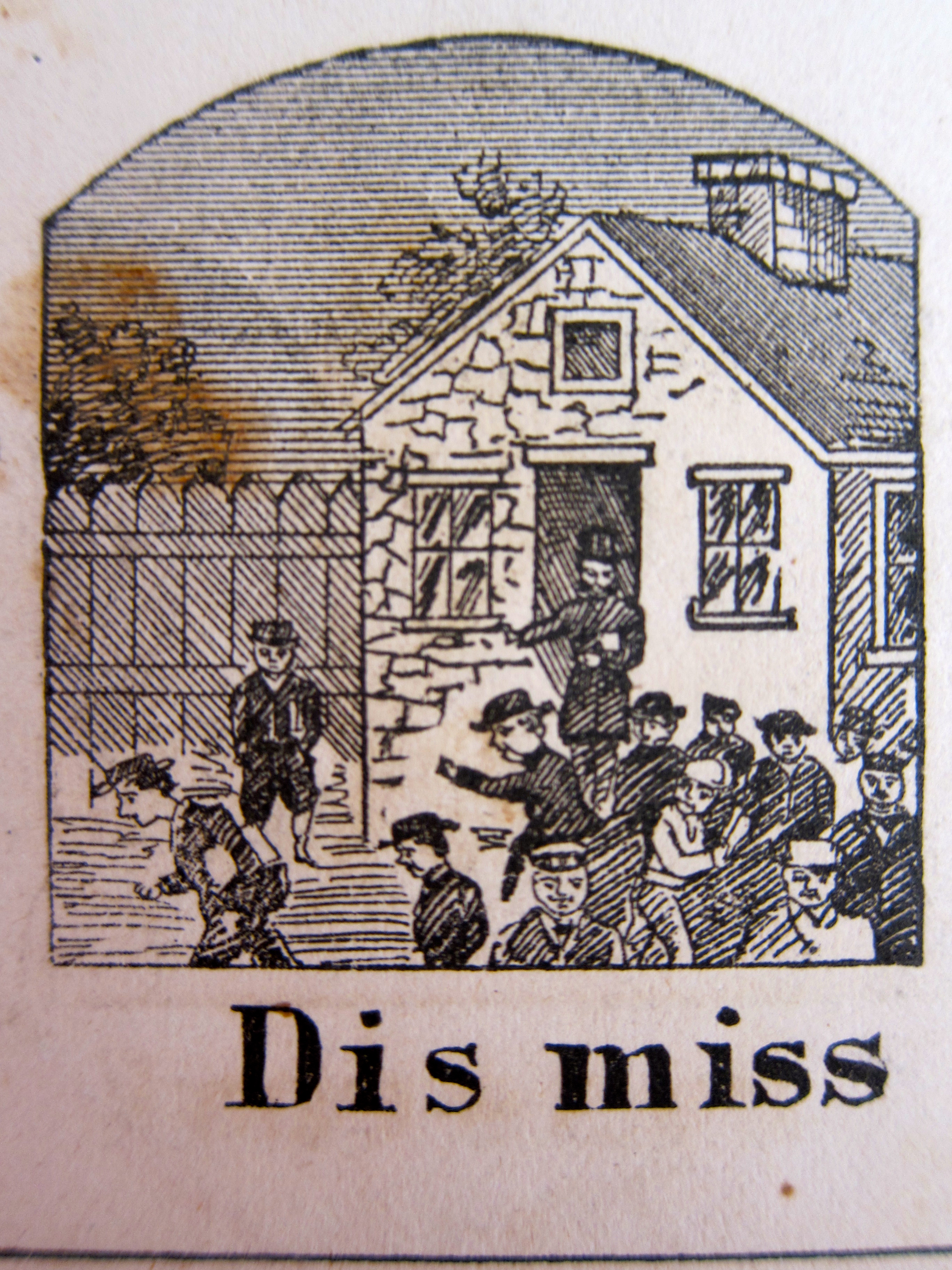
Susie Ames and Emily Witherell may have been happy today to reach the end of their school term. Class, dismissed!  1851, dismissed!

Just how the Ames family celebrated the departure of the old year and arrival of the new, we don’t know. Old Oliver, with his usual terse assessment of the day, merely noted that “this was a cloudy day and some cooler + misty + foggy.” The cool mist he saw would develop into a huge rain storm over night, preventing folks from moving around much.

A group of friends and relatives gathered for tea next door at the home of Oliver Ames, Jr. and his wife Sarah Lothrop Ames. Besides Evelina and Oakes, at the party were Reverend William Whitwell and his wife Eliza, Reverend William Reed and his wife Abigail, Jason Guild Howard and his wife Martha, and Evelina’s brother Alson Gilmore and his wife Henrietta.  In just a few more years, a group like this might have sung the beloved  Auld Lang Syne to mark the occasion. In fact, a version of Auld Lang Syne, written in 1855 and called Song of the Old Folks would become “the tradition of the Stoughton Musical Society to sing […] in memory of those who had died that year.”*

Out with old, in with the new. What a year it would be for the Ames clan.

http://www.americanmusicpreservation.com/SongoftheOldFolks.htm

December 25, 1851

Turnstile


Dec 25th Thursday  The Irish are expecting to have a great

time to day Jane went to the meeting house about

eight but the priest did not come she stoped an

hour. Carried my knitting into Olivers awhile this

forenoon. This afternoon have been to mothers

with Mr Ames & Frank as they were going to West

Bridgewater.  Finished knitting the front & back of

my hood  Made a present to Lavinia of Turnpike Dividend $800

Christmas Day! But as Evelina points out, the Irish Catholics in town would be celebrating, but the Ames family wouldn’t. Jane McHanna left the house to attend a Christmas mass for which, unfortunately, the priest was either late or didn’t show up at all.  Jane returned home to prepare dinner. Evelina, meanwhile, visited Sarah Lothrop Ames next door, knitting in hand.

After dinner Evelina rode along with her husband and youngest son as they went on an errand to West Bridgewater.  They dropped her off to see her mother at the family farm. There may have been some recognition of the holiday in this gesture, although Evelina makes no mention of gift-giving, with one significant exception. Evelina gave an $800 dividend to her niece Lavinia Gilmore.

The dividend came, somehow, from proceeds from the Taunton and South Boston Turnpike, a road that had run through part of Easton since the early 1800s, between “‘Taunton Green, so called, to the Blue Hill Turnpike,'” according to town historian William Chaffin.* Its origin was controversial and involved a long-standing disagreement with the Town of Raynham, but its impact on the Gilmore family was generally positive, as various Gilmores, including Evelina’s father and brother, served as toll-gate keepers. As Chaffin points out, however, “[t]he toll-gate naturally became unpopular.” It was closed in October of 1851.

How Evelina came to possess $800 from the road is unclear. Was this a regular dividend that Evelina received, or was the family compensated for the road’s discontinuance? That Evelina passed this money on to her niece, however, is a clear demonstration that for all her economical instincts, Evelina was capable of great generosity.


*William L. Chaffin, History of Easton, Mass, 1866, pp. 454 – 458.

December 23, 1851

4-currier-ives-winter-scene-granger


Tuesday Dec 23  Julia has been here to day to make Susans cotton

& wool Delaine  I have not sewed much with her

was choring about the house most all the forenoon

painted over some boxes for Mr Scott to grain.  made

the skirt & cuffs to Susans dress then went to knitting

on my hood which I commenced last evening.  Julia

cut and made and gathered the skirt and basted 

it on to the waist, the sleeves are not made


Old Oliver’s wintry weather report for this day suggests a scene worthy of Currier & Ives:”[T]his was a cloudy day + a verry little fine snow. wind north west it cleard of[f] about sunsett. what snow fell to day + last night was 1 ½ inch.” The countryside was covered with snow, appropriate enough for the first full day of winter.  And winter was a season much illustrated by the 19th century printmakers, Nathaniel Currier and James Ives.  Working out of New York, the firm produced enormously popular hand-colored lithographs of mostly American scenes. Currier began the prints in 1835 and was joined by Ives, who had been the firm’s bookkeeper, in 1856. The men soon developed a stable of artists and produced prints through the rest of the 19th century and into the early 20th. Evelina would have been familiar with Currier & Ives images, in the same way that many mid-20th century Americans were familiar with the illustrations of Norman Rockwell. The images were everywhere.

Many, if not most, Currier & Ives prints were scenes of the outdoors. On this day at the Ames’s, however, the action was all indoors, as the women chored, painted, sewed and knitted. Dressmaker Julia Mahoney was at the house to sew a wool dress for nine-year-old Susan Ames. That a child Susie’s age was having a dress made by a “professional” rather than her own mother was certainly a sign of the Ames’s wealth. Helen Ames, Susie’s fifteen-year-old cousin next door, often had her dresses made by Julia. Evelina was keeping up with her sister-in-law, Sarah Lothrop Ames, in providing the best for her daughter.


December 16, 1851

OLYMPUS DIGITAL CAMERA


From Godey’s Lady’s Book, October, 1851, Outfits for the Fair 

Tuesday Dec 16  Have finished the hood for the fair

Mrs Witherell has made a Dolls hood & half

dozen linen collars.  Mrs Ames a hood & childs apron

Mr & Mrs Reed called on Mrs Witherell for the 

things and made a long call  Mrs S Ames

& self went to see her.  She brought some

things she made such as dolls comforters bonnets &c

Mrs Howard & Miss Jarvis made eight straw hats

How productive the Unitarian women had been lately.  Sarah Witherell, Sarah Ames, Abigail Reed and others had sewn or knitted many small items like collars and doll clothes to sell at what must have been a church fair. Both Sarahs were planning to work, or perhaps preside, at the event.  Why wasn’t Evelina going to work at it? Had she been asked? Had she declined? Did she care particularly?

For whatever reason, Evelina was less involved in the church fair than either Sarah.  Her sisters-in-law had sewn a number of articles between them to donate, while she herself only made one small hood.  Was her small contribution a reflection of disinterest in the event?  Was she too busy at her domestic responsibilities to take the time?  Was it against her inclination to make things to give away?

Evelina admired the pieces that others had made, but it would seem that either the fair itself didn’t interest her or she felt left out of the goings-on. She never mentioned the fair again, which suggests that she didn’t even attend it.


December 15, 1851

Hood

Monday Dec 15  The girls have both been washing to 

day but it was so windy they could not put their clothes

out  Jane has sewed this afternoon the bags for the

sausages  I knit on Susans hood this morning

and this afternoon commenced knitting on a little

hood for the fair  Mrs Witherell & Ames have been

in awhile and are to work for it

While her servants Jane and Mary struggled with the Monday laundry, Evelina began to knit. Her nephew, Augustus Gilmore, had fetched some yarn – or worsted, as she called it – for her on Saturday while in Boston, and she was finally able to get to it today.

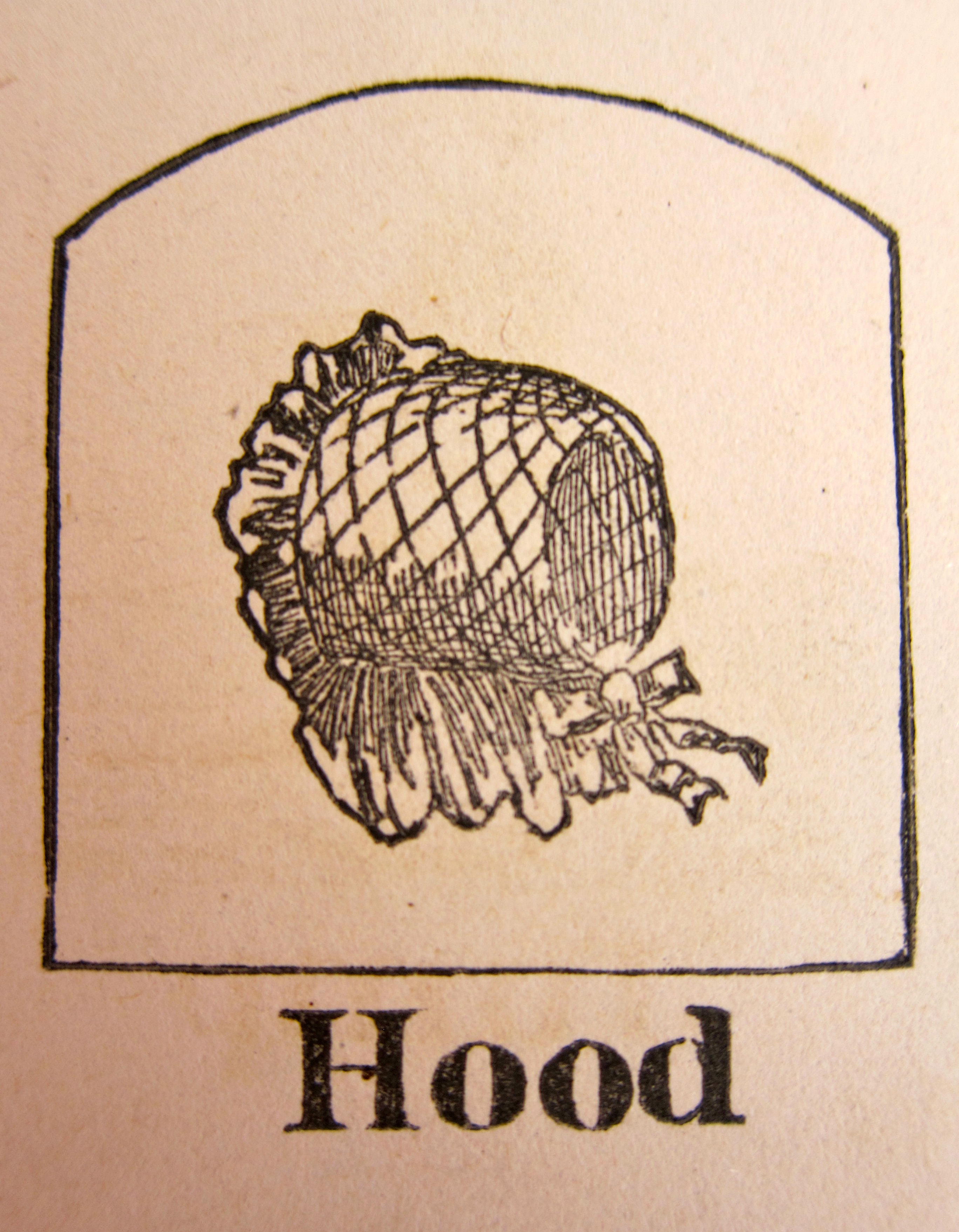
Evelina “knit on” two hoods, one for her daughter Susan and another for a church fair that was coming up. A hood might take a few different shapes, from a fitted piece that covered the top, sides and back of one’s head to one that covered the top and sides only, as in the period illustration above. The one above – which isn’t knitted, but sewn – is really just a variation of a bonnet.

Jane McHanna, too, worked with a needle today once the washing was done. She sewed some cloth bags for the pounds and pounds of sausage that had been produced on Saturday.  Sausage was usually forced into casings made from pig intestines, and this may have been the case with the pork that Evelina and Sarah Witherell produced.  But it may be that an additional cloth covering was desirable for storage or identification.  Hard to know.  Any thoughts from readers who have made their own sausages?


December 11, 1851

Unpack

Dec 11th Thursday.  Have had a bad head ache and

very bad cold  Called into the other part of the

house with Mrs S Ames.  Mrs Witherell had bound

the quilt that we quilted yesterday  Mrs R Pool

called & I went into Edwins house with her.  She & her

husband have spent the day at Augustus  I varnished

store room stairs & porch.  Mr Ames came from New York

Mr Clarke put the inside windows in sitting room

Both Evelina and Old Oliver noted that Oakes Ames “came from New York” today after having been away eight days. He was probably glad to be home; he confessed late in his life that he didn’t enjoy travel. And family dynamics, if they had altered at all in his absence, would have reverted to normal once his “stalwart and rugged”* self returned to his own place as the head of the household.

Evelina’s cold, which had been hovering since Sunday, finally landed with vehemence, although Evelina continued to be up and around. She sat with both sisters-in-law, Sarah Ames and Sarah Witherell, and went over to Edwin Gilmore’s new house with her niece (and Edwin’s sister) Rachael Gilmore Pool. In addition to socializing, Evelina varnished her porch and storeroom stairs. The strong smell from the varnish wouldn’t have helped her “bad head ache,” at all; in fact, it probably made it worse. What was she thinking? Was she too economical to let Mr. Scott complete the job? And did she know that she was spreading her cold everywhere she went?

*William L. Chaffin, Oakes Ames, 1804/1873, Easton Historical Society, North Easton, 1996, p. 1