November 3, 1852

Thread

Wednesday Nov 3d  The girls took their eigth

lesson this forenoon and I sat with

Susan to see her take hers so that I 

could assist her some if required

We have been to the funeral and 

then Mrs S Ames and self went to the sewing

circle at Mr Clarkes,  Miss Alger took

tea with Witherell.  Lavina Wms called

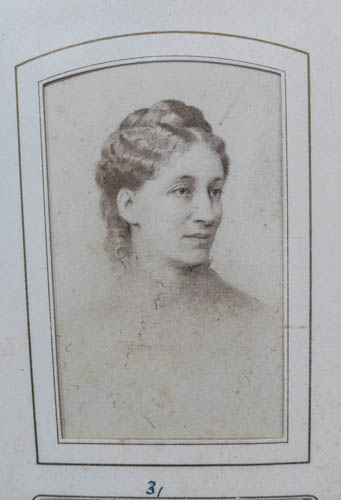
Susie Ames and Emily Witherell took another piano lesson this morning. Evelina, still determined that her reluctant daughter was going to learn to play the new instrument, “sat with Susan” in the parlor as she had her lesson. Miss Alger, the teacher, had tea with Sarah Witherell later in the day. The two women might have discussed how the girls were faring with their lessons; with Evelina out of the house, it would have been easier to discuss the fact that Emily was the stronger student.

Evelina and Oakes, presumably, and other Ameses attended the funeral of the Swain baby. John H. Swain Jr. had died on Sunday from “Teething,” much to his parents’ sorrow. Today, the sun was out, though the wind blew, as folks gathered around the little grave.

Afterwards, Evelina and her sister-in-law, Sarah Lothrop Ames, rode to the monthly Sewing Circle at the home of “Mr Clarke.”  He may have been Daniel Clark, a carpenter, whose wife was Elvira Clark and whose daughter, Elizabeth, had played the piano at the meeting house the summer before last. The piano again! Evelina couldn’t get away from other mothers whose daughters did well at the piano. How frustrated she must have felt about her own daughter.
 

October 29, 1852

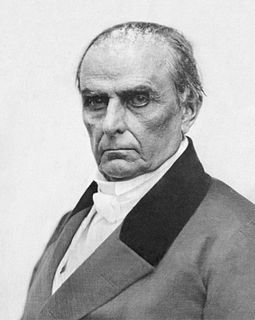
255px-Daniel_Webster_-_circa_1847

Daniel Webster

(1782 – 1852)

1852 Friday Oct 29th  Mr Dawes came from Boston

about ten Oclock  Miss Alger expected

him before and began to feel uneasy

They went to the shops after dinner

Helen Susan & Emily went to the shop

& then rode to call at Mr Roachs

They were all in here this evening to

hear Mr Dawes play on the guitar  Mrs S

Ames & self called Swains, to see their child

Mrs Lothrop & Brett called with her babe


Old Oliver must have been an admirer of Daniel Webster, else why would he mention the man in his daily weather journal? He wrote, “the 29th was a verry plesant warm day. it clouded up some toward night – Daniel Webster was buried to day”.

Daniel Webster, lawyer, diplomat, statesman, orator and Whig leader, was indeed buried on this day. He had died three days earlier after a fall from a horse and was buried with “impressive ceremonies”* at Marshfield, about 35 miles east of Easton. Considered by many to be one of the finest senators ever, Webster had also been a Secretary of State, U.S. representative, constitutional lawyer par excellence, and a devoted preservationist of the union. To the latter end, he co-authored and spoke eloquently on behalf of the Compromise of 1850, which included the controversial Fugitive Slave Act. As a result, he lost the support of many New Englanders; abolitionists washed their hands of him.

On this day in Boston, however, it would have been hard to find his enemies. According to a newspaper account the next day, a united citizenry mourned:

Boston never before presented – probably never will present – such a funeral aspect as was worn in her streets yesterday. Most of the stores and shops were closed, as well as the institutions, offices, and markets, and a large proportion of the city was dressed in the habiliments of wo. [sic] Though the work was only voluntarily the act of individuals, it was very general – Washington, Hanover, and many other streets being covered in black, interspersed with mottoes, flags, portraits, and other mementoes, as the taste of each led him to adopt and carry out.  It was one of the last acts which Boston can perform to express her sorrow for the loss of the great statesman, and it is praise enough to say that it was well and appropriately done. The streets were thronged nearly all the day, crowds of people being present from other places, – and our young men wore the insignia of mourning which had been adopted, and grieved countenances were observed at every turn of the street…*


*New York Times, October 28, 1852


October 27, 1852

381-1233891708GdW7

Wednesday Oct 27  Miss Alger has given the

girls the seventh lesson and Susan

makes hard work of practicing and 

I am sorry that she is so unwilling

Mrs S. Ames, Miss Alger Oakes A and

self have passed the afternoon at Mr

Nahum Williams  Mrs Rollins is at

her fathers  Mrs H & C Lothrop were there


“[T]his was a mild day & little hazy wind southerly.”* Once night fell, a full moon shone down on the rooftops, dooryards and unpaved streets of North Easton, lighting the byways even after curfew. The day itself was unremarkable, although Susan Ames grudgingly endured yet another piano lesson. Evelina bemoaned her daughter’s intransigence.

Evelina did pay a rare visit to Nahum Williams, “a farmer at Easton.”**Accompanying her were the ever-present piano teacher, Miss Alger, as well as Sarah Lothrop Ames and Oakes Angier Ames, the latter an unusual participant in the women’s sociable errand. They visited not only Nahum but his wife Amanda (nee Lothrop) and their daughter, Sarah Elizabeth Rollins. Also present were some Lothrop women – possibly Mrs. Henry Lothrop and Mrs. Clinton Lothrop. Sarah Lothrop Ames was probably related to Amanda.

We have met Nahum Williams before in Evelina’s pages; some time back, he lost his father, Seth, and various Ames family members had attended the funeral. Sarah Rollins was his recently married daughter; she and her husband had moved to Vermont and were expecting their first child. By 1860, she would return to her parents homes in Easton, possibly widowed, with three children: Ellen, George and Jennie.

*Oliver Ames, Journal, Stonehill College Archives, Arnold Tofias Collection

**Hyde Family Geneaology

October 26, 1852


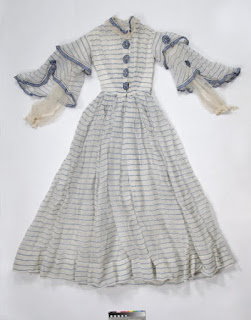
1860s blue striped muslin dress from St. Albans Museums

Dress with undersleeves, mid-19th c.*

Tuesday Oct 26  We have had a large washing

done to day and not finished untill

after dinner  Miss Alger & self spent

the afternoon in Olivers  Mr Ames

& all the children there to tea  Mr & Mrs 

Whitwell was there an hour or two

I made Susan a pair of undersleeves

and she is delighted with them


Because of all the company that had visited over the weekend, the servant girls were unable to launder clothes on Monday. Today, extra sheets and towels were added to the usual load and the washing went on into the afternoon. Not that Evelina rolled up her sleeves; after the midday meal, she and her remaining houseguest, Miss M. J. Alger, went next door to visit with Sarah Lothrop Ames and stayed for tea. All the family partook.

At various points during the day, Evelina had her work box open as she completed a pair of undersleeves for her daughter. Susie was “delighted” with them. Were they a peace offering from mother to daughter, perhaps to make up for Evelina’s insistence on Susan learning to play piano?

We’ve seen Evelina sewing undersleeves before. In the 1850’s and into the Civil War, undersleeves were an essential component of any woman’s dress, fitting independently but securely under the looser outer sleeve of the dress proper. Like the collars of the day, a good pair of undersleeves could be worn with different dresses. Susie must have felt rather grown-up with her new pair.

On the industrial side of American life, meanwhile, today was the 27th anniversary of the opening of the Erie Canal. The technological wonder of its day, it was already becoming obsolete. Railroads had arrived and, through their own capacity for moving freight, would soon obviate commercial use of the canal for many (though not all) industries. Shipping would change – was changing. The very word “shipping” derives from the fact that, initially, more goods moved by water than by land. This would no longer be true in this country or elsewhere in the developed world.

We should remember that Harriet Ames Mitchell, Old Oliver’s youngest daughter, was living in Erie at the time with her husband Asa and their three children.  Did they mark the day?


*Image of striped blue muslin dress with undersleeves courtesy of St. Albans Museum, England


October 25, 1852

Ames_machine_shop_1857

Monday Oct 25th We all walked down to the

shops this morning and Mr & Mrs D

left here about ten Oclock and since

Miss Alger & self have had a quiet day

Susan has practiced a good deal but

is rather impatient  We did not

have the washing done


Monday morning came around and the Davenports and their child were still in the house. By the time they left, it was too late to start the laundry. So Evelina and the remaining houseguest, Miss M. J. Alger, “had a quiet day.” Quiet except for the sound of Susan Ames practicing her scales on the new piano; she could hardly skip out on practicing when her piano teacher was right there under the same roof. Was this Evelina’s design?

It “was a fair warm day for the season”* wrote Old Oliver in his journal. When Evelina and her company walked across the way to visit the shovel shop, what did they see? Shovels being made, obviously, in the rebuilt section of the factory, down close to the pond. But they also must have stood inside the new Long Shop, where the first-ever steam engine had been installed, ready to be put to use. It may be that a construction crew was still active in the building, putting in the finishing touches. To the visitors – and perhaps to the family, too – the new space must have seemed wondrous: the height of modernity, a model of expansion and a promise of wealth. However much she usually distanced herself from the action at the factory, Evelina must have felt some pride in showing off the progress of the company to her guests.

October 23, 1852

Railway_Station,_Stoughton,_MA

Stoughton Railroad Station, built 1888*


1852

Saturday Oct 23d Baked in the brick oven brown

bread cake & pies  After I got the first

oven full I had pies enough for a second

and I put the brown bread with the

stove oven and heat the brick oven again

Oakes A & Susan went to Stoughton after

Fred and then after Miss Alger and she has

given her sixth lesson Mr & Mrs Davenport &

child came this evening from Attleboro

Bread, cake, pies and more pies. There was so much baking going on at the Ames house that Evelina used both ovens, the new cast iron one and the original brick oven – the latter twice. What was all the baking about? Company was coming.

A young couple from Attleboro came for a visit: Edward Davenport, a jeweler, with his wife Celestine and their toddler, Annie. What was their connection to the Ames family? They stayed for several days. Also arriving for a stay was the piano teacher, Miss M. J. Alger. We might wonder how Susie Ames felt about that.

Susie helped pick up Miss Alger, in fact. She and her brother Oakes Angier drove around today, first to the train depot in Stoughton and then to Miss Alger’s house. At Stoughton, they met their cousin Fred Ames, who must have been coming home on a break from Harvard. The depot they went to was the earliest iteration of a train station in that town, built in the mid-1840s for the Old Colony Railroad. It was later replaced; today, the Romanesque stone building erected in 1888 is on the National Register, reminding us of the tremendous role that the railroad played in the second half of the 19th century – and well into the 20th.

What a full house Evelina had tonight. Where did she fit everyone?

*Image from 1901, courtesy of Wikipedia


October 22, 1852


F201308231348352569927452

Tibetan Sheep, 21st century

Friday Oct 22d Julia Mahoney was here to work

this forenoon on Susans Maroon Thibot

making a new waist and put a new yoke

and making over the waist to her dark

striped wool deLaine  Carried home the

waist to finish to her Thibot dress  I spent

the afternoon at Olivers with Hannah + Augustus

Mr Whitwell called


Julia Mahoney, a local dressmaker, worked at Evelina’s sewing at least two dresses for Susan Ames. Susie, who was ten-going-on-eleven, was growing taller and more mature. The dresses she had worn the previous winter needed to be altered, the waists expanded, the tucks let out, a new yoke put in. One of her dresses was made of delaine, a wool that Evelina sewed often for herself and her daughter. It was a popular, open-weave, light-weight wool that came in many patterns and colors; it may or may not have been imported.

The “Thibot” cloth that Evelina describes was more unusual. It was of “[w]ool material, worsted with soft and smooth plain-finished face; made from mountain sheep of Thibet, Asia*.” This textile was imported and would have been more expensive, suggesting that Susie’s little maroon dress may have been meant for “Sunday best.” It was special enough that the dressmaker took it home to work on.

In Boston at this time, sources for wool were both domestic and foreign.  There were approximately 15 wool merchants in the city, most of whom were prospering. According to an early 20th century history:

“The quantity of domestic wool showed a steady decrease for several years subsequent to the enactment of the tariff of 1846. The effect of the gold discoveries upon general commerce in 1849, stimulating the manufacturing industry, is reflected in the rapidly increased imports of home grown wools. The imports of foreign wools show considerable yearly fluctuation, corresponding in the main to the varying quantities of domestic wools.”**

Some years later, Susie would marry a wool merchant named Henry French. She and Evelina would then – presumably – have access to whatever wool they needed or wanted, foreign or domestic.

*Betty J. Mills, Calico Chronicle: Texas Women and Their Fashions, 1830-1910, Texas Tech University Press, 1988, p. 183

**Joseph T. Shaw, The Wool Trade of the United States: History of a Great Industry:Its Rise and Progress in Boston, Now the Second Market in the World, 1909, p. 52

October 21, 1852


Sarah Emily Witherell                                           Susan Eveline Ames French

Emily Witherell                                                                                   Susan Ames


1852

Thursday Oct 21st  Miss Alger came to day to give

her fifth lesson and Susan is now as far

as Emily but unless she takes more

interest it will be very hard for her

to keep up with her.  Mrs Witherell feels

to blame Miss Alger that she does not

give Emily longer lessons


Relationships among the females who lived under the roof of the Ames homestead were becoming strained. Susie Ames wasn’t much interested in learning to play the piano, while Emily Witherell was. Yet the cousins took their lessons together, yoked into learning side by side. Emily was facile and wanted more challenging fare, but was slowed down by Susie’s reluctant participation. The disparity in the girls’ interest and ability was no doubt challenging for poor Miss Alger. The situation wasn’t helped by the mothers hovering over the girls as they took their lessons.

The two mothers had their own set of expectations. Sarah Witherell, who had endured so much loss in her life, had nourished hope that her daughter would develop a taste and talent for music. Evelina probably felt the same way, hoping to see her daughter become “accomplished.” Sarah was unhappy that Miss Alger wasn’t giving Emily enough to do, and, also, was surely displeased with Susie holding Emily back. Evelina had to be disappointed by Susie’s disinterest, nervous, perhaps, that she had made an expensive mistake in buying a piano. Evelina was learning, probably not for the first time, that a parent can have aspirations for a child that the child doesn’t share or follow.

All was not lost, however. For all the initial struggle, both girls eventually learned to play piano with some credibility, yet neither grew up to be a great pianist. They never outshone their older cousin, Helen Angier Ames, who had started earlier and, evidently, concentrated harder on perfecting her skill. Family historian Winthrop Ames, who was a first cousin once-removed of the three pianists, noted that by 1861, at the “Unitarian meeting-house […] Helen, Emily and Susan took turns in playing the reed organ, though Helen was acknowledged to be the best performer.”*


Winthrop Ames, The Ames Family of Easton, Massachusetts, 1938, p. 130


October 20, 1852

piano_voice_guitar_lessons

Wednesday Oct 20th  Have been expecting Miss Alger

all day but she has not come  Have been

trying to assist Susan some about her

music lessons and it hinders me about

my work very much  I wish it was not

such an effort for her to practice.

A gentleman here to dine from New York.


It’s easy to imagine the affable Oakes Ames inviting visitors to dine. He was a sociable man, for all his competitive spirit, and had a fine sense of humor.  He knew that his wife took pride in her home, that she could act the hostess and that she – or her servants – prepared a midday meal hearty enough to feed him and his grown sons. How much warning he might have given her that he was bringing someone over from the shovel office for dinner, we can’t know. But Evelina seemed prepared to feed guests as well as her own family, and she no doubt welcomed the gentleman from New York.

The meal preparations were usually left to the servants, of course, although Evelina supervised. Today, however, her focus was on her daughter and the new piano. She was unhappy with Susan’s evident disinterest in the instrument. The girl wasn’t practicing her scales and lessons as she should have been.

When Evelina and her sister-in-law, Sarah Witherell, purchased the pianos and arranged for Susan and Emily to take lessons, Evelina likely had imagined that she was doing her daughter a favor, giving her a gift that she herself had never gotten. But Evelina was disappointed, as things didn’t turn out the way she expected. Susan wouldn’t practice so, for now, Evelina had to intervene and “assist.”


October 19, 1852


Gentiana-crinita-Fringed-Gentian-plant

Fringed gentian (Gentiana Crinita)

Oct 19th Tuesday  Have been sewing on Susans

fall de Laine that I bought last summer

and it appears to me that it will never

be finished  I get along so slowly on it

Ann has ironed the coloured clothes

Catharine sewing

“[P]ritty fair,”* today was. Evelina spent much of the day – more time than she wished, in fact – working on a dress for her daughter Susan. The material was delaine, a light wool that should have been easy to sew, but for some reason Evelina was going along “so slowly” that she just couldn’t see the end of it. Perhaps she wished she could be outdoors, instead. Her servant Catharine Murphy was also sewing, most likely on a project that Evelina would have assigned her to do. Evelina occasionally gave material to her girls to sew their own aprons or simple dresses with.

Another diarist, not far away, definitely preferred to be outdoors. In Concord, Henry David Thoreau went for a walk and found the very last flowers of the season:

“I see the dandelion blossoms in the path. The buds of the skunk-cabbage already show themselves in the meadow […] I found the fringed gentian now somewhat stale and touched by frost […] It may have been in bloom a month. It has been cut off by the mower, and apparently has put out in consequence a mass of short branches full of flowers. This may make it later. I doubt if I can find one naturally grown. At this hour the blossoms are tightly rolled and twisted, and I see that the bees have gnawed round holes in their sides to come at the nectar. They have found them, though I had not. “Full many a flower is born to blush unseen” by man. An hour ago I doubted if fringed gentians were in Concord now, but, having found these, they as it were surrender […] It is too remarkable a flower not to be sought out and admired each year, however rare. It is one of the errands of the walker, as well as of the bees, for it yields him a more celestial nectar still. It is a very singular and agreeable surprise to come upon this conspicuous and handsome and withal blue flower at this season, when flowers have passed out of our minds and memories; the latest of all to begin to bloom, unless it be the witch-hazel, when, excepting the latter, flowers are reduced to the small Spartan cohort, hardy, but the most part unobserved, which linger till the snow buries them, and those interesting reappearing flowers which, though fair and fresh and tender, hardly delude us with the prospect of a new spring, and which we pass by indifferent, as if they only bloomed to die. Vide Bryant’s verses on the Fringed Gentian. […] It is remarkable how tightly the gentians roll and twist up at night, as if that were their constant state. Probably those bees were working late that found it necessary to perforate the flower.”**

Much as Evelina enjoyed flowers, we might doubt that she would have been as eloquent about seeing the late-blooming gentian in the meadow as Thoreau.

*Oliver Ames, Journal, Stonehill College Archives, Arnold Tofias Collection

*Henry David Thoreau, Journal, 1852, courtesy of http://hdt.typepad.com/henrys_blog/2010/10/october-19-1852.html