August 4, 1851

9999008697-l

[No entry]

Evelina made no entry today in her diary, for reasons we’ll never know.  Too hot? Too cross? Too busy? Too much laundry? We can only guess.

Instead of commentary, we’ve posted an image of the Ames family tree familiar to many Ames descendants, especially those who own copies of Winthrop Ames’s 1937 family history, The Ames Family of Easton, which includes a fold-out version of this illustration.  The tree features the lineage of the two Ames brothers who stayed in North Easton: Oakes and Oliver Jr., but doesn’t include the other sons and daughters of Old Oliver and Susannah who also produced issue: Horatio, William Leonard, Sarah Witherell and Harriett Mitchell.

Some readers have asked for clarification on who was who within the family. What follows is a list of the children and grandchildren of Old Oliver and Susannah.  More information about this group and their descendants can be found in a detailed family geneaology produced by William Motley Ames and Chilton Mosely Ames in the late 1980s.

Old Oliver and Susannah’s children and their children in birth order:

Oakes Ames and Evelina Gilmore Ames had five children:

Oakes Angier, Oliver (3), Frank Morton, Henry Gilmore (d. young) and Susan Eveline Ames

Horatio Ames and Sally Hewes Ames had three children:

Susan Angier, Horatio Jr., and Gustavus Ames

Oliver Jr. and Sarah Lothrop Ames had two children:

Frederick Lothrop and Helen Angier Ames

William Leonard Ames and Amelia Hall Ames had seven children:

William Leonard Jr., Angier, Oliver, John Hall, Amelia Hall, Fisher, and Herbert M. Ames

William Leonard Ames and Anna Pratt Hines had one child:

Oakes Keene Ames

Sarah Angier Ames and Nathaniel Witherell, Jr. had three children:

George Oliver, Sarah Emily, and Channing Witherell (d. young)

Harriett Ames and Asa Mitchell had three children:

Frank Ames, John Ames, and Anna Mitchell

Two other children of Old Oliver and Susannah, Angier Ames and John Ames, died without issue.

July 28, 1851

Bookcase

Monday July 28th  Was about house as usual this 

morning and have been mending some and fixing

some of Susans clothes  Oakes & Oliver (3) are

having a book case put up in their room by

Ira Ford  They have almost got books enough to

fill it  Julia is to work for Mrs Witherell

making her a purple morning dress

A young carpenter named Ira Ford built a bookcase at the Ames house today in the bedroom of Oakes Angier and Oliver (3).  The boys had acquired schoolbooks and other “books enough” and needed a place to store them all.

Like their mother and unlike their father, the Ames sons like to read. The middle son, Oliver (3), in particular, cherished reading. According to an unnamed eulogist in a memorial volume published in 1895,  Oliver (3) built up quite a collection of books in his lifetime: “In the company of books he found an absorbing pleasure, and to the library which he had begun to collect in his early age he made in later years large additions of rare and valuable volumes.”* After Oliver (3)’s demise, those books that weren’t kept by his family were auctioned off at Sotheby’s.


*Anonymous, Oliver Ames Memorial, ca. 1895, p. 38 

July 26, 1851

SE003586small

Saturday July 26th  This day is very pleasant and we should

have had fine weather to be in Boston  Mr

Ames has gone as usual  I feel quite disappointed

that we did not go but I presume it is for the 

best  The school does not keep to day & […Susan]

is sewing some but she does not like it & I fear

she will never learn at this rate

Stuck at home when she had planned to be in Boston, Evelina was clearly sorry to have misjudged the weather and missed the trip. Oakes was in town and she wasn’t, and she had little choice but to turn to her sewing.  She coped with her disappointment by handing it over to providence and accepting the change of plans as “for the best.” God knew better than she did.

Susan Ames was possibly less philosophical about the change of plans.  Her mother put her to work sewing, for which Susie had neither inclination nor aptitude.  In an era when society decreed that a “woman who does not know how to sew is as deficient in her education as a man who cannot write,”* Susie was expected to acquire at least the fundamentals of needle and thread whether she liked it or not.

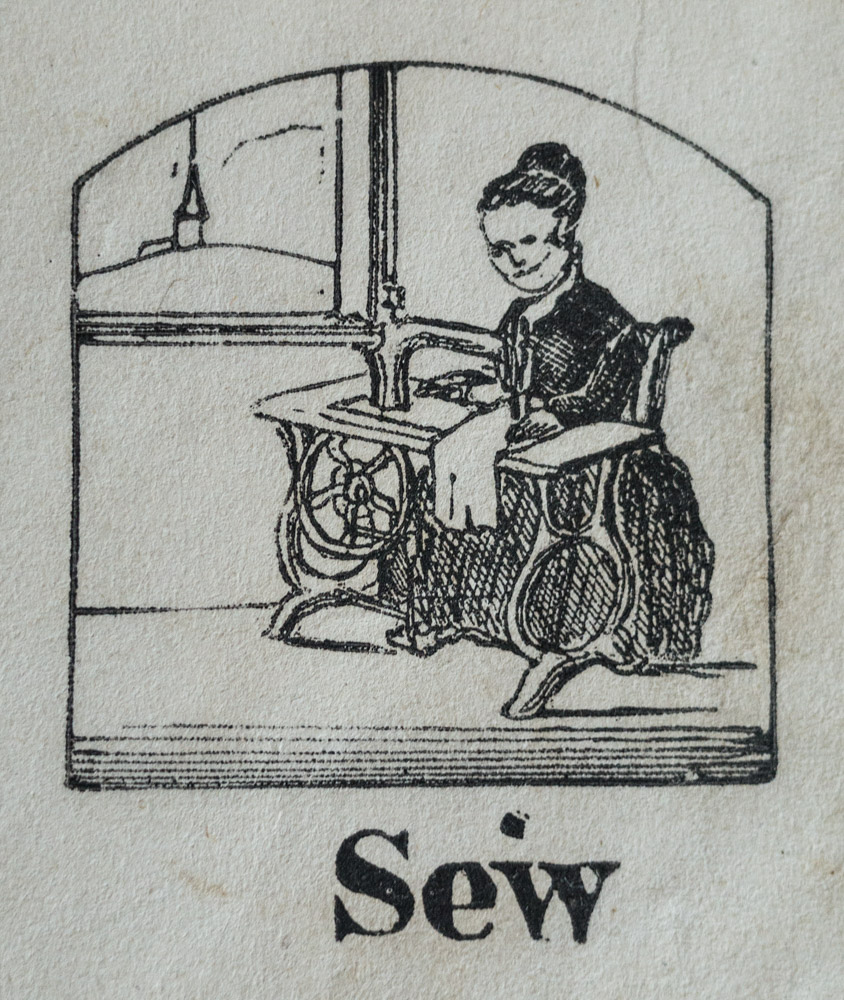
Neither Susan nor her mother could know that mechanical machines for sewing would soon be introduced that would obviate hand-sewing. The illustration above, from 1877, a quarter-century later, suggests how readily the sewing machine would replace hand-sewing and how quickly the production of clothing would become an industry.  Although bespoke clothing would never disappear, and many women for personal or economic reasons would continue to sew their own clothes, ready-to-wear clothing would become more and more available in Susie’s lifetime. No one in the Ames sitting room could envision that development on this sunny summer Saturday ten years before the Civil War.


* Eliza Ware Farrar, The Young Lady’s Friend, Boston, 1836 (from Judith Sumner, American Household Botany, Portland, Oregon, 2004)


July 25, 1851

Wine glass

Friday 25th July  Was expecting to go to Boston with

Mr Ames & Susan in the wagon but it was

misty & cloudy and we gave up going.  It cleared

up very pleasant about nine  I pick[ed] some 

currants for some wine.  Jane strained them

About ten Oclock Augustus carried me up to

see his new heir, found mother & babe comfortable

Evelina was disappointed not to travel into Boston today; the possibility of bad weather put her off the jaunt. However, she got to see William Gilmore, her new great-nephew.  Her niece-in-law, Hannah Lincoln Gilmore, and the baby seemed to be doing well, which must have been a relief. In an era when childbirth could be dangerous for mother and infant, Hannah and Willie were doing fine.

But what was going on in the kitchen at the Ames house? Evelina and servant Jane McHanna were making wine from the currants off the bushes in the back yard. Why did they do this? Alcohol was never served at the Ames house. As Sarah Josepha Hale, author of The Good Housekeeper, a popular cook book, stated emphatically, “t]here is one rule for drinks which no woman should violate – never make any preparation of which alcohol forms a part for family use!”

Yet here was alcohol being prepared in Evelina’s own kitchen.  Rather than being made to be served as a beverage, however, it was being prepared for culinary and medicinal purposes and, for such cases, it was evidently permissible. In cooking, wine or cider could be used as a preservative in mincemeat pies, for instance.  An even more viable use was as medicine for the sick.  In Little Women, Mr. March stores away some wine bottles for his invalid daughter, Beth. In Evelina’s kitchen, the homemade wine would probably be served to someone who became ill and needed a tonic. A drink called wine whey, made from strained wine and milk, was a common treatment for fever and other ailments. Wine had its uses; distilled liquors did not.

* Sarah Josepha Hale, The Good Housekeeper, 1841


June 15, 1851

Burning_Bush_Dictamnus_Fraxinella_Seeds

June 15 Sunday  Have been to meeting all day.

At noon went with Alsons wife & Rachel to

Mr William Reeds had a very pleasant call

Since meeting walked with Mr Ames & Susan 

up to the fly away pond and home by

Edwin Manlys to see his flowers  he has 

fine plants in blossom, among others the

Fraxinella  It sprinkled some and we called

at Mr Peckhams & saw Mrs Washburn

The weather over the past week was so mild that, despite the occasional sprinkle, folks were outdoors as much as possible. Evelina made all kinds of social calls today.

At the intermission between services, she went calling with a sister-in-law from the Gilmore side of the family: Henrietta Hall Gilmore, wife of Alson.  Henrietta was Alson’s second wife, his first having died young, and mother of six of his seven children, including Lavinia, of whom we have seen much this past spring. With Henrietta was someone named Rachel, who was possibly Henrietta’s daughter or another niece with the same name. The ladies called at the home of William and Abigail Reed.  Mr. Reed, older than Evelina by a generation, was a former teacher at Milton Academy and a graduate of Harvard’s Divinity School, although he never settled in a particular parish.  An acting Justice of the Peace, Mr. Reed was well known and well liked.

This afternoon after church, Evelina, Oakes and their daughter walked the road to Fly Away Pond and on to Edwin Manley’s garden.  There the Fraxinella, also known as Burning Bush, caught Evelina’s eye.  More for her garden?


* Fraxinella, seedempire.com

June 7, 1851

images-1

1851

June 7th Saturday  We have had a powerful

rain all day  Orinthia & self have been sitting

sewing most of the time  Orinthia has made a

pair of overalls for Frank  I have trimmed &

lined or rather Harriet trimmed the bonnet

and I feel very well satisfied about it.  The

school did not keep to day or yesterday

Susan has turned a sheet  Horatio Ames Jr &

Mr Scoval came to father Ames.  Mr Ames

brought a lobster that weighed 15 lbs.


No gardening today, but it wasn’t a bad day, despite the rain.  Evelina and Orinthia got to visit for hours over sewing, Oakes Ames brought home lobster – a big lobster – from Boston and, best of all, Evelina was finally “very well satisfied” about her bonnet.

Harriett Ames Mitchell visited, too, and trimmed Evelina’s bonnet. She might have used ribbons or cloth flowers or even a feather or two to adorn the summer headdress. Nine-year old Susie sewed as well.  Either the bad weather kept her indoors, or her mother finally made good on her threat from a few weeks ago to make Susan play less and learn to sew.  Susie “turned a sheet,” which means she did some hemming.

Old Oliver had a rare visit from one of his grandsons, Horatio Ames, Jr., who must have travelled up from Connecticut with a Mr. Scoval.  Horatio Jr. was a first cousin to Oakes Angier, Oliver (3), Frank Morton, and Susan.  The eldest son of Horatio and Sally Hewes Ames, and a recent student at Rensselaer Polytechnic Institute, he would prove to have a difficult life.  Closer to his mother than to his father, he was incensed when his parents divorced. According to some sources, he actually tried to kill his father during an argument in 1856.* His father, who was no saint himself, described his eldest son as “the worst hardened villain I have ever seen.”*

Still, Horatio Jr. was family, and Old Oliver welcomed him to his home more than once over the course of Evelina’s diary.


*John Mortimer, Zerah Colburn: The Spirit of Darkness, 2005

June 5, 1851

e_gg_hook_organ2-291x440

*

1851

June 5th Thursday  To day I have been to Mothers, stoped at Orinthias

school and staid about an hour, left Susan there

and got to Mothers about noon.  Met A Augustus & wife

and her sister Elizabeth, John Pool & wife.  On my way

home stoped to Miss Louisa Howards & got some Asters

and at the meeting house to hear Elizabeth Clark play

Met Oliver & wife & Harriet, Mr Clark and

two daughters  A beautiful pleasant day


Several Ameses gathered this afternoon with others for a concert at the meeting house. Presumably, the new organ was featured again, played this time by a more proficient organist than Mr. Rotch from a few Sundays ago. Miss Elizabeth Clark, daughter of Daniel and Elvira Clark and barely 19 years old, treated the listeners to a recital. The Clarks were Unitarians, and Daniel was a capable carpenter who did occasional work for the Ames family. Elizabeth was evidently a fine pianist.

The new organ was possibly made by E. G. and G. Hook of Boston, whose factory was later in Weston, Massachusetts. Known by 1885 as Hook and Hastings, their firm was prominent in the 19th century in the production of church organs. Their first concert hall organ, no longer extant, was installed in the Tremont Temple across from the Boston Common. Their largest was placed in Boston’s Cathedral of the Holy Cross.  More common were smaller organs such as the one in the illustration that were installed in more modest meeting houses, like the Easton one used by the Unitarians in 1851.

The occasion for this particular recital is unknown, and how it came to be held on a weekday afternoon is also a puzzle.  It made sense to the townspeople, however, who turned out in full for the occasion.

*E. G. and G. Hook organ, Boston, Mass., circa 1848.  Athol Historical Society

May 25, 1851

Cemetery


25 May Sunday  Have been to church all day. Went to Mr

Whitwells at noon with Mother and Mrs Whitwell

made us take a cup of tea Also Mrs Elijah Howard & Miss

Louisa H.  Had quite a spirited chat about Mr

Wm Reed & Mr Dean. After meeting Mr Ames & Oliver

& wife rode to the burying grounds  Cannot 

feel reconciled to having it where it is. Oakes A Susan

& Orinthia went to a sing & Oakes carried Orinthia home.


A cup of tea and good, “spirited chat” among the women during intermission brightened Evelina’s Sunday.  Who were Mr. Reed and Mr. Dean that they evoked such consideration from the female population?  There were several men of either name who lived in Easton at the time.

When church was over, Evelina, Oakes, Oliver Jr. and Sarah Lothrop Ames drove together to look at the new cemetery in South Easton. Created by the Easton Cemetery Corporation, it was one of almost thirty graveyards in the town.  For reasons lost to history, this newest burial-ground had been deemed desirable and consequently established by men well-known to the Ameses, including Elijah Howard and Dr. Caleb Swan.  Perhaps their intention had been to create at burial place that would be tended to as time passed, as many smaller, family graveyards throughout the town were not. Perhaps they were responding to personal inclinations to group Unitarians together for eternity.

Whatever the thinking behind the new burial-ground, Evelina was dubious.  Did she look at it and think she and Oakes might be buried there someday?  Did she wish instead to be buried near her son Henry, wherever that was? Or did she think of another graveyard where her father and certain siblings were buried? Little could she imagine that twenty-five years hence, the Village Cemetery of North Easton would be created behind a Unitarian Church that hadn’t yet been built, both projects funded by Oliver Jr, and that there she, her husband, and all her children would eventually be laid to rest.


May 20, 1851

Play

1851

Tuesday 20th  Washed the front entry windows

& front chamber and put the room in order, have

not been idle but cannot see much that I have done.

Have ripped the pieces of the carpet that formerly

belonged in the parlour and have it already for the 

sitting rooms  Susan runs wild with the other 

children.  I do hope after house cleaning is over that

I shall attend to her better and make her sew.

Rain this evening

Spring cleaning continued today with window washing and carpet rearrangement, the latter a seemingly endless task. Evelina, thrifty housewife that she was, reused old pieces of carpet in new places. The parlor got the newest and best carpet while the less formal sitting room got the recycled floor covering. By ripping, cutting, cleaning and placing, she did the recycling herself.

If Evelina was all about working, her daughter Susan was all about playing. Running “wild with the other children” probably felt pretty good to the nine-year old girl, who was enjoying a week of no school.  Her mother might have wished to make her sit and sew, but the fresh air and companionship of friends from the village was too much fun for Susie to resist.

In this diary entry, Evelina expressed something close to dismay. She didn’t feel she was accomplishing much, either in her housekeeping or in her management of her daughter.  Part of this feeling might have stemmed from memories of her own childhood on a farm where everyone, young or old, had chores and responsibilities. There was always work to be done, and playing instead of working was a rare option. Perhaps Evelina looked at her carefree daughter with puzzlement and guilt.  Susie should be working and it was probably Evelina’s fault that she was playing instead.


May 14, 1851


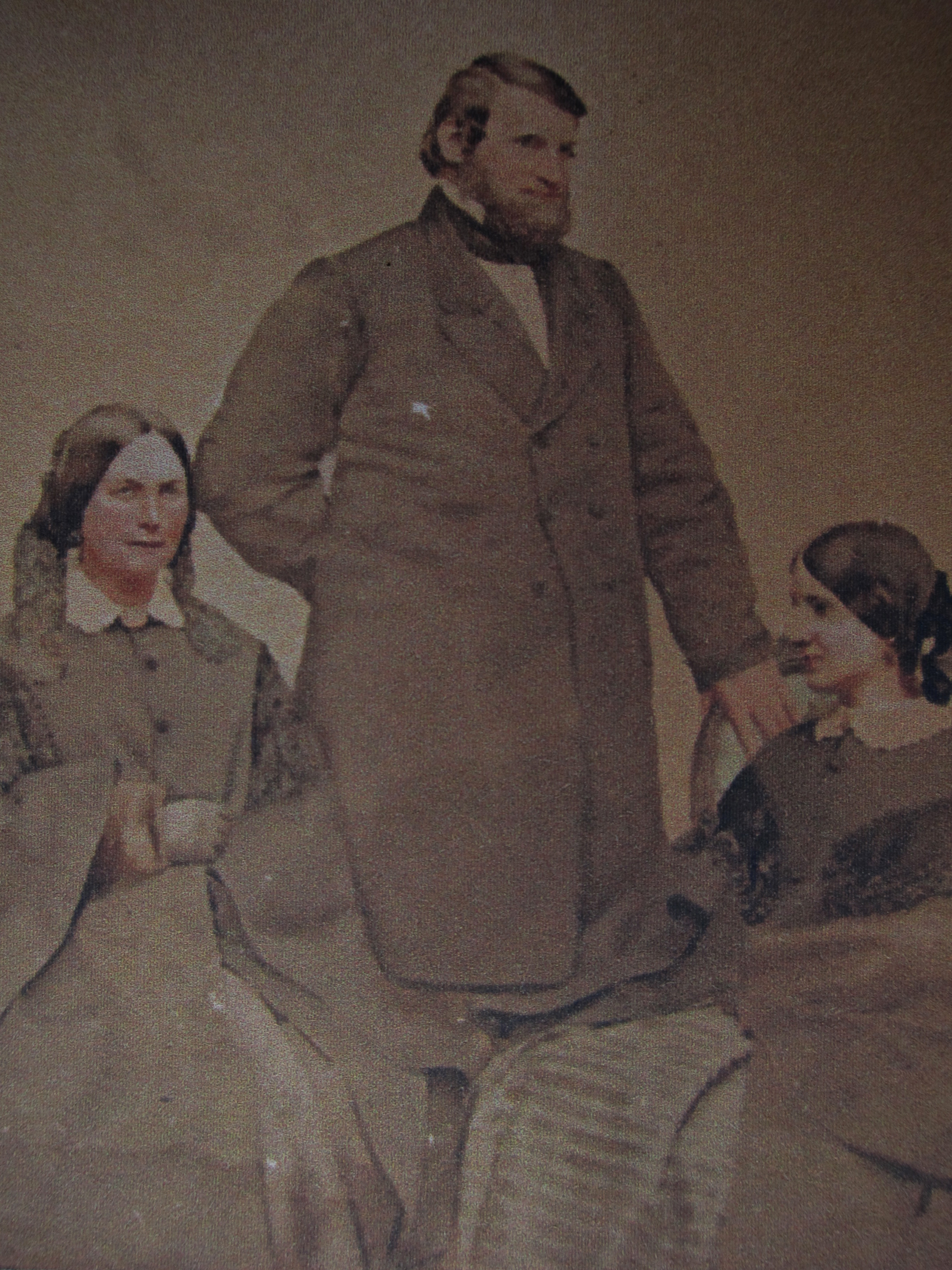
Evelina, Oakes and Susan Ames, ca. 1860 Archives at Stonehill College, Easton, Massachusetts

Evelina, Oakes and Susan Ames, ca. 1860
Archives at Stonehill College, Easton, Massachusetts

Wednesday May 14  Susans birth day and she has had a little

party.  Julia has been here to work on Orinthias

dresses.  Ellen Howard called this evening

came from Jasons. Mrs Holmes called a 

few moments this morning.  I have swept

and dusted the front chamber and taken the 

carpet from the stairs and painted them It

has been a confused day. Pleasant this afternoon

Augustus gone to Boston


Another interruptious day, filled by “confused” and overlapping events: Susie Ames’s birthday party, Julia Mahoney’s work on dresses for Orinthia Foss, calls from Ellen Howard and Harriet Holmes, the usual choring in the downstairs rooms, not to mention Evelina’s removing the carpet from the stairs and painting the treads. What commotion.

Susan Eveline Ames, the only daughter and youngest child of Evelina and Oakes Ames, turned nine years old today and was treated to a little party. Did she have friends over or was the party strictly en famille? Did she have cake? Ginger snaps? Presents? What was a nine-year-old’s birthday party like in 1851?

Born in 1842, Susie Ames came along several years after all her big brothers were born. From the beginning, she was raised differently from them. While they were slated to work, earn and provide, her education and training were oriented toward a future of domestic responsibilities. Like most girls of the time, she was brought up assuming that she would marry and raise a family. If she failed to marry, she would have to make her way as a spinster aunt living with one or more of her brothers, or become a schoolteacher like Orinthia Foss. Which route was hers?  Marriage.

On January 1, 1861, Susan married Henry W. French, a wool merchant. She was 18 years old; he was 27. For many years, the couple lived in the Ames house with her parents, and possibly looked after the house during the periods when congressman Oakes and Evelina were in Washington. For a time, Susan and Henry lived in their own home on Main Street, on the site where the Oakes Ames Memorial Hall came to be built circa 1880.

As Evelina moved into widowhood and grappled with illness and age, Susan looked after her. She and Henry never had any children, so the particulars of her story weren’t passed on to interested offspring. She only comes to life in her mother and brother Oliver’s journals.