December 27, 1851

imgres-1

Sat Dec 27th  Have put more sugar lemon & ginger to the syrup

of the citron  swept and dusted the rooms got

the lining ready to quilt to Susans hood quilted

the lining to Susans bonnet and fixed the collar

to my cloak  A[u]gustus Lothrop brought me a 

bushel of cranberries.  A Augustus called to bring

soap shoes &c that he got me in Boston


The cold temperature continued, Old Oliver noting in his diary that “the thermometer according to the papers was down to 8 in some places.”* Such temperatures wouldn’t have harmed the bushel of cranberries that Evelina received today. As author Mrs. Cornelius advised in her 1846 household guide, “cranberries keep well in a firkin of water. If they freeze, so much the better.”**

Cranberries were common in New England.  There is debate over whether they were served at the earliest Thanksgiving dinners, but there’s no debate that both Native Americans and English settlers consumed the fruit in season. Botanist Judith Sumner notes that: “Wild cranberries were originally hand-picked, but efficient New-Englanders soon crafted scoops that could be used to rake the berries from the lax stems.  During the nineteenth century, bogs carpeted with wild cranberries transformed into cultivated sites that were raked systematically each fall.”***  Augustus Lothrop, the youngest brother of Sarah Lothrop Ames, evidently cultivated cranberries at his farm in Sharon.

Henry David Thoreau enjoyed cranberries, finding them in the wild and eating them raw.  He considered them “a refreshing, cheering, encouraging acid that literally puts the heart in you and sets you on edge for this world’s experiences.”***

*Oliver Ames, Journal, Stonehill College Archives, 1848-1863

**Mrs. Cornelius, The Young Housekeeper’s Friend, New York, 1846

*** Judith Sumner, American Household Botany, Portland, Oregon, 2004, p. 124


Ed. note:  Horace “Augustus” Lothrop was the youngest brother of Sarah Lothrop Ames.  He lived in Sharon.

Alson “Augustus” Gilmore was a nephew of Evelina Gilmore Ames, son of her brother Alson. He lived in Easton.

December 23, 1851

4-currier-ives-winter-scene-granger


Tuesday Dec 23  Julia has been here to day to make Susans cotton

& wool Delaine  I have not sewed much with her

was choring about the house most all the forenoon

painted over some boxes for Mr Scott to grain.  made

the skirt & cuffs to Susans dress then went to knitting

on my hood which I commenced last evening.  Julia

cut and made and gathered the skirt and basted 

it on to the waist, the sleeves are not made


Old Oliver’s wintry weather report for this day suggests a scene worthy of Currier & Ives:”[T]his was a cloudy day + a verry little fine snow. wind north west it cleard of[f] about sunsett. what snow fell to day + last night was 1 ½ inch.” The countryside was covered with snow, appropriate enough for the first full day of winter.  And winter was a season much illustrated by the 19th century printmakers, Nathaniel Currier and James Ives.  Working out of New York, the firm produced enormously popular hand-colored lithographs of mostly American scenes. Currier began the prints in 1835 and was joined by Ives, who had been the firm’s bookkeeper, in 1856. The men soon developed a stable of artists and produced prints through the rest of the 19th century and into the early 20th. Evelina would have been familiar with Currier & Ives images, in the same way that many mid-20th century Americans were familiar with the illustrations of Norman Rockwell. The images were everywhere.

Many, if not most, Currier & Ives prints were scenes of the outdoors. On this day at the Ames’s, however, the action was all indoors, as the women chored, painted, sewed and knitted. Dressmaker Julia Mahoney was at the house to sew a wool dress for nine-year-old Susan Ames. That a child Susie’s age was having a dress made by a “professional” rather than her own mother was certainly a sign of the Ames’s wealth. Helen Ames, Susie’s fifteen-year-old cousin next door, often had her dresses made by Julia. Evelina was keeping up with her sister-in-law, Sarah Lothrop Ames, in providing the best for her daughter.


December 22, 1851

100793

*

Monday Dec 22d  Washed the dishes with Susan, made

the beds &c and then went to work on the hour glass

table got it made about the middle of the afternoon

Mr Ames went to Canton this afternoon  Mrs Mc

Hanna to Mr Savages  Spent the evening at 

Augustus  Went with Oakes Angier in the sleigh

as he was going to Mr Whitwells  They went this

afternoon to the funeral of Lewis Keith

Domestic chores and neighborhood errands reigned on this winter solstice, the darkest day of the year. Jane McHanna did laundry, little Susie helped wash dishes, and Evelina made the beds. Evelina had a special project, too, that she worked on: an hourglass table she was making to give to her nephew, Edwin Gilmore, and his bride-to-be, Augusta Pool.  She made major progress on it, but what was it?  Does any reader know about the design and/or purpose of an hourglass table?

In the afternoon, after the midday dinner, family members rode out in various directions. Under a cold, cloudy sky, Oakes Ames went north to Canton, to the family works there or perhaps to the Kinsley’s. Oakes Angier drove a sleigh south to the minister’s house in order to attend the funeral of a local farmer, Lewis Keith.  Evelina rode along with her son but stopped to visit her nephew, Augustus Gilmore.  Jane McHanna, meanwhile, went out on foot to see William and Hannah Savage, who lived in the village.  Mrs. Savage was poorly.

Did anyone tell a ghost story tonight after dark fell? Such tales were customary for some families at winter solstice.  On her way home from her nephew’s, was Evelina able to see Orion in the night sky through the clouds?

*Image courtesy of http://www.dreamviews.com


December 15, 1851

Hood

Monday Dec 15  The girls have both been washing to 

day but it was so windy they could not put their clothes

out  Jane has sewed this afternoon the bags for the

sausages  I knit on Susans hood this morning

and this afternoon commenced knitting on a little

hood for the fair  Mrs Witherell & Ames have been

in awhile and are to work for it

While her servants Jane and Mary struggled with the Monday laundry, Evelina began to knit. Her nephew, Augustus Gilmore, had fetched some yarn – or worsted, as she called it – for her on Saturday while in Boston, and she was finally able to get to it today.

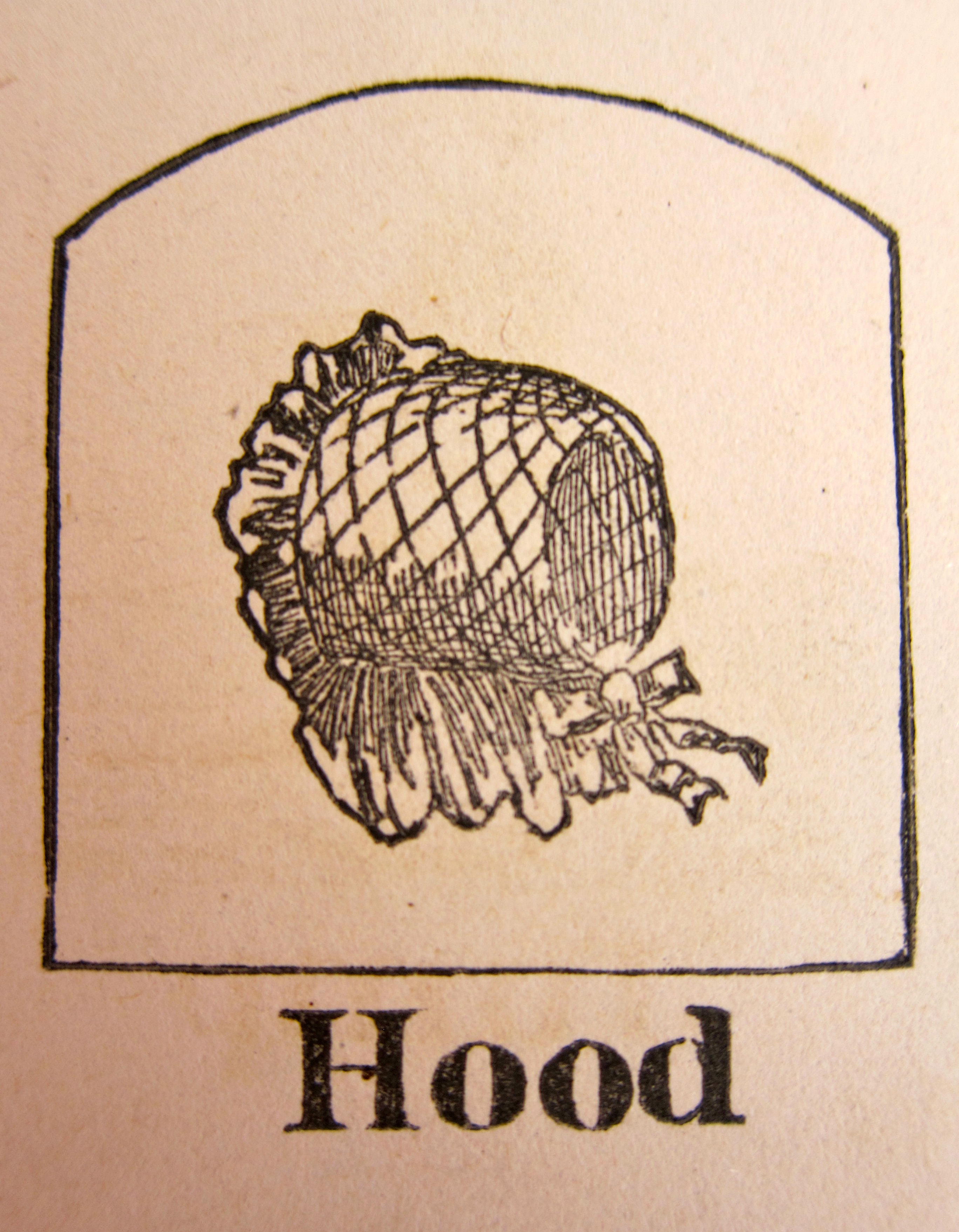
Evelina “knit on” two hoods, one for her daughter Susan and another for a church fair that was coming up. A hood might take a few different shapes, from a fitted piece that covered the top, sides and back of one’s head to one that covered the top and sides only, as in the period illustration above. The one above – which isn’t knitted, but sewn – is really just a variation of a bonnet.

Jane McHanna, too, worked with a needle today once the washing was done. She sewed some cloth bags for the pounds and pounds of sausage that had been produced on Saturday.  Sausage was usually forced into casings made from pig intestines, and this may have been the case with the pork that Evelina and Sarah Witherell produced.  But it may be that an additional cloth covering was desirable for storage or identification.  Hard to know.  Any thoughts from readers who have made their own sausages?


November 30, 1851

Church


Nov 30th Sunday  We have all been to church except

Susan. She did not get ready in season

and I did not hurry her to break her of being so

tardy.  Mother Henrietta & self went to Mr Whitwells

at noon.  Mrs Whitwell insisted on our taking a

cup of tea, squash pie, &c &c  Mother came home

with us from church  Augustus & wife have passed

the evening here


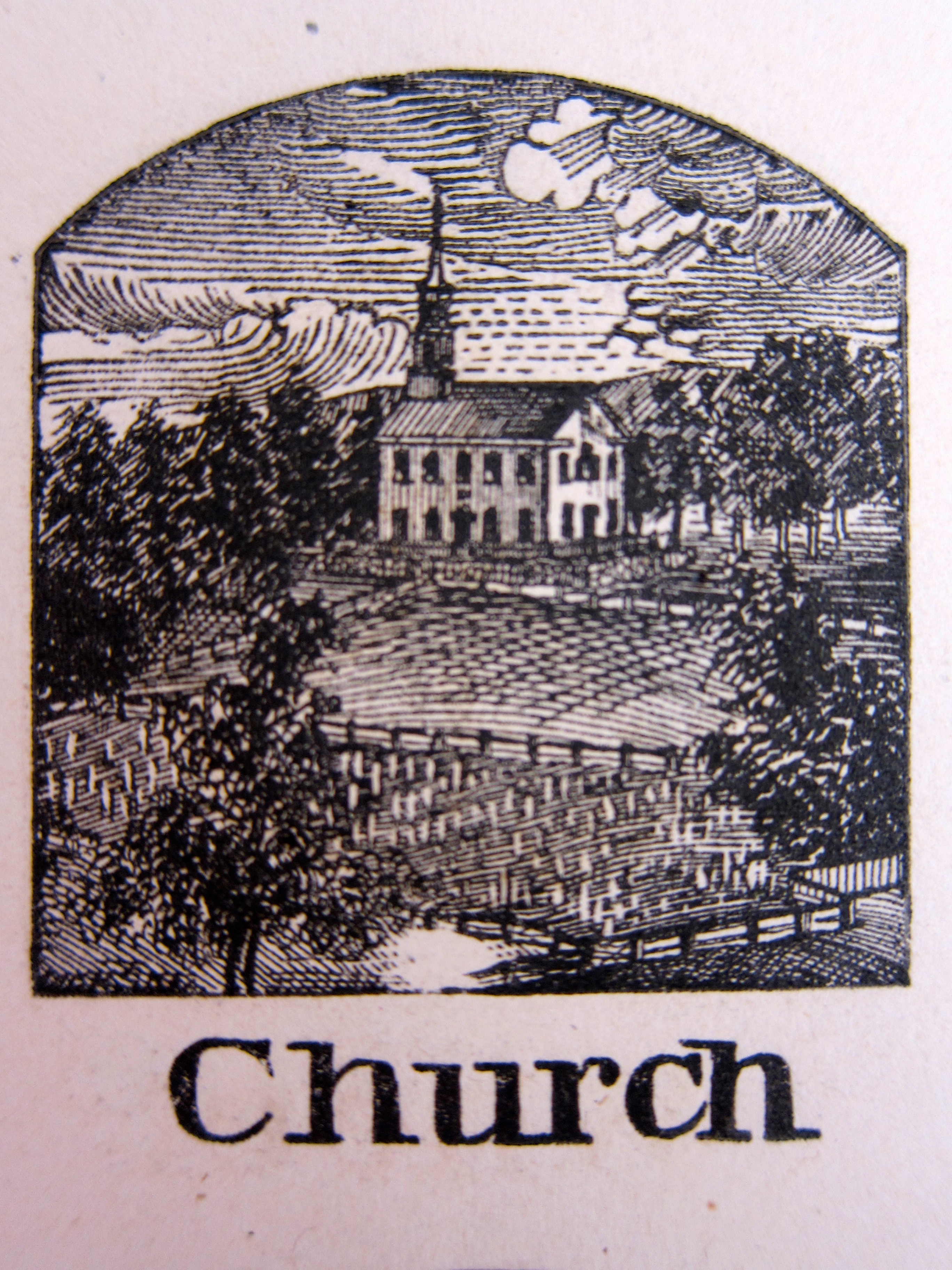
Punctuality is a trait much prized by the Ames family; as it is in 2014, so it was in 1851. Evelina liked to be on time. She was probably familiar with the proverb that “People count the faults of those who keep them waiting.”

Susan Eveline Ames, nine-years-old, was often tardy.  In particular, Susie wasn’t fond of going to meeting, something her mother tried vainly to cure her of.  On this Sunday in 1851, Susie dawdled and missed the carriage, so to speak. The family left for the morning service without her. Evelina clearly saw this as a good punishment for her daughter, but it’s entirely possible that Susie enjoyed staying behind.

The lesson about tardiness, or, at least, the importance of going to church, didn’t stick. Ten years later, circa 1861, Susie was still finding ways to escape going to meeting. According to Winthrop Ames:*

“[M]y grandmother [Evelina] notes with suspicion in her diary that the headaches of her nineteen-year-old daughter, Susan, seemed to occur rather oftener on Sundays than on other days, especially when there was to be a second sermon in the afternoon.”*

“In season”, by the way, was a 19th century phrase meaning “in time.”


*Winthrop Ames, The Ames Family of Easton, Massachusetts, privately printed, 1937, p. 130

November 13, 1851

Drum


Thursday Nov 13th  Have been cleaning the draws in

the beaureaus and have papered the closet beside

the fire place and painted some boxes &c

Ellen Meader […] has been making Susan a visit

this afternoon  The Stoughton band have been

in the neighborhood this evening. They marched 

and played up as far as the house and back to the

school house.  Went to Mr Swains and had coffee &c &c

Mr Ames has been to Boston

Stoughton, Massachusetts, has a wonderful musical legacy, most famously the Old Stoughton Musical Society, a choral group that has been active since 1786. Known in its first hundred-twenty years simply as the Stoughton Musical Society, some of its members referred to it as the “Grand Club”*. When it celebrated its centennial in 1886, Lt. Governor Oliver Ames and Governor George D. Robinson were two notable attendees at a celebratory concert. Oliver (3) was very fond of music; he even took singing lessons in his youth. He must have enjoyed the musical evening.

The long and revered history of the Old Stoughton Musical Society sheds no light on the existence of a Stoughton marching band, however. Evelina’s entry may be the only known mention – at least to date – of such a band.  On this day in 1851 it marched and played instruments through the village of North Easton, presumably after the factory had closed for the day. Why did it stop at the Ames’s house? What was the occasion? Surely the music it played was a welcome change from the usual clanging and hammering that emanated from the shovel shop.

Other than this pleasant interlude, Evelina’s day was ordinary.  While her daughter Susie had a friend over, Evelina cleaned, papered and painted.  Later in the day – perhaps as she accompanied little Ellen Meader home – she had “coffee &c &c” at the home of Ann and John H. Swain.  Oakes Ames spent the day in Boston.


Mary Swan Jones, The One Hundredth Anniversary Celebration, 1886


November 12, 1851

IcePond-732701

*

Wedns Nov 12th  Painted the closets in the sitting

room chamber which with other things has taken

me most of the day.  Susan has passed the 

afternoon at Mr Swains  Mr Whitwell called

this afternoon. I felt very sorry to stop my work as

I was very much engaged at the time  Have not

sewed at all to day  This evening have felt too much

fatigued


According to Old Oliver, “this was a fair cold day wind north west. the factory pond was frozen over this morning”  It was a good day to stay indoors, which Evelina did.  She still hadn’t completed all the refurbishments on the house, so she spent the day painting the shelves in the closet in the sitting room; the shelves in the parlor were already finished.  By evening, she was “too fatigued” even to sew.

Daughter Susie spent the day at the home of Ann and John Swain, perhaps playing with Ann’s niece, Ellen Meader.  Reverend William Whitwell braved the north west wind and paid a call on Evelina.  Much as she liked him and admired his Sunday sermons, she was less than pleased to set aside her painting for his visit.

And “the factory pond” – probably Shovel Shop Pond – had skim ice, at least, all the way across it.  What did that do to shovel production?  How did the dams, flumes, and wheels work when the water began to ice up?


*Photo courtesy of Kenneth Aisawa, http://www.theboundsofcognition.blogspot.com

November 9, 1851

Nurse


Sunday Nov 9th  Did not go to meeting to day on account of

Bridgets being sick.  Expected Mr Ames home at noon to carry

me this afternoon but he went off electioneering and 

forgot all about it.  This evening have been to Mrs

Swains with Mr Ames & Susan  Her nurse is there

and her brothers wife and daughter of about Susans

age  Mr & Mrs Meader returned home about a week since


Not only did Oakes Ames stop in Canton for a Whig meeting on Saturday, but he spent Sunday afternoon “electioneering” and forgot to go home at noon to take Evelina to church for the afternoon service.  In personal terms, this was not an auspicious beginning to his political career, but it was certainly indicative of the wholeheartedness and zeal with which he approached politics.  If Oakes and Evelina had, in fact, reached an understanding about his getting into politics – about which we can only conjecture – we have to wonder if that understanding had already been violated.  Yet Evelina’s diary is not particularly dispirited; she writes matter-of-factly and without obvious annoyance.  Perhaps she already understood and forgave her husband’s capacity for preoccupation.

After missing church in the morning because of a sick servant and in the afternoon because of an absent-minded husband, Evelina must have been pleased at last to go out in the evening. She, Oakes and their daughter Susie paid a call on Ann and John Swain, a younger couple who were relatively new in town.  New parents, their infant son was being tended by a nurse, while two relatives, the last remainders of a crowd who had arrived to tend at the birth, were still visiting.  Ellen Meader, a little girl about Susie’s age, was there with her mother, Sarah Bliss Meader, wife of Ann Swain’s brother, Reuben Meader.

November 4, 1851

450px-Caraway_seed_cake


Tuesday Nov 4th  Put down the parlour carpet this

forenoon baked some cake &c &c  Mrs Buck &

Mrs Drake (formerly Lucy Reed) called about half

past eleven.  Mrs Hubbell & Ames & Mrs Witherell

Father were here to tea  They all dined

at Olivers.  Mrs Hubbell commenced knitting

me a hood. I have put the trimming on the sleeves

of Susans Delaine dress


The day was “cloudy […] + cold + chilly,”* according to Old Oliver, meaning that baking “cake &c &c” in the shared brick oven at the Ames compound might have been pleasurable.  At least it was one way to stay warm. It may still have been in the oven when Polly Buck and Lucy Drake, the former Reed sisters, came for a short call.  Local women, Polly was married to Benjamin Buck, who lived in the village; Lucy was the wife of Ebeneezer Drake.

In all likelihood, Evelina baked the cake – seed cake, perhaps – to serve at tea later in the day. She invited Mrs. Hubbell and Almira Ames, visitors from New York, as well as Sarah Witherell and “Father Ames” to join the family in their newly redecorated parlor. How happy Evelina must have been to show off the recent refurbishments.

Mrs. Hubbell and Almira Ames had midday dinner earlier in the day next door, at Sarah Lothrop and Oliver Ames Jr., a gathering to which Evelina and Oakes don’t appear to have been invited. In turn, Oliver Jr and Sarah Lothrop didn’t appear for tea at Evelina and Oakes’s. It may be that Evelina and Sarah Lothrop Ames agreed to split hospitality responsibilities for the day. Almira Ames was a favorite cousin who often came to visit; she had even lived with family for a period after Old Oliver’s wife, Susannah, died.


* Oliver Ames, Journal, Courtesy of Stonehill College Archives


October 25, 1851

WHEATLAN-h

*

1851

Sat Oct 25th  Mr Scott & Holbrook have been to work

all day papering the parlour and they have got

it papered only from the little entry door

around to that corner of the mantlepiece.

Mr Smiley worked here about two hours to day

put on the border in the parlour as far as it [was]

papered and some paint on top of the closet

shelves.  I have trimmed the paper and &c.


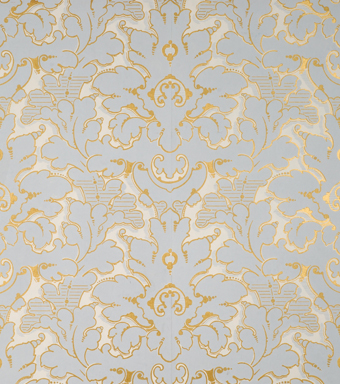
The wallpaper in the illustration above is an example of a mid-19th century pattern that might have been available in Boston, where Evelina purchased her new paper for the parlor. Two men, Mr. Scott and Mr. Holbrook, did some papering today, but not fast enough to suit Evelina. She was so eager to have the paper up that she helped by trimming some of it herself.  What did the workmen think about that? Mr. Smiley, who only seemed to work a few hours at a time, applied a border to what paper had been put up and painted a few shelves.

Oakes Ames was probably absent today, as Saturday was his usual day to be in Boston taking orders for shovels. Sons Oakes Angier and Frank Morton would have been at the factory across the street, honing their skills in the manufacture of shovels. Little Susie was probably at school.


*Example of mid-19th century wallpaper, courtesy of adelphiapaperhanging.com