June 5, 1851

e_gg_hook_organ2-291x440

*

1851

June 5th Thursday  To day I have been to Mothers, stoped at Orinthias

school and staid about an hour, left Susan there

and got to Mothers about noon.  Met A Augustus & wife

and her sister Elizabeth, John Pool & wife.  On my way

home stoped to Miss Louisa Howards & got some Asters

and at the meeting house to hear Elizabeth Clark play

Met Oliver & wife & Harriet, Mr Clark and

two daughters  A beautiful pleasant day


Several Ameses gathered this afternoon with others for a concert at the meeting house. Presumably, the new organ was featured again, played this time by a more proficient organist than Mr. Rotch from a few Sundays ago. Miss Elizabeth Clark, daughter of Daniel and Elvira Clark and barely 19 years old, treated the listeners to a recital. The Clarks were Unitarians, and Daniel was a capable carpenter who did occasional work for the Ames family. Elizabeth was evidently a fine pianist.

The new organ was possibly made by E. G. and G. Hook of Boston, whose factory was later in Weston, Massachusetts. Known by 1885 as Hook and Hastings, their firm was prominent in the 19th century in the production of church organs. Their first concert hall organ, no longer extant, was installed in the Tremont Temple across from the Boston Common. Their largest was placed in Boston’s Cathedral of the Holy Cross.  More common were smaller organs such as the one in the illustration that were installed in more modest meeting houses, like the Easton one used by the Unitarians in 1851.

The occasion for this particular recital is unknown, and how it came to be held on a weekday afternoon is also a puzzle.  It made sense to the townspeople, however, who turned out in full for the occasion.

*E. G. and G. Hook organ, Boston, Mass., circa 1848.  Athol Historical Society
June 4, 1851

Thread

1851

June 4th Wednesday  This morning Mr Lothrop

brought me a calf head and as Jane was Ironing it has

taken me some time to prepare it  Went in to Olivers

to assist Sarah about making her cake for the sewing

Circle.  It met there this afternoon and they had a

goodly number  I have cut two shirts

for Mr Ames and put them into the sewing circle to

make  We have had a pleasant meeting

Even as cows all around town and country were giving birth, some of their calves were slated for slaughter.  In sheer numerical, if unfortunate, terms, not all calves had a place on a farm. Females, once grown, could breed and produce milk, but the males had less of a role, unless they had the lines and build to become fine steers or oxen.  Male calves in particular had good market value as veal and thus were often culled. The arrival of a calf’s head for the dinner table signaled that some culling was going on.  Mr. Lothrop may have been DeWitt “Clinton” Lothrop, a farming brother of Sarah Lothrop Ames and manager of the Lothrop property.

The cook rooms at both houses on Main Street were bustling today. Not only was Evelina preparing the calf’s head, but Jane McHanna was ironing near the stove, keeping her irons hot and using the kitchen table as the ironing surface. In Sarah Lothrop Ames’s kitchen, there was much preparation for the afternoon meeting of the Sewing Circle. Evelina went next door to help Sarah with a cake.

No memory of her own failed meeting back in February seemed to cloud Evelina’s enjoyment of today’s Sewing Circle, even when her sister-in-law’s parlor welcomed “a goodly number.” She was able to put a couple of shirts into the pile of work and had a pleasant time.


May 29, 1851

carriage_wreck


1851

May 29th Thursday  Worked in the garden upon weeds untill about

eleven Oclock & then put clean curtains up in the

sitting room & dining room.  have taken up the 

carpet & had the dining room cleaned

Early this afternoon changed my dress and sit down

to sewing which I have not done before for a long

while  worked on Susans dresses that Julia cut.

It has rained all the afternoon had fire in furnace


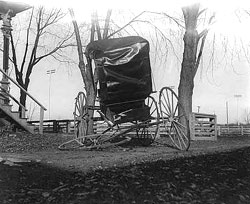
Today was an anniversary of sorts.  According to Old Oliver Ames, exactly one year earlier, Sarah Witherell and Sarah Ames had been injured in a carriage accident: “Sarah + Olivers wife went to Foxborough today and they got hove out of the carriage + hurt some.”  Fortunately, no lasting harm seems to have occurred to either woman.

What had happened?  Had their horse taken a fright and tried to run away? Carriage accidents were usually the result of horses bolting, spooking or crashing.*  Sudden noises – a dog barking, a wave crashing, a flock of birds lifting off, a train whistle – could startle a horse and make it run. Some statistics suggest that horse travel was more dangerous than today’s car travel. For a time, in cities like New York and Chicago, more people per capita were killed in horse-related accidents than are killed now in automobiles.  Travel, then as now, was risky.

Probably oblivious to any recollection of last year’s accident, Evelina managed to spend several hours weeding in her flower garden before rain arrived. In the afternoon she bent to some sewing and worked on dresses for Susan.  Given how fast children grow, Susie’s dresses needed to be completed sooner rather than later.  No doubt Evelina put tucks into these newest clothes for her daughter, intending to make them last.

*http://vickyenglishscamelot.blogspot.com/2011/08/anatomy-of-carriage-accident-what-went.html

May 28, 1851

il_570xN.460322737_72tp

1851

Wednesday May 28  Another busy day about house and what have

I done  I am sure I cannot tell how I do spend

my time  I have lengthened the valance for the 

new bedstead which took some time  Mrs Witherell

and Mrs S Ames have been to Dr Washburns to

have something done to their teeth.  Mrs Ames had

a new one put in  I have planted some Asters

Alousom & princes feathers &c.  Very pleasant

Either Evelina was getting absent-minded or her work load was so varied today that she just couldn’t keep track of all that she did. “What did I do all day?” she wondered when she sat down in the evening (or the next morning, perhaps) to record the day’s events in her diary.

For one thing, she worked on the textile that was to go with the new bedstead, a task that had to have been more pleasant than what her sisters-in-law, the two Sarahs, faced. They went to see a dentist, Dr. Nahum Washburn in Bridgewater. Dentistry in the nineteenth century was primitive compared to what it is today, and often involved extraction as a solution to toothache. A visit to the dentist was nothing to look forward to. Sarah Ames came home with a new tooth tucked somewhere in her mouth.

Working in her flower garden, of course, was another way Evelina spent her time. Today’s new plants included asters, alyssum, and prince’s feathers, a trio of choices that offered different texture and size.  Was she putting in seeds or seedlings?

May 25, 1851

Cemetery


25 May Sunday  Have been to church all day. Went to Mr

Whitwells at noon with Mother and Mrs Whitwell

made us take a cup of tea Also Mrs Elijah Howard & Miss

Louisa H.  Had quite a spirited chat about Mr

Wm Reed & Mr Dean. After meeting Mr Ames & Oliver

& wife rode to the burying grounds  Cannot 

feel reconciled to having it where it is. Oakes A Susan

& Orinthia went to a sing & Oakes carried Orinthia home.


A cup of tea and good, “spirited chat” among the women during intermission brightened Evelina’s Sunday.  Who were Mr. Reed and Mr. Dean that they evoked such consideration from the female population?  There were several men of either name who lived in Easton at the time.

When church was over, Evelina, Oakes, Oliver Jr. and Sarah Lothrop Ames drove together to look at the new cemetery in South Easton. Created by the Easton Cemetery Corporation, it was one of almost thirty graveyards in the town.  For reasons lost to history, this newest burial-ground had been deemed desirable and consequently established by men well-known to the Ameses, including Elijah Howard and Dr. Caleb Swan.  Perhaps their intention had been to create at burial place that would be tended to as time passed, as many smaller, family graveyards throughout the town were not. Perhaps they were responding to personal inclinations to group Unitarians together for eternity.

Whatever the thinking behind the new burial-ground, Evelina was dubious.  Did she look at it and think she and Oakes might be buried there someday?  Did she wish instead to be buried near her son Henry, wherever that was? Or did she think of another graveyard where her father and certain siblings were buried? Little could she imagine that twenty-five years hence, the Village Cemetery of North Easton would be created behind a Unitarian Church that hadn’t yet been built, both projects funded by Oliver Jr, and that there she, her husband, and all her children would eventually be laid to rest.


May 24, 1851

Calf


May 24th Saturday.  Have been about the house at work

most of day.  After dinner carried my old sitting

room carpet out on the grass to wash the spots

and worked awhile in the garden  About two

Oclock Orinthia came.  She walked to Mr Elijah

Howards before breakfast and he brought her up 

She stoped to dine with Abby.  We called at the

store and at Mr Holmes.  Cow calved.

Housework and gardening informed most of Evelina’s day until a visit from Orinthia in the afternoon, at which point Evelina put down the stained carpet pieces or sat up from weeding to welcome back her young friend. The two women went shopping in the village at the Ames company store, and called on Harriet Holmes.  They must have been glad to be back together, even though Orinthia had only left a week earlier. Perhaps Abby Torrey joined them on their errands and calls.

Evelina’s work on the old carpet took place out of doors, somewhere in the yard of the house on Main Street. It only made sense to wash a large piece of rug outside in good light with a place for the water to run off.  The job was messy by definition, but needed to be done and to Evelina, how the project might have looked to passersby was perhaps less important than how effectively the spots were removed. Front yards were becoming more formal, so perhaps Evelina worked on the carpet in the back of the house where the laundry, presumably, was hung, out of sight of the street. We might imagine that Sarah Lothrop Ames, next door, would certainly be discreet in her management of a similar task, a task, in fact, she would most likely delegate to others.

Old Oliver had to have been pleased today. One of his cows calved, adding to his herd. It’s curious that Evelina, who rarely mentions the agricultural side of their lives, made mention of what must have been a predictable springtime event. She wasn’t often engaged by the external activities of either the farm or the factory.  She stayed focused on her house and her yard, but today something about the new calf drew her attention.

May 23, 1851

Road

May 23d Friday  Have finished putting the sitting room in

order and it looks very much better with my new

carpet  About 11 Oclock Mrs S Ames & I started

for North Bridgewater & returned at four.  Called

at Susan Copeland to get her to sew over my straw

bonnet.  It looks like a fright but I shall have

to wear it two weeks more as she cannot do it any

sooner  Mr Whitwell called.  Last night it rained very hard

Various members of the Ames family were on the road today.  Evelina and her sister-in-law, Sarah Lothrop Ames, rode to North Bridgewater on errands.  Sarah seemed to be feeling better after being sick for much of the spring, and Evelina seemed still to be focused on finding a summer bonnet.  She’d have to content herself with looking “like a fright” for a while longer.

Old Oliver Ames, meanwhile, rode home from Plymouth, where he had been since Wednesday on a court matter.  He wrote, “I went as evidence, in a case betwen thomas Ames and Dwelly [illegible]*.” Thomas Ames was a distant cousin, but what the case was about and what Oliver’s role in it isn’t known. Whatever Oliver’s testimony, people on both sides of the case would have paid attention to him. Old Oliver wasn’t known to prevaricate or equivocate.  What he saw or thought, he said.

The rain of which Evelina spoke was probably part of a front that had moved across from the midwest, depositing heavy rain in its path.  Des Moines, Iowa, in fact, was suffering from “The Great Flood of 1851,” an historic deluge that would go on for days. Today anyone can turn on a television or check an app to see what the weather is, but citizens in 1851 could only learn about flooding as it arrived in their area or, if it happened elsewhere, by reading about it a few days later in the newspapers.  We might think we are still at the mercy of the weather, and we are, but at least nowadays we can generally anticipate what might be coming our way in the immediate future.  Not so in 1851.

* Possibly “Goward”

May 21, 1851

faneuil-hall


May 21

Wednesday  This day have been to Boston and had a hard days

work but accomplished very little  Had a green silk

bonnet made for me which fitted […] no better than the

other that I sent back. Mr Remick paid back the four

dollars and I was glad to get off so well after all my 

trouble.  Spent most of the time with Sarah [and] Oliver in

looking for her things.  Bought me a pair of cuff pins

Called at Martin Halls store about some sugar

The search for the perfect bonnet continued today. It was back to Boston, to Alfred Remick & Co. to pick up a bonnet that Evelina had ordered – green silk this time instead of blue plaid – and it still didn’t fit. She had left the instructions up to her husband, Oakes.  Had he gotten it wrong or was the milliner once again at fault? So much for “all my trouble.”

Like yesterday’s diary entry, the tone of this one is self-deprecatory, even grumpy. Gone is the light-hearted pleasure she had expressed earlier in the month when gadding about buying plants for the garden in the company of Orinthia Foss or her nieces. Evelina couldn’t seem to get things to go her way. Her inability to find a bonnet was proving irksome, and the best she could manage was to tag along with her sister-in-law, Sarah Ames, and brother-in-law, Oliver Ames Jr., while they did some shopping. She did buy a pair of cuff pins, however, which was consolation of a sort.

While they were at Faneuil Hall, Evelina purchased or ordered or, at the very least, inquired about some sugar from a grocer there. Faneuil Hall was – and is – a prominent, historic building in Boston. In the middle of the 19th century, it featured a spreading marketplace, called Market Square, where merchants such as Martin Hall sold their wares.  Upstairs there was a large hall for civic gatherings. The illustration above, by Winslow Homer, shows Faneuil Hall in 1861, at the very start of the Civil War, ten years after Evelina bought sugar there. The image of a regiment of Massachusetts volunteers famously marching off to Washington was published in Harper’s Weekly, a periodical to which Evelina and Oakes subscribed.


May 15, 1851

pond_water

Ames Long Pond

May 15

Thursday  I was intending to go to Boston with Mrs S Ames

this morning but she has the ague in her face

which prevented and lucky for me that I did

not go for about twelve Oclock Lavinia, Ann Pool,

and Francis, came and this afternoon Abby.  We all

rode to Edwins and Mr Clapps garden and to the ponds

Jane cleaned the […] buttery, and I was working

in the chambers when they came


Sarah Ames was sick once again, this time with what was probably a head cold, so a planned outing to Boston was called off. Sarah had been quite ill for much of the spring; perhaps she hadn’t given herself enough time to recover and was now suffering a relapse.

Normally, Evelina would have been disappointed to miss a trip to Boston, especially as she still needed to buy a bonnet, but a visit from a set of young relatives made for a happy alternative.  Her nieces Lavinia Gilmore and Abby Torrey, nephew Francis Gilmore, and a young friend of theirs, Ann Pool, arrived and rescued her from choring. With Francis holding the reins, presumably, the group rode north toward Stoughton, where they stopped at two farms to look at garden plants, one farm belonging to Edwin Manley, the other to Lucius Clapp.

They also rode by the ponds, including Ames Long Pond, which sits on the boundary between Easton and Stoughton. Most likely they also rode by Flyaway Pond which had been created only six years earlier, in 1845, to supply more water power from the Queset River to the shovel factory. Queset, according to historian Ed Hands, was “the most heavily used of all the drainage systems” in the watersheds of Easton.*  The shovel business would never have started in Easton had it not been for the Queset (Brook) River; O. Ames & Sons absolutely relied on it for decades.

Flyaway Pond is no longer configured the way Evelina and her companions would have seen it during their pleasant afternoon ride. It collapsed during a huge flood in March, 1968, wreaking havoc and causing considerable property damage.   As Hands points out, that 20th century flood washed away an important symbol of the Ames period in Easton, that of the control of the Queset River for commercial purposes.  Evelina couldn’t imagine that future for Flyaway Pond, of course; she could only enjoy riding past it and Ames Long Pond – and others, perhaps? –  in the spring air.

*Edmund C. Hands, Easton’s Neighborhoods, 1995


May 7, 1851

Thread

Wednesday May 7th  Orinthia went to Boston this morning

with Abby Torrey after she left I went into Olivers

on an errand and stopt a long while as I am

sure to do when I ought not and then went into the

other part of the house to bid Mrs Stetson good

by (as Mrs S Ames and Frank went with her to Bridgewater)

and Mrs Lincoln Drake rode up and saw me by

the window and I was obliged to see her, thus the day passed

and I accomplished very little Went with Mrs Witherell

to the sewing circle at Daniel Clarkes


The Sewing Circle held its monthly meeting today, this time at the home of Daniel and Elvira Clark.  Roughly contemporary in age to Oakes and Evelina, the Clarks were members of the Unitarian Church.  Daniel was a carpenter who occasionally did work for the Ames family. Elvira, like Evelina, was a housewife with teenaged children.  She and Evelina visited together last Sunday during the intermission between sermons.

So much socializing went on today that Evelina had to chastise herself – “I am sure to do what I ought not” – when she spent too much time next door visiting her sister-in-law, Sarah Lothrop Ames. Sarah must have been feeling better; although she didn’t go with Evelina and Sarah Witherell to the Sewing Circle, she had improved enough not only to have a good, long chat with Evelina, but also to have an outing to Bridgewater, which she was “carried to” by her nephew Frank Morton Ames.

Evelina stopped in at Sarah Witherell’s to say goodbye to Mrs. Stetson, a friend of the family who was departing for Bridgewater, too. She then was spotted by Caroline Torrey Drake, a friend who stopped in for a visit. Mrs. Drake, a woman in her early fifties, was the mother of eight children: five girls followed by three boys.  Her first child was born when she was 20, her last child when she was 45.  Now that’s childbearing!