May 26, 1852

Bird

1852

Wedns  May 26th  Jane has done part of the ironing  I have

put down the carpet in the front chamber & sitting

room and the bedroom carpet partly down and 

got the rooms in pretty good order  Mr Scott

& Holbrook commenced painting in the other

part of the house yesterday   Mrs Patterson

staid at home to do her washing & ironing

Mr Ames went to Bridgewater West


Spring cleaning continued; Evelina laid carpet today, often one of the last chores on the list. She could almost check the sitting room off the list, and seemed pleased that the house was “in pretty good order.”

Another spring ritual, this one involving bird hunting, may or may not have taken place on this date; by 1852, it may have been outlawed.  But the hunt, which always took place on the last Wednesday in May, was recent enough to have included various Ameses, if we assume they chose to participate.  Town historian William Chaffin describes the ritual in his 1886 History of Easton:

“At different times in the history of the town rewards were offered for killing crows and blackbirds, which were supposed to be very destructive to corn […]

“Scarcely two generations ago [which would place the event somewhere as late as the 1840s] the custom prevailed of young men choosing sides, and each side on a given day starting out and killing all the birds they could. The day chosen was the old ‘Election day’ so called, the last Wednesday in May, once the time for the convening of the State Legislature, and which came to be known as ‘Nigger ‘lection.’  It was one of the greatest holidays of the year for the boys. […] [T]hose taking part in the shooting started out at daybreak and killed as many birds as possible.  They usually met at some appointed place before dinner, to count the birds and see which side had won the victory.  In North Easton, the rendezvous was at Howards’ store […]

“The understanding was that only harmful birds should be killed; but it was easy to include nearly all birds in this category, because, it was argued, bobolinks and swallows destroyed bees, and robins stole cherries, etc. In some places the party beaten paid for the dinner and drinks of all.”*

In the 21st century, it’s difficult to fathom both the wanton waste of this offensively-nicknamed holiday, and the glee that evidently accompanied it. That hunting has an appeal, we don’t question, but that songbirds were the quarry is hard for modern folks to accept. **


William Chaffin, History of Easton, Massachusetts, 1886, pp. 776-777

** This editor freely confesses to being a birder and particularly fond of bobolinks.
May 21, 1852

67

*

1852

Friday May 21st  Mrs Patterson came to help clean house

to day and has done very well.  We have

cleaned the boys chamber and put down the

carpet & the store room,  all […] that is necces-

sary for painting the dining room.  have put

some clean paper on part of the dining room.

Have not changed my dress to day and have not

had a chance to sit scarcely a moment.  Have a

trellis from Lucius Clapp

“[T]his was a fair day neither verry cold or warm,” recorded Old Oliver in his journal; he was beginning to look for rain for his crops, as the spring was turning dry.

Evelina probably paid less attention to the weather than her father-in-law, because she was focused on the ritual spring cleaning. She hired extra help in the form of Mrs. Patterson, who may have been Mary Patterson, the forty-ish wife of Thomas Patterson, a farmer in Bridgewater.

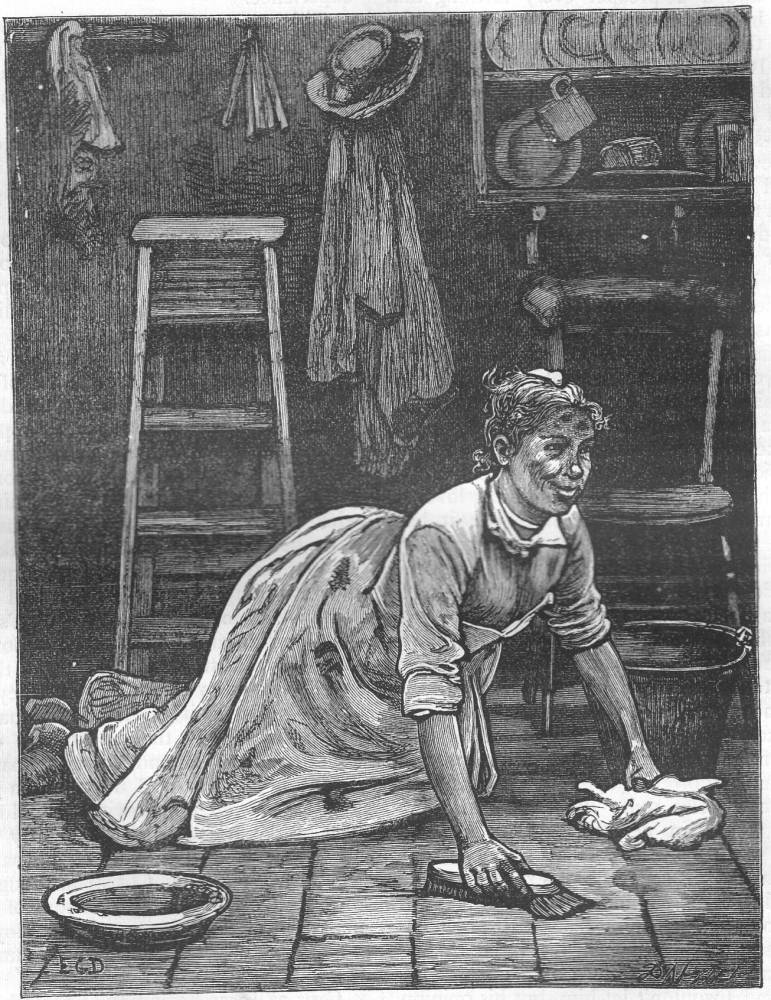
Whoever she was, Mrs. Patterson proved a boon to Evelina. The two women were busy all day cleaning, washing the floors, putting down carpet, and putting up new wallpaper. Evelina never changed out of her work dress, as would have been customary in the afternoon, and barely sat down. Meanwhile, the regular servant, Jane McHanna was preparing the meals and tending to the ordinary chores of the house.

The trellis that Evelina and Oakes ordered from Lucius Clapp arrived today, and was most likely placed, free-standing, somewhere in the yard. It could well have been a centerpiece for Evelina’s flower garden.

*Illustration from “Mrs. Lirriper’s Lodgings,” 1863, published in Charles Dickens’ periodical, All the Year Round

May 20, 1852


Mattress

1852

Thursday May 20th  Went to Bridgewater quite early this

morning and did not get back until

after four Oclock  Bought an oilcloth

carpet for the dining room,  Straw carpet

for O Angiers chamber and engaged some

husk mattress  Called into Edwins after 

I returned  Have a bad head ache.  Very pleasant

Today’s shopping objective: new floor coverings for the dining room and a bedroom, as well as “some husk mattress.”  At least one of the mattresses of the house was due to be restuffed or entirely made over.

By the mid-nineteenth century, mattresses were stuffed with various materials, including cotton batting, wool, horsehair or corn husks. As they had been for centuries, mattresses were placed within a wooden bed frame and set atop a latticed support of rope or leather or wire. The box-spring that we use today would come along a few decades later.

It’s a little curious that Evelina “engaged some husk” for a mattress, when she could have selected cotton or something finer, like down. Feathers would have required poultry, however, which the Ameses didn’t keep, and were expensive to purchase. The husks, probably harvested the previous fall from a corn harvest and dried over the winter, would have been less expensive.

By the end of the day, Evelina had a headache. Perhaps her long day of shopping or a bumpy ride to and from Bridgewater set her off.  With so much time spent outside, a high pollen count could have been the culprit, too, and might also account for Susie Ames’s recent nose bleeds.

April 9, 1852

images-1

April 9th Friday  Have made the skirt of my Delaine

dress and Orinthia has been sewing on her own

clothes most of the day  I have done but very

little sewing this spring.  Have had some one staying

here for the last few weeks and have been upon the

go a great deal of the time.  Abby came about four

this afternoon and spent the evening

Evelina was trying to catch up on her sewing today, admitting that she had been distracted by “someone staying” at the house for several weeks. She had been “upon the go” with visits from her sister-in-law Amelia Gilmore, her mother, and her former boarder, Orinthia Foss. As a consequence, her sewing had suffered. It was time to get busy.

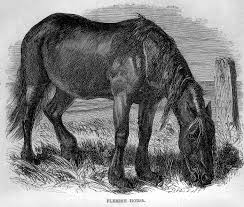
Her father-in-law, Old Oliver, was busy, too. After noting that“it was cloudy all day wind north east + snowd a little,” he went on to report the purchase of several animals.  “[W]e bought 12 pigs to day that weighd 2041 lb at 7 ½ cents a lb – paid 143=00 cents for them [and] we bought a black hors[e] to day of Mr Feild of North Bridgewater which he cald 5 years old for 125$ if he proves good we are to pay 25$ more for him”

A few days ago it was oxen, today it was pigs and a horse.  Old Oliver was filling the barn.


March 27, 1852

north-bridgewater-mass-1844-sm

1852

March 27  Sat  Have been mending again to day and painted

some spots in the back entry chamber  Mrs Witherell

& Mrs Lovell from Bridgewater came to see Mrs Witherell

& spent the day.  Mrs Lovell called on Hannah.

Mrs S Ames came in soon after dinner and staid

most of the afternoon  We called to see Mrs

Witherell & Lovell  Have read in the papers this

evening

Sarah Ames Witherell, Evelina’s sister-in-law, had visitors today from Bridgewater. Sarah’s mother-in-law, Lydia Witherell, and a Mrs. Lovell called. Mrs. Witherell was a recent widow, more recent even than her daughter-in-law, Sarah, who had been widowed three years earlier. Where Sarah’s late husband, Nathaniel Witherell, Jr. had died in October, 1848, his father, Nathaniel Witherell, Sr., had passed away in January of this year. Sarah and her two children, George and Emily, had traveled through a snowstorm to attend the funeral.

The Mrs. Lovell who came to call may have been Emeline Perry Creasy Lovell,  wife of Reverend Stephen Lovell, former resident of Easton and one-time pastor of the recently defunct Protestant Methodist church in Easton. But the clergyman and his wife possibly lived in Boston, too, so this Mrs. Lovell “from Bridgewater” may have been someone else. Yet her extra visit to see Hannah Lincoln Gilmore, who was still ailing, suggests that this Mrs. Lovell was familiar with at least some of the residents of North Easton.

While this visiting was going on, Evelina stayed on her side of the house with her other close sister-in-law, Sarah Lothrop Ames.  How did it work to have two separate social conversations going on under one roof, one on each side of divided parlor walls? One imagines that Evelina and Sarah Ames were curious about the nature of the call in “the other part of the house.”

March 6, 1852

Whitewash

1852

March 6th Saturday  Mr Scott whitewashed the parlour

& sitting room chamber this morning and I

varnished the front entry oil cloth.  Lavinia

came at eleven and Augusta this afternoon

Alson came after Lavinia and stopt to tea

Charles Pool came up and carried Edwin

and Augusta home to stay till Monday

I have been to work on a stiched pink apron

for Susan

A full moon shone down on North Easton this night, highlighting the charred ruins of the shovel factory.  Before it rose, however, Old Oliver took the opportunity of “a fair day”* to travel to Bridgewater, quite probably on shovel business.  He and his sons were developing plans to rebuild the factory, and some help for that would be found in Bridgewater.

Evelina’s way of coping after the devastating fire appears to have been to keep the domestic front moving smoothly. Redecorating continued, social calls were made and enjoyed, and sewing continued without a blink of an eye. Daughter Susan would soon have a new pink apron.

Years later, Evelina and Oakes’s grandson, Winthrop Ames, would credit his grandmother and other Ames wives with exerting a positive influence on his male ancestors. “They made the homes, reared the many children, saved their husbands’ money, encouraged their undertakings, and steadied them in failure and misfortune,”** he said. Evelina’s evident steadiness during this challenging period is one such instance of positive influence. Oakes Ames had come home from the fire “more cheerful” than Evelina had expected; she seems to have behaved with equal optimism. Though naturally sanguine, Oakes’ bright outlook and ability to cope in the aftermath must also have been bolstered by his wife’s unflappable focus on home and (redecorated) hearth. Together, they maintained continuity.

Charles Pool, Augusta’s eldest brother, drove up from southeastern Easton today and fetched his sister and her husband, Edwin Williams Gilmore, “home to stay” for a few days. Perhaps this visit had been prearranged, or perhaps it was an effort by the young couple to get out of the way of remnant smoke and disruption from the fire.

*Oliver Ames, Journal, Stonehill College Archives, Arnold Tofias Collection

**Winthrop Ames, The Ames Family of North Easton, Massachusetts, 1937, p. vi.


January 14, 1852

il_340x270.670708305_2grg

Jan 14th Wednesday  Have been to work some on a 

morino hood for Susan to wear to school  Augusta called 

this forenoon and I went home with her to assist her in

cutting her cake to send to her friends  This afternoon

have been to N. Bridgewater and called on Miss Foss

with Mrs S Ames Emily & Susan  bought Edwin a clock

Called at Edwins and staid till about eight Oclock this

evening spent the rest of it at Olivers

Orinthia Foss is back.  “Miss Foss,” as Evelina calls her, more formally than usual, had taught school in Easton the previous year, living part of that time with the Ames family.  Although twenty years younger than Evelina, the two women had become close friends, often sewing, gardening and socializing together. When Orinthia left to go back to her family in Maine, Evelina had missed her. Now, Orinthia had returned and was teaching in North Bridgewater (today’s Brockton).

Evelina, Sarah Lothrop Ames, and the girls Susie and Emily rode to Bridgewater to call on Orinthia, a reunion that was presumably happy and animated.  The women also did some shopping.  Evelina, feeling pleased, bought a gift for her nephew Edwin Gilmore, despite having made a table for him and his bride, Augusta.  She had been over at the newlyweds’ home earlier in the day, in fact, showing Augusta how to cut up the wedding cake that she herself had made.  Pieces of the cake would be sent out to friends and relatives as a keepsake.  Wedding cakes were meant to bring luck to the new couple.

Back in Easton, Old Oliver noted that “we kild a yoke of oxen I bought at randolph for 125$ one of them weighd 1359 + the other 1277 one of their hyde weighd 116 lb and the other 104 pounds”.  There would be beef and tripe headed for Evelina’s kitchen.


January 13, 1852

images-1


Jan 13 Tuesday  Have not done much work to day

can scarcely tell what I have been doing  Have

been trying to fix Susan some work to learn her to sew

Have got out an apron and commenced a stocking

for her to knit.  This afternoon called on Mrs Richards

Holmes, Torrey Savage & Hannah  Spent the evening with

Augustus and wife at Olivers.  Mrs Witherell been to Dr Washburns

& had her teeth out.  Mrs S Ames George & Emily went with her.  Father

& Oliver dined here & the others when they came back from Bridgewater

This was not Sarah Witherell’s best week. Limping from a bad burn on her foot, she kept an appointment with a dentist, Dr. Nahum Washburn, to have her teeth pulled. Dr. Washburn had his office in Bridgewater, in an historic building known as “the Tory House.”  It was the same office that Evelina had been to several months earlier to have her own teeth worked on.

Modern historian Jack Larkin has noted that “[h]undreds of thousands of Americans had at least some of their teeth badly rotted, a source of chronic pain and foul breath to many, with extraction its only cure […] Dentistry, which most rural American physicians practiced, was by far the most effective form of surgery; extraction was a decisive and relatively safe procedure (although infection always posed some risk).”*

While Sarah Witherell suffered today, her family united to support her. Her children and sister-in-law accompanied her to the dentist’s office.  Evelina (with Jane McHanna in the kitchen, of course) fed the entire family, which made for twelve around the dining table. Old Oliver, whose midday meal was usually prepared by Sarah Witherell, came over from the other part of the house. The Ameses from next door were there, too. Everyone came together for Sarah Witherell.

Evelina managed to socialize today, too.  She called on various friends and relatives around town, perhaps sharing the news of poor Sarah’s painful dentistry.


*Jack Lardin, The Reshaping of Everyday Life, 1988, pp. 92 – 93

December 25, 1851

Turnstile


Dec 25th Thursday  The Irish are expecting to have a great

time to day Jane went to the meeting house about

eight but the priest did not come she stoped an

hour. Carried my knitting into Olivers awhile this

forenoon. This afternoon have been to mothers

with Mr Ames & Frank as they were going to West

Bridgewater.  Finished knitting the front & back of

my hood  Made a present to Lavinia of Turnpike Dividend $800

Christmas Day! But as Evelina points out, the Irish Catholics in town would be celebrating, but the Ames family wouldn’t. Jane McHanna left the house to attend a Christmas mass for which, unfortunately, the priest was either late or didn’t show up at all.  Jane returned home to prepare dinner. Evelina, meanwhile, visited Sarah Lothrop Ames next door, knitting in hand.

After dinner Evelina rode along with her husband and youngest son as they went on an errand to West Bridgewater.  They dropped her off to see her mother at the family farm. There may have been some recognition of the holiday in this gesture, although Evelina makes no mention of gift-giving, with one significant exception. Evelina gave an $800 dividend to her niece Lavinia Gilmore.

The dividend came, somehow, from proceeds from the Taunton and South Boston Turnpike, a road that had run through part of Easton since the early 1800s, between “‘Taunton Green, so called, to the Blue Hill Turnpike,'” according to town historian William Chaffin.* Its origin was controversial and involved a long-standing disagreement with the Town of Raynham, but its impact on the Gilmore family was generally positive, as various Gilmores, including Evelina’s father and brother, served as toll-gate keepers. As Chaffin points out, however, “[t]he toll-gate naturally became unpopular.” It was closed in October of 1851.

How Evelina came to possess $800 from the road is unclear. Was this a regular dividend that Evelina received, or was the family compensated for the road’s discontinuance? That Evelina passed this money on to her niece, however, is a clear demonstration that for all her economical instincts, Evelina was capable of great generosity.


*William L. Chaffin, History of Easton, Mass, 1866, pp. 454 – 458.

December 18, 1851

62834-004-ED8B9BE0


A Delaine Sheep

Dec 18 Thursday  Finished the back of Susans hood

and finished the blue and orange deLaine

for self that Julia cut a new waist for last spring

Mary left this morning said she was going

to Bridgewater for her clothes   It is bitter cold and 

I fear she will suffer  Jane has finished two

prs of cotton flannel drawers for me that she

has been sewing on since she was sick

Another “fair cold day;”* not an ideal time for the servant, Mary, to travel from North Easton to her home in Bridgewater.  Whether she rode or walked, she must have been quite exposed and have become sick, for she didn’t return to the Ames household for the rest of the winter. She only reappears in Evelina’s diary the next July, working by that time for Alson and Henrietta Gilmore at their farm.  What prompted her departure?  Was she homesick for family in Bridgewater, or tired of working at the Ames’s house?

Sewing was today’s occupation of choice for Evelina and her remaining servant, Jane McHanna. Evelina picked up an unfinished project from the previous spring, one that she had nearly finished with help from local dressmaker, Julia Mahoney.  It was a “blue and orange deLaine,” meaning that it was a print or plaid, fine-weave, challis-like wool dress, one that would be of service in this cold weather. The wool itself came from a type of Merino sheep known as a Delaine (as in, “of wool” in French.) Jane, meanwhile, sewed some flannel underclothes for Evelina, who would be warmly dressed once these articles were finished.

Next door, in the other part of the house, a man named Holman Johnson, probably visiting on shovel business, stayed the night.

*Oliver Ames Journal, Stonehill College Archives, Arnold Tofias Collection