April 15, 1852

images-1

April 15 Thursday.  Oakes Angier 23 years old to day.

This day 23 years ago not a cloud to be seen to day

a heavy rain storm  Julia Mahoney here making

my Delaine and altering my black silk having

a new waist and sleeves.  She has both waists fitted

but did not get much ready for me to work upon

till just at night  I have made the button holes

in the delaine

In both years of her diary Evelina takes note of Oakes Angier’s birthday. She also mentions him by name approximately 117 times as he comes and goes, works, reads, rides, eats or ails. By comparison, her other sons, Oliver [3] and Frank Morton, are each cited with similar purpose only 74 times, or one third less often, and neither of their birthdays draws any mention at all. This numerical disparity, coupled with the soft tone of Evelina’s rare reminiscence about her first child’s birth, when “not a cloud” could be seen, hints at maternal favoritism for the eldest son.

Not only was Oakes Angier the firstborn child of Oakes and Evelina, he was, on his father’s side, the eldest of 24 grandchildren of Old Oliver and Susannah. On his mother’s side of the family, he placed in the middle of a pack of a dozen grandchildren of Joshua and Hannah Gilmore, many of whom, like cousin Edwin W. Gilmore, lived in the vicinity.

Oakes Angier Ames would have known all four of his grandparents, although he was only seven years old when his grandfather Gilmore died. He was just turning 18 when his grandmother Ames passed away and in his thirties, with children of his own, when his grandfather Ames and his grandmother Gilmore (who lived to be nearly 92) died. Throughout his life, Oakes Angier was surrounded by multiple generations of relatives; he grew up amid a swirl of siblings and first cousins, among most of whom he held primogenitary status. He was the standard bearer. His siblings and cousins called him simply “Oakes,” leaving it to Evelina (and his descendants and historians) to append his middle name when spoken of.

 

April 14, 1852

Washing

1852

April 14th Wednesday  Jane washed yesterday and put

her clothes out to day […] and it is very pleasant and

most like spring of any day we have had.  Made two

toilet cushions and covers for them of plaid muslin

Mrs Sarah Ames brought in her work this afternoon

awhile and I put a bosom into a shirt for

Mr Ames.  Read this evening in Night & Morning

The rain and snow of the preceding two days had disrupted domestic routine, meaning that servant Jane McHanna washed the weekly laundry on Tuesday instead of Monday and hung clothes out today. Evelina didn’t seem to mind, given how “most like spring” the day turned out to be. She seemed to have recovered from having gone without much sleep the day before.

Sarah Lothrop Ames came over from next door and the two sisters-in-law sat and sewed. Evelina sewed a shirt front for her husband and made two toilet cushions. The word “toilet” in the nineteenth century referred to personal grooming, as in getting dressed or cleaning one’s teeth or sitting at a dressing table.  A toilet cushion, then, was most likely a seat for a stool or small chair for a bedroom or dressing area. Evelina made both the pillow itself and its cover of “plain muslin.”

Night and Morning was, presumably, a work of fiction. Evelina must have found it in one of the periodicals she liked to read, such as Gleason’s Pictorial, or in a book she or Oakes had purchased in Boston.  Any readers out there familiar with this work?


April 13, 1852

Ill

1852

Tuesday April 13th  Watched with Mrs Brett last night

She is quite low seemed to like my being there and

urged my coming to see her often and said she meant

to come to see me and be more friendly if she ever

gets well  said her Mother told her in her last hours

to come to me for advice and regretted that she

had not done so but meant to in future  The rain of 

the morning has turned into a heavy snowstorm  Susan & self

carried our work and stopt a couple of hours with Mrs W

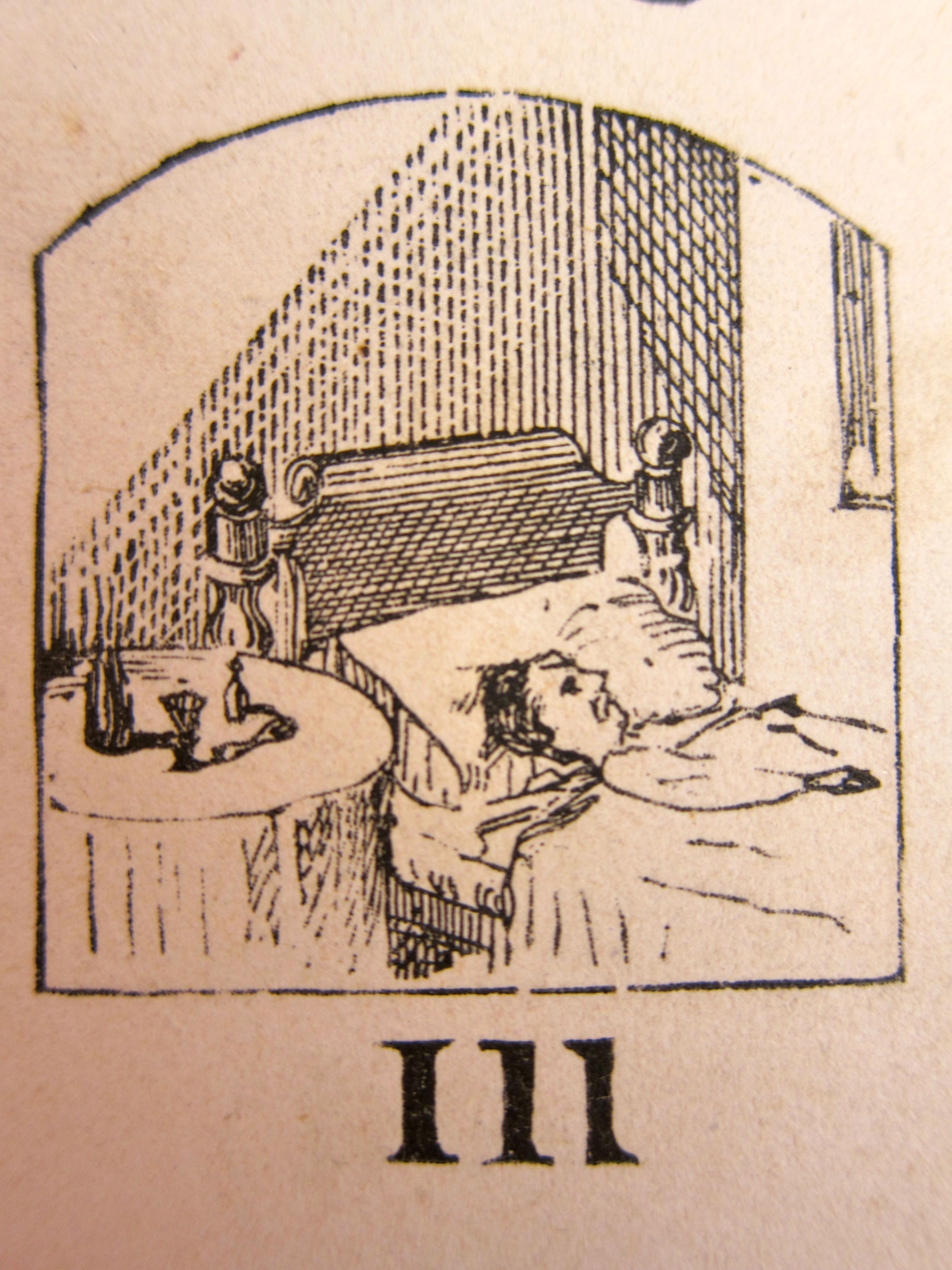
A young neighborhood wife named Eveline Brett was ill, probably with childbed fever. Evelina went to stay with her during the night, taking her turn with family members and other neighbors to watch, suggesting that some must have thought that the new mother wouldn’t survive.

Modern historian Jack Larkin has described this neighborly service as “one of the commonest of rituals.”* In towns across New England, when someone was seriously ill, or “dangerously sick,” as Evelina noted a few days ago, “neighbors took turns staying through the night at the sick bed to allow exhausted family members to sleep. Watchers could administer medicine when needed, but, far more important, they provided a continuous comforting presence – as well as witnesses who could quickly gather the family around if death seemed imminent.” *

Evelina’s personal experience on this occasion was especially rewarding. The young mother confided that Evelina’s presence was truly comforting and that if she recovered, she hoped she could go to Evelina for advice. Happily, Eveline Brett would indeed survive her illness and, in the future, bring her baby by to visit the understanding woman who had given her such comfort.


*Jack Larkin, The Reshaping of Everyday Life, New York, 1988, p. 93

April 12, 1852

$_35

Tin Dipper

Monday April 12th  have been making sausages.  Tried

lard salted pork &c &c  Went to the store and bought

large tins mixing pan two small and one larger pan and 

tin dipper.  Susan washed the dishes  She does not like

to work very well, though she improves some

I had 38 lbs sausage meat seasoned them with 3/4 lbs salt

4 1/2 oz sage & savory 3 1/2 oz pepper  Am going to

watch with Mrs Brett tonight.  Not very pleasant

Evelina gave us one of her own recipes today, for sausage seasoned with salt, sage, savory and pepper.  She “tried the lard,” too, meaning that she boiled it down somewhat. And she probably used some of her new cookware in the process, while young Susie Ames helped grudgingly with the dishes.

As usual, Evelina cooked on a grand scale, inviting speculation as to just how much food her family ate. With a husband, three grown sons and a still-growing little girl all at the dinner table, we can imagine that 38 pounds of sausage didn’t last long. A month, maybe?

Old Oliver, meanwhile, was in forward gear.  After noting the “cool” and “chilly” temperature, he seemed please to write that “we were a digging a cellar to day for a cariage hous –“  Perhaps the planning for the new stone shops had inspired him to add another building – a carriage house – to the list of new constructions.

April 11, 1852

article-2606221-1D23CB0C00000578-490_964x613


Sunday April 11th  Mr Whitman of E Bridgewater preached

He gave us two good sermons but he is very dull and

I was very sleepy. Came home at noon  Alson & wife

came to Augustus’ After meeting went into Edwins

Augustus & E Andrews came there.  Susan staid

at home from everything  It has been very pleasant

In the tradition of their Puritan ancestors, Evelina and her family did not celebrate Easter. No hidden eggs or little bunnies or even new bonnets appeared in the Unitarian homes of Easton on Easter Sunday, 1852. Many of the Catholic families in town, however, would have celebrated this significant Christian holiday, further underscoring the strong cultural differences between the new Irish and the old Yankees of Massachusetts.

Other parts of the country celebrated this holiest of Christian remembrances. It was the German community of the mid-Atlantic states, better known as the Pennsylvania Dutch who, some say, introduced the Easter bunny to America in the 1700s. The rabbit and the egg were symbols of the Germanic fertility goddess Eostre, whose pagan festival was eventually taken over by early Christians as a celebration of Christ’s death and resurrection.

It being Sunday, the Ameses went to meeting, at least, for both an afternoon and a morning service. Reverend Whitwell, the usual minister, was replaced today by Mr. Whitman from East Bridgewater who was, unfortunately, “very dull.” Evelina struggled to stay awake.


April 10, 1852

hand_washing

1852

April 10th  Saturday  Worked in the chambers all the forenoon

Mr Colwell came after Orinthia she will commence her school Monday.

Have been painting some spots in the dining room  Made a call in

Olivers  Julia is at work there for Helen.  I have engaged her the 

last of the week.  Heard that Mrs Brett is dangerously sick

Eveline Brett, wife of George Brett, a bootmaker, was a twenty-year-old who had recently given birth.  The baby had survived – at least so far – but she herself was “dangerously sick.”  She likely had come down with childbed fever.

Childbed fever, known medically as puerperal fever, is a postpartum, streptococcal infection of the mother’s reproductive tract. The fever was often fatal. For much of the 19th century, it was usually, if inadvertently, caused by attending doctors. At the time, doctors had no knowledge of germs and didn’t believe in hand washing. The prevailing attitude, as expressed by one Philadelphia obstetrician, Dr. Charles Meigs, was “Doctors are gentlemen, and gentlemen’s hands are clean.”*

It took a Hungarian physician named Ignaz Semmelweis to realize that women with home births had fewer cases of the fever than those women who gave birth in maternity wards. He determined “that washing hands with an antiseptic solution before a delivery reduced childbed fever fatalities by 90%.“*  Publication of his findings was not well received by the medical community, but he was right.

* Puerperal infections  Wikipedia, accessed March 24, 2015


April 9, 1852

images-1

April 9th Friday  Have made the skirt of my Delaine

dress and Orinthia has been sewing on her own

clothes most of the day  I have done but very

little sewing this spring.  Have had some one staying

here for the last few weeks and have been upon the

go a great deal of the time.  Abby came about four

this afternoon and spent the evening

Evelina was trying to catch up on her sewing today, admitting that she had been distracted by “someone staying” at the house for several weeks. She had been “upon the go” with visits from her sister-in-law Amelia Gilmore, her mother, and her former boarder, Orinthia Foss. As a consequence, her sewing had suffered. It was time to get busy.

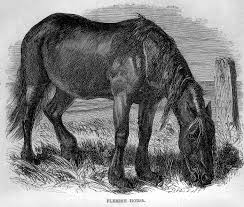
Her father-in-law, Old Oliver, was busy, too. After noting that“it was cloudy all day wind north east + snowd a little,” he went on to report the purchase of several animals.  “[W]e bought 12 pigs to day that weighd 2041 lb at 7 ½ cents a lb – paid 143=00 cents for them [and] we bought a black hors[e] to day of Mr Feild of North Bridgewater which he cald 5 years old for 125$ if he proves good we are to pay 25$ more for him”

A few days ago it was oxen, today it was pigs and a horse.  Old Oliver was filling the barn.


April 8, 1852

slide3_4


1852

April 8th Thursday  Fast day  Orinthia & Frank went to meeting

and at four oclock to a sing at the meeting house

hall.  Mr Ames has been to work all day the same

as usual  I have been very busy at work on

one thing and another have sewed on Susans

apron have it nearly done which makes the fifth

that I have made this spring

Evelina made note that today was a Fast Day, an annual event intended to be spent in fasting, prayer and supplication to the Almighty for a good growing season. The practice originated with the Puritans and evolved over time.  By 1852, it was a fading custom. Frank Morton Ames and Orinthia Foss went to church and to a “sing” afterwards, but both Evelina and Oakes Ames worked “as usual.” No one appeared to fast or spend the day in church.

A different long-standing custom of the country – slavery – needed to fade and disappear, yet hadn’t. It would only disappear with bloodshed, because the untenable social and cultural practice could not be resolved in a practical, orderly and non-violent way. War would be required, and soon.

On this day in 1852, a state court in Missouri decided against Dred Scott, a one-time slave who had sued his former owner’s estate for freedom. Scott and his wife, Harriet, had once been owned by the late Dr. John Emerson. The narrative of the case was complicated, but was based mainly on the Scotts having resided for a period of time in the free state of Illinois while working for the Emersons.  Scott believed that he and his wife should have been freed. But Dr. Emerson’s widow, Irene, kept the couple as her slaves, and wouldn’t even allow Scott to purchase his freedom. Scott sued and won in a lower court, but lost his case in the Supreme Court of Missouri.*

Scott and his lawyer appealed the case, which would go on to the U.S. Supreme Court in 1857. In one of the Court’s most infamous decisions, Chief Justice Roger B. Tanney, a Jacksonian Democrat who believed in states’ rights and a slaveholder who had manumitted his own slaves, would nonetheless declare that the Negro had no rights. An “originalist” group, Tanney’s court determined that the Constitution as originally written had made no provision for the citizenship of Negroes. For Tanney, slavery was an issue to be decided at the state level.

The Dred Scott case was one more irrevocable step in the path to civil war. The U. S. government essentially abdicated federal jurisdiction over slavery, which only accelerated the sectional divisions and conflicts. Bloody Kansas burst open, and within a decade, unprecedented conflict would convulse the nation.


*”Decision in a Slave Case,” article from the Washington National Intelligencer, April 8, 1852, courtesy of http://hd.housedivided.dickinson.edu/node/25809 


April 7, 1852

images-2

Five Dollar Gold Piece, 1850

1852

April 7th  Mother is 80 years old this day and notwithstanding

the snow banks have been down to see her and made

her a present of a five dollar gold piece.  She is

not very smart to day but is generaly very well and

capable for one of her years.  Orinthia Abby & Augusta

went with me and we have had a very pleasant visit

Augustus stoped the evening here  Helen came

home this afternoon with her father.

Evelina’s mother, Hannah Lothrop Gilmore, turned 80 years old. She was the grandmother of Oakes Angier, Oliver (3), Frank Morton and Susan Eveline Ames – among other grandchildren –  and first cousin-once-removed of Sarah Lothrop Ames. She was born in Bridgewater in 1772, the fifth child and only daughter of Daniel and Hannah (Howard) Lothrop.  Her mother died soon after she was born and her father remarried two times more and had six additional children.

In 1789, at age 17, Hannah married Joshua Gilmore of Easton. They had a large family, too, producing eight children, of whom Evelina was seventh. By this 80th birthday in 1852, Hannah was a widow with only three offspring still alive. As we have seen, she lived on a farm with a son, Alson Gilmore, but often visited her daughter, Evelina.

Beyond these genealogical facts, little is known of the life of Hannah Lothrop Gilmore. When she was barely twenty, however, and already a mother of her first baby, John, she walked on a trail one day with her husband in an area of Easton known at the Great Cedar Swamp. Town historian William Chaffin recorded the tale:

“There was then no road through Cedar Swamp. Trees were however felled, and on these by hard work pedestrians at certain seasons could pick their way through from Easton to Raynham, or return.

“In 1792 […] Raynham had petitioned the Court of General Sessions for Bristol County to require Easton to build a road through the swamp to connect the two towns. The advantages of such a road were obvious. But Easton stood aghast at the prospect of incurring the expense of building a causeway such a distance and in such depths of mire.  The difficulty is illustrated by the fact that as Joshua Gilmore was going on the footpath through the swamp one day with his wife, carrying a little child in his arms, Mrs. Gilmore was speaking of the difficulty of the passage, and her husband replied that some day the child would ride through the swamp in a carriage; and the idea struck her as so essentially preposterous that she had a hearty laugh over it. However, the Court of Sessions did not, it would seem, share her skepticism, for it ordered Easton to construct the road.”*

The road, known then as the Turnpike Road or Street, was built, and Hannah Gilmore lived to ride it in a carriage.

*William L. Chaffin, History of Easton, Massachusetts, 1886, pp. 454-455

April 6, 1852

330px-Harriet_Beecher_Stowe_c1852

Harriet Beecher Stowe

(1811 – 1896)

1852

April 6th  Tuesday  We have had one of the driving

snow storms of the season  the snow is very

much banked.  We have been reading Uncle

Toms Cabin  Susan has read to us most of the

time  have been sewing & mending.  Orinthia hemmed

a black cravat for O Angier and sewed some

on Susans pink apron.  Have made a little needle

book for mother

Yesterday, Evelina and Orinthia had been in Evelina’s garden planting flowers. Today the two women sat indoors “sewing & mending” because the unstable spring weather had brought on “one of the driving snow storms of the season.” According to Old Oliver, the snow “was all in heaps and the wind blowing verry hard from northeast” *

Yet the women weren’t disconsolate. While they sewed, Evelina’s daughter Susan read aloud to them from Uncle Tom’s Cabin, a popular new novel. Originally published in serial form in the National Era, an abolitionist periodical out of Washington, D. C.,  the full book had just been published in Boston by John P. Jewett and was on its way to becoming the best selling work of fiction of the 19th century.

Written by Harriet Beecher Stowe, Uncle Tom’s Cabin, or a Tale of Life Among the Lowly tells the story of two Kentucky slaves, Tom and Eliza, who are forced to leave their home plantation and make their way in a hostile society, one sold south, the other escaping north. It was a tale that gripped readers north and south, within the country and abroad, and provoked various imitations, interpretations and theatrical iterations. It has never been out of print.

Mrs. Stowe was not only an author, mother of seven children and wife of a Biblical scholar and educator; she and her husband were also active abolitionists. For a number of years they had lived in Cincinnati, Ohio, an active depot for escaping slaves, where they were participants in the Underground Railroad and personally helped hide slaves on the run. When the Fugitive Slave Act was enacted in 1850, Mrs. Stowe was distraught. She wrote Uncle Tom’s Cabin in protest.

How might Evelina have liked Uncle Tom’s Cabin?  Very much, one suspects. Though hardly an active abolitionist, Evelina was sympathetic to the slaves. After the Civil War, she even tried to hire some freed black women to come work for her but, according to her grandson Winthrop Ames, the plan never worked out.

*Oliver Ames Journal, Stonehill College Archives, Arnold Tofias Collection