August 14, 1852

440px-Henry_Jacob_Bigelow_c1854


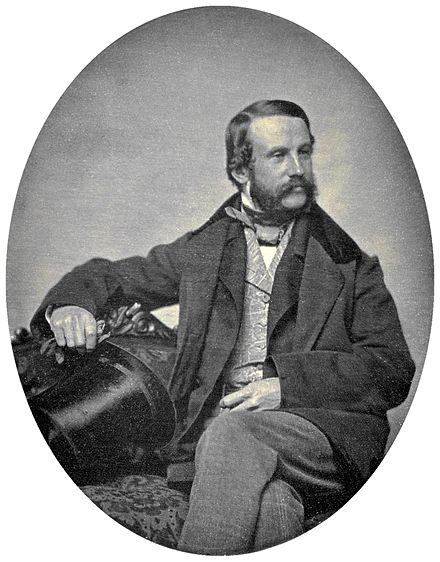
Dr. Henry Jacob Bigelow

(1818 – 1890)

Aug 14th

1852 Saturday  Oakes A went to see Dr Bigelow

He agrees with Dr Swan that the blood

comes from the lungs and that he must leave the

shop and be very quiet.  Returned from

Boston to night.  Mrs Stevens came here in

the Cars  Mrs Witherell A L Ames & Mrs

S Ames called

Oakes Angier saw a doctor in Boston today about his bad cough and bloody sputum.  He went to a Dr. Bigelow, who could have been either of two well-regarded medical men: Jacob Bigelow or his son, Henry Jacob Bigelow. The son, only a decade older than Oakes Angier himself, was a Harvard grad who was becoming famous for his role in introducing ether into the operating room. Without the modern diagnostic equipment to which we 21st century readers have become accustomed, Dr. Bigelow was nonetheless able to give an informed opinion about Oakes Angier’s pulmonary condition. If the doctor used the word “consumption,” Evelina didn’t write it down.

The illness was serious and Oakes Angier was ordered to ” leave the shop and be very quiet.” Rest and fresh air, in other words, were the treatment. If diagnostic ability was limited, treatments were even more so. Oakes Angier would have to go away and rest and hope for the best.

Back in Easton, the women of the family gathered in the sitting room or parlor to hear what the Boston physician had said, and perhaps to take a look at Evelina’s new bonnet. We can imagine that each member had a notion of what should happen next: where Oakes Angier should go, how he might travel, and what needed to be done to get him ready. In all likelihood, however, the decision on what to do would be decided by Oakes Angier’s father.
 

August 13, 1852

Chaise

Friday Aug 13th  Went to Boston with Oakes A and

Susan in Mr Whites Buggy chaise

Mrs S Ames went in the Cars. Met her at

12 Oclock at Mr Daniells  Ran around most

all day to get a bonnet  Mrs Norris went

with me in the afternoon and at last just

at night found one such as I wanted


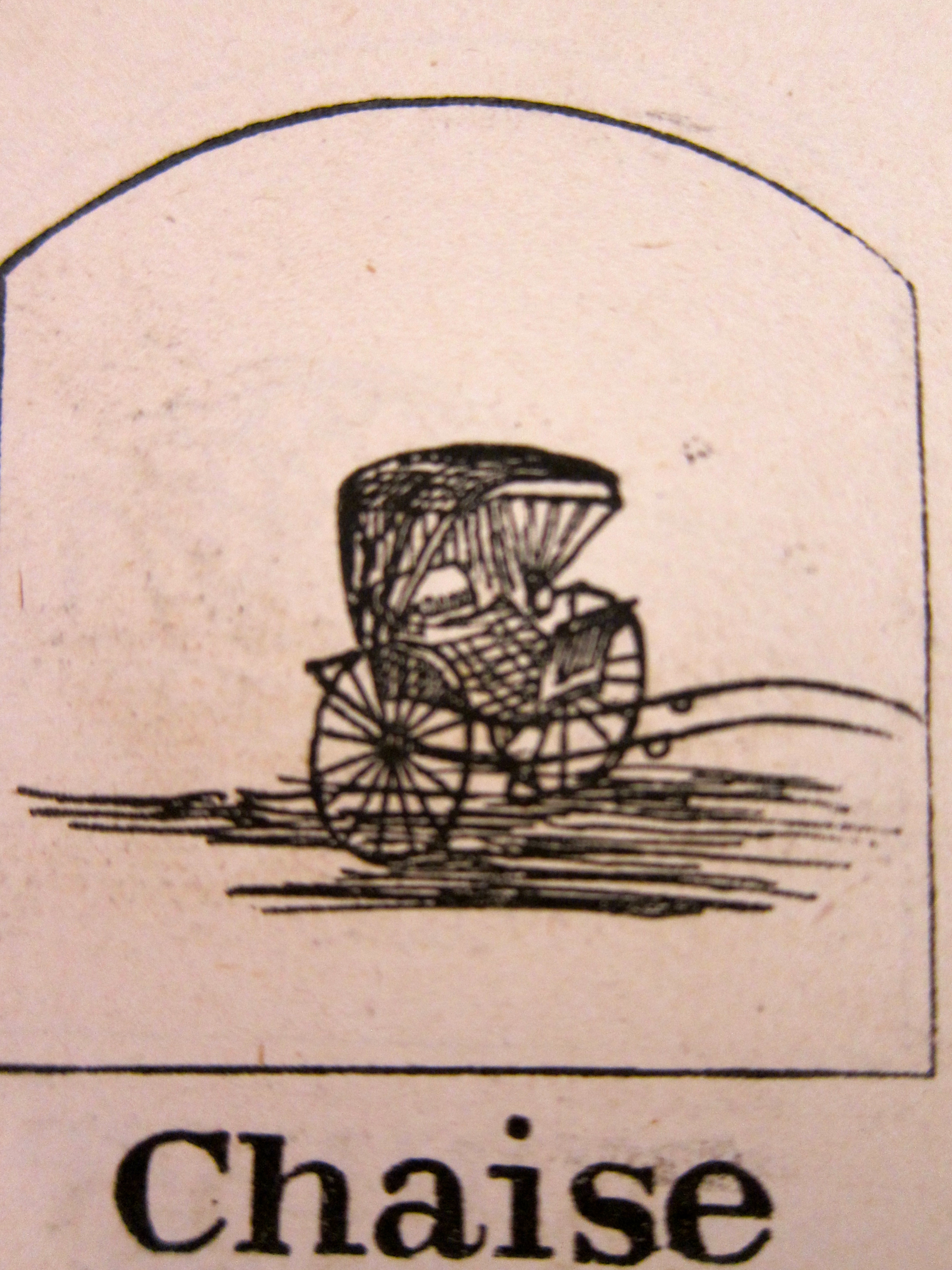
Evelina had a bonnet to buy in Boston; Oakes Angier had a medical appointment to make. So, sitting snugly in a chaise borrowed from Col. Guilford White, Evelina, Oakes Angier, and little Susie Ames rode into Boston. Most likely, Oakes Angier drove while the females sat beside him and examined the passing countryside. This trip would have been a big adventure for Susie, who didn’t move beyond Easton very often.

Sarah Lothrop Ames, meanwhile, took the train into town. The two women met up at noon at a familiar haunt, Mr. Daniell’s Dry Goods store on Washington Street. From there they “ran around most all day,” Evelina looking everywhere for the right bonnet – at the right price, no doubt. She secured one at the end of the day and presumably went to the home of Robert and Melinda Orr to spend the night, probably with Susan. Whether Oakes Angier joined her there isn’t recorded.

The Ames family didn’t own a chaise, evidently, though such two-wheeled vehicles were quite common. One hears of chaises, known colloquially as shays, being the definitive carriage for rural doctors and country parsons – men who had to move around frequently to see their patients and parishioners, respectively. In 1858, Oliver Wendell Holmes Sr. wrote a satirical poem about a well-built chaise entitled the “The Deacon’s Masterpiece or The Wonderful One-Hoss Shay” that was quite popular in its day.


August 12, 1852.

Sow Thursday Aug 12th  I have been very busy and have not

written in this book for a number of days and

have made a mistake  Yesterday it rained and

prevented our going to Boston and it was last

night that Oakes  A bled and prevented our

going to day  Mrs Dorr returned to Boston

this morning  I have been very busy fixing work

for Catharine

Evelina was rattled. She usually kept pretty good track of her days, but this week she was delinquent and confused. She jumbled her activities around. In all probability, she was upset about Oakes Angier’s illness. He had been coughing up blood for a couple of weeks, at least, and wasn’t getting any better. The worry and fatigue was getting to her.

Outside the sickroom, the day was pleasant. The wind was “southerly + pritty warm,” allowing Old Oliver’s crew of outdoor men to sow “grass seed + turnips on one half of the Peckham lott this day.”* Life of the farm and, presumably, at the factory were proceeding as normal. But it wouldn’t have felt normal to Evelina and others. Their lives were threatened by a sinister possibility.

Easton readers and local historians, where was the Peckham lot?

*Oliver Ames, Journal, Stonehill College Archives, Arnold Tofias Collection

August 11, 1852

Doctor

Aug 11 Wednesday  Was intending to go to Boston

with Oakes Angier to day but last night he had another

attack of bleeding  Dr Swan came and ordered

medicine every two hours  I waited upon him

and of course did not sleep much  He appeared

pretty well this morning and walked to the 

shop  Passed the afternoon with Mrs Dorr

and others at Father Ames

A scary night at the Ames home. Oakes Angier had “another attack of bleeding,” one that was bad enough to call out Dr. Swan. For several weeks now, the Ames’s eldest son had been hacking and periodically coughing up blood; in the night, he did it again. Yet by morning Oakes Angier had recovered enough to go to work, and his mother, Evelina, was obligated to move through her day on very little sleep. She spent most of the afternoon sitting down in the other part of the house.

Serious illness may attack one person, but it impacts everyone around that person. Oakes Angier, the eldest son, had a difficult physical challenge in front of him, but others, too, had to find an acceptable path through these dark nights and troubling possibilities. Evelina, the mother, certainly had a frightening prospect to deal with and, as primary care-giver, an exhausting role to play.

What might be the medicine that Dr. Swan ordered for Oakes Angier? Laudanum? Any thoughts, readers?


August 10, 1852

Ames_machine_shop_1857

Ames Machine Shop, built in1857


Aug 10th Tuesday Was sewing & puttering about one thing

and another untill about four Oclock

Mrs Witherell Mrs A L Ames & self spent the 

afternoon at Mrs Sheldons.  Mrs Johnson Swan

Williams, Howard and their brother Thomas were

there had a very pleasant visit.  On our return

found Mrs Dorr at Fathers and called to see her


“Sewing & puttering” filled Evelina’s hours up until near tea-time, at which point she, Sarah Ames Witherell, and Almira Ames went out to see some friends. They called on Sarah Sheldon, wife of the Congregational minister, where they saw several members of the Johnson family, including Louisa Johnson Swan, Nancy Johnson Howard, Ann Johnson and Thomas Johnson. It was “a very pleasant visit.”

Families often visited in groups, as we see in this entry and as we have seen from previous visits made by the Ames women. The Ameses went to see the Gilmores, or the Kinsleys, or the Howards, and vice versa. Families in the same town knew one another, or knew of one another, and had much in common. Whether or not everyone agreed about everything (which they didn’t – witness the old division between the Congregationalists and the Unitarians,) there was nonetheless a level of familiarity among long-established families in a given area.

Families worked in groups, too, most obviously on the numerous farms that still dominated the landscape. Yet as industrialization began to replace, or at least compete with, the agrarian lifestyle, members of the same family (at least those members who didn’t move away) often opted to work in the same trade. The Ames family is a prime example. Old Oliver developed an artisanal business that became a commercial factory. By the middle of the 19th century, artisanal businesses that were to thrive – such as the Ames Shovel Company – were becoming industrialized. Products were developed and produced, workers were hired and trained on the job, and the whole outfit was managed by members from one family. In Old Oliver’s case, he appointed certain sons and certain grandsons to take leadership roles.

Industrial historian Greg Galer has studied this work pattern. He writes, “kinship was a critical aspect of early industrial development. As manufacturers faced a growing national market in which to sell their products and acquire their raw materials they also found an increasingly unfamiliar body of people from whom they required trustworthy relationships. By using kin in some of these roles Ames eased the transition to these anonymous markets. Kin also played an important part in the management of the main shovel-making operation and affiliated enterprises located elsewhere…”

Family was everything.

*Oliver Ames, Journal, Stonehill College Archives, Arnold Tofias Collection

** Gregory Galer, Forging Ahead, MIT, 2001, p. 5


August 9, 1852

06_01_002623.LARGE

Map of Bristol County, Massachusetts, 1852*

1852

Aug 9th Monday  Part of the forenoon was working

about the house & cut out some work.

This afternoon started to go to Taunton

and got as far as brother Alsons when it rained

poringly and we were obliged to ride into

the barn untill it slacked a little so that we

could get into the house  Spent the afternoon 

there.  It was quite pleasant when we came 

home.  Mrs Witherell A L Ames & S Ames were with me


On the 1852 map of Bristol County, illustrated above, the town of Easton sits at the very top. Its eastern border abuts Plymouth County, which was the home of Bridgewater (today’s Brockton), West Bridgewater, and more. On Easton’s northern line sits Stoughton in Norfolk County. To its immediate south lies Raynham, home of many Gilmore cousins. We often read of Evelina traveling to these three vicinities – Bridgewater, Stoughton and Raynham –  to see family, friends, and vendors.

To the west of Easton lies Mansfield – where Oakes and Oliver (3) caught the stagecoach for Providence – and Norton. Further south, on a NNW/SSE axis, is the somewhat bow-tie-shaped town of Taunton. Taunton in the 19th century was known locally as “Silver City,” for its silver manufacturing, being the home of Reed & Barton, F. B. Rogers and others. We seldom hear of Evelina heading there, but for some reason, she and her sisters-in-law were traveling there this afternoon.

The ladies never got to Taunton, however, as an abrupt rain shower came down “poringly” while they were en route. “Good showers,”**too, according to Old Oliver, the kind of showers he’d been looking for most of the summer. When the rain commenced, the women drove their vehicle into Alson Gilmore’s barn and waited, then hurried into the house when “it slacked a little.” And there they sat, visiting with the Gilmores.

With the notable exception of Boston, to which Evelina traveled several times a year, this map pretty well represents the geographic scope of Evelina’s life to date. The northern portion of Bristol County and its abutting towns constituted her largest neighborhood, her network of friends and family, her travel pattern, her home. That was her world. It would soon get larger.


*Courtesy of the Norman B. Leventhal Map Center, Boston Public LIbrary

** Oliver Ames, Journal, Stonehill College Archives, Arnold Tofias Collection

August 8, 1852

51m0N6OXmoL

St. Mary’s Cathedral, Fall River, Massachusetts

Sunday

Aug 8th  Have been to meeting came home with

Mr Ames at noon, and returned again

Lavinia Williams came home to Joshuas with us […]

Lavinia returned home  Mr Whitwell preached

Since meeting have written a letter to Mrs

Louisa J Mower & Mrs S Stevens


As shovel-making led the industry of Easton in 1852, so textile manufacturing led the commerce of nearby Fall River. Surely, some of the cloth that Evelina cut and sewed came from the busy textile center that lay about 25 miles to her south.

Fall River is situated at the mouth of the Taunton River, the head of Mount Hope Bay, and (before the construction of the modern interstate put it underground) alongside the swiftly flowing Quequechan River, whose steep drop gave Fall River its name as well as the power to run the mills that lined its banks. Considered “the best tidewater privilege in southern New England,”* Fall River was an important industrial entity for much of the 1800’s. Bustling with bales of cotton and bolts of printed cloth, the city was accessed at mid-century by the Old Colony Railroad line and the Fall River Steamship Line, two entities that would soon merge.

The work force employed to support this industry consisted mostly of immigrants, initially Irish and, after the Civil War, Portuguese. They needed a place to live and a place to worship. The former was supplied by triple-decker tenements, the latter by a succession of churches. The Catholics quickly outgrew the first church built for them in 1840 and thus on this date in 1852, a cornerstone was laid for a new, major church for the congregation. By December, 1855, The Cathedral of St. Mary of the Assumption was duly consecrated and opened for worship. In 1983, St Mary’s was added to the National Register of Historic Places.

We might wonder if any Catholics or others from Easton ever visited St. Mary’s. We can be pretty sure that Evelina and her family never darkened its threshold. On this day, of course, they attended their own Unitarian Church and listened to their beloved Reverend Whitwell.


* “Fall River,” Wikipedia, accessed August 5, 2015

August 7, 1852

Wagon

Sat Aug 7th  Was sewing part of the forenoon made

some pies & cake  Went into Olivers about four,

Started to go to Augustus in a waggon and

got caught in a shower turned back at the

school house got completely wet  My sons & Mr Ames

were at tea at Olivers  Edwin & wife Lavinia & Abby

there Catharine & I have done some sewing this week

two nightgowns for self one for Susan & one cotton & 

moire skirt & c &c  Susans waists are finished


“[T]he 5, 6 + 7th were pritty warm day[s] + there was some rain,”* wrote Old Oliver in his journal. Evelina was out in that rain and “got completely wet.” Late afternoon showers are part and parcel of August weather in New England. The showers can come up quickly, too, so it’s small wonder that folks moving around the countryside in horse-drawn wagons could get caught in the rain.

While Evelina was getting soaked, her husband Oakes and sons Oakes Angier, Oliver (3) and Frank Morton Ames had tea next door with the Oliver Ames Jr family. How was Oakes Angier feeling, now that he was coughing so much? Perhaps he and his brothers got to hear their cousin Helen play piano again, or perhaps they just ate and conversed. Various Gilmore relatives, including Edwin and Augusta Gilmore, Lavinia Gilmore and Abby Torrey were there as well.  As previously noted, Lavinia and Helen were particularly friendly.

And speaking of friends, fans of Sherlock Holmes might enjoy knowing that August 7, 1852 is the purported birthdate of the fictional Holmes’ steady, tolerant and equally fictional sidekick, Dr. John Watson.

*Oliver Ames, Journal, Stonehill College Archives, Arnold Tofias Collection


August 6, 1852

sarudy4-R14-E422

Friday Aug 6th

1852 Sewed but very little this forenoon picked

some peas currants &c  Lavinia came to 

dinner  Edwin & wife to tea  Lavinia & I

called to Augustus’ to see their babe who 

is quite sick with the disentary  He looked

quite bright  Mrs Witherell & A L Ames

called a few moments

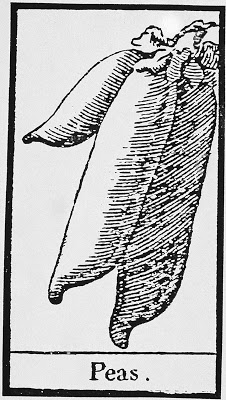
There were fresh peas at the Ames dinner table today.  We readers might not have enjoyed them, however, as the recipes of the time called for cooking peas – and other vegetables – much longer than our modern preferences allow. Domestic doyenne and editor of Godey’s Lady’s Book, Sarah Josepha Hale, declared that peas are “a most delicious vegetable,” but cautioned that “[i]t takes from half an hour to an hour to boil them.”* That seems overcooked to us, but, nevertheless, the Ames’s peas were fresh, untarnished by pesticides, and indisputably local.

With her niece Lavinia Gilmore, Evelina went to visit her nephew (and Lavinia’s half-brother) Alson Augustus Gilmore, who had lately been ill. He was now well, but his one-year old son, Willie, had become “quite sick” with dysentery. Had the child caught something from his father? Or was he suffering a condition not uncommon in children in the heat of the summer?  His bright red face suggests fever and dehydration. Augustus and his wife, Hannah, would have been worried about the little boy.

*Sarah Josepha Hale, The Good Housekeeper, 1841, p. 75


August 5, 1852

Rein

1852

Thursday Aug 5th  Have had a rainy day which was

very much needed.  Was intending to go to

Boston with Oakes A in a carriage  Am most

affraid to have him drive Caty as he has been

raising blood of late and has a hacking cough

Lavinia is at Edwins has had Julia

cut her a dress to day  I went there and 

carried my work awhile this afternoon 

Put a new breadth into Susans Borage Delaine

where she tore it

Caty (or Katy), one of the Ames’s horses, was famous in Easton for her willful – and fast-paced – ways. Evelina has complained about her in previous diary entries. Today, however, Evelina had another reason entirely to be “most affraid” to let her son, Oakes Angier, drive the horse. Oakes Angier Ames was coughing up blood.

In an age when consumption, which we know as tuberculosis, was rampant and usually fatal, any person “raising” bloody sputum was immediately suspected of having the disease. TB wasn’t restricted to the lungs, actually; it could attack other parts of the body, such as the spine, but its most common manifestation was pulmonary. Blood coughed into a handkerchief was bad news.

How frightening this development must have been for Oakes Angier, and indeed for the entire Ames family.  Oakes Angier was the eldest grandson, the heir, the star cousin and nephew in whom many expectations were placed. He was beloved, and suddenly he was evincing signs of a potentially fatal illness. Old Oliver makes no mention of this in his journal, however, and Evelina herself had taken a few days to record the news. She may not have wanted to see such words in writing. We may suspect that Oakes Ames knew about his son’s condition earlier, but we can’t know for certain, of course. We can only follow the family as it copes with this huge development.

On this day, Evelina seemed to cope as she always did, by sewing. She took her work across the way to visit Augusta Pool Gilmore, the young bride who was now in the family way. Dressmaker Julia Mahoney was there, as was Lavinia Gilmore, so the women were able to sit and sew and talk in their usual fashion. The touch of normalcy must have been somewhat soothing for Evelina.