July 27, 1852


Asleep

Tuesday July 27th  Mrs Savage had quite a

comfortable night & I came home a

little before 5 Oclock & went to bed

did not rise untill nearly nine

Elizabeth Pool & Augusta came

in this forenoon with their work

Mrs Whitwell Reed Howard & Miss

Jarvis called on us all & Alsons wife

was here to tea & Mother at Augustus’

Evelina’s all-nighter at the bedside of Mrs. Savage didn’t seem to impinge on her day.  After a catch-up sleep in the early morning, she was back on her feet.  Augusta Gilmore and her young sister Elizabeth came over “with their work,” meaning that they brought some sewing with them, and the women sat, sewed, and visited. Later in the day, several ladies from her Unitarian circle of friends “called on us”.  Her brother Alson’s wife, Henrietta Williams Gilmore, came by for tea. A most sociable day, it was.

In the other part of the house, “Horatio Ames Jun r came here to day.”* Horatio was, obviously, the eldest son of Horatio Ames, who was the brother of Oakes, Oliver Jr., Sarah Witherell, Harriet Mitchell and William Leonard Ames. Repeating previous posts, Horatio ran a forge in Connecticut, far from the shovel shop in Easton, but still connected to it financially and emotionally. He and his son were not on friendly terms, and it’s hard to determine just what had brought Horatio Jr to Easton.  He arrived in the evening and for some reason Evelina didn’t mention it in her diary.


*Oliver Ames, Journal, Stonehill College Archives, Arnold Tofias Collection


July 15, 1852

imgres-1

1852

Thursday July 15  Mary had to pick out all the work

she did while I was at Canton and it has

taken her a long while  I shall not get much

of my sewing done by her Im thinking.  I have been

to work on my borage and there is a great 

deal to do with it   Have spent the afternoon 

at Fathers with Olivers family and mine

at tea

Sarah Ames Witherell, two months bereft of her eldest son, was entertaining again, if only for the family. She and her father, Old Oliver, had everyone in for tea. This must have been a good sign for the entire clan, as they could only have wished to see Sarah able to pick up her life again.

Evelina was dissatisfied with sewing done by her servant, Mary, and had her take out every stitch from a piece she had been working on in Evelina’s absence. No servant yet had been able to meet Evelina’s standard for needlework. She was too good at it, and seemed frustrated that she couldn’t rely on anyone else to accomplish what she herself was able to do. And she was doubly frustrated to find herself paying for a sequence of poor work being done, then undone, then redone. Not good for a Yankee. She would have to lower her standards, find someone who could do the work, or do it herself.


July 9, 1852

201000506-lemonpie-500

July 9th Friday  This day I was in hopes to pass quietly

and sew but quite early Mr Jessop & Linds 

from Sheffield and Fullerton from Boston came

and were here to dinner & tea and so

I had to go to cooking instead of sewing  Made

some Lemon & custard pies &c  It has been

excessively warm and the flies have come

in swarms  Frank went to carry the gentleman to

S Bridgewater


“[T]he thermometer was up to 96,”* recorded Old Oliver Ames in his daily journal.  “[E]xcessively warm,” indeed.  It was certainly disagreeable for Evelina to be in the kitchen baking pies on such a day, wearing an apron and a long-sleeved, full-length dress over a chemise and petticoat. Hot.

Many 19th century cookbooks carry recipes for lemon custard, lemon pie, and the like, indicating that lemons were a familiar and reliable ingredient, either imported like coffee, tea and sugar or shipped north from the southern-most states. The Shakers of Ohio, in fact, had a famous recipe for lemon pie that was more or less a tart marmalade within a crust. Evelina probably followed a recipe that was more like lemon custard inside a crust, such as the one suggested by Sarah Josepha Hale:

Boil in water, in a closely covered sauce-pan, two large lemons till quite tender; take out the seeds, and pound the lemon to a paste; add a quarter of a pound of pounded loaf sugar, the same of fresh butter heated to a cream, and three well-beaten eggs; mix all together and bake it in a tin lined with puff paste; take it out, strew over the top grated loaf sugar.*

We can imagine that the pies met the approval of the gentlemen from Sheffield and Boston who came to dinner and tea.

*Oliver Ames, Journal, Stonehill College Archives, Arnold Tofias Collection

**Sarah Josepha Hale, The Good Housekeeper, 1841, p.80

July 8, 1852


IMG_7790

1852

July 8th Thursday  This forenoon cut out a night dress

from Mrs Ames pattern and was busy in my 

chamber made some cake & ginger snaps and 

baked them in Mrs Witherells oven  This

afternoon Mrs Witherell S Ames & A Ames were

here & Helen & Emily  The gentlemen came to 

tea  Mrs Augustus Gilmore passed the evening

This was a hot day for baking, but Evelina nonetheless made “cake & ginger snaps” in her sister-in-law’s brick oven. No doubt she served some of the goodies later in the day when the Ames clan gathered for tea. There didn’t seem to be any special occasion for the tea, except that a cousin, Almira Ames, was visiting. Rather, it was perhaps Evelina’s turn to entertain the family. As Evelina’s grandson, Winthrop Ames, later pointed out, “[e]very week at least, and usually oftener, one household would invite the others and their visitors to tea; and the whole Ames family might assemble…”*

Ginger snaps were pretty standard fare at such occasions. Evelina baked them regularly. In recipes from that time, they’re often referred to as hard gingerbread. Sarah Josepha Hale includes a “receipt” for them in The Good Housekeeper from 1841:

Rub a half a pound of butter into a pound of flour; then rub in half a pound of sugar, two table-spoonfuls of ginger, and a spoonful of rose water; work it well; roll out, and bake in flat pans in a moderate oven. It will take about half an hour to bake. This gingerbread will keep good some time.**


Winthrop Ames, The Ames Family of Easton, Massachusetts, 1937, p. 128

**  Sarah Josepha Hale, The Good Housekeeper, 1841, p, 99


May 19, 1852

a57b960ef05c59d007f70efe1b8f5f79


Wednesday 19th May  Washed the windows in the 

parlour and cleaned it   all that is necessary this spring

Was about house until about four Oclock

when Mrs Swain came and spent the 

afternoon  Mr Swain came to tea  Worked

on the garden about an hour  Susan has

the nose bleed almost every day.  This afternoon

came home before the school was done


Spring cleaning was late this year, as the women’s attention had been given over to family illness. The kitchen had been repainted some weeks earlier, but other rooms hadn’t been dealt with. Evelina set out to rectify the delay and, probably with support from Jane McHanna, donned her apron to tackle the best room in the house, the parlor, much of which had been redecorated back in February, so needed little attention beyond its windows and a basic cleaning.

One imagines Evelina and Jane in working clothes as they went about with their brushes, rags and mops. But what did Evelina wear under her apron, or after she changed out of her choring dress? Was she wearing any mourning attire? Did her outfit signify at all the recent loss of her nephew George?

In the 19th century, “[m]ourning was particularly a woman’s affair,”* perhaps because of a societal norm that women were sentimental and emotional, and men were not. There were rules about attire to be followed after the loss of a loved one. At the beginning, black crepe dresses, black veils or headgear, and even black jewelry – onyx, usually, or pins netted with a lock of hair of the departed – were expected to be displayed in some manner. After a certain period, black was put away and lavender, grey or purple dresses were acceptable. The closer the relative was to the deceased, the more exacting the expectation.

In her fine book about death in the Civil War, This Republic of Suffering, Drew Gilpin Faust notes:

“By convention, a mother mourned for a child for a year, a child for a parent the same, a sister six months for a brother. A widow mourned for two and a half years, moving through proscribed stages and accoutrements of heavy, full, and half mourning, with gradually loosening requirements of dress and deportment. A widower, by contrast, was expected to mourn only for three months, simply by displaying black crape on his hat or armband.”**

By these calculations, Sarah Ames Witherell had been dressed in black or lavender too often before. Her husband had died in August, 1848, her young son Channing in May, 1849 and now her son George. Sad to say, she would have had a black dress or two, plus the appropriate accessories, in her cupboard. But what was Evelina obliged to wear? Perhaps not a black dress – although she had one – but an armband? Or a black ribbon in her bonnet? What was the expectation for an aunt?


Jack Larkin, The Reshaping of Everyday Life, New York, 1988, p. 102

**Drew Gilpin Faust, This Republic of Suffering, New York, 2008, p. 147


May 6, 1852

images-1

Queen of the Prairie

1852 May

Thursday 6th Worked in the garden a short time and

about nine went to the shovel shops with Hannah

and her sister  They spent the afternoon here and

Augusta.  Edwin came to tea  Mr Brown,

Olivers room mate, came to night.  We ladies rode

to Mr Clapps, bought Queen of the Prairie for 37 cts

Warm sunshine sent Evelina outdoors for much of the day. She gardened after breakfast, then broke away at nine a.m. to go over to the shovel shops with her niece, Hannah Lincoln Gilmore, and Hannah’s sister, Sarah Lincoln. What were the ladies doing at the factory? Evelina wouldn’t have gone there on her own volition.

The Lincoln sisters, originally from Hingham, spent much of the day with Evelina.  They were joined by Augusta Pool Gilmore, whose husband Edwin Williams Gilmore later came to tea. “We ladies” traveled to the home of Lucius Clapp, another fine gardener with plants to sell, where Evelina purchased a Filipendula rubra, or Queen of the Prairie. Clapp was a well-respected citizen of Stoughton, described by a contemporary historian as “one of the representative farmers of this progressive age.” *

Oliver (3), meanwhile, was briefly home from Brown University.  His roommate, a Mr. Brown, came to North Easton for a visit. It was a full table at tea time.

D. Hamilton Hurd, History of Norfolk County, Massachusetts, pp. 424-425


May 1, 1852

Wreath

1852

Sat May 1st  The children were hoping to have a fine

time maying this morning had their wreaths

all made but it rained which prevented

their taking a walk but they had a nice time

in the old tool house. I dined in Edwins

John came there last night  Lavinia & Helen

here.  They were all here to tea to night

S E Williams called at Olivers  I gave her some plants


Rain spoiled the annual outing that Susan, Emily and other children had planned for May Day. They had made special wreaths for the occasion, probably to deliver to the homes of friends. To get out of the weather and save the pleasure of the day, they gathered instead in the “old tool house,” which seemed to make for an agreeable substitute.  Readers from the Easton area, does anyone know the probable whereabouts of this building?

Rain may have spoiled the children’s walk, but it helped soften the ground in the garden.  Old Oliver reported that today the garden was “spaded up and manured.”  He was most likely describing the family vegetable and herb garden, as opposed to Evelina’s flower beds, which were already under cultivation and probably out of Old Oliver’s immediate purview as well as beneath his notice.

Evelina, meanwhile, had her midday meal at Edwin’s and Augusta’s house, seemingly while the rest of the family ate at home. She went over to visit their mutual relative, her brother John Gilmore, who rarely came to town.


April 30, 1852

135555850

1852

Friday April 30th  Worked in the garden awhile this

morning  Mr Scott has grained the cook

room  Rachel dined here & was intending to 

spend the day but Mrs Packard came to Edwins

and she went back there  Mrs Lincoln

passed the afternoon & Augustus to tea  Abby

spent the day, was away awhile with Mrs

Clapp after some flowers.  Hannah gone to Boston


The last day of the month was “a fair day + the warmest we have had this spring …,”* according to Old Oliver Ames, who also noted that he “killed 4 shoats to day.”

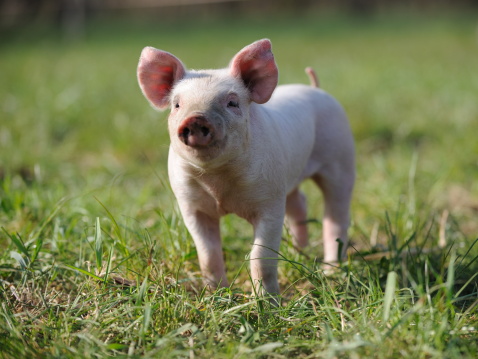
A shoat is a newly weaned pig that typically  weighs in at about thirty pounds. It wasn’t unusual to find a farmer thinning a litter of pigs (also known as a drift of pigs) at this time of year, for different reasons. Many farmers bought shoats at this time of year to fatten up over the summer and slaughter in the fall. For reasons known only to himself, Old Oliver chose to slaughter four of his young pigs rather than sell them. Perhaps the shoats in question were unpromising specimens, or perhaps the Ames family was ready for a little fresh pork.

In the first part of the 19th century, the word “shoat” was also used as a pejorative slang term, intended to describe someone as fairly useless. To call someone a shoat was to say that he or she was dispensable and unimportant.

*Oliver Ames, Journal, Stonehill College Archives, Arnold Tofias Collection

March 23, 1852

SurvChain

 Gunter’s Chain**

March 23

1852 Tuesday. Alson and wife dined here and spent

the afternoon at Edwins  He has been running

out lines for Edwin & Melvin Randall  Orinthia

went home with them.  Was at tea in Edwins

& this evening with Augusta at Augustus’

Augustus has gone to New York.  Susan is staying

there to night went just after dinner.  Oliver & wife

went to Boston this morning   Rained untill early night.

The Gilmore clan was moving around today. Evelina’s nephew, Alson “Augustus” Gilmore, was headed for New York City on business for his boot company or the Ames shovels, or both. Evelina’s brother (and Augustus’s father), Alson Gilmore, and his wife, Henrietta Williams Gilmore, had midday dinner at the Ames house. Alson was in the village helping another son, Edwin Williams Gilmore, and an Easton man, Melvin Randall, run out lines.

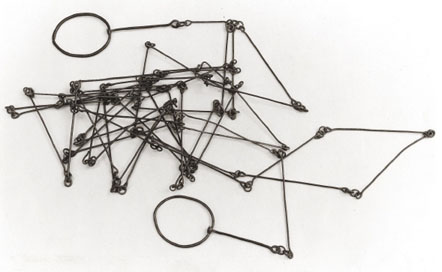
The phrase “running out lines” is open to interpretation (ice fishing is a possibility!), but the most likely meaning is that ground was being measured, perhaps for the new factory buildings soon to be built. A running measure is the cumulative distance in a straight line from a fixed point. The standard instrument used to get a running measure, at least in the 18th and 19th centuries, was a Gunter’s chain. It was used in conjunction with a compass and a transit (for establishing straight lines) to measure ground.

Invented by an English clergyman and mathematician, Edmund Gunter, around 1620, the Gunter’s chain “played a primary role in mapping out America.”** The Army Corps of Engineers would have owned such chains in bulk. The chain’s 100 lines measure 4 poles, or 66 feet, or 22 yards, depending on how you care to count it. Eighty chains equal one mile.

The Gunter’s chain, however, helpful as it was, was apt to be hand-made and thus subject to variation. It was eventually replaced by the more accurate surveyor’s tape.

By the way, for those readers who follow the game (or watch Downton Abbey), the length of a cricket pitch is exactly one chain.

*Thank you, Frank Mennino, for your assistance on today’s blog.

**Image from Colonial Williamsburg, courtesy of http://www.history.org

February 27, 1852

Tea kettle


Feb 27

1852  Friday  this morning I invited Mrs Lothrop here

but she went to Mrs Jason Howards to spend the day

came here this evening  Mrs S Ames & Fred dined

here  Mrs & Mr Horace Pool  Mrs W Williams  Abby

Edwin & wife Oliver & wife & Fred & Mrs Witherell

were here to tea  All came unexpectedly.  Had 

a very pleasant visit from them.

Many folks came to call today.  Sarah Ames Lothrop and her son, Frederick Lothrop Ames, joined the Ameses for midday dinner. (Although Oliver (3) had returned to Brown, Fred hadn’t yet gone back to Harvard.) A real crowd arrived “unexpectedly” for tea.  Sarah and Fred returned, bringing Oliver Ames Jr. with them. Sarah Ames Witherell came in from the other part of the house, resulting in all three sisters-in-law being together. Newlyweds Edwin and Augusta Gilmore walked over from their nearby home, and old Mrs. Gilmore – Evelina’s mother – was already on the premises. The family gathered.

From farther away came Horace and Abby Avery Pool, uncle and aunt to the bride, Augusta.  A Mrs. W. Williams arrived, as did Abby Torrey, Evelina’s niece. Abby’s head must have been full of the previous evening’s entertainment, that of Willard Lothrop’s visit and trance. It’s likely that some of this evening’s conversation turned on spiritualism.  One wonders what Oakes and Oliver Jr. thought of the topic.

Perhaps Evelina served some ginger snaps or currant cake from Tuesday’s baking. The tea itself could have been one of any number of types. Lydia Maria Child published her opinion on the subject: “Young Hyson is supposed to be a more profitable tea than Hysons; but though the quantity to a pound is greater, it has not so much strength. In point of economy, therefore, there is not much difference between them. Hyson tea and Souchong mixed together, half and half, is a pleasant beverage, and is more healthy than green tea alone.  Be sure that water boils before it is poured upon tea  A tea-spoonful to each person, and one extra thrown in, is a good rule.  Steep ten or fifteen minutes.”*

*Lydia Maria Child, The American Frugal Housewife, 1846