April 21, 1852

01-01_full

Examples of 19th c. lunch pails*

1852

Wednesday April 21st  It still continues to rain through not as

hard as yesterday  Have been to work on

Susans dresses altering them  Went with

Mrs S Ames to the store  Susan has carried

her dinner to school three days and thinks

it something nice  Swept my chamber and put

it in order

The heavy rain of the past two days wasn’t giving up easily. Old Oliver wrote that “it raind considerable last night + the wind blew hard and it is cloudy + rainy this morning + the water is verry high.”**

Despite the weather, the Ames women continued many of their usual routines: sewing, of course, and housework, but errands, too. Evelina and her sister-in-law Sarah Lothrop Ames went to the company store in the village. Little Susie Ames went to school, as she had even during the worst part of the storm. Instead of coming home for dinner in the middle of those rainy days, however, she carried her meal to school and ate there.  No school cafeteria or hot lunch program in those days! She thought it “something nice” to stay at school for the midday meal.

Courtesy of the National Museum of American History, Smithsonian

** Oliver Ames, Journal, Stonehill College Archives, Arnold Tofias Collection
April 17, 1852

Village

1852

April 17  Saturday  Julia was at work here a year ago to day

has improved very much in dress making since then

I have my black silk nearly finished.  The Delaine

all done except the sleeves & buttons, am waiting

to go to Boston to get the trimmings.  This afternoon 

have been altering some old dresses for Susan

Hannah called to get me to go up by the school

house and select a place for a house for them

Mrs Witherell went with me  A beautiful pleasant day

Sewing continued today, with Julia Mahoney again on hand to assist with Evelina’s new dresses, one of black silk, the other of a light wool they called delaine. The finished projects would have to wait for trimmings to be fetched from Boston. Evelina meanwhile refashioned some old dresses for her daughter, for “[e]very season there was a great remaking of old garments to bring them up to date.”*

The bad weather of the past two days disappeared and was replaced by fair skies. Despite continued cold temperatures, Evelina was finally drawn outside on a fun errand. Invited by her niece, Hannah Lincoln Gilmore, and accompanied by her sister-in-law, Sarah Ames Witherell, she went to the local school house to look at some property that her nephew, Alson Augustus Gilmore, and Hannah, his wife, were considering.  They had been renting rooms from Col. John Torrey, but now were planning to build a house.

Everyone in North Easton lately seemed to be wielding a hammer. It was spring.


*Winthrop Ames, The Ames Family of Easton, Massachusetts, p. 127


April 16, 1852

 women sewing*

1852

April 16th Friday.  Julia here again to day and we have

been to work on my dresses  Mrs S Ames & Witherell

helped some time this afternoon and we have

got along nicely  Hannah & Augusta called

Augusta brought her work and Hannah finished

Susans stocking.  Susan has the other stocking about

half done.  The first pair that she ever attempted to knit.

Stormy again to day.

The day before had rained “pritty fast” all day long, and today opened in much the same vein, with “snow squals + rain + a high wind.”***  The women stayed indoors and focused on fashion.  Dressmaker Julia Mahoney came over to work on new outfits for Evelina. Sisters-in-law Sarah Ames and Sarah Witherell helped for a time, too, both of them as accomplished at sewing as Evelina. They all “got along nicely,” a phrase that suggests good progress was made on Evelina’s dresses, although the women’s sociability quotient was also probably pretty high.

Others joined the hum.  Nieces-in-law Hannah Gilmore and Augusta Gilmore, a younger set of eyes and hands, arrived with work in hand. Hannah helped her little cousin, Susie Ames, knit a pair of stockings.

The sewing of new dresses – as opposed, say, to the mending of men’s shirt fronts – was the favorite expression of the women’s collective talent with needle and thread. As Winthrop Ames noted, “An immense amount of sewing went on in every family.”** We’ve certainly learned that from Evelina’s diary.  In 1852, they still made their own dresses. “[T]he materials and trimmings, after much consultation about their style and quality, were made up in the house with the help of the town seamstress and pictures from the fashion magazines.”

Things would change. By the start of the Civil War, the Ames women began to have their dresses made up in Boston. But on this day in North Easton, needles flew.


*Image courtesy of nhdsewingmachine.weebly.com

** Winthrop Ames, The Ames Family of Easton, Massachusetts, p.126

*** Oliver Ames, Journal, Stonehill College Archives, Arnold Tofias Collection


April 13, 1852

Ill

1852

Tuesday April 13th  Watched with Mrs Brett last night

She is quite low seemed to like my being there and

urged my coming to see her often and said she meant

to come to see me and be more friendly if she ever

gets well  said her Mother told her in her last hours

to come to me for advice and regretted that she

had not done so but meant to in future  The rain of 

the morning has turned into a heavy snowstorm  Susan & self

carried our work and stopt a couple of hours with Mrs W

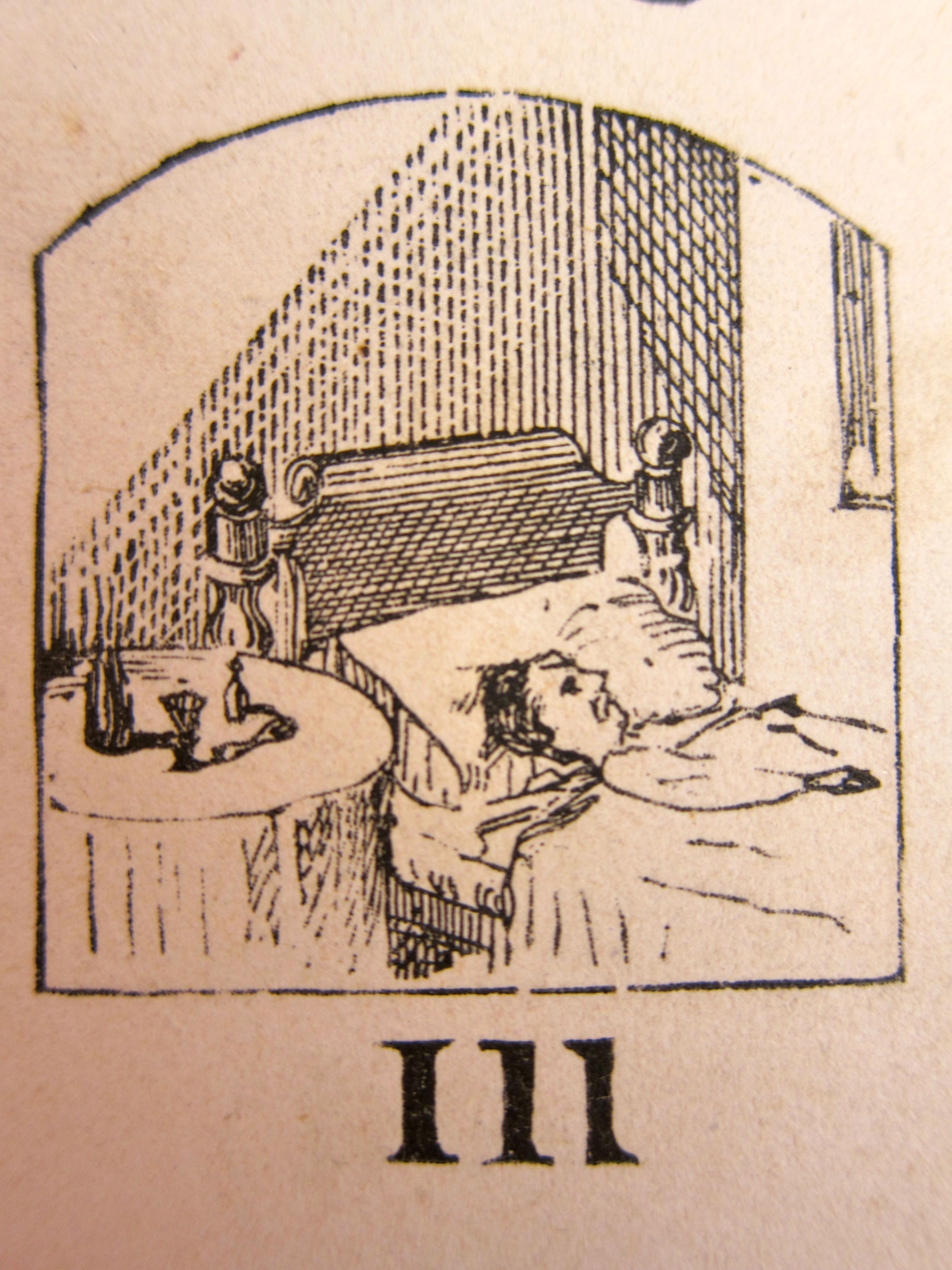
A young neighborhood wife named Eveline Brett was ill, probably with childbed fever. Evelina went to stay with her during the night, taking her turn with family members and other neighbors to watch, suggesting that some must have thought that the new mother wouldn’t survive.

Modern historian Jack Larkin has described this neighborly service as “one of the commonest of rituals.”* In towns across New England, when someone was seriously ill, or “dangerously sick,” as Evelina noted a few days ago, “neighbors took turns staying through the night at the sick bed to allow exhausted family members to sleep. Watchers could administer medicine when needed, but, far more important, they provided a continuous comforting presence – as well as witnesses who could quickly gather the family around if death seemed imminent.” *

Evelina’s personal experience on this occasion was especially rewarding. The young mother confided that Evelina’s presence was truly comforting and that if she recovered, she hoped she could go to Evelina for advice. Happily, Eveline Brett would indeed survive her illness and, in the future, bring her baby by to visit the understanding woman who had given her such comfort.


*Jack Larkin, The Reshaping of Everyday Life, New York, 1988, p. 93

April 12, 1852

$_35

Tin Dipper

Monday April 12th  have been making sausages.  Tried

lard salted pork &c &c  Went to the store and bought

large tins mixing pan two small and one larger pan and 

tin dipper.  Susan washed the dishes  She does not like

to work very well, though she improves some

I had 38 lbs sausage meat seasoned them with 3/4 lbs salt

4 1/2 oz sage & savory 3 1/2 oz pepper  Am going to

watch with Mrs Brett tonight.  Not very pleasant

Evelina gave us one of her own recipes today, for sausage seasoned with salt, sage, savory and pepper.  She “tried the lard,” too, meaning that she boiled it down somewhat. And she probably used some of her new cookware in the process, while young Susie Ames helped grudgingly with the dishes.

As usual, Evelina cooked on a grand scale, inviting speculation as to just how much food her family ate. With a husband, three grown sons and a still-growing little girl all at the dinner table, we can imagine that 38 pounds of sausage didn’t last long. A month, maybe?

Old Oliver, meanwhile, was in forward gear.  After noting the “cool” and “chilly” temperature, he seemed please to write that “we were a digging a cellar to day for a cariage hous –“  Perhaps the planning for the new stone shops had inspired him to add another building – a carriage house – to the list of new constructions.

April 8, 1852

slide3_4


1852

April 8th Thursday  Fast day  Orinthia & Frank went to meeting

and at four oclock to a sing at the meeting house

hall.  Mr Ames has been to work all day the same

as usual  I have been very busy at work on

one thing and another have sewed on Susans

apron have it nearly done which makes the fifth

that I have made this spring

Evelina made note that today was a Fast Day, an annual event intended to be spent in fasting, prayer and supplication to the Almighty for a good growing season. The practice originated with the Puritans and evolved over time.  By 1852, it was a fading custom. Frank Morton Ames and Orinthia Foss went to church and to a “sing” afterwards, but both Evelina and Oakes Ames worked “as usual.” No one appeared to fast or spend the day in church.

A different long-standing custom of the country – slavery – needed to fade and disappear, yet hadn’t. It would only disappear with bloodshed, because the untenable social and cultural practice could not be resolved in a practical, orderly and non-violent way. War would be required, and soon.

On this day in 1852, a state court in Missouri decided against Dred Scott, a one-time slave who had sued his former owner’s estate for freedom. Scott and his wife, Harriet, had once been owned by the late Dr. John Emerson. The narrative of the case was complicated, but was based mainly on the Scotts having resided for a period of time in the free state of Illinois while working for the Emersons.  Scott believed that he and his wife should have been freed. But Dr. Emerson’s widow, Irene, kept the couple as her slaves, and wouldn’t even allow Scott to purchase his freedom. Scott sued and won in a lower court, but lost his case in the Supreme Court of Missouri.*

Scott and his lawyer appealed the case, which would go on to the U.S. Supreme Court in 1857. In one of the Court’s most infamous decisions, Chief Justice Roger B. Tanney, a Jacksonian Democrat who believed in states’ rights and a slaveholder who had manumitted his own slaves, would nonetheless declare that the Negro had no rights. An “originalist” group, Tanney’s court determined that the Constitution as originally written had made no provision for the citizenship of Negroes. For Tanney, slavery was an issue to be decided at the state level.

The Dred Scott case was one more irrevocable step in the path to civil war. The U. S. government essentially abdicated federal jurisdiction over slavery, which only accelerated the sectional divisions and conflicts. Bloody Kansas burst open, and within a decade, unprecedented conflict would convulse the nation.


*”Decision in a Slave Case,” article from the Washington National Intelligencer, April 8, 1852, courtesy of http://hd.housedivided.dickinson.edu/node/25809 


April 6, 1852

330px-Harriet_Beecher_Stowe_c1852

Harriet Beecher Stowe

(1811 – 1896)

1852

April 6th  Tuesday  We have had one of the driving

snow storms of the season  the snow is very

much banked.  We have been reading Uncle

Toms Cabin  Susan has read to us most of the

time  have been sewing & mending.  Orinthia hemmed

a black cravat for O Angier and sewed some

on Susans pink apron.  Have made a little needle

book for mother

Yesterday, Evelina and Orinthia had been in Evelina’s garden planting flowers. Today the two women sat indoors “sewing & mending” because the unstable spring weather had brought on “one of the driving snow storms of the season.” According to Old Oliver, the snow “was all in heaps and the wind blowing verry hard from northeast” *

Yet the women weren’t disconsolate. While they sewed, Evelina’s daughter Susan read aloud to them from Uncle Tom’s Cabin, a popular new novel. Originally published in serial form in the National Era, an abolitionist periodical out of Washington, D. C.,  the full book had just been published in Boston by John P. Jewett and was on its way to becoming the best selling work of fiction of the 19th century.

Written by Harriet Beecher Stowe, Uncle Tom’s Cabin, or a Tale of Life Among the Lowly tells the story of two Kentucky slaves, Tom and Eliza, who are forced to leave their home plantation and make their way in a hostile society, one sold south, the other escaping north. It was a tale that gripped readers north and south, within the country and abroad, and provoked various imitations, interpretations and theatrical iterations. It has never been out of print.

Mrs. Stowe was not only an author, mother of seven children and wife of a Biblical scholar and educator; she and her husband were also active abolitionists. For a number of years they had lived in Cincinnati, Ohio, an active depot for escaping slaves, where they were participants in the Underground Railroad and personally helped hide slaves on the run. When the Fugitive Slave Act was enacted in 1850, Mrs. Stowe was distraught. She wrote Uncle Tom’s Cabin in protest.

How might Evelina have liked Uncle Tom’s Cabin?  Very much, one suspects. Though hardly an active abolitionist, Evelina was sympathetic to the slaves. After the Civil War, she even tried to hire some freed black women to come work for her but, according to her grandson Winthrop Ames, the plan never worked out.

*Oliver Ames Journal, Stonehill College Archives, Arnold Tofias Collection
April 4, 1852

Crucifix


1852

April 4th Sunday.  Orinthia and self went to the

Catholic meeting this forenoon after waiting more than

an hour the priest came and driveled over a mess

of nonsense in latin, they distributed palm as they called

it being nothing more than cedar & pine twigs.

Sat there three tedious hours, came home and

went to our church in the afternoon. since have

written a letter to Sister H. &c  Susan went over to Anna.

Evelina’s ill-tempered condescension continued today when she and her sidekick, Orinthia Foss, attended a morning service at the little Catholic church on Pond Street. It was Palm Sunday. Father Thomas was late – not unusual for an itinerant priest – and the service was in Latin, a language that Evelina didn’t understand, all for a holy day that Unitarians didn’t acknowledge. Most vexing of all, perhaps, was that the palms weren’t even real.

By her own account, Evelina was better satisfied by a service in the afternoon at her own church. The question is, why did Evelina attend the Catholic service to begin with? Out of curiosity? Out of respect for her own Catholic servant, Jane McHanna? Was this Orinthia’s idea?

Whatever her motive, Evelina came away from her “three tedious hours” as anti-Catholic as ever. Such feelings would not have been encouraged by her husband, Oakes, who was more welcoming of the Irish newcomers. But Evelina would have found reinforcement at home from her father-in-law, Old Oliver, who was no fan of the Irish Catholics in Easton, for all the work they did at the shovel shops.

In Easton, in Boston and all over New England, differences between the old Puritan customs and the transplanted Irish culture were pronounced and, for many, unyielding. In strictly religious terms, Unitarians couldn’t imagine a religion that kowtowed to a foreign leader, as they deemed the pope, while Catholics were incredulous that Protestants could just shake off the time-honored and revered practices of the original church. The melding of the two cultures would be a long time coming, and in some circles is still a work in progress.

March 29, 1852

 d2a4da_a34883211bc64e72a561a89b7ee3091d.jpg_srz_299_239_75_22_0.50_1.20_0

Moreen Fabric*

1852

March 29 Monday.  Orinthia returned with us from meeting

yesterday  She helped Susan wash the dishes and

I cleaned the sitting room and afterwards sat down

to our sewing  Have new bound my moreen skirt

Orinthia and self went into Edwins this evening

had a pretty lively call making fun of Orinthia’s spelling

Evelina may have “had a pretty lively call making fun of Orinthia’s spelling,” today, but her own orthography was far from perfect. Neither woman, evidently, could have won a spelling bee – and Orinthia was a school teacher!  To be fair, however, spelling in the 19th century was not as standardized as it became later. Spelling has long been a fluid practice, actually, however often periodic efforts were made by different groups and individuals – Teddy Roosevelt among them – to reform and standardize it. So the two women would have had plenty of company with their wayward pens. Just consider the various ways that Old Oliver Ames spelled (or spelt) slate: sleight, slaight and slayt.

Presumably unworried about her own grammatical shortcomings, Evelina pursued her usual agenda for a Monday. She cleaned part of the downstairs while daughter, Susie, washed the breakfast dishes and servant, Jane McHanna, started the weekly laundry and prepared midday dinner. After Evelina had finished dusting, sweeping and tidying, she and guest Orinthia Foss, the poor speller, sat down to “our sewing”.

Evelina was working on a skirt of moreen, a ribbed fabric of cotton or wool that today serves more often for upholstery or curtains. In the 19th century, however, its stiffness lent itself to the voluminous skirts that defined the era. It would have been a thick, tough fabric to work on by hand. But Evelina was nothing if not an excellent needlewoman.

*Image courtesy of http://www.eatonhilltextiles.com


March 23, 1852

SurvChain

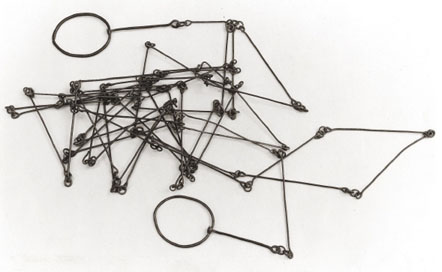
 Gunter’s Chain**

March 23

1852 Tuesday. Alson and wife dined here and spent

the afternoon at Edwins  He has been running

out lines for Edwin & Melvin Randall  Orinthia

went home with them.  Was at tea in Edwins

& this evening with Augusta at Augustus’

Augustus has gone to New York.  Susan is staying

there to night went just after dinner.  Oliver & wife

went to Boston this morning   Rained untill early night.

The Gilmore clan was moving around today. Evelina’s nephew, Alson “Augustus” Gilmore, was headed for New York City on business for his boot company or the Ames shovels, or both. Evelina’s brother (and Augustus’s father), Alson Gilmore, and his wife, Henrietta Williams Gilmore, had midday dinner at the Ames house. Alson was in the village helping another son, Edwin Williams Gilmore, and an Easton man, Melvin Randall, run out lines.

The phrase “running out lines” is open to interpretation (ice fishing is a possibility!), but the most likely meaning is that ground was being measured, perhaps for the new factory buildings soon to be built. A running measure is the cumulative distance in a straight line from a fixed point. The standard instrument used to get a running measure, at least in the 18th and 19th centuries, was a Gunter’s chain. It was used in conjunction with a compass and a transit (for establishing straight lines) to measure ground.

Invented by an English clergyman and mathematician, Edmund Gunter, around 1620, the Gunter’s chain “played a primary role in mapping out America.”** The Army Corps of Engineers would have owned such chains in bulk. The chain’s 100 lines measure 4 poles, or 66 feet, or 22 yards, depending on how you care to count it. Eighty chains equal one mile.

The Gunter’s chain, however, helpful as it was, was apt to be hand-made and thus subject to variation. It was eventually replaced by the more accurate surveyor’s tape.

By the way, for those readers who follow the game (or watch Downton Abbey), the length of a cricket pitch is exactly one chain.

*Thank you, Frank Mennino, for your assistance on today’s blog.

**Image from Colonial Williamsburg, courtesy of http://www.history.org