August 28, 1852

2_6_1_b

Example of Kashmir Shawl Popular at Mid-19th Century*

Sat Aug 28th  Mr Ames called at Mr Orrs this morning said

they were not any of them very well at home.  Went

out to find Mrs S Ames at last met her at

Mr Orrs about noon.  Melinda has not got home

from her journey yet. Bought Mrs Witherell &

self a Cashmere shawl  Have had a pleasant 

visit but am glad to be home again


As he usually did on Saturdays, Oakes Ames traveled from North Easton into Boston on business. Instead of going right to his customers, however, he stopped by the Orrs’ where his wife was staying.  Evelina had been away for over a week and he wanted to report that they – meaning he and two of his sons, Oliver (3) and Frank Morton – had fared ill without her. “They were not any of them very well at home,” he complained.

The fact that Evelina didn’t go rushing home to take temperatures or brew beef tea, but spent the day shopping in the city with her sister-in-law Sarah Lothrop Ames, suggests that she didn’t take her husband’s report too seriously. If she had, she would have headed home right away. She may have felt that Oakes was just expressing dismay over the disorder that had arisen in her absence, a complaint that wouldn’t have been surprising in an era when the majority of men had no role in, skill at, or inclination for the domestic side of life. Evelina hadn’t been there to tend to the household and probably could have related to the words of Elizabeth Cady Stanton, suffragist and mother of seven, who had cause to bemoan “the chaotic conditions into which everything fell without her constant supervision.” Still, Evelina must have been warmed by the thought that she had been missed, and she was glad to get home.

While in Boston, though, Evelina did buy a couple of cashmere shawls, one for herself and one for Sarah Ames Witherell. If the shawls were as beautiful as the one in the illustration, they were two lucky women.  As seen, some shawls during this fashion era were made extra large to fall over the full skirts of the time.


*Image courtesy of Meg Andrews, “The Girton Curtains,” http://www.meg-andrews.com/articles
August 14, 1852

440px-Henry_Jacob_Bigelow_c1854


Dr. Henry Jacob Bigelow

(1818 – 1890)

Aug 14th

1852 Saturday  Oakes A went to see Dr Bigelow

He agrees with Dr Swan that the blood

comes from the lungs and that he must leave the

shop and be very quiet.  Returned from

Boston to night.  Mrs Stevens came here in

the Cars  Mrs Witherell A L Ames & Mrs

S Ames called

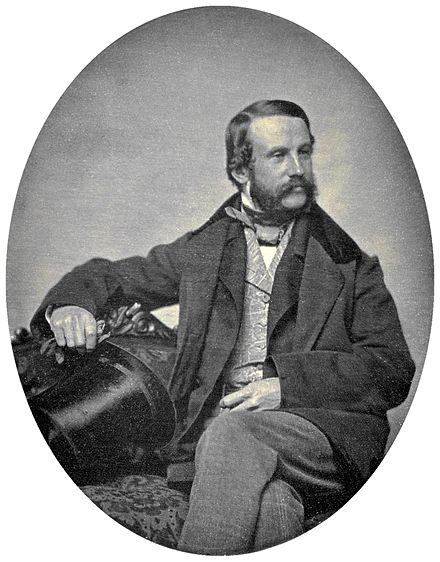
Oakes Angier saw a doctor in Boston today about his bad cough and bloody sputum.  He went to a Dr. Bigelow, who could have been either of two well-regarded medical men: Jacob Bigelow or his son, Henry Jacob Bigelow. The son, only a decade older than Oakes Angier himself, was a Harvard grad who was becoming famous for his role in introducing ether into the operating room. Without the modern diagnostic equipment to which we 21st century readers have become accustomed, Dr. Bigelow was nonetheless able to give an informed opinion about Oakes Angier’s pulmonary condition. If the doctor used the word “consumption,” Evelina didn’t write it down.

The illness was serious and Oakes Angier was ordered to ” leave the shop and be very quiet.” Rest and fresh air, in other words, were the treatment. If diagnostic ability was limited, treatments were even more so. Oakes Angier would have to go away and rest and hope for the best.

Back in Easton, the women of the family gathered in the sitting room or parlor to hear what the Boston physician had said, and perhaps to take a look at Evelina’s new bonnet. We can imagine that each member had a notion of what should happen next: where Oakes Angier should go, how he might travel, and what needed to be done to get him ready. In all likelihood, however, the decision on what to do would be decided by Oakes Angier’s father.


August 10, 1852

Ames_machine_shop_1857

Ames Machine Shop, built in1857


Aug 10th Tuesday Was sewing & puttering about one thing

and another untill about four Oclock

Mrs Witherell Mrs A L Ames & self spent the 

afternoon at Mrs Sheldons.  Mrs Johnson Swan

Williams, Howard and their brother Thomas were

there had a very pleasant visit.  On our return

found Mrs Dorr at Fathers and called to see her


“Sewing & puttering” filled Evelina’s hours up until near tea-time, at which point she, Sarah Ames Witherell, and Almira Ames went out to see some friends. They called on Sarah Sheldon, wife of the Congregational minister, where they saw several members of the Johnson family, including Louisa Johnson Swan, Nancy Johnson Howard, Ann Johnson and Thomas Johnson. It was “a very pleasant visit.”

Families often visited in groups, as we see in this entry and as we have seen from previous visits made by the Ames women. The Ameses went to see the Gilmores, or the Kinsleys, or the Howards, and vice versa. Families in the same town knew one another, or knew of one another, and had much in common. Whether or not everyone agreed about everything (which they didn’t – witness the old division between the Congregationalists and the Unitarians,) there was nonetheless a level of familiarity among long-established families in a given area.

Families worked in groups, too, most obviously on the numerous farms that still dominated the landscape. Yet as industrialization began to replace, or at least compete with, the agrarian lifestyle, members of the same family (at least those members who didn’t move away) often opted to work in the same trade. The Ames family is a prime example. Old Oliver developed an artisanal business that became a commercial factory. By the middle of the 19th century, artisanal businesses that were to thrive – such as the Ames Shovel Company – were becoming industrialized. Products were developed and produced, workers were hired and trained on the job, and the whole outfit was managed by members from one family. In Old Oliver’s case, he appointed certain sons and certain grandsons to take leadership roles.

Industrial historian Greg Galer has studied this work pattern. He writes, “kinship was a critical aspect of early industrial development. As manufacturers faced a growing national market in which to sell their products and acquire their raw materials they also found an increasingly unfamiliar body of people from whom they required trustworthy relationships. By using kin in some of these roles Ames eased the transition to these anonymous markets. Kin also played an important part in the management of the main shovel-making operation and affiliated enterprises located elsewhere…”

Family was everything.

*Oliver Ames, Journal, Stonehill College Archives, Arnold Tofias Collection

** Gregory Galer, Forging Ahead, MIT, 2001, p. 5


August 9, 1852

06_01_002623.LARGE

Map of Bristol County, Massachusetts, 1852*

1852

Aug 9th Monday  Part of the forenoon was working

about the house & cut out some work.

This afternoon started to go to Taunton

and got as far as brother Alsons when it rained

poringly and we were obliged to ride into

the barn untill it slacked a little so that we

could get into the house  Spent the afternoon 

there.  It was quite pleasant when we came 

home.  Mrs Witherell A L Ames & S Ames were with me


On the 1852 map of Bristol County, illustrated above, the town of Easton sits at the very top. Its eastern border abuts Plymouth County, which was the home of Bridgewater (today’s Brockton), West Bridgewater, and more. On Easton’s northern line sits Stoughton in Norfolk County. To its immediate south lies Raynham, home of many Gilmore cousins. We often read of Evelina traveling to these three vicinities – Bridgewater, Stoughton and Raynham –  to see family, friends, and vendors.

To the west of Easton lies Mansfield – where Oakes and Oliver (3) caught the stagecoach for Providence – and Norton. Further south, on a NNW/SSE axis, is the somewhat bow-tie-shaped town of Taunton. Taunton in the 19th century was known locally as “Silver City,” for its silver manufacturing, being the home of Reed & Barton, F. B. Rogers and others. We seldom hear of Evelina heading there, but for some reason, she and her sisters-in-law were traveling there this afternoon.

The ladies never got to Taunton, however, as an abrupt rain shower came down “poringly” while they were en route. “Good showers,”**too, according to Old Oliver, the kind of showers he’d been looking for most of the summer. When the rain commenced, the women drove their vehicle into Alson Gilmore’s barn and waited, then hurried into the house when “it slacked a little.” And there they sat, visiting with the Gilmores.

With the notable exception of Boston, to which Evelina traveled several times a year, this map pretty well represents the geographic scope of Evelina’s life to date. The northern portion of Bristol County and its abutting towns constituted her largest neighborhood, her network of friends and family, her travel pattern, her home. That was her world. It would soon get larger.


*Courtesy of the Norman B. Leventhal Map Center, Boston Public LIbrary

** Oliver Ames, Journal, Stonehill College Archives, Arnold Tofias Collection

August 4, 1852

Thread

1852

Wedns Aug 4th  Sewing circle met at the other part

of the house  Had an unusually large number

About 30 beside the gentlemen that came

to the second table.  My family all had tea

there  After tea all went into the gardens

and into Olivers to hear Helen play

Horatio and another man came from Salisbury

Sarah Witherell hosted the monthly Sewing Circle, to which people turned out in “an unusually large number.” Everyone would have known about the death of Sarah’s son back in May, and by showing up on this occasion, they likely were paying respect to a woman they probably admired. In her quiet, dignified way, Sarah had done so much for others that others now wanted to do something for her.  They may also have been demonstrating respect for her father, Old Oliver. Sarah was probably grateful for the outpouring and for the hostessing assistance she would have gotten from her visiting cousin, Almira Ames.

Old Oliver may or may not have been on the premises for tea. According to his daily record, on “the 4th Horatio + Mr Morse his traveling agent came here + went away the next day.”* Evelina doesn’t mention Horatio (Sr., probably) but as we know, they weren’t close.

After the busy gathering at Sarah Witherell’s, family and guests toured the gardens – of both houses, presumably – and then moved into the house next door to hear Helen Angier Ames, only daughter of Sarah Lothrop Ames and Oliver Ames Jr., play piano. Perhaps even Old Oliver, Horatio and Mr. Morse were part of the appreciative crowd.

This is the first entry that tells us that Helen Angier Ames played the piano, and it’s significant. Owning a piano or, more likely, a pianoforte was “the ultimate ‘badge of gentility’.”** Because “less than one in a hundred” households in the country owned such an instrument, those that did could be reckoned to be high up on the social scale. Owning a piano distinguished “‘decent people’ from the lower and less distinguished”, according to the standards of the time.


*Oliver Ames, Journal, Stonehill College Archives, Arnold Tofias Collection

**Jack Larkin, The Reshaping of Everyday LIfe: 1790-1840, New York, 1988, p. 143


August 3, 1852

Hpr HaravrdTraining-s

Harvard Crew Training on the Charles River, ca. 1869*

August 3d 1852

Tuesday  Cut out a linen & moire skirt for Catharine

to make and Susan a night gown  I have

at last got my travelling dress done  I believe

cape and all.  How provoking it is to have

to alter so much  Julia Mahoney has been

to work for Mrs Witherell making a Borage Delaine

Augusta & Mrs McHanna were here this afternoon

For Evelina, this was a fairly ordinary day of sewing and socializing. Her big news was that she “at last” completed her new traveling outfit.

In the annals of American sports, however, this was no ordinary day.  In a two-mile regatta on Lake Winnipesaukee, New Hampshire, under a bright blue sky, Harvard beat Yale in the very first intercollegiate athletic competition ever held in the U.S.A. Harvard’s  Oneida beat both of Yale’s boats, Shawmut and Undine. The first prize, a pair of black walnut oars, was presented to the Crimson team by one of the six judges, soon-to-be-president Franklin Pierce. Today, those oars are the oldest intercollegiate athletic prize in North America**. The contest itself has since moved to New London, Connecticut. It recently celebrated its 150th anniversary (not having been held in consecutive years in its earliest iteration.)

The contest was initiated by Yale, who “issued a challenge to Harvard ‘to test the superiority of the oarsmen of the two colleges.'”* According to the written recollection of James Morris Whiton, Yale Class of 1853 and bow oar of Undine, “[t]he race was supposed to be a frolic, and no idea was entertained of establishing a precedent.”*** The enthusiasm of the participants and the entertainment of the spectators, however, insured that a tradition had been born. Anticipation for the event had been high, so much so that the Boston, Concord and Montreal Railroad footed the bill for the event, believing it would attract visitors to the area. The excursion trains it set up arrived loaded with visitors.

The oarsmen themselves were so enthused about the occasion that they tried to arrange a dance at the inn where they were staying. According to Whiton, “Many of the College boys stayed at the Pemigewasset House, Plymouth, and it occurred to them it would be pleasant to give a ‘hop’, and invite the rural beauties of the town to the festivities. With this end in view, they applied to the landlord of the hostelry and received this reply: ‘Ye can hav the hall, young men, if ye want a gander dance, but ye won’t get no gal timber there, I tell ye.'”

No doubt the failure to dance with some of the “rural beauties” was a disappointment, but otherwise the race and its aftermath were entirely successful. By 1875, thirteen eastern colleges offered crew.


Image from Harper’s Weekly, 1869

**Harvard Athletic Association, Courtesy of http://www.gocrimson.com

*** Wikipedia, accessed July 30, 2015

****James Morris Whiton, “The Story of the First Harvard-Yale Regatta by a Bow Oar,” published in The Outlook, June 1, 1901 and privately printed with photographs of Lake Winnipesaukee and of the course of the race.


July 28, 1852

Sharps

Sharp’s Pistol, 1848-1850


July 28th, 1852

Wednesday Julia Mahoney has been here

to work to day on my travelling dress

but I have sewed but very little

Was about house all the forenoon 

making cake & pies &c &c  Mrs Ames &

Witherell have been to Dover  Horatio

Ames Jr came last night & I expected

him & father to dine but they went to

Olivers  Horatio went with Mr Ames

to Canton this afternoon & was here to tea

Horatio Ames Jr., a grandson of Old Oliver and nephew of Oakes, had come to the other part of the house for a short visit. By contemporary accounts, he was a troubled young man. The second child of Horatio and Sally Ames, he was born in Albany when his father was working there, but grew up in Connecticut.  In 1849 and 1850, he attended Rensselaer Polytechnic Institute in Troy, New York, but evidently left after just one year.

Early in 1853, Horatio Jr. was in Boston where he married Sophronia Eliot Hill of Salem. He worked as an iron monger at that time, but by 1858 was working as a clerk. On October 27, 1858, he killed himself.

What happened between his year in college and his suicide less than a decade later may pivot on the scandalous divorce of his parents, proceedings for which got underway late in 1852. His mother cited her husband’s multiple infidelities and harsh treatment to herself and her children. Horatio Jr. sided with his mother during and after the breakup. A 20th century account reports that Horatio Jr:

left home shortly after his parents’ divorce and so was out of touch with his father for some years. But he returned home in 1856 following his father’s remarriage. During an argument, he fired at his father in an attempt to kill him. Newspaper accounts of the incident, based on Horatio Sr.’s version of the events, depict him winning a heroic struggle for his life, but then magnanimously letting his son leave. Only after further warnings from his younger son, Gustavus, did Horatio finally have his son arrested. Horatio called his son ‘the worst hardened villain I have ever seen’, but then dropped the charges once Horatio Jnr. became contrite, begging forgiveness.*

The newspaper accounts on which this summation is based present only Horatio Sr.’s side of the story. We simply can’t know exactly what transpired between father and son, but we can know that the son eventually took his own life.  According to some 19th century records, Horatio Jr. is buried in Salem.

*John Mortimer, Zerah Colburn the Spirit of Darkness,2007


July 27, 1852


Asleep

Tuesday July 27th  Mrs Savage had quite a

comfortable night & I came home a

little before 5 Oclock & went to bed

did not rise untill nearly nine

Elizabeth Pool & Augusta came

in this forenoon with their work

Mrs Whitwell Reed Howard & Miss

Jarvis called on us all & Alsons wife

was here to tea & Mother at Augustus’

Evelina’s all-nighter at the bedside of Mrs. Savage didn’t seem to impinge on her day.  After a catch-up sleep in the early morning, she was back on her feet.  Augusta Gilmore and her young sister Elizabeth came over “with their work,” meaning that they brought some sewing with them, and the women sat, sewed, and visited. Later in the day, several ladies from her Unitarian circle of friends “called on us”.  Her brother Alson’s wife, Henrietta Williams Gilmore, came by for tea. A most sociable day, it was.

In the other part of the house, “Horatio Ames Jun r came here to day.”* Horatio was, obviously, the eldest son of Horatio Ames, who was the brother of Oakes, Oliver Jr., Sarah Witherell, Harriet Mitchell and William Leonard Ames. Repeating previous posts, Horatio ran a forge in Connecticut, far from the shovel shop in Easton, but still connected to it financially and emotionally. He and his son were not on friendly terms, and it’s hard to determine just what had brought Horatio Jr to Easton.  He arrived in the evening and for some reason Evelina didn’t mention it in her diary.


*Oliver Ames, Journal, Stonehill College Archives, Arnold Tofias Collection


July 16, 1852

FullSizeRender

Traveling dresses*

1852

July 16th  Have been to Boston & Mt Auburn with

Mrs Witherell, S Ames & A L Ames had a 

very pleasant time  Returned from Mt

Auburn about one or two called on Mrs 

Stevens and the rest of the day shopping

bought me a travelling dress &c &c

Did not see any of Mr Orrs family except

Mr Norris  Mrs N is at Newburyport


The Ames women went to town today. Apparently they headed first to Mt.  Auburn, probably to take a turn around the cemetery, then on to Boston. It sounds as if the four women rode in a carriage or wagon all the way from Easton. One of the women may have driven the vehicle, but it’s more likely that a man, such as Old Oliver’s coachman Michael Burns, drove. Whoever held the reins guided the horse along what is today’s Route 138.  The carriage would have traveled a short distance east to get out of Easton, then headed straight north through Canton and Milton into the outskirts of the big city. Normally the vehicle would have taken Washington Street as it veered northeast into Boston, but today they went instead via Jamaica Plain to cross the Charles River.

After their tour of Mt. Auburn Cemetery, a popular destination for many pedestrians and riders, the Ames women crossed back across the Charles River into Boston, where they spent “the rest of the day shopping.” Evelina purchased material and a pattern, perhaps, for a “travelling dress,” such as the one in the illustration. She will spend the next few weeks making this new outfit at home.

Back in Easton, meanwhile, Old Oliver reflected on the week going by and noted that “the 14 – 15 + 16th were all warm good hay days + verry drying.”** He was satisfied with the weather.


Godey’s Lady’s Journal, November, 1852

**Oliver Ames, Journal, Stonehill College Archives, Arnold Tofias Collection

July 15, 1852

imgres-1

1852

Thursday July 15  Mary had to pick out all the work

she did while I was at Canton and it has

taken her a long while  I shall not get much

of my sewing done by her Im thinking.  I have been

to work on my borage and there is a great 

deal to do with it   Have spent the afternoon 

at Fathers with Olivers family and mine

at tea

Sarah Ames Witherell, two months bereft of her eldest son, was entertaining again, if only for the family. She and her father, Old Oliver, had everyone in for tea. This must have been a good sign for the entire clan, as they could only have wished to see Sarah able to pick up her life again.

Evelina was dissatisfied with sewing done by her servant, Mary, and had her take out every stitch from a piece she had been working on in Evelina’s absence. No servant yet had been able to meet Evelina’s standard for needlework. She was too good at it, and seemed frustrated that she couldn’t rely on anyone else to accomplish what she herself was able to do. And she was doubly frustrated to find herself paying for a sequence of poor work being done, then undone, then redone. Not good for a Yankee. She would have to lower her standards, find someone who could do the work, or do it herself.