January 5, 1852

Abbott H. Thayer, Angel, 1887, oil Smithsonian American Art Museum Gift of John Gellatly

Abbott H. Thayer, Angel, 1887, oil
Smithsonian American Art Museum
Gift of John Gellatly


/52

Monday Jan 5 th

Another stormy Monday and we have not been 

able to put our clothes out  Susan washed the

dishes this morning and Jane has done the rest

of the work.  I have finished Susans hood and 

it looks very nice  Mrs Witherell came from

Boston to night  Mr Witherell died about six

yesterday morning


Old Oliver was keeping track of the stormy weather, noting that “it raind + snowd all last night. the snow fell about 2 inches deep + is a snowing now wind north east but it does not blow so hard as it did yesterday. it snowd untill about 3 O clock but was cloudy all day.” One imagines that he had his face close to the window panes of his sitting room – or accounting office, perhaps – as the snow fell outside.

Sarah Witherell returned from Boston in that same snow and wind, having managed to reach her father-in-law’s bedside before he passed away. She would gather her children and return to the city for the funeral.

Evelina, meanwhile, sewed and supervised household chores. “Another stormy Monday” meant that wet laundry was dried in the kitchen and around the house, near heat registers and the air tight stove that helped keep Evelina’s plants from freezing. Parts of the house were draped with white sheets and garments, the floors or carpets wet beneath them. Susie Ames helped some by doing the dishes, a chore that was becoming her regular responsibility. Jane McHanna, of course, bore the lion’s share of the work, with the laundry and “the rest.”


January 3, 1852

OLYMPUS DIGITAL CAMERA

*

1852

Jan 3d Saturday 

Finished my old hood and ripped Susans

old one & washed the lining and have partly quilted

it once again  Have spent all the afternoon in 

mending Franks shop coat.  Sewed this evening

untill nearly ten have not read at all

Mrs Witherell received news last night that her

father Witherell is not expected to live and she has gone

to see him.

Three-and-a-half years earlier, Sarah Ames Witherell had lost her husband, Nathaniel Witherell, Jr.  Now, she had the sad duty of traveling to Boston to say goodbye to her husband’s father, Nathaniel Witherell, Sr. Someone must have written a letter to tell her he was ill and, ever dutiful, Sarah Witherell responded quickly to the news.  Off she went.

Better news was that today was the birthday of one of Evelina’s many nieces, Mary “Melvina” (or “Malvina” as Evelina spelled it) Torrey. The youngest daughter of Evelina’s late older sister, Hannah Howard Gilmore Torrey, Melvina turned 11. Her father was Col. John Torrey, a high-profile personage in North Easton, of whom Evelina often writes. Melvina and her sister, Abby Torrey, were great favorites of Evelina; Melvina is the niece to whom Evelina gave a bloomer hat the previous summer.

In another ten years, Melvina would marry an older man, Sanford Blake Strout, who also lived in the village of North Easton, on Center Street. She would bear two sons, Byron Howard Strout and Havilen Torrey Strout.


Illustration from Godey’s Lady’s Magazine, 1851


January 2, 1852

Tea


1852

Jan 2d Friday  Seated myself quite early this morning to work

on Susans hood & finished item about ten Oclock

then ripped my old blue hood and washed the

lining & turned the outside have got it nearly done

We all went into the other part of the house to tea

Mr & Mrs Oliver & Helen there  Frank has a sore

ankle as [sic] does not go to the shop  Dr Swan called there

to see Helen & left Jane some medicine

The family gathered for tea today in “the other part of the house,” meaning that Evelina, Oakes, and their children, Oakes Angier, Frank and Susan went into the southern half of the shared house where Old Oliver and his widowed daughter, Sarah Witherell, lived with her two children, George and Emily. Joining them was the family next door: Oliver Ames, Jr, his wife Sarah and their daughter, Helen Angier Ames, who made an appearance despite being home from school with a cold. Other than missing Oliver (3) and Frederick Lothrop, the sons who were off at college, the group was a normal configuration for a gathering at the homestead.

Evelina’s grandson, Winthrop Ames, would one day describe such a family gathering from less than a decade later, by which time daughters-in-law and grandchildren had arrived:

“Supper, always called Tea, at seven, was the sociable occasion. It usually consisted of cold meats, hot biscuits, preserves and cakes – an easy menu to expand for unexpected guests.  Every week at least, and usually oftener, one household would invite the others and their visitors to tea; and the whole Ames family might assemble, even infant children being brought along and tucked into bed upstairs.  Fifteen or twenty was not at all an unusual gathering.”*

The family was as tightly-knit as any of Evelina’s knitted worsted hoods.

One other note about today’s entry: Dr. Swan left some medicine off for Jane McHanna, the servant, who had been ailing for much of the fall and winter. What did she suffer from?

* Winthrop Ames, The Ames Family of Easton, Massachusetts, privately printed, 1937, p.128


December 31, 1851

Dismiss


Wednesday Dec 31st  This morning sit down early to knitting

my hood  Have it all finished ready for the lining.  About ten 

Oclock went into the school with Mrs. Witherell.  Mr Brown

has closed his school to day.  Passed the afternoon & evening at Olivers

Mr & Mrs Wm Reed  Mr & Mrs J Howard, Whitwell & A Gilmore were there.

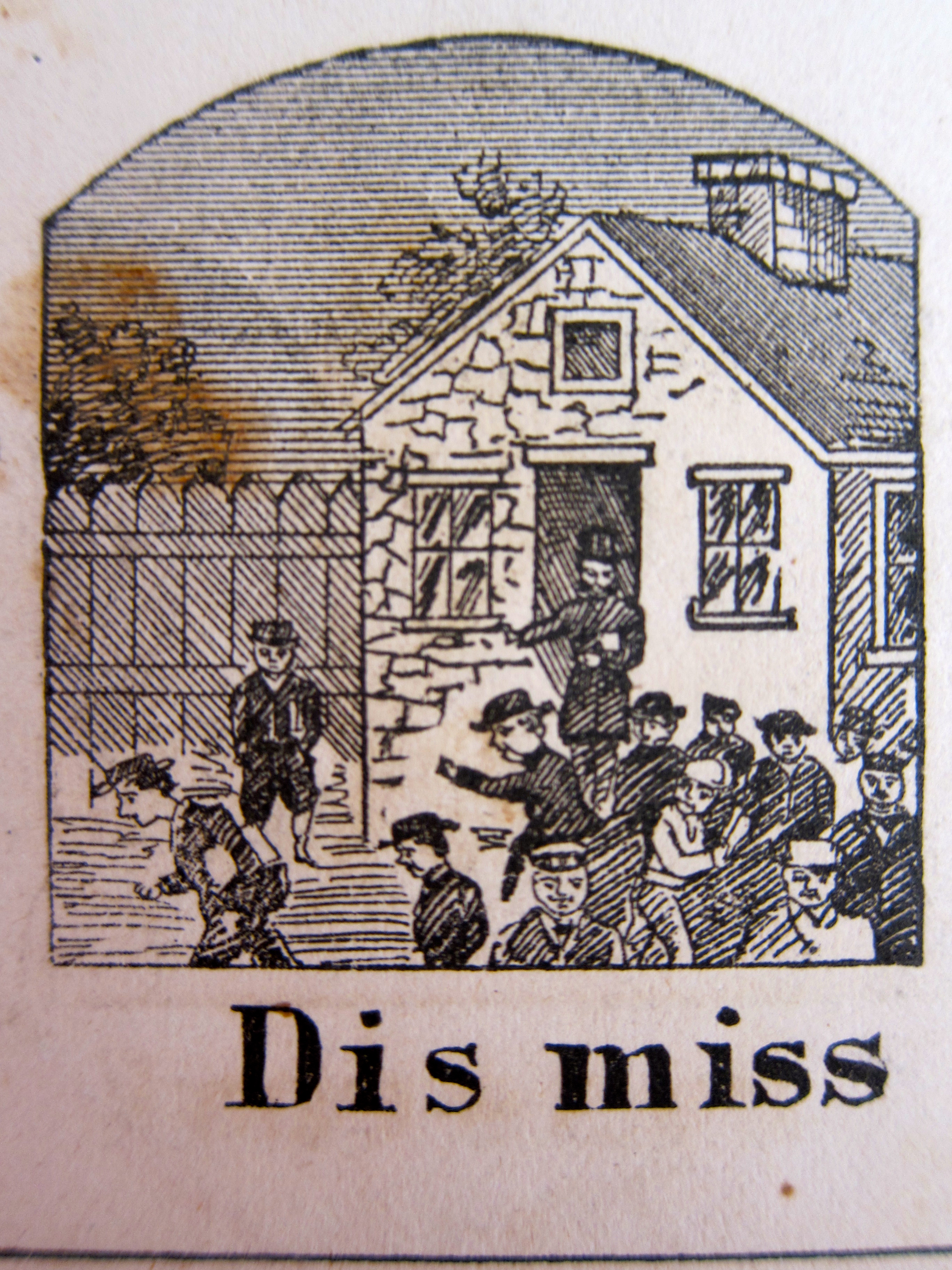
Susie Ames and Emily Witherell may have been happy today to reach the end of their school term. Class, dismissed!  1851, dismissed!

Just how the Ames family celebrated the departure of the old year and arrival of the new, we don’t know. Old Oliver, with his usual terse assessment of the day, merely noted that “this was a cloudy day and some cooler + misty + foggy.” The cool mist he saw would develop into a huge rain storm over night, preventing folks from moving around much.

A group of friends and relatives gathered for tea next door at the home of Oliver Ames, Jr. and his wife Sarah Lothrop Ames. Besides Evelina and Oakes, at the party were Reverend William Whitwell and his wife Eliza, Reverend William Reed and his wife Abigail, Jason Guild Howard and his wife Martha, and Evelina’s brother Alson Gilmore and his wife Henrietta.  In just a few more years, a group like this might have sung the beloved  Auld Lang Syne to mark the occasion. In fact, a version of Auld Lang Syne, written in 1855 and called Song of the Old Folks would become “the tradition of the Stoughton Musical Society to sing […] in memory of those who had died that year.”*

Out with old, in with the new. What a year it would be for the Ames clan.

http://www.americanmusicpreservation.com/SongoftheOldFolks.htm

December 24, 1851

new-england-for-web

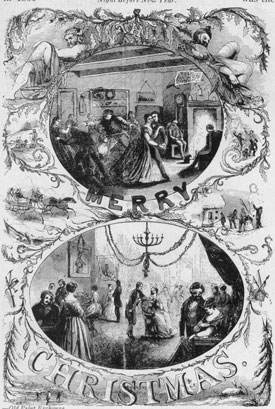
Christmas illustration from Godey’s Lady’s Book, December 1851

Wednesday Dec 24th  This morning gave the sitting room stairs

bedroom &c a thorough sweeping and was about the 

house at work a greater part of the forenoon

knit on my hood when I seated myself at work

read some in Ladys Book which I have

commenced taking for another year.  Emily brung

me a linen collar that her mother made for a

Christmas present


Emily Witherell delivered a Christmas gift from her mother, Sarah Witherell, to her Aunt Evelina, a gesture that may have caught Evelina off guard.  In practice, the Ameses had not been in the habit of observing Christmas, finding this religious celebration too festive for their Puritan-derived tastes. Yet times were changing and, in future years, Evelina would become both a recipient and giver of Christmas presents.

Evelina’s transition from being suspicious of Christmas to celebrating it was stimulated by various factors, not the least of which was its promotion in her favorite magazine, Godey’s Lady’s Book, the same magazine whose subscription Evelina renewed today. The periodical recognized and encouraged the holiday’s appeal to its well-heeled readers, many of whom would have read Charles Dickens’ A Christmas Carol, published less than a decade earlier. Unlike Unitarian (and one-time Congregationalist) Evelina, a growing number of Godey’s readers were less hide-bound to a doctrine devoid of celebration. The influx of Irish Catholics, who did honor the holiday, influenced some of this change, too.

While many in the nation made preparations for Christmas, a terrible fire at the Library of Congress in Washington, D. C., resulted in the destruction of nearly two-thirds of their holdings. Included in the loss was most of Thomas Jefferson’s original library.**

**http://www.accessible-archives.com/2013.01/the-other-fire


December 16, 1851

OLYMPUS DIGITAL CAMERA


From Godey’s Lady’s Book, October, 1851, Outfits for the Fair 

Tuesday Dec 16  Have finished the hood for the fair

Mrs Witherell has made a Dolls hood & half

dozen linen collars.  Mrs Ames a hood & childs apron

Mr & Mrs Reed called on Mrs Witherell for the 

things and made a long call  Mrs S Ames

& self went to see her.  She brought some

things she made such as dolls comforters bonnets &c

Mrs Howard & Miss Jarvis made eight straw hats

How productive the Unitarian women had been lately.  Sarah Witherell, Sarah Ames, Abigail Reed and others had sewn or knitted many small items like collars and doll clothes to sell at what must have been a church fair. Both Sarahs were planning to work, or perhaps preside, at the event.  Why wasn’t Evelina going to work at it? Had she been asked? Had she declined? Did she care particularly?

For whatever reason, Evelina was less involved in the church fair than either Sarah.  Her sisters-in-law had sewn a number of articles between them to donate, while she herself only made one small hood.  Was her small contribution a reflection of disinterest in the event?  Was she too busy at her domestic responsibilities to take the time?  Was it against her inclination to make things to give away?

Evelina admired the pieces that others had made, but it would seem that either the fair itself didn’t interest her or she felt left out of the goings-on. She never mentioned the fair again, which suggests that she didn’t even attend it.


December 15, 1851

Hood

Monday Dec 15  The girls have both been washing to 

day but it was so windy they could not put their clothes

out  Jane has sewed this afternoon the bags for the

sausages  I knit on Susans hood this morning

and this afternoon commenced knitting on a little

hood for the fair  Mrs Witherell & Ames have been

in awhile and are to work for it

While her servants Jane and Mary struggled with the Monday laundry, Evelina began to knit. Her nephew, Augustus Gilmore, had fetched some yarn – or worsted, as she called it – for her on Saturday while in Boston, and she was finally able to get to it today.

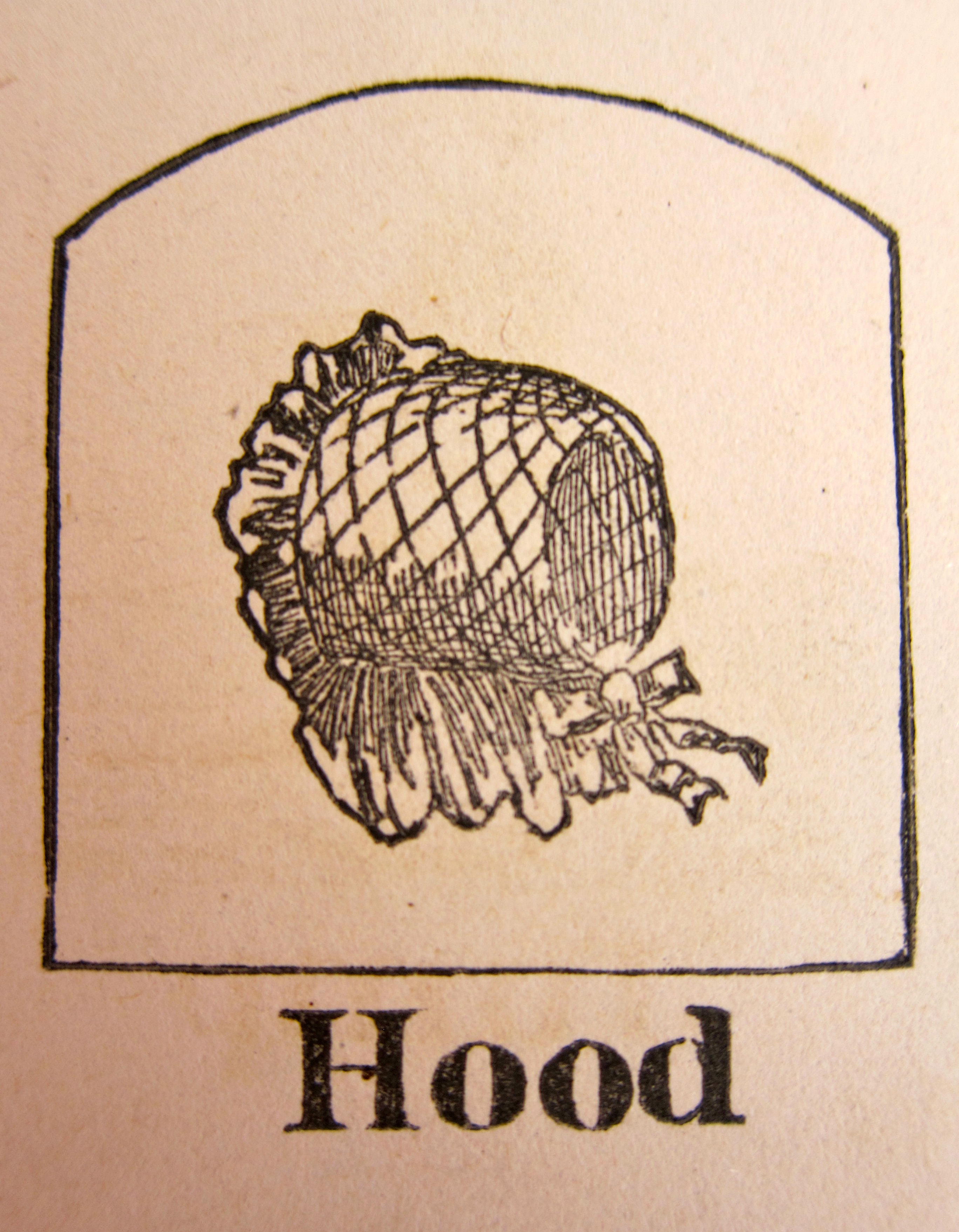
Evelina “knit on” two hoods, one for her daughter Susan and another for a church fair that was coming up. A hood might take a few different shapes, from a fitted piece that covered the top, sides and back of one’s head to one that covered the top and sides only, as in the period illustration above. The one above – which isn’t knitted, but sewn – is really just a variation of a bonnet.

Jane McHanna, too, worked with a needle today once the washing was done. She sewed some cloth bags for the pounds and pounds of sausage that had been produced on Saturday.  Sausage was usually forced into casings made from pig intestines, and this may have been the case with the pork that Evelina and Sarah Witherell produced.  But it may be that an additional cloth covering was desirable for storage or identification.  Hard to know.  Any thoughts from readers who have made their own sausages?


December 13, 1851

$(KGrHqJHJFMFJusCVdz8BSe+hz0oG!~~60_35

Sat Dec 13th  Have tried my lard cleaned hogs head

and fat and the meat ready choped & seasoned 

for filling  Have been to work all day on them

together with Jane & Mary.  Have 78 lbs meat

Mr Ames & Augustus have been to Boston.

Augustus got me some worsteds for hood

Frank & Oakes chopped my meat & Sarahs, she

had 28 lbs.

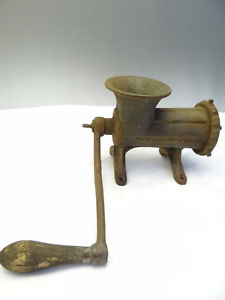
Sarah Witherell and Evelina Ames, sisters-in-law bent on taking care of some pork fresh from the slaughter of a few Ames hogs, had 106 pounds of pork between them to be turned into sausage. In addition to the capable hands of servants Jane McHanna and Mary, they had help from Evelina’s sons Oakes Angier and Frank Morton, who chopped the meat, and probably the fat, too,  into manageable chunks. Together with other ingredients – see below – the meat was forced into a grinder like the one pictured above.

Most likely, the women didn’t need to follow a recipe to make the sausage, having made it countless times before.  But if they did, they could have turned to Sarah Josepha Hale’s instructions in The Good Housekeeper.  They would have had to multiply the recipe times thirty or so:

“TO MAKE SAUSAGE MEAT. — Chop two pounds of lean with one of fat pork very fine – mix with this meat five teaspoonfuls of sale, severn of powdered sage, two of black pepper, and one of cloves.  You can add a little rosemary, if you like it”*

And sausage wasn’t the only product from the pork that Evelina, Sarah, Jane and Mary worked on.  They made lard and dressed a hog’s head. It was a most productive day in the Ames kitchen.

*Sarah Josepha Hale, The Good Housekeeper, Boston, 1841

December 12, 1851

tumblr_n6j6ijphsb1rly06do1_500

Dec 12 Friday  I am no better than yesterday & my cough

is increasing.  Have been mending most all day

Took a piece out of a comforter that the cat

had been on  Hannah called a few minutes

Mr Talbot brought home the sausage chopper

that he borrowed yesterday and Orville borrowed 

it and has brought it home this evening

Mary has been sick most all day talked of leaving

A cat! Today’s entry is the only mention in Evelina’s diary of the existence of a pet at the Ames house. There may have been some feral cats in the Ames barn, keeping the rodent population down, but the way this entry is written suggests that this cat was more of a household pet. And this pet “had been on” (what might that mean!) an old comforter or quilt, and had done enough damage to warrant the piece being removed. While the cat was no doubt indifferent to the fate of the comforter, Evelina was concerned enough to repair it.

Evelina was “mending most of the day,” which meant she was finally sitting down and holding relatively still. For several days, she had been indoors and out, painting and varnishing, kneeling and bending, and challenging herself to ignore her cold. No wonder her cough was “increasing.”  Her newest servant, Mary, had taken sick, too.

Neighbors were making sausage, and Evelina and Sarah Witherell would be doing that, too, in a day or two. Old Oliver had slaughtered four hogs a little over a week earlier, most of which he sold. But some of the pork made its way into the various Ames kitchens, and now the Ames wives and daughters would be putting it away.


December 11, 1851

Unpack

Dec 11th Thursday.  Have had a bad head ache and

very bad cold  Called into the other part of the

house with Mrs S Ames.  Mrs Witherell had bound

the quilt that we quilted yesterday  Mrs R Pool

called & I went into Edwins house with her.  She & her

husband have spent the day at Augustus  I varnished

store room stairs & porch.  Mr Ames came from New York

Mr Clarke put the inside windows in sitting room

Both Evelina and Old Oliver noted that Oakes Ames “came from New York” today after having been away eight days. He was probably glad to be home; he confessed late in his life that he didn’t enjoy travel. And family dynamics, if they had altered at all in his absence, would have reverted to normal once his “stalwart and rugged”* self returned to his own place as the head of the household.

Evelina’s cold, which had been hovering since Sunday, finally landed with vehemence, although Evelina continued to be up and around. She sat with both sisters-in-law, Sarah Ames and Sarah Witherell, and went over to Edwin Gilmore’s new house with her niece (and Edwin’s sister) Rachael Gilmore Pool. In addition to socializing, Evelina varnished her porch and storeroom stairs. The strong smell from the varnish wouldn’t have helped her “bad head ache,” at all; in fact, it probably made it worse. What was she thinking? Was she too economical to let Mr. Scott complete the job? And did she know that she was spreading her cold everywhere she went?

*William L. Chaffin, Oakes Ames, 1804/1873, Easton Historical Society, North Easton, 1996, p. 1