March 18, 1852

images-2

1852

March 18th  Thursday  A very heavy rain storm to day

Amelia Orinthia & self have had a quiet day

but mine has not been pleasant work, have

mended Mr Ames old shop coat have put new

cloth in the under part of the sleeves, mended

button holes so, think it will last some time.

Also mend Franks pants  Orinthia has been 

to work on her delaine dress

The women at the Ames residence stayed indoors today, held inside by “a cold driving rain storm.”* They sewed, naturally, but Evelina didn’t particularly enjoy herself. Orinthia got to work on a new dress, but Evelina had to mend her husband’s shop coat and her son Frank’s pants. Mending was never as much fun as sewing, but it was essential. As we have noticed before, Evelina was devoted to making things last. Like other Yankee housewives, she had been brought up to: “Eat it up, wear it out, make it do or do without.”**

Yet as the family grew more wealthy, Evelina began to enjoy the luxury of not doing without. She shopped in Boston for fashion accessories and household items that she would never have had in her youth. As modern historian Jack Larkin has pointed out, a “household’s furnishings constituted a material world that defined the limits of comfort, heating and lighting, and filled functional needs for sitting, sleeping and eating, but they also spoke of Americans’ economic status and aspirations.”***

Old habits die hard, as we know. The Ameses had money, and Evelina didn’t have to mend her husband’s shop coat; she could have insisted that he buy a new one, or she could have sewn one for him, perhaps. Her ingrained sense of economy, however tempted by the changing world around her, wouldn’t allow it. William L. Chaffin, the town historian who knew the Ames family, described Evelina as “economical” in his late-life remembrance of Oakes Ames, and shared the tale that Oakes joked about Evelina at the dinner table, suggesting to guests that his wife wanted them to help themselves to preserves that were going bad so she could use them up.

On this day, rather than demand that her husband purchase a new work coat – which we can surmise he had no interest in doing – Evelina fixed up the old one, and sighed that she wasn’t sewing a new dress instead.

*Oliver Ames, Journal, Stonehill College Archives, Arnold Tofias Collection

** A 20th century, World War II-era version of this maxim was “Use it up, wear it out, make it do or do without.”

***Jack Larkin, The Reshaping of Everyday Life, 1988, p. 264
 

March 17, 1852

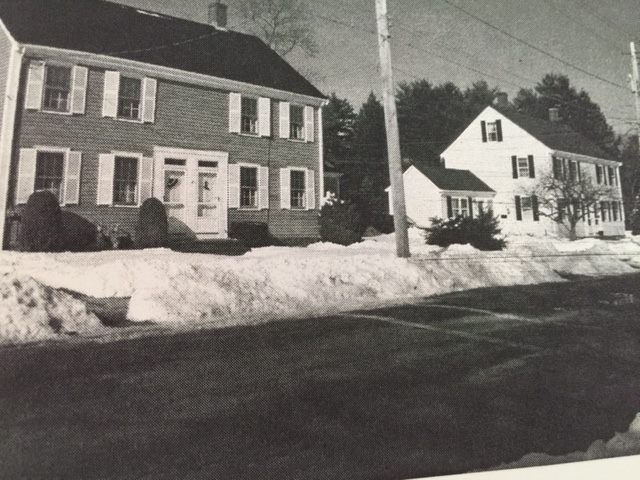
 IMG_0085Modern photograph of two private homes on Oliver Street in Easton, originally built in 1852 as part of the temporary structure for the shovel factory.*

March 17

1852  Wednesday.  Passed the day at Mothers with Amelia

and Susan   Carried Augusta to her fathers

and afternoon she and Rachel came down

to see us  Miss Foss closed her school Sat.

Came to Mothers this morning and to

night came home with us.  Carried cloth

and cut out a bleached shirt  Amelia worked

on the sleeves.

Evelina spent a pleasant day with her mother and several relatives. Her friend Orinthia Foss came to stay for a time. Evelina’s father-in-law, Old Oliver Ames, was completely focused on the rebuilding of the shovel shops. He seemed pleased to report:

“this was a cloudy day wind northeast. + in the afternoon it was cold + chilly. the roof is on the stone shop + the windows are in + the down stream end finisht- + the piece from that to the water shop is up + the roof shingled + the walls are boarded – one hundred + eight feet of the handeling shop is up and part of it clapboarded. the polishing shop is up and the roof shingled and the sides boarded + partly clapboarded the hammer shop is up + the sides + ends boarded and the roof and two thirds sleighted”**

This is one of the longest entries that Old Oliver ever wrote in his journal. He was clearly proud of the progress that had been made in the two weeks since the fire that destroyed almost all. The factory would soon be back on its feet, and planning for more permanent stone buildings could move forward. The wooden buildings that went up so fast would have another use after the stone buildings were erected, that of housing for some of the shovel workers. They would be moved from the original site by the pond and become residences. As you can see from the illustration, some of them are still used today.


* Image taken by Gregory Galer, Forging Ahead, MIT, 2001, Figure 50

** Oliver Ames, Journal, Stonehill College Archives, Arnold Tofias Collection

February 22, 1852

georgewashington

1852

Feb 22nd Sunday Quite a snow storm this morning but

most all went to church.  I came home at noon on

account of a violent tooth ache and did not return.  Mrs

S Lothrop & son spent this afternoon, Frank carried

Orinthia home after meeting. Read in Grahams

Magazine  Mr Ames & self passed the evening at Edwins

It has cleared off very pleasant this evening

“It was a snowing this morning + all the forenoon and fell 2 or 3 inches deep wind southerly + thawd some  was clear at night,” according to Ames patriarch, Old Oliver. Yet the family rode through the snow to get to church. Poor Evelina got “a violent tooth ache” and had to go home after the first service. She must have felt better as the day progressed, for in the evening she and her husband, Oakes, went across the way to visit newlyweds Edwin and Augusta Gilmore.

Today was George Washington’s birthday. Born in 1732, he died in 1799, when Old Oliver was twenty years old. After Washington’s death, the young Congress of the day, whose partisanship between Federalists and the Jeffersonian Democrat-Republicans rivaled the divide we see in our modern Congress, came together to pass a resolution honoring the first president’s birthday. February 22, 1800 was dedicated to him and by 1832, the centennial of Washington’s birth, some type of observance of the holiday was customary.  The holiday did not become federal law until the 1879, and at the time was qualified as a “bank holiday.”

Old Oliver would have remembered the hero of the American Revolution and probably revered him, as most Americans did. Old Oliver was a child when the Constitution was written and ratified, and lived to see 16 presidents take office. For his generation, no American leader would be more heroic than General Washington.


February 21, 1852

 21621-004-0B1C48DE

Angelina Grimke (1805-1879)

1852

Feb 21st Sat  Spent all the forenoon mending Mr Ames

shopcoat.  Cut Susan a pink long sleeve apron and

Orinthia sewed on it  Have finished Mr Ames another

dickey which makes seven that I have made lately

This afternoon carr[i]ed Mrs Solomon Lothrop &

Orinthia to mothers.  Orinthia stopt at a sing at

the Schoolhouse near Doct Swans  Frank went and

brought her back.  Mrs S Ames called this evening to 

settle and paid me 1,70 cts which makes us even

Normal wintertime activities went on under a sky that Old Oliver described as “fair in the fornoon + cloudy afternoon + much warmer.”*  Evelina mended, sewed and socialized with her friend and former boarder, Orinthia Foss; she also settled accounts with her sister-in-law, Sarah Lothrop Ames. Per usual, Oakes Ames went into Boston.

It was in Boston, in fact, on this date fourteen years earlier that for the first time ever in the United States, a woman addressed a legislative body. On February 21, 1838, abolitionist Angelina Grimke presented the Massachusetts Legislature with an anti-slavery petition signed by 20,000 Massachusetts women. In a speech that was lauded by abolitionists, deplored by traditionalists and parsed by all, she not only called for the abolition of slavery, but declared the right of women to act politically. “We are citizens of this republic and as such our honor, happiness, and well-being are bound up in its politics, government and laws.”**

Daughter of a southern slave-holder, Angelina (known as “Nina” in her family) and her older sister, Sarah Grimke, also an active abolitionist, faced predictable opposition as they transgressed convention. Angelina’s speeches in Boston and elsewhere drew taunts, outrage, disbelief, and disrespect. The Congregational clergy of Massachusetts condescended together one Sunday and, across pulpits, accused Grimke of jeopardizing “the female character with widespread and permanent injury.” Others – men and women – were impressed. One member of the audience at the statehouse said, “Angelina Grimke’s serene, commanding eloquence [she spoke for two hours] enchained attention, disarmed prejudice and carried her hearers with her.”**

How might the Ames clan have reacted?


*Oliver Ames, Journal, Stonehill College Archives, Arnold Tofias Collection

**www.massmoments.org


February 7, 1852

dickens12_2084187b


Charles Dickens, ca. 1852

(1812 – 1870)


1852  Sat  Feb 7th  Orinthia Miss Burill Susan & self called this

morning on Mrs J Howard, Whitwell & E Howards

left Susan at Mr Howards, came home with Frank

from a sing this evening.  Abby Augusta & Helen were

here awhile this afternoon  Helen went out to Bridgewater

last night and came up with Mr & Mrs James Mitchell this

forenoon  Orinthia went home about five and this

evening we have been into Olivers.  Mr Mitchell returned at nine.


This was a non-stop sociable Saturday for Evelina; she, her daughter Susan, dear companion Orinthia Foss, and another young schoolteacher, Miss Burrell, made calls all morning long. In the afternoon, she entertained three of her nieces and in the evening, visited next door at Oliver Jr and Sarah Lothrop Ames’s house. Chat, chat, chat.

In the larger world of letters, Charles Dickens turned 40 years old today. Even at mid-career, he was known as “The Inimitable,” so great was his talent, so voracious his readers. Evelina loved his work and benefited from his prolificacy.

By this point in Dickens’ life, among the books he had already published were The Pickwick Papers, Nicholas Nickleby, various Christmas novellas including A Christmas Carol, Dombey and Son, and David Copperfield, which Evelina had read the previous year. At this time he was composing Bleak House which, like most of his novels, was published in serial form over many months. Its first episode would come out in March, 1852, and run through September, 1853.

Still waiting to be born were future classics such as Hard Times (which targeted Unitarianism, among other entities), Great Expectations, A Tale of Two Cities, Our Mutual Friend – and more. Dickens wrote articles, made speeches, toured, and even acted. He was a high-profile tour de force with a fertile imagination and a thirst for success. Ralph Waldo Emerson, who heard Dickens speak in Boston, compared the author’s ability to “a fearful locomotive to which he is bound and can never be free from it nor set to rest.”*

*Ralph Waldo Emerson, quoted in Annie Field’s diary, 1868.


February 6, 1852

Write

Feb 1852

Friday Feb 6  Jane has baked some mince to day of

meat that was left last week and has done

very well.  Cut out a shirt for Oliver to day

and intended to finish it tomorrow but this

afternoon Miss Foss came and Miss Burrell

from W Bridgewater  We called at Edwins

this evening  commenced raining about five

Domestic tranquility reigned today as Jane McHanna made some fine mincemeat and Evelina cut cloth for a shirt, until interrupted by the arrival of Orinthia Foss and her friend Miss Burrell. For Evelina, chores gave way to social intercourse.

Besides keeping a record of various domestic details such as her sewing, Evelina often lists in her daily diary entries the names of the friends and relatives who come to call – in this case, Orinthia Foss and Miss Burrell. She writes of the women with whom she spends time, in fact, more often than she is apt to describe interactions with her immediate family (unless, of course, her husband forgets to pick her up to go out on a social call.) She includes the names of female friends, including her sisters-in-law, as much if not more often than she mentions the names of her children. Her social life, as in “We called at Edwins this evening,” is terribly important to her. She narrates it to her diary in order to remember it and savor it. It doesn’t mean that she doesn’t care about her family; she does. But looking after her almost-grown children is not noteworthy.

Evelina’s diary is simple, even for the nineteenth century, when the “practice” of keeping a diary was “to record personal feelings and explore intellectual growth.”* Eveline doesn’t concern herself with external events the way Mary Chesnut of South Carolina did in her diary of the Civil War, nor does she describe or question the secondary status of women as other Bostonians such as Caroline Healey Dall did in her diary. The intellectual pursuits and considerations of the brilliant Margaret Fuller never interested her – it was beyond her ken.  Evelina was literate and engaged in her life, but in a diffident and unsophisticated way. She wrote in a manner that more closely resembled her father-in-law, Old Oliver; her brother-in-law, Oliver Ames, Jr.; and, eventually, her son, Oliver (3). She simply wrote down whom she saw and what she did.


Steven Stone, Making Sense of Letters and Diaries, http://www.historymatters.gmu.edu

Other resources for information about diaries in the nineteenth century:

Schlesinger Library, Harvard University, http://ocp.hul.harvard.edu/ww/diaries.html

http://www.victorianpassage.com/2007/02/19th_century_diaries_and_scrap.php

January 14, 1852

il_340x270.670708305_2grg

Jan 14th Wednesday  Have been to work some on a 

morino hood for Susan to wear to school  Augusta called 

this forenoon and I went home with her to assist her in

cutting her cake to send to her friends  This afternoon

have been to N. Bridgewater and called on Miss Foss

with Mrs S Ames Emily & Susan  bought Edwin a clock

Called at Edwins and staid till about eight Oclock this

evening spent the rest of it at Olivers

Orinthia Foss is back.  “Miss Foss,” as Evelina calls her, more formally than usual, had taught school in Easton the previous year, living part of that time with the Ames family.  Although twenty years younger than Evelina, the two women had become close friends, often sewing, gardening and socializing together. When Orinthia left to go back to her family in Maine, Evelina had missed her. Now, Orinthia had returned and was teaching in North Bridgewater (today’s Brockton).

Evelina, Sarah Lothrop Ames, and the girls Susie and Emily rode to Bridgewater to call on Orinthia, a reunion that was presumably happy and animated.  The women also did some shopping.  Evelina, feeling pleased, bought a gift for her nephew Edwin Gilmore, despite having made a table for him and his bride, Augusta.  She had been over at the newlyweds’ home earlier in the day, in fact, showing Augusta how to cut up the wedding cake that she herself had made.  Pieces of the cake would be sent out to friends and relatives as a keepsake.  Wedding cakes were meant to bring luck to the new couple.

Back in Easton, Old Oliver noted that “we kild a yoke of oxen I bought at randolph for 125$ one of them weighd 1359 + the other 1277 one of their hyde weighd 116 lb and the other 104 pounds”.  There would be beef and tripe headed for Evelina’s kitchen.


December 28, 1851

CEM2250808_135321565571


Sunday Dec 28th A very stormy day but all went to meeting

except Oakes A & self, came home at noon so few

there that Mr Whitwell thought best not to have one in the afternoon.

Mr Swains brother went with them  Capt Johnathan Pratts wife

was buried this afternoon  Have written to Miss Foss and

partly written a letter to Lucy Norris


The “stormy day” kept most folks home from church; it had snowed overnight and the snow had turned to rain.  According to the family’s indefatigable weather man, Old Oliver, it “raind by spells all day but there was not more than ½ an inch fell.”

It was dreadful weather for a burial, but the frozen ground and cold precipitation didn’t prevent the funeral of Sophia Pratt, who had died the day before of consumption. Fifty-seven years old, she was the mother of four sons and the wife of Capt. Jonathan Pratt, a farmer and former member of the local militia. The Pratt family had been settled in Easton for several generations; their farm was not very far from the Gilmore spread in the southeastern section of town.

In common with any human community, the people of Easton had ceremonies for dealing with death. Protestant or Catholic, a dead person’s body was placed in a coffin and buried as soon as practicable, for reasons of hygiene, convenience and respect. As historian Drew Gilpin Faust explains: “Redemption and resurrection of the body were understood as physical, not just metaphysical realities, and therefore the body, even in death and dissolution, preserved ‘a surviving identity.’ […][T]he body and its place in the universe mandated attention even when life had fled; it required what always seemed to be called ‘decent’ burial, as well as rituals fitting for the dead.”*

As her coffin was lowered into a plot in Pine Grove Cemetery, Sophia Pratt would have received a fitting funeral.


*Drew Gilpin Faust, This Republic of Suffering, New York, 2008, p. 62


October 5, 1851

Letter

Oct 5th Sunday  Mr Whitwell has gone to Philadelphia and

we have no meeting and Mr Ames self & Susan

staid at home  Oakes A & Charles Mitchell went

to N Bridgewater to meeting  Wm & Mr B Scott

came to the other part of the house this morning.

Mrs Latham & Aaron Hobart this afternoon.  I have

been writing most all day  Am not at all well

It has been a beautiful day.

Feeling as poorly as she did, Evelina was probably grateful not to attend church. Her rash was so irritating that she had trouble sitting still, yet lacked the vigor to move around much. Too, she had worked hard the day before putting up fruit preserves and may have felt tired from the effort. She wasn’t “at all well.”

Letter writing occupied her, and probably helped take her mind off her discomfort, just as playing with dolls had distracted little Susie when she was ill. Evelina often corresponded with several female friends and relatives, like Louisa Mower and Orinthia Foss in Maine, cousin Harriet Ames in Vermont and Pauline Dean, whose home address we don’t know. Which friends did she write to today?

Other family members were more active, despite the cancellation of the usual church service. Son Oakes Angier Ames rode over to North Bridgewater with Charles Mitchell (a younger brother-in-law of Harriett Ames Mitchell) to attend meeting there. Old Oliver and Sarah Ames Witherell, in the other part of the house, received several visitors, including Aaron Hobart.  Susan Orr was still visiting there, and may have been the draw for some of the new visitors.

September 4, 1851

800px-Manning_Hall,_Brown_University,_Providence,_Rhode_Island_-_20091108

*

Thurs Sept 4th  This morning Orinthia left for Maine

& Pauline for Roxbury in the stage.  Mr Ames &

Oliver via Mansfield to Providence.  Oliver is

delighted with the idea of going to school & I am

sure he will improve his time  It seems

very lonely to day I have taken the bedstead down from

the boys chamber to clean it swept the parlour & washed

most all the windows in the lower part of the house both sides

Guests and family departed the Ames compound in North Easton today. Schoolteacher Orinthia Foss left to return to Maine, probably to Leeds where her parents and two younger siblings lived.  Houseguest Pauline Dean, left, too, taking the stage with Orinthia as far as Roxbury. Her final destination was unknown.  The most noteworthy departure, however, was that of 20-year-old Oliver Ames, middle son of Oakes and Evelina.  He was going to college.

Oakes Ames, after having resisted giving his son a college education, had evidently made a decision to let Oliver go. Father and son traveled together to Providence.  Perhaps Oakes helped his son find his living quarters, perhaps he explored the campus at Brown in an attempt to know it for himself, if he didn’t know it already. Sarah Lothrop Ames’s brother from Detroit, George Van Ness Lothrop, had once attended the school; Oakes and Oliver must have known that.

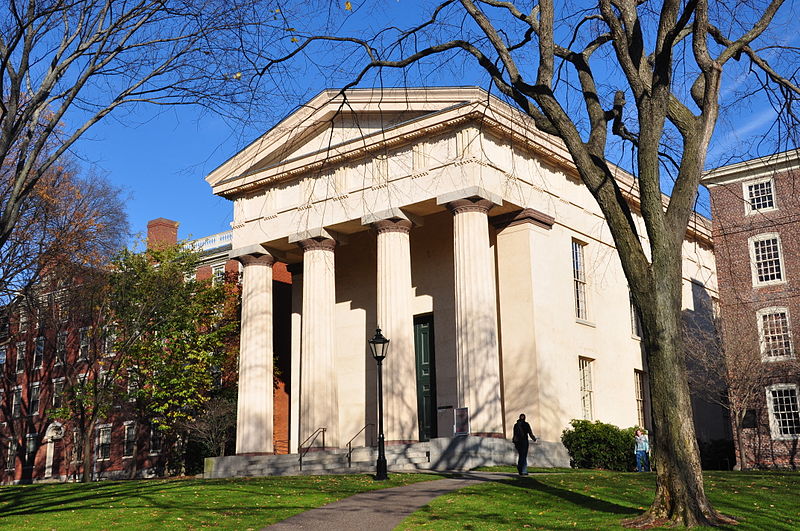
Established in 1764, Brown was the third oldest college in New England. Manning Hall, the neoclassical building shown in the photograph above, was the newest building on campus. No doubt it was a building that Oliver went into often, for it held both the library and the chapel. The president of the college at the time was Francis Wayland, a Baptist minister, who was stern but beloved and progressive.

As Evelina noted, Oliver was immensely pleased to be going to Brown, and she, in turn, seemed pleased for him. She was confident that he would study hard and do well.  Her pride didn’t protect her from feeling
“very lonely” today, though.  Choring was the only antidote she could imagine to liven up the quieter house.


Manning Hall, Brown University, Providence, Rhode Island