February 20, 1851


images-1

Feb 20th  Thursday  This morning sat down to sewing quite

early with Lavinia.  worked for Susan and she

sewed some with us  Sent George after Mr & Mrs

Whitwell about one Oclock.  Mr Whitwell attended 

the funeral of James Wells child  Commenced 

raining quite hard & this evening is very dark

The boys & Lavinia & Susan have gone to the 

dancing school at Lothrop Hall

The Thursday evening assemblies, or dancing school, continued. On this occasion, Oakes Angier, Oliver (3) and Frank Morton took their cousin, Lavinia Gilmore, and little sister, Susie, with them.  How exciting for Susan to go along to watch the young men and women dance; probably exciting for Lavinia, too.  She was at the marriageable age of nineteen and, in the manner of the day, was probably hoping to marry soon.  Getting off the farm for a week to stay with her aunt Evelina in the village of North Easton was an opportunity to socialize and perhaps meet someone special.  Did anyone ask her to dance?  Did her male cousins watch out for her?  Did she like what she wore?

Elsewhere in Easton life was not so light-hearted.  Reverend Whitwell officiated at a funeral for the infant son of James and Celia Wells.  James and his brother John, for whom the little boy was named, worked at the shovel factory.  They were originally from Maine.

And, being February, the weather took a dive for the worse.  The young people’s ride home from Lothrop Hall must have been disagreeably wet.  Mr. and Mrs. Whitwell, who had evidently stayed for tea after the funeral, were unable to get home and had to spend the night at the Ames’s house. Young George Witherell was spared the challenge of carrying them back to the parsonage in the dark, windy downpour.

February 19, 1851

Farm

Feb 19  Wednesday  A[u]gustus & wife came this morning in

the stage  We had our breakfast about six Oclock

and I had my morning work most done

We went to Mr Torreys to make a call met Alson

and Lavinia coming.  Alson went back to the poor

farm & Lavinia went with us to Mr Ts  Alson came

here to tea.  Augustus has engaged Mr Torreys

tenement if he concludes to take it   Beautiful weather.

Breakfast at six a.m., at work by seven.  That was the way it was done in the small industrial town of North Easton. By the time Augustus and Hannah Lincoln Gilmore arrived, the men of the house were at the factory and Evelina had washed the dishes, dusted the parlor and instructed Jane McHanna on the menu for dinner and  tea, probably adding additional directions on finishing up the ironing or some other piece of housework.

Off she went, then, to the home of her old brother-in-law, Col. John Torrey, with their mutual nephew, Augustus, only to meet her brother (and Augustus’s father,) Alson Gilmore, en route.  Alson had brought one of his daughters, Lavinia Eveline Gilmore, into town for a visit with the Ameses.  Evelina was fond of her niece, so the visit promised to be pleasant.

Alson soon drove off.  Evelina said he was headed to the “poor farm,” which may have been a jest expressing her opinion of the old family place or perhaps an expression of concern over the economics of the Gilmore homestead.  Or Alson may actually have been on an errand to an Almshouse located in the center of Easton*, near the church that the family attended.  Perhaps Alson was in search of temporary laborers for his farm, although why he would need help in the middle of winter is questionable.  Maybe he had an official role in its oversight.

Many towns had poor houses where the indigent lived; Worcester, Massachusetts established one in the late 1830s in alarmed response to a rising influx of immigrants.  Some citizens were afraid of the diseases that immigrants might be bringing with them, so part of the impetus for setting up a poor farm or poor house or Almshouse, as they were also known, was to establish a discrete site for new arrivals, pending further inspection.

Incidentally, today was an anniversary that probably went unnoticed in the Ames family.  On this date in 1810, a baby named Angier Ames was born.  He was the fourth son of Old Oliver and Susanna Angier Ames, coming along after Oliver Jr. and before William Leonard.  He only lived to be fifteen months old, dying in the summer of 1811 of an unrecorded cause.  Old Oliver wrote no record of this child; did he think of him on this day, some forty years later?

*A shout-out to Frank Mennino, Curator of the Easton Historical Society, for his capable sleuthing about the “poor farm.”  As he pointed out to me, the Almshouse can be identified on an 1855 map of the town. Thank you, Frank!

February 18, 1851

yoke-of-oxen

Feb 18  Tuesday  After doing my usual mornings work sit

down to sewing on Susans work   She sewed with me

and counted stiches again  She will do pretty well

and keep quite steady when we count stiches

This afternoon went into Olivers to assist on Helens

quilt but found it most done.  Was called home

to see Mr Whitwell   Abby & Malvina Torrey & their 

cousin Mrs Fullerton  called  Pleasant

Sewing lessons for eight-year old Susie Ames continued today.  She seemed to be getting the hang of the needle as long as she counted her stitches.  This meant calculating and maintaining an equal number of stitches per inch of sewing. After the lesson was through, Evelina tripped next door to help with the making of a quilt. She discovered that the work was pretty well complete, however, which was just as well as she was called back home to sit with Reverend Whitwell, who came to visit.  More follow-up to the Sewing Circle meeting?

Outside, away from this cozy domesticity, Old Oliver was clomping around looking at oxen to buy.  He found a pair that he particularly admired and seemed pleased with his purchase:

“this was fair day  wind about west and not cold   I bought a yoke of oxen to day of a Mr Whitcom of East Randolph for $125-00 they are a handsom red + look a good deal alike.  he said they would be 6 years old this spring comeing   the off one girts 7 feet + 2 inches + the nigh one 7 feet   they weighed after drinking with yoke on 3220 lb.  the man  said he had them for twins”

And while Old Oliver dealt with the farming side of the Ames enterprises, Oakes and his three sons were no doubt busy at the shovel works, the young men continuing to learn the ins and outs of manufacturing, much as little Susie was learning to be domestic.   The futures of all four offspring were being lined up.

February 12, 1851

Thread

1851

Feb 12th This was the day for the sewing circle & what a crowded

house! Not one here except Mr Whitwell and our own

families  Father Ames came in to tea & Sarah W

George, Emily & Oliver & wife  Poldens boy was buried

to day  Isabell & Ann went to the funeral & took tea

with Jane after they came back.  I prepared enough

for 40 and think it is very provoking to have none

 of the members  It is a delightful day.  Letter from Miss Foss

No one came to Evelina’s party.

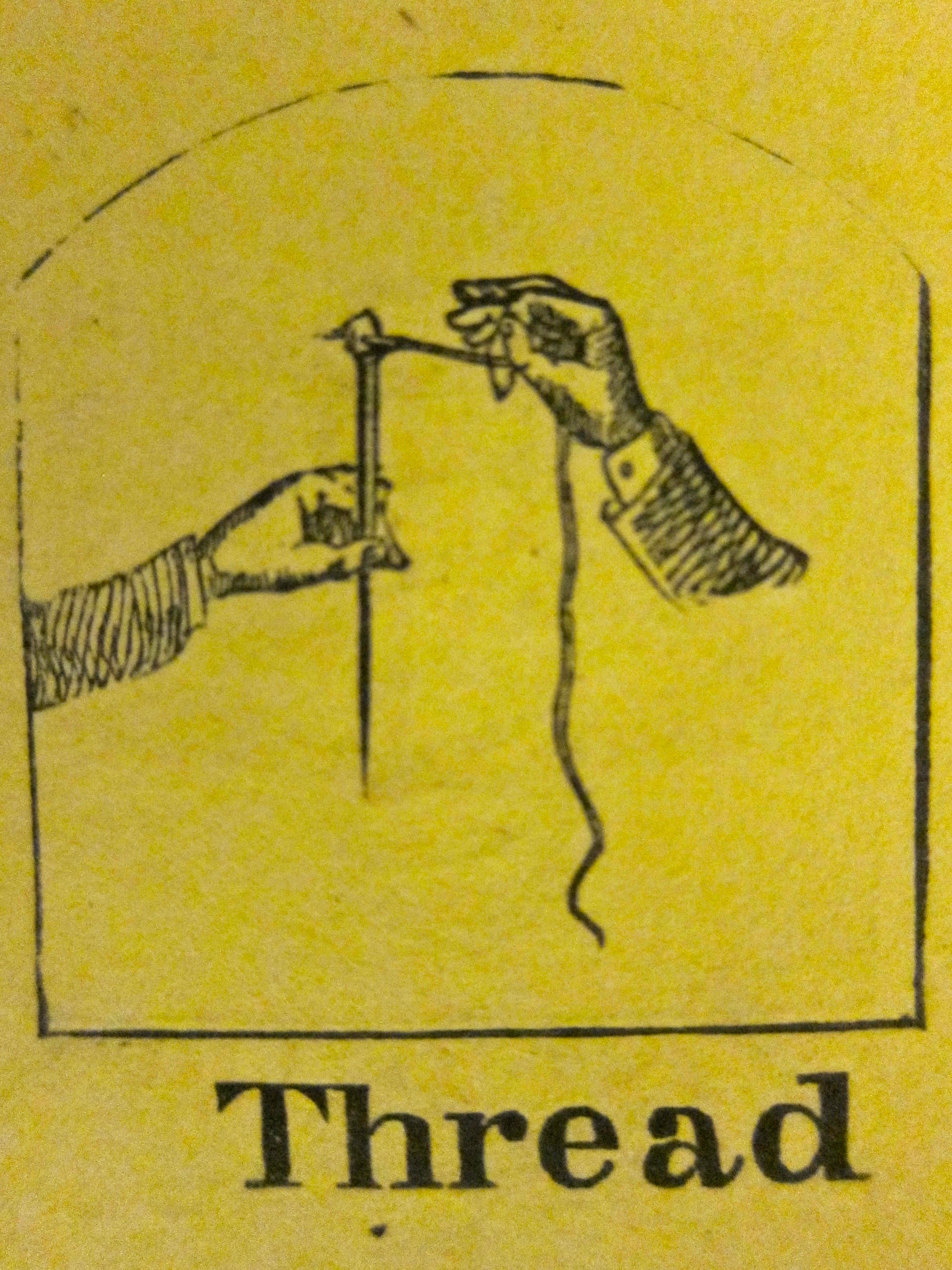
“Very provoking,” indeed.  Mortifying, even, that not a single member of the Sewing Circle attended today’s meeting, unless you count Reverend Whitwell.  All the preparations, the baking, the cleaning, the spools of thread from Boston, all in vain.

Evelina took the rejection with a lacing of humor: “What a crowded house!”  Although disappointed and upset, she must have been grateful for the way the Ames clan filed in to partake of the feast. From Old Oliver (who almost never came to tea) and all three Witherells to Oliver Jr and Sarah Lothrop Ames to her own children and husband, presumably, the family closed ranks around her and filled her parlor with warm bodies.  Even the Irish servant girls on their way home from a wake partook of the spread of food – in the kitchen with Jane McHanna, of course.

So what happened?  Evelina said the day was delightful but her father-in-law, a dependable chronicler of the daily weather, described “the going” that day as “rough + bad” even though the weather itself was “fair”.  After days of terrible weather that had swung from rain to ice and back again, some of the absentee members probably couldn’t drive their wagons out of their own yards.  Bad roads might account for some, if not all, of the truancy.

Nevertheless, the incident raises questions about Evelina’s popularity and social standing.  She was married to one of the most important men in town, and she and Oakes enjoyed the friendship of many.  Is it possible that some of the women in the Unitarian Circle resented her, or felt themselves superior to her?  Where were the women she had grown up with? Were they jealous of her? Did she fail socially in comparison to her sisters-in-law, each whom had a more refined upbringing? Sarah Ames and Sarah Witherell never failed to attract a lively turnout for their Sewing Circles.

All these possibilities must have swirled in her mind.  The true test would come when the Sewing Circle met again at Evelina’s, many months from this day, this awkward day that Evelina surely hoped to forget.

February 10, 1851

Storm

Feb 10th Monday  Warm this morning but not pleasant  Jane 

put her clothes out but the wind commenced blowing quite

hard with some rain, so that the clothes had to be taken

in & were dried over the registers  Cut Susan a Chemise

out of the width of  1  1/4 yd wide cloth and partly made it

Worked about house as usual on washing days in 

the forenoon  Wind blows quite hard this eve.

What a jungle of white linens the Ames house featured this Monday, with Jane McHanna having to drape dripping laundry around the heat registers.  So much for Evelina’s cleaning the floors the other day.  Miserable winter weather – snow, rain, ice, wind and rain again – was wreaking havoc with the domestic schedule.

One person in the Ames household celebrated her 12th birthday today: Sarah “Emily” Witherell.  Emily was born in New Jersey where her parents had lived while her father, Nathaniel Witherell, Jr., worked with William Leonard Ames, her mother’s brother, at various Ames enterprises.  Tragedy had struck in recent years, though, with the death of her father and the subsequent “drounding” of her two year old brother, Channing.  Emily was stricken with loss at an early age.

With her mother, Sarah; older brother, George Oliver Witherell; and grandfather Old Oliver Ames,  Emily now lived in North Easton, Massachusetts in “the other part of the house”.  She probably still attended school, but she and Susie Ames were too far apart in age at this point to be close friends, although they would soon find themselves sharing  piano lessons.  Her cousin Oliver (3) found Emily to be outspoken and opinionated; she was, evidently, unafraid of speaking her mind at a time when candor in women was not prized.

Emily never married.  After Old Oliver died in 1863, when she was about twenty-four, Emily and her mother moved into Boston, eventually taking up residence in Back Bay at the Hotel Hamilton and living off of distributions from investments managed by her male cousins.  A spinster cousin, Amelia Hall Ames, the only daughter of William Leonard Ames, eventually moved in with Emily.  These two cousins, in turn, may have undertaken to raise yet another cousin, Eleanor Ames, a granddaughter of William Leonard Ames. All that is in the future; on this day in 1851, we can hope that Emily had a special birthday despite the weather. She deserved a happy moment.

February 4, 1851

Governor Oliver Ames (Feb. 4, 1831 - Oct. 22, 1895)

Governor Oliver Ames

Tues Feb 4  Had my morning work done about nine Oclock just

as A A Gilmore & wife came to pass the day.  About eleven

we called to see Simeon Randalls house.  This afternoon

called at Mr Torreys and at Mr Peckhams.  While

we were at tea Mr Torrey called to talk about letting his

house to Augustus.  Received a letter from O Foss.

Passed this evening with Sarah W in the other part

of the house finished another pair pantletts  Pleasant

Evelina’s nephew, Alson “Augustus” Gilmore, and his wife, Hannah Lincoln Gilmore, came to North Easton today to search for a house to rent.  A young couple with one child, Eddie, they were expecting a second child in July, although they may not have shared that information with their aunt.  Even if they had, she would never have spoken of it.  The increasingly prim culture of the day forbid it, but the high rate of infant mortality, too, caused many expectant parents and their relatives to downplay “the blessed event.”  Evelina carried Augustus and Hannah around to look at available properties.

Although Evelina doesn’t mention it, today is the birthday of her middle son.  Oliver Ames (3) turned 20 today.  Like his older brother, Oakes Angier, and his younger brother, Frank Morton, Oliver worked at the shovel shop, learning the business in the expectation that he would one day help run the company.  He had attended school at Leicester Academy and had hoped to go on to college, as his cousin Fred Ames was planning to do, but his father had insisted that he return home to work. Oakes Ames was no fan of formal education, having despised learning in his own youth.

The eldest son, Oakes Angier, naturally stood first in line to superintend the shovel business, but Oliver (3), would be a partner. Like his father, he was ultimately slated to travel as the company’s salesman.  Third son Frank, on the other hand, would be given an auxiliary administrative position in a related family-owned business, the Kinsley Iron Works Company in Canton.

But on this day, those occupations were in the future, as was Oliver (3)’s more memorable service as Governor of Massachusetts from 1886 to 1889. On this birthday, he was a brand-new twenty year old who worked hard all day, read alot, and enjoyed attending “sings”.


February 1, 1851

Ames Home and Office, North Easton, Massachusetts ca. 1852 - 1862

Ames Home and Office, North Easton, Massachusetts
ca. 1852 – 1862

Feb 1st  Saturday  Sit down to mending again this morning

Mended a pr of kid gloves and a number of other things

Went into the other part of the house with mother

to tea  worked on panteletts finished two prs.  Mrs Packard

and Mrs Rhoda Fuller called there  Mr Ames has been 

to Boston & brought home Ladys Books Grahams & Harpers

& International Magazines & 1/4 lb Angola yarn.  Have been

reading in the magazines this evening.  Cloudy & warmer

Evelina often mentions going into “the other part of the house,” which was a section of the house on the southern side in which Old Oliver, a widower, lived with his widowed daughter Sarah Witherell and her children.  This section was created when Old Oliver turned the original (ca. 1812) dwelling into a duplex in 1827 on the occasion of the marriage of Oakes and Evelina.

In 18th century New England, family custom often dictated that the eldest son inherit the family homestead and, in order to effect that, houses were sometimes renovated to allow two families to live side by side until the transfer of property came to pass.  That this practice was becoming less prevalent in the 19th century meant nothing to Old Oliver who, independent and conservative, still had his feet in the 18th century in certain ways.  His home would go to his eldest son, and he would eventually provide homes for his other children as well.

In the above photograph of the Ames House on Main Street, we can see the original home in the center, a building that is divided in two on the inside, with Old Oliver’s doorway facing toward the camera (behind the middle tree).  The entryway for Oakes and Evelina faces the street.  To the left of the house is the attached office, where Oakes and Oliver Jr and others kept track of business matters.  It was known as the Counting House.

In the background to the right is the house Old Oliver built for Oliver Jr and wife Sarah Lothrop Ames on the occasion of their marriage in 1833.  In 1863, they would tear this down and rebuild a more modern and formal abode, one that still stands today. The old homestead, which housed generations of Ameses in its time, was torn down in 1951, approximately 100 years after this photograph was taken.

January 30, 1851

Flames

Jan 30th  Thursday  Mended Mr Ames pants which

took me most of the forenoon, read some to Mother.

Spent this afternoon at Olivers with mother & Mr

Whitwell.  They sent the carriage for Mrs Whitwell

but it was so cold that she did not come.  Mr Ames

took tea with us & Mr Ames Oliver Jr C Lothrop & 

Helen played cards I commenced a stocking of the yarn

Mrs Foss gave me.  A bitter cold day & quite windy.

A great fire in Taunton

“A verry bad day to go out in,” noted Old Oliver in his journal today.  Eliza Whitwell refused to leave her home several miles away to join the Ames ladies in the afternoon, even though her husband was there.  The carriage – did it belong to Old Oliver, or Oliver Jr, or to the family in general?  Whoever owned it, its likely driver was Michael Burns, an employee of Old Oliver who looked after the horses and carriages.

While Michael drove to and from the parsonage in the howling cold, various family members gathered next door at Oliver and Sarah Lothrop Ames’s house for tea. Oakes and his son Oliver (or possibly his brother Oliver – unclear) played cards – probably whist – with Cyrus Lothrop and Helen Ames.  Cyrus was an unmarried brother of Sarah Lothrop Ames who lived with Sarah and Oliver, Jr. for many years. Helen was their only daughter; their son, Fred, was probably away at Phillips Exeter Academy on this occasion.  Evelina knitted and kept her mother company.

In nearby Taunton, Massachusetts, Evelina reported, the furious wind contributed to a “great fire.”  The histories of that period don’t mention this fire, so perhaps it was not as great as Evelina thought.  That, or it paled in comparison to the larger fires that Taunton suffered in 1838 and 1859.*  Fire, naturally, was the dread of every homeowner and municipality; towns and cities in the 19th century (and before) were pock-marked by periodic burnings, its citizens haunted by the loss of life and property that fires engendered. The fire on this day in Taunton would have been made especially difficult by the frigid air and icy wind.

*Information obtained from Old Colony Historical Society, Taunton, Massachusetts

January 29, 1851

Carpetbag

Carpetbag

Jan 29th  Finished my carpet bag this morning and afterwards made

a long call on S Witherell and then she came here and sit awhile

with Mother.  This afternoon cut Susan 4 prs of pantletts

and finished a pr that was cut out a long time since.

S Witherell passed an hour with us this afternoon and 

then again this evening  The boys went to the shop awhile

Mr Ames came home at 1/2 past seven (wonderful to relate)

and has been reading in Mr Lovells paper  Very heavy rainfall

Pleasant tonight but very windy

Sewing the carpet bag was speedy work for Evelina, given her skill with a needle.   Carpetbags were fashionable travel bags from as early as the 1820s, in America and England.  They gained notoriety after the Civil War when they became symbolic of certain ruthless opportunists – “carpetbaggers” – from the North who flooded into the South to take advantage of the post-war confusion and economic disarray.  The negative symbolism of this small piece of luggage was unknowable in 1851, obviously, so we can imagine that Evelina carried her new carpetbag with pride.  Perhaps she used it on her next trip to Boston.

Oakes Ames didn’t linger in the office tonight as usual but came home for a quiet evening of reading the Olive Branch.  Evelina was pleased to have his company, which must have provided some variety for her elderly mother, too.  Sarah Witherell’s company would have added to the ease and sociability of the evening.  More often, Sarah stayed in her part of the house in the evening in order to be company to her father. And the boys – Oakes Angier, Oliver (3) and Frank Morton – went back to the shop, although the nine o’clock curfew was nigh.

The Ames house was divided into two living areas, with Old Oliver, Sarah Witherell and her two children on the southern side and  Oakes and Evelina’s family on the northern.  Old Oliver made this division back in 1827 when Oakes and Evelina first married, indicating then that Oakes, as his eldest son, would inherit the family  homestead.  The two families had lived side by side ever since, the house expanding and contracting as children grew up, occupants died or moved out, and grandchildren came into the world.

Some Ames family members of today who can remember the old homestead (it was torn down in 1951) shake their heads in wonder at this living arrangement, curious as to how everyone fit in.

January 27, 1851

Read

Jan 27th Monday.  As usual this morning have been washing dishes

and working about house all the forenoon.  could not sit

with mother at all.  It was cloudy and looked like rain

but Jane ventured to put her clothes out to night  They

are nearly dry.  This afternoon & evening have finished

Susans gingham apron.  Sarah W came in awhile this

evening and the boys have been reading.  After school

Susan went to see Mary Ann Randall.  Cloudy

Another Monday, meaning that Evelina did the housework while Jane McHanna tackled the laundry.  Evelina was too busy “choring,” as she often called it, to sit down in the morning and sew or read with her mother, Hannah Gilmore, who was visiting for the week.  The women sewed together in the afternoon, however, after the midday meal, and in the evening, they enjoyed a visit from Sarah Witherell.  Oakes was most likely over in the office; he and his brother Oliver Jr. often worked there in the evenings after tea.

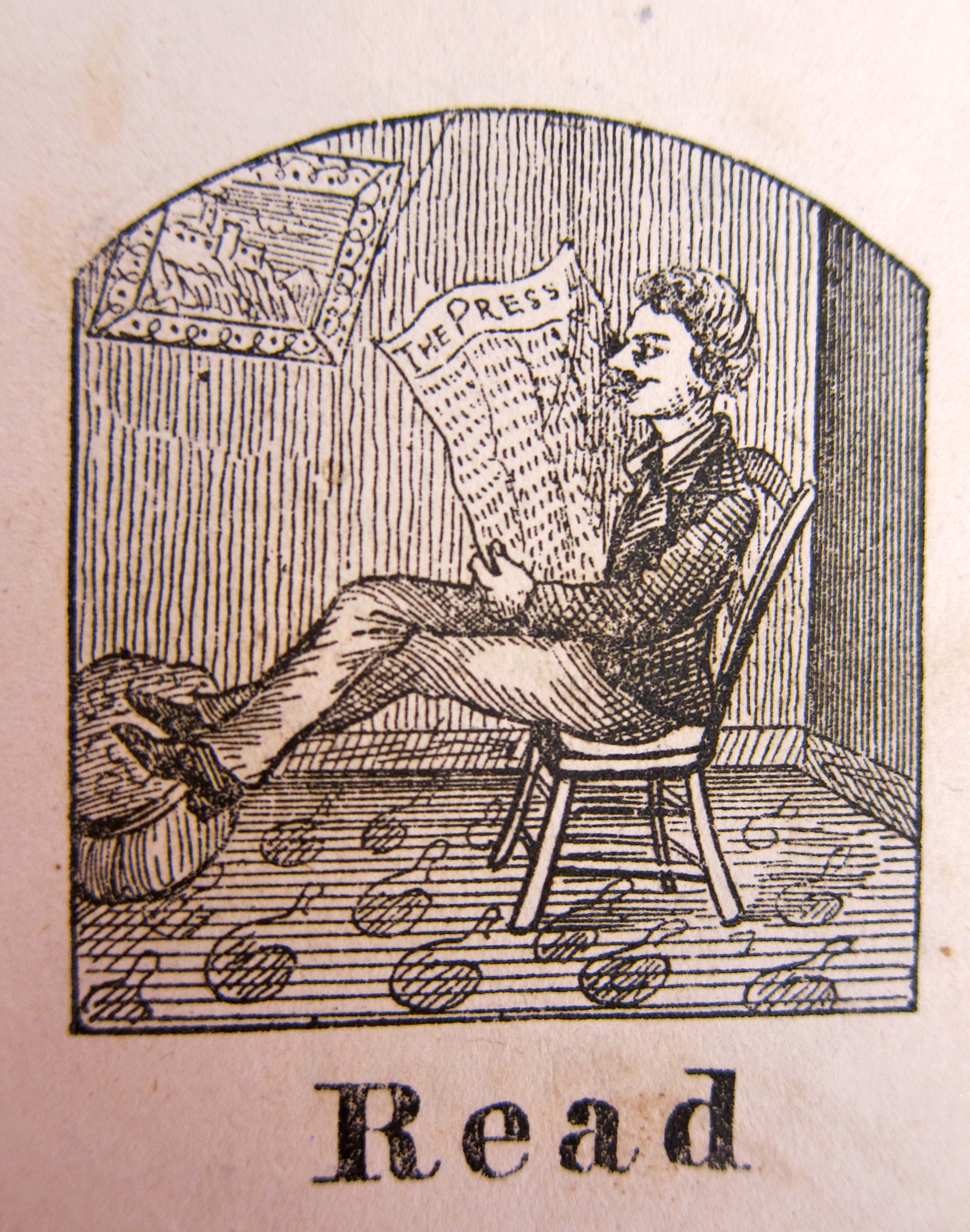
The boys were around, of course.  The shovel factory closed at 6 P. M. whereupon Oakes Angier, Oliver (3) and Frank Morton walked home. There were no dances on a Monday night, so after tea, they amused themselves by reading.  All three boys read, yet Oliver (3) was reckoned to be the most scholarly.  Even as a child he enjoyed reading and, with Oakes Angier, began to collect books. Years later, a colleague would say of Oliver that “in the company of books he found an absorbing pleasure.”*

On this winter night, everyone indulged in the papers or books, reading by the light of various oil lamps.  Evelina was no doubt eagerly turning the pages of David Copperfield, perhaps reading aloud to her mother whose aging eyesight may have precluded the pastime.  Hannah Gilmore loved to read.   In fact, she had named Evelina after the heroine of a book popular in her youth: Evelina; Or the History of a Young Lady’s  Entrance into the World.  This comic novel by British author Fanny Burney came out in 1778, and continued to find an appreciative audience in both Britain and America.   Evelina had probably read it at some point, if only to see how Evelina Anville captivated Lord Orville.

*Memorial Volume for Governor Oliver Ames, ca. 1896