November 29, 1852

il_570xN.860424141_hg5d

Monday Nov 29  I was intending to go to Boston to day

but as the weather was rather unfavorable

early this morning did not but it has been

a beautiful day.  Father has six hogs killed

and we have one.  Rode down to Mr Whitwells

to see her cloak and get the pattern.  Malvina

has come to spend the night with Susan

Mr Ames has presented me with a pr of Silver butter

knives  it is 25 years to day since we were married


Evelina and Oakes Ames celebrated their 25th wedding anniversary on this date. They had been married on Thanksgiving Day, November 29, 1827.  During the first part of the 19th century, Thanksgiving was a common time for couples to marry, as family members were already gathered for the annual feast, and a qualified leisure prevailed since most agrarian obligations were set aside for the winter. There was time to celebrate.

Oakes and Evelina’s wedding would have been a simple one, at home, not unlike one described by an English couple who happened to attend a nuptial ceremony in western Massachusetts in 1827:

“They found a company of kin and neighbors crowded into a farmhouse parlor, some perched on benches, others sitting on chairs ‘as if they were pinned to the wall.’ The bride and groom, with their bridesmaid and groomsman, sat facing the minister, who pulled up ‘a chair before him, on the back of which he leant.’ He then motioned for the company to rise, joined the couple’s hands together and led them through a brief exchange of vows. Most American couples were wed by a clergyman at the home of the bride, in such informal ceremonies of republican simplicity.”*

Oakes was the first of his brothers, and Evelina the last of her sisters, to marry. The couple moved right into the Ames family home, one-half of which had been remodeled to accommodate the newlyweds. Twenty-five years later, they were still in that homestead, as well as four-children-and-many-dollars richer, richer enough for the old groom to buy the old bride a pair of silver butter knives.

Evelina had intended to go into Boston, but couldn’t. Instead, she had to content herself with riding down to see the minister’s wife, Eliza Whitwell, to borrow a pattern for a cloak. Earlier, she had seen a cloak that her sister-in-law, Sarah Lothrop Ames, had bought and she wanted one, too. She would make her own, however, rather than order something bespoke from Boston.

Evelina also notes that her father-in-law has butchered some hogs, yet Old Oliver himself mentions nothing about it – at least on this date in his journal. He does say that he killed six hogs three days later, December 2. It’s possible that Evelina was writing some of these entries several days after the fact, and may have been confused as to dates. Or she may have been anticipating the slaughter.


*Jack Larkin, The Reshaping of Everyday Life, New York, 1988, p. 63

November 25, 1852

Turkey

Nov 25

[…] Thanksgiving  Mr & Mrs

Whitwell Father Mrs Witherell Emily Horatio &

Gustavus dined at tea here.  Michael &

sister & Ann Oral at the second table.

Mr W went home at half past three to

marry a couple   Oakes A Emily & Susan went

with him After they left this evening Mrs

Witherell & self called on Mrs Dow in Olivers

Mr & Mrs Dow & family Mr & Mrs H Lothrop & Cyrus

at Olivers 

“[T]his was thanksgiving day,” wrote Old Oliver Ames, after a brief notation that the day “was fair in the morning but clouded up in the afternoon”. Evelina and her servants prepared a feast that fed at least fifteen people. The whole Oakes Ames family was there, naturally, and so was Old Oliver. Dining with them were Sarah and Emily Witherell, Reverend and Mrs. Whitwell, brother Horatio Ames and his youngest son Gustavus, the latter two having arrived from Connecticut the day before. At the “second table”  – which likely means a second seating – the servants partook. Catharine Murphy and Ann Shinkwin were presumably present, as was Michael Burns (Old Oliver’s coachman/ostler), his sister and Ann Orel, a young Irish girl who worked for Sarah Witherell.

Family gathered next door, too. The Oliver Ameses, meaning Oliver Jr.,Sarah Lothrop Ames and their children Fred and Helen, shared the repast with two of Sarah’s brothers, Henry and Cyrus, along with Henry’s wife Eleanor and long-time friends, the Dows. Quite a gathering, all told, as family members dined and visited.

Sarah Josepha Hale, the patron saint of Thanksgiving, describes her understanding of the origin of Thanksgiving in a novel she wrote in 1827 and republished in 1852:

“Soon after the settlement of Boston, the colony was reduced to a state of destitution, and nearly without food. In this strait the pious leaders of the pilgrim band appointed a solemn and general fast. […] The faith that could thus turn to God in the extremity of physical want, must have been of the most glowing kind, […] On the very morning of the appointed day, a vessel from London arrived laden with provisions, and so the fast was changed into a Thanksgiving.”

This may have been the version of Thanksgiving that Mrs. Hale used to persuade Abraham Lincoln to make it a national celebration. It also may have been the story of Thanksgiving with which the Ameses were most familiar.


November 19, 1852


images


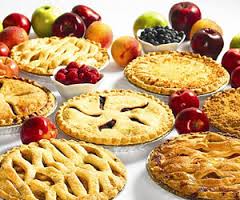
Friday Nov 19th  Have heat the brick oven

three times have baked Apple squash

& mince pies & […] bread & ginger snaps

Mr Adriance here from New York to

spend the night  I guess he thinks

we are nice folks here & that I look 

neat.  Catharine [entry incomplete]

Thanksgiving was less than a week away, so housewives and servants across Easton were beginning to prepare. Just as we do in the 21st century, family members would gather for the holiday, often arriving to stay for a number of days. Thus not only did the grand feast itself have to be prepared, but all the breakfasts, dinners and teas leading up to and following Thanksgiving had to be amplified as well. No wonder Evelina was baking such an abundance of food. Her immediate family was already all in place, but others would be joining them.

In fact, the Ameses had company today, a Mr. Adriance from New York – probably a business associate of Oakes, perhaps someone who purchased shovels. Evelina never seemed to mind setting an extra place at the table and Mr. Adriance evidently admired her. She looked “neat.” What fun for her to be complimented this way. Do we think that Oakes noticed?


November 11, 1852

alcott_lou

Louisa May Alcott

(1832 – 1888)

Thursday Nov 11th

Ann & Catharine has cleaned the shed chamber

and sitting room chamber & I have been 

putting draws & closets in order.

Mr Ames & self at Olivers to tea  Mr &

Mrs Swain & Mrs Meader there

Commenced Susan an Angola yarn stocking


For Evelina, this was a productive day. Her servants, Ann Shinkwin and Catharine Murphy, cleaned the shed and the sitting room, while she herself reorganized “draws & closets”. She must have felt quite satisfied having put two key rooms in order. Come evening, she and her husband went next door to tea where they visited not only with the Oliver Ameses, but also with Ann and John Swain and Ann’s mother, Sarah Bliss Meader. Mrs. Meader was from Nantucket; she must have been visiting in the wake of the death of little John Swain.

For Louisa May Alcott, a 19th century author who should need no introduction, this was an important day. Some literary sources have it that Miss Alcott, using the name “Flora Fairfield,” published her first story, The Rival Painters: A Story of Rome, on this exact date, when the author was barely twenty years old. However, closer examination suggests that The Rival Painters first appeared back on May 8 in The Olive Branch, a periodical published in Boston from 1836 through 1857.  A second story, easily confused with the first, was The Rival Prima Donnas, which was published on this date in 1854 in The Saturday Evening Gazette, earning the author five dollars.

Regardless of the scholastic disagreement over the first appearance in print of Louisa May Alcott, we can imagine that Evelina was exposed to her writing at various times from this year onward. Surely Evelina read other short stories and novels by this increasingly famous author. If she developed an affection for the author’s work, Evelina would have read Little Women, Little Men, and Jo’s Boys and been as familiar with the triumphs and travails of the March family as devoted readers still are 160 years later.

*A fine resource for readers wanting to know more about Louisa May Alcott is “Louisa May Alcott: The Woman Behind Little Women,” by Harriet Reisen, New York, 2009.


November 8, 1852

83a3a337ba181f911b01be69f4dabfa0

Monday Nov 8th  Ann & Catharine washed this morning

and I have been making part of my

quince preserve and some marmalade

Mr & Mrs Swain & Mrs Meader spent

the afternoon in fathers and Mr Ames

& self were there to tea. Mrs [entry incomplete]

“[T]his was a fair good day. it was Town meeting day and Wade Daily was chosen Representative, Free soil.” wrote a pleased Oliver Ames. Although the national election for president had been held the previous week, voting men from Easton gathered to vote on local issues and perhaps to hear the formal results from last week’s election. We must remember that voting, and vote counting, was a manual affair.

Historian William Chaffin gives us the run-down, confirming Old Oliver’s account:

“Horace Mann, the Free Soil candidate for governor, received one hundred and eighty-eight votes in Easton, one more than the Whig candidate, John H. Clifford; and on a second ballot, and with the help of the Democrats, the Free Soil candidate for representative, Wade Daily, was elected.”

Wade Daily, elected to the General Court of Massachusetts, was an older member of the community, a veteran of the War of 1812. A “master carpenter,” according to Rev. Chaffin, Mr. Daily was responsible for the erection in 1816 of the church building that housed Luther Sheldon and his congregation. He had also served as a selectman in the early 1830s.  As a Free Soiler – meaning he wasn’t in favor of the spread of slavery – Wade Daily rated high in Old Oliver’s opinion. He and his wife of sixty years, Ruth, are buried in the Easton Central Cemetery.

Back at home, the women, who did not attend town meeting or participate in the political decisions of the town, were busy in the kitchen washing the weekly laundry and making preserves. All gathered for tea.

November 5, 1852

Oliver Ames, Jr.

Oliver Ames, Jr.

(1807 – 1877)

Friday Nov 5th Susan has taken her ninth lesson

in music and I fear she is rather dull

does not call her letters well at all

Mrs Swain called this afternoon to settle

with me about her things and to night sent

me as a present as much as a half bushel […]

quinces  We passed the evening in Olivers

After stopping by to pay for the mourning apparel Evelina had picked up in Boston, Ann Swain sent Evelina two pecks of quinces to further thank her for her kindness. This thoughtful gesture may have distracted Evelina from her ongoing annoyance at her daughter’s “dull” piano playing. Susan had not yet learned her scales. At night, Evelina and Oakes, and perhaps other family members, “passed the evening” next door at Oliver Ames Jr’s.

Today, in fact, was Oliver Ames Jr.’s 45th birthday. He and his wife, Sarah Lothrop Ames, lived next door to Oakes and Evelina. At this juncture, Oliver Jr. was serving his first term as State Senator; he would serve a second term in 1857. According to Reverend William Chaffin, who knew the Ames family well, “Oliver Ames stood among the foremost in his reputation for a manly and unblemished character and for business ability…a strong, substantial, able, and honorable man.”****

The third of Old Oliver’s eight children, Oliver Jr. had originally been the brother who tinkered with the possibility of a career away from the shovel factory. In his teens, he suffered a “severe fall,”**** and was unable to work. He was sent to the Franklin Academy in North Andover after which he began to read law with William Baylies, Esq., of West Bridgewater. Reading and debating – good lawyering skills, both – had always been sources of pleasure for Oliver, but “[t]he confinement of office proving unfavorable to his health, together with the increasing demands of business at home,”**** he returned to North Easton. In 1833, he married Sarah Lothrop, the daughter of the Honorable Howard Lothrop and Sally Williams Lothrop. They had two children, Frederick Lothrop and Helen Angier Ames.

Relative to his brother, Oakes, Oliver Jr was reckoned to be “pretty dignified, and takes a good deal after his father, but Oakes is always ‘hail fellow well met.”** Another contemporary acquaintance of both men said simply that Oliver Jr. was “the conservative one.”***They made a good business pair. Over time, Oliver Jr. and Oakes, under the watchful eye of their father, turned the shovel shops into an industrial powerhouse, even as they groomed the next generation, Oakes Angier, Oliver (3) and Fred, to take over when the time was right. They invested in technological improvements and hired more help, especially from the newly arrived Irish population. They improved supply and delivery; in 1855, Oliver Jr. helped create the Easton Branch Railroad spur from Stoughton to North Easton.  In 1863, he oversaw the creation of a railroad line through the Great Cedar Swamp to Raynham. His interest in railroads led him to join his brother in the plan to build a transcontinental railroad when Oakes, by that time a U. S. Congressman, was tapped by Lincoln to lead the way.

The rest, as they say, is history. Both brothers became “deservedly famous”*****for their involvement with the Union Pacific. More than one contemporaneous historian has noted: “In 1866, Oliver Ames was elected president of that railroad, an office he held with significant ability until March, 1871.  During this time the road passed through some of its stormiest days and severest trials. His sound judgment, great business capacity, and inflexible integrity were of immense service in carrying this great enterprise safely through difficulty and peril to final success.”*****

On this dark autumn night in 1852, the “difficulty and peril [and…] success” lay ahead for both brothers as they sipped tea with their wives and watched “a few flakes of snow” fall.*

*Oliver Ames, Journal, Stonehill College Archives, Arnold Tofias Collection

**“Ames at Easton: The Shovel Makers and Their Works. Life and Habits of the Congressman. Cursed Abroad – Applauded at Home,” The Boston Times, February, 1873

***Josiah Bushnell Grinnell, Reminiscences of Forty Years, 1891, Boston, p. 137

****William Chaffin, History of Easton, Massachusetts, 1886, p. 655.

*****Duane Hamilton Hurd, History of Bristol County, Massachusetts, Vol. II, 1883, pp. 430 – 431 (also Chaffin, p. 656)

November 3, 1852

Thread

Wednesday Nov 3d  The girls took their eigth

lesson this forenoon and I sat with

Susan to see her take hers so that I 

could assist her some if required

We have been to the funeral and 

then Mrs S Ames and self went to the sewing

circle at Mr Clarkes,  Miss Alger took

tea with Witherell.  Lavina Wms called

Susie Ames and Emily Witherell took another piano lesson this morning. Evelina, still determined that her reluctant daughter was going to learn to play the new instrument, “sat with Susan” in the parlor as she had her lesson. Miss Alger, the teacher, had tea with Sarah Witherell later in the day. The two women might have discussed how the girls were faring with their lessons; with Evelina out of the house, it would have been easier to discuss the fact that Emily was the stronger student.

Evelina and Oakes, presumably, and other Ameses attended the funeral of the Swain baby. John H. Swain Jr. had died on Sunday from “Teething,” much to his parents’ sorrow. Today, the sun was out, though the wind blew, as folks gathered around the little grave.

Afterwards, Evelina and her sister-in-law, Sarah Lothrop Ames, rode to the monthly Sewing Circle at the home of “Mr Clarke.”  He may have been Daniel Clark, a carpenter, whose wife was Elvira Clark and whose daughter, Elizabeth, had played the piano at the meeting house the summer before last. The piano again! Evelina couldn’t get away from other mothers whose daughters did well at the piano. How frustrated she must have felt about her own daughter.


October 26, 1852


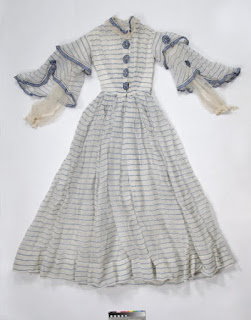
1860s blue striped muslin dress from St. Albans Museums

Dress with undersleeves, mid-19th c.*

Tuesday Oct 26  We have had a large washing

done to day and not finished untill

after dinner  Miss Alger & self spent

the afternoon in Olivers  Mr Ames

& all the children there to tea  Mr & Mrs 

Whitwell was there an hour or two

I made Susan a pair of undersleeves

and she is delighted with them


Because of all the company that had visited over the weekend, the servant girls were unable to launder clothes on Monday. Today, extra sheets and towels were added to the usual load and the washing went on into the afternoon. Not that Evelina rolled up her sleeves; after the midday meal, she and her remaining houseguest, Miss M. J. Alger, went next door to visit with Sarah Lothrop Ames and stayed for tea. All the family partook.

At various points during the day, Evelina had her work box open as she completed a pair of undersleeves for her daughter. Susie was “delighted” with them. Were they a peace offering from mother to daughter, perhaps to make up for Evelina’s insistence on Susan learning to play piano?

We’ve seen Evelina sewing undersleeves before. In the 1850’s and into the Civil War, undersleeves were an essential component of any woman’s dress, fitting independently but securely under the looser outer sleeve of the dress proper. Like the collars of the day, a good pair of undersleeves could be worn with different dresses. Susie must have felt rather grown-up with her new pair.

On the industrial side of American life, meanwhile, today was the 27th anniversary of the opening of the Erie Canal. The technological wonder of its day, it was already becoming obsolete. Railroads had arrived and, through their own capacity for moving freight, would soon obviate commercial use of the canal for many (though not all) industries. Shipping would change – was changing. The very word “shipping” derives from the fact that, initially, more goods moved by water than by land. This would no longer be true in this country or elsewhere in the developed world.

We should remember that Harriet Ames Mitchell, Old Oliver’s youngest daughter, was living in Erie at the time with her husband Asa and their three children.  Did they mark the day?


*Image of striped blue muslin dress with undersleeves courtesy of St. Albans Museum, England


October 20, 1852

piano_voice_guitar_lessons

Wednesday Oct 20th  Have been expecting Miss Alger

all day but she has not come  Have been

trying to assist Susan some about her

music lessons and it hinders me about

my work very much  I wish it was not

such an effort for her to practice.

A gentleman here to dine from New York.


It’s easy to imagine the affable Oakes Ames inviting visitors to dine. He was a sociable man, for all his competitive spirit, and had a fine sense of humor.  He knew that his wife took pride in her home, that she could act the hostess and that she – or her servants – prepared a midday meal hearty enough to feed him and his grown sons. How much warning he might have given her that he was bringing someone over from the shovel office for dinner, we can’t know. But Evelina seemed prepared to feed guests as well as her own family, and she no doubt welcomed the gentleman from New York.

The meal preparations were usually left to the servants, of course, although Evelina supervised. Today, however, her focus was on her daughter and the new piano. She was unhappy with Susan’s evident disinterest in the instrument. The girl wasn’t practicing her scales and lessons as she should have been.

When Evelina and her sister-in-law, Sarah Witherell, purchased the pianos and arranged for Susan and Emily to take lessons, Evelina likely had imagined that she was doing her daughter a favor, giving her a gift that she herself had never gotten. But Evelina was disappointed, as things didn’t turn out the way she expected. Susan wouldn’t practice so, for now, Evelina had to intervene and “assist.”


October 17, 1852

The knife and fork. Old with white bone handle.

Sunday Oct 17th  

Went to church all of us.  Came home

at noon with Mr Ames and had a cup

of tea and lunch in the buttery

Catharine Middleton left this evening

and I paid her five dollars for the

three weeks that she has been here now

and one week some time since

This may be the first time that Evelina uses the word “lunch” in her diary. Usually, the meal in the middle of the day was dinner, and it was the big meal. But on Sundays, the routine was changed because, ostensibly, housewives didn’t cook. It was a Day of Rest. The women were at church and had no time to prepare a hot meal between services. Instead there was a cup of tea and a piece of cake at the parsonage or, in good weather, there might be a bread and fruit picnic on the lawn of the church, near the carriages. Early tail-gating, if you will. If a housewife were at home on a Sunday, as Evelina sometimes was, she might end up cooking, especially if she had houseguests. But the norm was no cooking.

Lunch, per se, was something different. The word itself was a shortened version of “luncheon,” which was generally accepted to be a small meal that might be held at any time of day, in between two larger meals. For most of the 19th century, luncheons were considered to be the province of middle- to upper-class ladies – hence the phrase, “ladies who lunch.” Cold meats, fruit, pastries and tea might make up the menu for the female meal.

Yet as industrialization of the workday took over, replacing the former agrarian practice of a substantial meal in the middle of the day, lunch as we know it became more accepted. Men took their cold meals to work, or warmed up a can of something over a stove or a radiator at the workplace. By the 20th century in America, lunch happened in the middle of the day and dinner moved to the evening.

In her diary, Evelina was only suggesting that the meal she and her husband shared at a scrub-top table in the pantry was no regular dinner. Little did she know that this simpler midday meal would one day be the norm.