May 8, 1852

Ill

1852

Saturday May 8th  Mrs Witherell has finished working

my Delaine sleeves and I have put them in

and have finished the dress which I think

is about time.  I sit with George for Mrs Witherell

to lay down this afternoon  He is very sick and 

suffers very much.  Mr Manly brought me some

more plants & I paid him 1,58 cts.  Oliver &

Brown returned this morning

George Witherell, fourteen years old,  was ill with rheumatic fever. In the age before antibiotics, the “rheumatics,” as Evelina called it, was a serious illness. It was a complication of strep throat, which George must have had three or four weeks earlier. Its symptoms, many of which George manifested, were fever; a flat rash; involuntary twitching in the hands, feet and face; painful, tender and swollen joints; chest pain; palpitations and fatigue. As Evelina noted, George suffered a great deal, for rheumatic fever was extremely uncomfortable and unsettling. It was also often fatal.

Sarah Ames Witherell had been nursing her son for several days now.  She took a rest in the afternoon and let Evelina sit with George.  All the family was helping, although George wasn’t the only sick child. Helen Angier Ames next door was down, too, with a somewhat mysterious ailment in her face. Family members were worried about both young people.

Despite the concern everyone must have been feeling, normal routines in this season of planting had to be adhered to. Old Oliver reported that “we began to plow the hill back of the shovel shop pond to day.”



May 7, 1852

il_340x270.517720740_i0s3

Polyanthus

Friday May 7th  Was in the garden to work a short

time transplanted some pinks but worked on

Olivers clothes most of the time.  Mr Brown &

Oliver rode to Mr Copelands and got me a polyanthus

and to the furnace in the afternoon to Canton 

and Sharon.  Mrs S Ames returned from Boston to

night & Helen with her  Helens face is very

swollen has not been to school for a week


With her middle son Oliver home from Brown, Evelina had a great deal of mending to tend to. She might have preferred to be in her flower garden, but she only had a short window in which to repair her son’s shirts, hose, and coats. Oliver, meanwhile, rode out with his college roommate, Mr. Brown. They roamed from Easton to Canton and Sharon and in the process picked up a polyanthus, or primrose, for Evelina. They got the latter from a Mr. Copeland, who was perhaps Josiah Copeland, an elderly resident of Easton who lived with his wife and unmarried daughter.

George Witherell continued to be ill in the other part of the house, but he wasn’t the only family member who was ailing.  Helen Angier Ames had to come home from boarding school because of a swollen face. Perhaps she had an infection – an abcess of some sort – or perhaps she was having an allergic reaction to an insect bite or other allergen. Whatever was ailing her, she hadn’t attended class for a week, and her mother had to fetch her home.


May 5, 1852

Thread

Wednesday May 5th  Worked about house & got my sleeves for Delaine ready

for Mrs Witherell to work  The sewing circle met

at Mrs Nahum Pools.  Mrs S Ames gone to Boston

George quite sick with the rheumatics Augusta gone

to N Bridgewater and so poor I should have had to

go alone.  Preferred to stay at home  Mr Peckham +

family all at Mr Swains.  called to see them & after they

left Mr & Mrs Swain went with me to Edwins garden got

two Gladiolus bulbs.  A beautiful pleasant day

The Sewing Circle met today at the home of Nahum and Lidia Pool, but Evelina didn’t attend. Her usual companions from the village were otherwise occupied, and “poor” she didn’t want to go by herself. She stayed home, or at least she stayed in North Easton. She parcelled out some sewing to her sister-in-law, Sarah Witherell, to work on, and headed out. Perhaps Sarah sat and sewed near her son George, who was “quite sick.”

The day was beautiful, and Evelina seemed to be in fine spirits despite missing the sewing circle, or perhaps because of missing it. She went to see John and Ann Swain and there encountered the Peckham family, who had moved away from North Easton the previous year. They must have been back for a visit.  When they left, Evelina and the Swains went up to the garden of Edwin Manley and bought two Gladiolus bulbs.

April 13, 1852

Ill

1852

Tuesday April 13th  Watched with Mrs Brett last night

She is quite low seemed to like my being there and

urged my coming to see her often and said she meant

to come to see me and be more friendly if she ever

gets well  said her Mother told her in her last hours

to come to me for advice and regretted that she

had not done so but meant to in future  The rain of 

the morning has turned into a heavy snowstorm  Susan & self

carried our work and stopt a couple of hours with Mrs W

A young neighborhood wife named Eveline Brett was ill, probably with childbed fever. Evelina went to stay with her during the night, taking her turn with family members and other neighbors to watch, suggesting that some must have thought that the new mother wouldn’t survive.

Modern historian Jack Larkin has described this neighborly service as “one of the commonest of rituals.”* In towns across New England, when someone was seriously ill, or “dangerously sick,” as Evelina noted a few days ago, “neighbors took turns staying through the night at the sick bed to allow exhausted family members to sleep. Watchers could administer medicine when needed, but, far more important, they provided a continuous comforting presence – as well as witnesses who could quickly gather the family around if death seemed imminent.” *

Evelina’s personal experience on this occasion was especially rewarding. The young mother confided that Evelina’s presence was truly comforting and that if she recovered, she hoped she could go to Evelina for advice. Happily, Eveline Brett would indeed survive her illness and, in the future, bring her baby by to visit the understanding woman who had given her such comfort.


*Jack Larkin, The Reshaping of Everyday Life, New York, 1988, p. 93

April 10, 1852

hand_washing

1852

April 10th  Saturday  Worked in the chambers all the forenoon

Mr Colwell came after Orinthia she will commence her school Monday.

Have been painting some spots in the dining room  Made a call in

Olivers  Julia is at work there for Helen.  I have engaged her the 

last of the week.  Heard that Mrs Brett is dangerously sick

Eveline Brett, wife of George Brett, a bootmaker, was a twenty-year-old who had recently given birth.  The baby had survived – at least so far – but she herself was “dangerously sick.”  She likely had come down with childbed fever.

Childbed fever, known medically as puerperal fever, is a postpartum, streptococcal infection of the mother’s reproductive tract. The fever was often fatal. For much of the 19th century, it was usually, if inadvertently, caused by attending doctors. At the time, doctors had no knowledge of germs and didn’t believe in hand washing. The prevailing attitude, as expressed by one Philadelphia obstetrician, Dr. Charles Meigs, was “Doctors are gentlemen, and gentlemen’s hands are clean.”*

It took a Hungarian physician named Ignaz Semmelweis to realize that women with home births had fewer cases of the fever than those women who gave birth in maternity wards. He determined “that washing hands with an antiseptic solution before a delivery reduced childbed fever fatalities by 90%.“*  Publication of his findings was not well received by the medical community, but he was right.

* Puerperal infections  Wikipedia, accessed March 24, 2015


March 12, 1852

192_600_Red_Doll_Bed

1852  

March 12th Friday.  Spent most of the forenoon about

the house gave the sitting room a thorough

sweeping  This afternoon & evening have

spent at Mr Torreys  Amelia came home

with me.  Called to see Hannah in bed

almost sick with the canker & has weaned her babe.


Poor Hannah Lincoln Gilmore, wife of Alson Augustus Gilmore and mother of two little boys, 3-year old Eddie and 7-month old Willie, had been feeling poorly for more than a week.  Her complaint was canker sores, a common enough ailment but one that struck her unusually hard. As Evelina points out, Hannah was “in bed almost sick.”

As most of us know, a canker sore is a benign but painful sore located inside the mouth and lips or at the base of the gums. Known medically as aphthous stomatitis, a canker is not contagious and has no cure. It is often caused by stress; perhaps Hannah’s recent efforts to wean Willie had set them off. A canker sore can last from seven to ten days, and can be painful enough to make talking and eating difficult. Hannah must really have felt crummy.

Meanwhile, at the shovel shop, reconstruction was continuing.  Old Oliver noted that “the 12th + 13th were both good fair days for our work.”*

*Oliver Ames, Journal, Stonehill College Archives, Arnold Tofias Collction


February 15, 1852

 lilliam_wald2

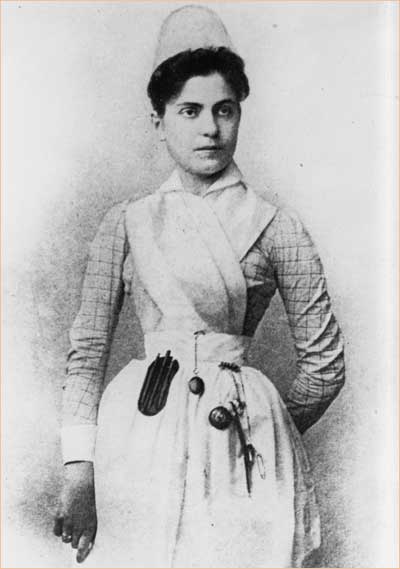
Nursing uniform from the late 19th c.*

1852

Sunday Feb 15th  Have been to church and at

noon went to Mr Baileys to see sister Amelia

who is nursing there  Mother went with me

Have been reading since meeting  Edwin & wife came

in to spend the evening but Mr Ames & self were

just going to Mr Swains and they would not let 

us stop for them so they went to Augustus  Had a 

pleasant call or rather visit at Mr Swains  came away

about nine Oclock  Very pleasant

The sun came out today, so despite it being “pritty cold,”** the Ames family went to church. During the intermission between morning and afternoon services, Evelina and her elderly mother, Hannah Lothrop Gilmore, rode out to visit Amelia Gilmore.  Amelia was the widow of Evelina’s brother, Joshua Gilmore, Jr. Joshua had died three years earlier, at age 35, leaving Amelia with two sons to raise.

In order to support herself and her boys, Amelia hired out as a nurse.  In this instance, she was looking after a Mr. Bailey, who must have lived near the Unitarian church. He may have lived alone, been ill and needed paid help; otherwise the convention of the day would have meant his female relatives looked after him. When Amelia wasn’t working, she and her youngest son, Samuel, lived with the Alger family near the Gilmore farm. The older son, Charles, had hired out somewhere but would soon come to reside with his uncle Alson Gilmore.

In 1852, nursing was not a formal profession.  Women (nursing was considered the exclusive province of women at the time) undertook nursing because they needed to work and this was one of very few avenues open to them. They based their protocol on personal experience in caring for ill members of their own families. There were no training programs or certification venues available, in no small part because there were so few hospitals. People were cared for at home. It would take the Crimean War in Europe and the Civil War in the U.S. to change attitudes and formalize medical care.

*Courtesy of http://www.nursinglink.monster.com

**Oliver Ames, Journal, Stonehill College Archives, Arnold Tofias Collection


December 28, 1851

CEM2250808_135321565571


Sunday Dec 28th A very stormy day but all went to meeting

except Oakes A & self, came home at noon so few

there that Mr Whitwell thought best not to have one in the afternoon.

Mr Swains brother went with them  Capt Johnathan Pratts wife

was buried this afternoon  Have written to Miss Foss and

partly written a letter to Lucy Norris


The “stormy day” kept most folks home from church; it had snowed overnight and the snow had turned to rain.  According to the family’s indefatigable weather man, Old Oliver, it “raind by spells all day but there was not more than ½ an inch fell.”

It was dreadful weather for a burial, but the frozen ground and cold precipitation didn’t prevent the funeral of Sophia Pratt, who had died the day before of consumption. Fifty-seven years old, she was the mother of four sons and the wife of Capt. Jonathan Pratt, a farmer and former member of the local militia. The Pratt family had been settled in Easton for several generations; their farm was not very far from the Gilmore spread in the southeastern section of town.

In common with any human community, the people of Easton had ceremonies for dealing with death. Protestant or Catholic, a dead person’s body was placed in a coffin and buried as soon as practicable, for reasons of hygiene, convenience and respect. As historian Drew Gilpin Faust explains: “Redemption and resurrection of the body were understood as physical, not just metaphysical realities, and therefore the body, even in death and dissolution, preserved ‘a surviving identity.’ […][T]he body and its place in the universe mandated attention even when life had fled; it required what always seemed to be called ‘decent’ burial, as well as rituals fitting for the dead.”*

As her coffin was lowered into a plot in Pine Grove Cemetery, Sophia Pratt would have received a fitting funeral.


*Drew Gilpin Faust, This Republic of Suffering, New York, 2008, p. 62


December 21, 1851

Toasted rice blancmange


Sunday Dec 21st  My cough and cold is much better but not

well enough for me to go to meeting  Oliver is sick

with the rheumatism there was no one to meeting

from there  All the rest went.  I spent the forenoon

in making ice cream, blanc mange &c  have written

a letter to Brother John & wife.  About 8 Oclock went

into the office with Mr Ames   Mr Swains brother came 

in awhile  Checked over our account since May

A “pritty cold,” quiet Sunday, which Evelina spent productively. She missed church; her cold was better, but her cough wasn’t.  Next door, her brother-in-law Oliver Ames, Jr., was ill with rheumatism.

Evelina had some milk or cream on hand that she needed to use up, so she made not one but two dairy desserts: Ice cream, which seems ill-calculated to please on such a cold day, and blancmange, which was also served chilled.  Blancmange is a traditional, simple dessert made with milk, flour and sugar, poured into a mold to set. Sometimes used medicinally for sore throats, it was a popular treat in the 19th century.

Once the desserts were put away in the coldest area of the house (the shed? the buttery?), Evelina went to her desk and wrote a letter to her oldest brother, John Gilmore, and his wife, Eliza.  She hadn’t seen them since their brief visit back in June.

In the evening, Evelina walked across the yard to the office, where her husband and his brother usually met in the evening to go over the day’s business. On this occasion, however, with Oliver, Jr., under the weather, Oakes Ames was likely there by himself. Husband and wife sat together in rare, private companionship before being joined by an acquaintance.


December 12, 1851

tumblr_n6j6ijphsb1rly06do1_500

Dec 12 Friday  I am no better than yesterday & my cough

is increasing.  Have been mending most all day

Took a piece out of a comforter that the cat

had been on  Hannah called a few minutes

Mr Talbot brought home the sausage chopper

that he borrowed yesterday and Orville borrowed 

it and has brought it home this evening

Mary has been sick most all day talked of leaving

A cat! Today’s entry is the only mention in Evelina’s diary of the existence of a pet at the Ames house. There may have been some feral cats in the Ames barn, keeping the rodent population down, but the way this entry is written suggests that this cat was more of a household pet. And this pet “had been on” (what might that mean!) an old comforter or quilt, and had done enough damage to warrant the piece being removed. While the cat was no doubt indifferent to the fate of the comforter, Evelina was concerned enough to repair it.

Evelina was “mending most of the day,” which meant she was finally sitting down and holding relatively still. For several days, she had been indoors and out, painting and varnishing, kneeling and bending, and challenging herself to ignore her cold. No wonder her cough was “increasing.”  Her newest servant, Mary, had taken sick, too.

Neighbors were making sausage, and Evelina and Sarah Witherell would be doing that, too, in a day or two. Old Oliver had slaughtered four hogs a little over a week earlier, most of which he sold. But some of the pork made its way into the various Ames kitchens, and now the Ames wives and daughters would be putting it away.