May 19, 1851

330px-Mainelupin

May 1851

Monday 19th  Orinthia left here to commence her school in

No 2 district  I shall miss her very much

this morning had to wash the dishes and clean 

the sitting room &c which she has done for

some time.  Afterward worked in the garden

untill noon, planted some Pansy & Lupin seeds

Called in Olivers awhile  We have a gardener

commenced work to day.  Pleasant weather

Orinthia Foss left today to board with another family.  She had lived with the Ameses since February when she arrived from Maine to teach a small group of students in North Easton. Evidently, she had done her job well, and as a consequence had been hired by the school superintending committee to teach elsewhere in town. She would be missed by the Ames family, as she had made herself at home there, helping Evelina with sewing and chores and joining in various social activities with the Ames sons. Evelina especially would miss her, and not just because Orinthia had been so helpful in the house. The two had become good friends.

So, all by herself, Evelina worked in the garden this morning, planting pansy and lupin seeds. Pansy, also known in the 19th century as “heart’s ease,” was relatively easy to plant and grow. Lupin, on the other hand, was (and still is) trickier.  Though “found, frequently, in large masses,” “this fine perennial”, according to Joseph Breck in his 1851 Book of Flowers, is “very difficult, even impossible, to transplant, with success.” Seed, and seed alone, must be used. Evelina needed her green thumb today.

That said, Evelina wrote in her diary that a gardener had “commenced work to day.” Who hired him, and what was his job?  Was he hired just for the flower beds? Did he also work for Sarah Witherell, or next door for Oliver Jr. and Sarah Lothrop Ames? Whatever his job, he wasn’t going to be as much fun to work with as Orinthia had been.



May 18, 1851

DCF 1.0 *

1851

Sun 18st  Went to church this morning and heard our

new Organ for the first time  Mr Roach

does not understand playing on it very well,

but it is a fine toned one I should think.  Came

home at noon with Mr Ames got some violet

roots for my garden […] Went

back to meeting this afternoon  Since have been

reading & visiting   Orinthia & OAA called on S E Williams


Albert A. Roach, later spelled “Rotch,” was pretty well known throughout Easton.  A resident of the Furnace Village section of town and a manufacturer of cotton thread, Rotch held several civic offices and even moderated at Town Meeting.  But his pride must have been particularly gratified when, back in 1841, he had been chosen as the very first leader of Easton’s very first military band. According to historian William Chaffin, the band’s first performance – or gig, as we might say today –  was playing for the Norton Artillery in May, 1842, where “their remuneration was one dollar each, the band members paying their own expenses.”**  First known as the Easton Brass Band, they later became known at the Second Brigade Brass Band.

Unfortunately, Mr. Rotch’s talent on the horn or trumpet evidently didn’t turn him into an effective organist.  Evelina’s polite assessment of his inaugural performance on the new church organ suggests that Mr. Rotch’s notes did not hit their target.  The tone, evidently, was fine but the pitch, perhaps, was uncertain.  The congregation, including Evelina, soldiered on, however, and returned to church for the afternoon service, despite the discordant sound from the new instrument.

The thought of pretty little violets eventually growing in her garden must have offered strong consolation.


*blog.thbfarm.com

**William Chaffin, History of Easton, 1886, pp. 607 -608.


May 17, 1851

Plant

1851

May 17  About eight Oclock this morning

Orinthia & I rode to Mr Manlys to get some plants for

our garden  He kept us there a long while talking

about them and calling over the long names untill we

almost despaired of getting any  At last we got a few

and come home & set them out & called at Mr

Savages, got a few there  This afternoon we have had

a shower.  I mended the stockings &c &c


With help from her boarder and young friend, Orinthia, Evelina was making headway everyday in her garden. Early this Saturday morning, the two women rode once again to Edwin Manley’s for plants. Mr. Manley, a knowledgeable and somewhat eccentric fellow, kept the ladies “there a long while” discussing the selection of plants, going over their Latin names and properties. Let’s hope that Evelina’s impatience to be on her way didn’t spoil his clear appreciation of the flowers he could offer her.

From Mr. Manley’s, the eager gardeners went on to yet another source for plants. William Savage was an employee at the shovel shop. Unlike Mr. Manley and Mr. Clapp, he lived in the neighborhood of North Easton. He grew petunias, which were a fairly new flower for the home gardener, among other plants. Evelina was collecting all kinds of specimens for her parlor garden.

Other growers were less sanguine than Evelina about the prospect of the coming growing season.  Old Oliver, Evelina’s crusty father-in-law, noted in his daily journal that  “this was a fair day in the forenoon with a strong south west wind it was cloudy in the afternoon + a verry little rain and rather cool. the ground is verry wett + the season backward about doing the planting”.  Backward season or not, the planting – and gardening – had to go forward.

May 12, 1851

ServiceBerry1

Monday May 12th  Was about house all the forenoon but

cannot tell what doing  Jane has done the washing.

Orinthia washed the dishes for her. This afternoon

Orinthia and I have been out to plant the flower seeds

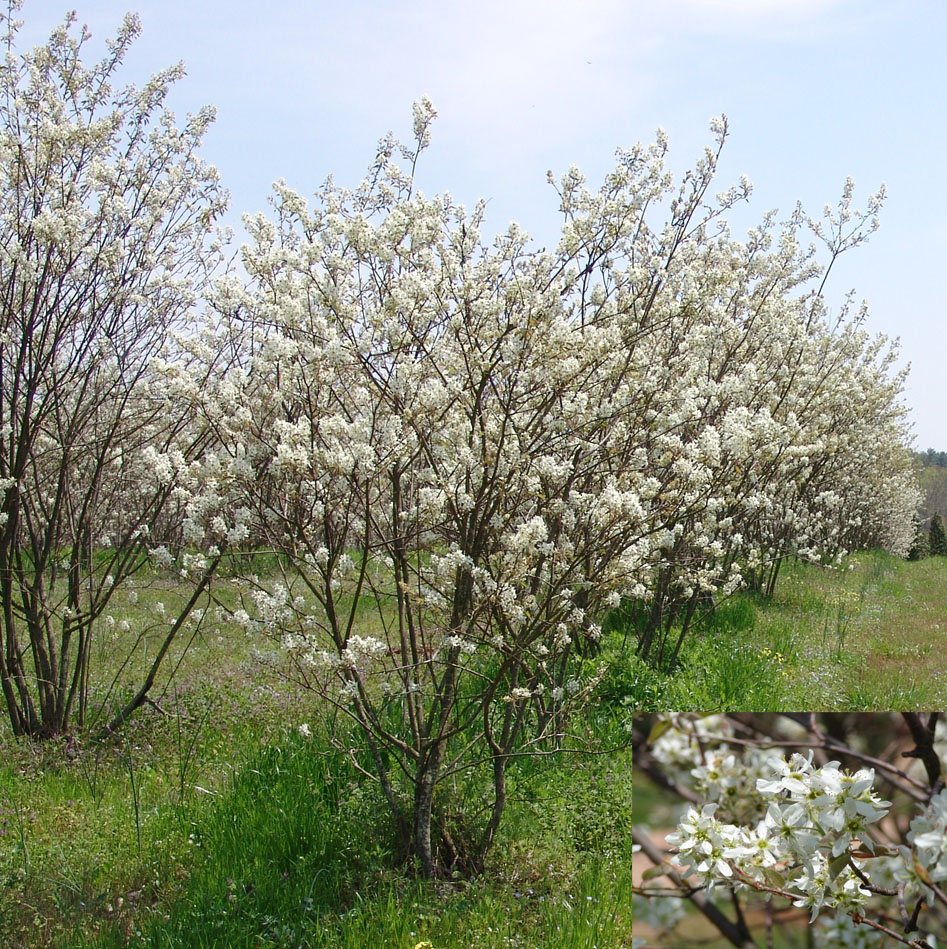
and I got some Shad berry & Burgundy Rose bushes

from Olivers & flowering Almonds from Alsons We 

were at work in the garden three or four hours

A sure sign of spring in New England is the blooming of the shadbush.  Because its little white flowers are among the earliest to be seen, its blossoms were often used at springtime funerals in the seventeenth, eighteenth and nineteenth centuries. Thus shadbush is also called the “serviceberry” bush for its appearance at funeral services; in some other locations it’s known as the “Juneberry” bush.  Wherever and whenever it grew, its presentation of blossoms was as welcome as the first robin.  The red berries it produced could be used in pies or, if not harvested, would be consumed by those same robins and other birds like cedar waxwings.

The shadberry bushes at Evelina’s were most likely planted out back behind the house near the Queset Brook, where they would tolerate the partial shade and indifferent soil.  However, the Burgundy Rose bushes that Evelina also obtained from her obliging brother-in-law, Oliver Jr., would have required a more selective location in the sun.  Were those roses planted right in Evelina’s flower beds?  Were they as red as their name sounds?

Her brother, Alson Gilmore, provided Evelina with flowering Almond bushes (Latin name is Prunus triloba.)  In contrast to the white serviceberry and the red roses, the flowering almonds produced pink blossoms.  Evelina was evidently aiming for a rosy spectrum in her yard. The flowering almonds like sun, so where might she have planted them?

The work of planting the various bushes took Evelina and Orinthia several hours to complete, and must have given them a real sense of accomplishment – not to mention sore backs.

May 6, 1851

sweet-peas

*

May 6th Tuesday  Orinthia & I went into the flower garden

and worked some time on the beds but the

ground was very wet as it rained last night.

Robinson has painted the bedroom up stairs

over the first time. This afternoon we planted

some sweet peas and have got the beds ready for

the seeds Had Mr Swain to dine with us

Orinthia finished her school Saturday […]


Mr. Robinson was back doing work for Evelina.  He was the handyman who, earlier in the year, had spilled varnish on the parlor carpet and taken too long to paint the mantels. Either he was an affable favorite of the family or his price was right, or both, for he was back at the Ames’s, this time painting an upstairs bedroom.  Jane McHanna must have been at work, too, keeping busy with meals and chores while she waited for the sun to dry yesterday’s wash. John Swain, the new clerk at O. Ames & Sons, came for dinner.

Despite the wet ground, Evelina and Orinthia, the young teacher who had become her friend, planted sweet peas and worked the ground for seeds yet to come. Sweet peas were a popular flower in the 19th century; John Keats praised them in a stanza of his 1817 poem “I stood tip-toe upon a little hill:”

Here are sweet-peas, on tip-toe for a flight:

With wings of gentle flush o’er delicate white,

And taper fingers catching at all things,

To bind them all about with tiny rings.

The flowers were fragrant, delicate-looking but hardy, and slow to germinate.  Evelina and Orinthia probably placed them in a sunny spot in the beds. Did they need a trellis? Did the ladies wear gloves as they worked, or did they just dig into the dirt? Evelina, at least, probably wore some kind of protection, as she wasn’t at all fond of chaffing her hands.


*sweetpeas, landlund.com

May 4, 1851


Vintage Ad for 1887 Brecks Seed Catalog (Original)

*

May 4th Sunday  Went to church this morning and at

intermission called with Mother at Mr Whitwells

Mrs Daniel Clark went with us Heard two good

sermons from Mr Whitwell. Orinthia went

in the afternoon, staid at home this morning

Have been reading since church in the book of

flowers & called in the other part of the house

to see Mrs Stetson who came Friday night


The Flower Garden or Breck’s Book of Flowers is probably the book to which Evelina gravitated on her return home from church.  Its subtitle was “In which are described all the various hardy herbaceous perennials, annuals, shrubby plants, and evergreen trees, desirable for ornamental purposes, with directions for their cultivation” and it probably took her mind away from Reverend Whitwell’s sermons. Written by Joseph Breck, head of an eponymous gardening firm, the “book of flowers” was published by J. P. Jewett of Boston and was immediately popular. It met a need among a burgeoning population of female gardeners like Evelina who were happily creating “parlor gardens” for their homes.

Naturally, women had gardened before the nineteenth century, but earlier gardens, at least of the kitchen variety, were generally planted for culinary or medicinal purposes. Flower gardens existed, certainly, but tended to be presented within a larger landscape that was most often designed by men. Female participation in gardening was a more recent phenomenon, promoted assiduously by landscape designers like Andrew Jackson Downing, authors such as Englishwoman Jane Loudon, taste-setters such as Sarah Josepha Hale, and commercial gardeners like Breck. All were guided by “the nineteenth century urge for the beautification of the American home and its surroundings.”**

The Church, too, latched on to the fashion for flower gardening. As Godey’s Lady’s Book counseled, women needed to “[s]tudy the flowers and behold the wisdom, the goodness and mercy of the Almighty.” *** According to a diary kept by Oliver Ames, Jr., Easton’s own Reverend William Chaffin, a few years later, drew an appreciative “analogy between the cultivation of the Garden and of the Spiritual nature.” Religion was to be found among the pinks and pansies.


* Catalogue for Joseph Breck & Sons, 1887

** Ann Leighton, American Gardens of the Nineteenth Century, 1987

*** Godey’s Lady’s Book, May 1851


May 3, 1851

_O7J0613


*

May 3d Saturday  Early Orinthia & I went to work on the flower

beds to lower them.  We cut the center bed down

about three or four inches and have got some of

the others done I worked most all the forenoon

moving plants Have been to N Bridgewater this

afternoon with O A & Frank Have engaged 

a new bedstead for my chamber and a small one

or a lounge in the dark bedroom  


Although we don’t know how Evelina arranged the flowers in her garden, she gives us a clue today about the overall formation of her plantings.  She and Orinthia Foss worked on a central bed with other beds placed around it.  This kind of design was very common in the 18th century and into the 19th. It could well have been the pattern of a garden that Evelina’s mother-in-law, Susannah Angier Ames, might have started in the yard.  Susannah had died five years earlier; Evelina could have inherited the design and was in the process of making it her own. Sarah Witherell, her sister-in-law who lived in “the other part of the house,” was apparently less interested in gardening than Evelina, so Evelina made most of the decisions about the flower beds on the property.

Any good gardener knows that personal flower gardens are as unique as snowflakes.  No one is exactly alike. Even a repetitious scheme with a central bed surrounded by a formation of other beds will differ from gardener to gardener.  Some central bed gardens have each bed replicate the plantings in the other beds, so that a particular pattern of flowers is repeated.  Other central gardens, such as the John Jay garden in the illustration above, feature different groupings in each square.

How did Evelina approach her garden?  We might guess that her taste was broad and reactive rather than predetermined.  She planted a wide variety of flowers, so her garden undoubtedly featured a sampler of colors, shapes and textures.  Certainly, her taste was less formal than her sister-in-law, Sarah Lothrop Ames.  At their property next door, particularly after they built their new house in 1863, Oliver Jr and his wife hired a gardener and cultivated more modern Victorian plantings. Their gardens were probably less rambunctious than Evelina’s, featuring formal walkways, lengthy borders and other haute designs.  Anyone who knows their house, Unity Close (which still stands today), will know that later generations of Ameses, under the guidance of landscape architect, Fletcher Steele, built upon that landscape.

On another front entirely, Ralph Waldo Emerson gave a speech today in Concord on abolition.  That speech is in the collection of the Concord Library, should anyone care to track it down.**


*18th-19th c. garden at John Jay Homestead Historic State Park, New York, from themarthablog.com

**concordlibrary.org/scollect.Emerson_Celebration/Em_Con_39.htm/ 

May 2, 1851

1528

Globe Amaranth

1851

May 2nd Friday.  Susan started with several other children

about 6 Oclock maying and did not get back

untill half past nine.  They went over three miles

to the “West Shire”  I made cake & ginger snaps to

bake with Mrs Witherell. Jane made some pies and 

bread.  Mr & Mrs Whitwell and Mrs William Reed

called. Afterward planted some globe seed and 

carried my stockings to mend in the other part of the house

Today’s good weather gave Susie Ames and her friends the opportunity they missed yesterday. Leaving early in the morning, they walked west to deliver May baskets to friends and family, or perhaps even to strangers. It sounds as if the children walked a long way on their little legs. Readers in Easton, where exactly is the “West Shire?”  By the Bay Road?

Baking was in order today. Evelina and her sister-in-law Sarah Witherell baked cake and ginger snaps, while Jane McHanna prepared the usual pies and brown bread. Did the children get any ginger snaps when they returned home? Certainly, Reverend and Mrs. Whitwell would have been offered some to eat, as would Abigail Reed, wife of the Reverend William Reed. Guests who dropped in, whether or not they were expected, were always offered refreshments such as tea and fruit or biscuits. Cider was a common refreshment, too, but not at the Ames’s house; it was too close to alcohol.

Once the guests had departed, Evelina went out to her garden and began to plant globe seed. Did she have a specific plan in mind for the garden, or was her planting haphazard and spontaneous? If she consulted any of the publications she read, like The Massachusetts Ploughman, or the ladies’ periodicals, she probably found suggestions for arranging her flower beds.


May 1, 1851

Basket


1851

May 1st Thursday  Have cleaned the shed chamber to

day and a long dirty job it is  there is so much in it.

I got through just in time to go to Mr Torreys

after some plants when Orinthia came out of

school.  She went with me and we brought home

three baskets full and have set them out in

the garden This morning it was quite unpleasant

and Susan was disappointed in her walk

May Day! In our modern world, the first day of May means many things to many people, among them International Workers’s Day, the Roman Catholic Celebration of the Blessed Virgin Mary Day, even a day for the 21st century Occupy Movement. May Day has ancient iterations, too, most of them having to do with pagan rites of spring.

In 1851, the first of May meant “maying.” Young people like nine-year old Susie Ames filled small baskets with flowers, ribbons, or other little treats and left them, anonymously, on doorsteps around the town. The game was to leave a basket, ring the doorbell, and run away.  If the recipient caught you, he or she was allowed to chase you for a kiss; at least, that was one version. Another version was to leave the basket as a surprise at the home of an elderly person. On this particular May Day, the weather was too disagreeable for the traditional maying walk, so Susie and her friends were unable to deliver their baskets.

Evelina dealt with baskets, too. She and Orinthia Foss filled three of them with plants from John Torrey and put them in her garden. It was her reward for having spent most of the day cleaning out the “shed chamber.”  Spring cleaning was still underway.

April 29, 1851

CultivationToolsBP

April 29 Tuesday  Frank has finished the beds in the flower

garden and I have set out some plants that Henrietta

gave me and some that I bought of Edwin Manly paid

him one dollar Julia here finishing the dresses for

Susan & my blue Delaine dress.  Mrs George Ames

& I went to Sharon and spent the afternoon

Had a pleasant ride with Dominic


Three spheres of activity informed Evelina’s day. First was gardening, made possible by Frank Morton Ames finally finishing tilling the soil in the flower beds.  He and others had been loosening the soil off and on for several days, which raises the question of how many flower beds Evelina had, and how large they were, and where they were situated relative to the house. Evelina “set out” some plants that she got on Saturday. One group came from her sister-in-law, Henrietta Lincoln Gilmore, at the Gilmore farm; she probably got those for free.  The other group from Edwin Manley, however, she had to pay one dollar for.

The second sphere of action was sewing, of course, which always seemed to be going on in center ring at the Ames house. Today Julia Mahoney, the dressmaker of choice, worked on a dress for Susan and a blue delaine, or light wool, dress for Evelina. The warm weather would soon arrive and the lighter dresses would be needed.

The last sphere was a nice change of pace – literally – for Evelina and her cousin-in-law, Almira Ames. With Dominic, a horse, pulling them along, the two women drove the carriage (or were driven) to nearby Sharon. Whom did they visit? Did they shop in the town?  The ride was pleasant, whatever the errand.