May 4, 1852


IMG_0159

Trellis on the door of the home of Oakes and Evelina Ames and extended family, ca. 1860


Tuesday May 4th  Mr Healy & Morse commenced the trellis

for our front door  We had quite a consultation how it should

be made  I[t] was very cold & windy this morning & I fear I

have taken cold in being out so long  Have mended Olivers

sack and cut the pattern and have done some other mending

Augusta made a long call. It is really very pleasant to have

her so near.  Mrs S Ames went to Boston

The trellis that Evelina refers to today could very well be the modest trellis that graces one of the doors in the above photograph. The doorway facing the street in the approximate middle of the photograph was the door that Evelina, Oakes, and their family used for their own. The doorway on the far left, facing the yard, was likely the entry that Old Oliver and his daughter, Sarah Witherell, used. The house on the far right was a separate dwelling that belonged to Oliver Ames Jr. and his wife, Sarah Lothrop Ames.

None of these buildings is still standing. The one on the far right was torn down in 1863 and replaced by a larger, more formal house that is still extant today, with lovely gardens and a well-kept air.  The house in the center, halved on the interior to accommodate the two households of Evelina and Sarah Witherell, was torn down in the 1950s, at the behest of Oakes Angier Ames’s eldest son, Hobart Ames. The site has since been reclaimed by trees and undergrowth.

The trellis was meant to add a fashionable air to Oakes’s and Evelina’s side of the house. Evelina was trying to bring the simple, old Federal dwelling into the Victorian age, inside and out. She had a particular vision for her home, and she worked hard to realize it. Small wonder that the construction required “quite a consultation.”


 

April 26, 1852

ragged-robin

Ragged robin

Monday April 26

1852  Was about house and to work about the

garden all the forenoon  Mr Manly brought

me a Japan Quince Syringa P Lilac Compfre

Ragged robbin Cowslip Fleur de Luce &c  charged

90 cts.  Went this afternoon to Alsons with

Augustus & wife & her sister.  Came home

quite early and set out some plants that

I got there

Edwin Manley, Easton’s resident green thumb, brought Evelina her lilac bush this morning, along with a quince tree, some comfrey, ragged robin, cowslip and “fleur de luce,” which probably was Evelina’s spelling for fleur-de-lis, also known as  iris.  For less than a dollar, she acquired flora that promised to add fragrance and color to her garden. Later in the day she got more plants – for free, most likely – from her brother Alson Gilmore.

The countryside itself was still wanting in color at this mid-spring juncture, something Evelina and her fellow passengers might have noticed on their way to and from the Gilmore farm. Henry David Thoreau wrote about the pale fields and expectant woods in his journal on this date: “The landscape wears a subdued tone, quite soothing to the feelings; no glaring colors.”* Perhaps Evelina’s rush to add more vibrant colors to her yard would have jarred his sensibility.

Even with all the gardening, the day’s housework went on as usual with dusting, sweeping, dishes and laundry. Evelina and Jane McHanna both worked at various tasks, while Thoreau – not that many miles away – responded otherwise:  “It is a dull, rain dropping and threatening afternoon, inclining to drowsiness. I feel as if I could go to sleep under a hedge.”*

The two diarists reacted differently to the awakening pulse of spring.


**Henry David Thoreau, Journal

April 19, 1852

 March_2014_nor'easter_2014-03-26Satellite image of a Nor’easter

1852

April 19th Monday  It rained very fast all day and 

about noon the rain beat in the side lights 

of the entry, and parlour windows   had to take

back the carpet a little from our window put

dishes under the windows and caught a good

deal of water.  Have cut down my Verbenas

and Petunias fixed a skirt of a dress for

gardening

A powerful Nor’easter storm beat into New England this day.  Both Evelina and her father-in-law described the rain as “fast,” Oliver further elaborating that the rain came in sheets, “not in drops.”*  Evelina (and Jane McHanna, most likely) had to deal with water coming in through the side light panels on either side of the outside door. They scurried, too, to pull back the carpet from the windows and put dishes on the floor to catch some of the water beating into the house.

The wind howled and “[t]he storm continued all day , a part of the time pritty fast,” reported Old Oliver. Everyone stayed indoors, no doubt, yet Evelina reports cutting back some of her plants, which suggests outdoor work. That couldn’t have happened on a day such as this, however, so perhaps the verbenas and petunias had wintered-over in pots inside the house, and it was those that she cut down.

Gardening was on her mind, of that much we can be sure. She prepared a skirt to wear outside when she was in her flower beds, probably “repurposing” an old dress for the task. Her handwriting was rushed and incomplete when she wrote the last sentence of today’s entry; she inadvertently omitted to cross the “x” in fixed, leading this editor to conclude that she had “fired” a skirt.  Not so, thanks to a sharp reader who came up with the correct version.

Image courtesy of Wikipedia, April 18, 2015

April 16, 1852

 women sewing*

1852

April 16th Friday.  Julia here again to day and we have

been to work on my dresses  Mrs S Ames & Witherell

helped some time this afternoon and we have

got along nicely  Hannah & Augusta called

Augusta brought her work and Hannah finished

Susans stocking.  Susan has the other stocking about

half done.  The first pair that she ever attempted to knit.

Stormy again to day.

The day before had rained “pritty fast” all day long, and today opened in much the same vein, with “snow squals + rain + a high wind.”***  The women stayed indoors and focused on fashion.  Dressmaker Julia Mahoney came over to work on new outfits for Evelina. Sisters-in-law Sarah Ames and Sarah Witherell helped for a time, too, both of them as accomplished at sewing as Evelina. They all “got along nicely,” a phrase that suggests good progress was made on Evelina’s dresses, although the women’s sociability quotient was also probably pretty high.

Others joined the hum.  Nieces-in-law Hannah Gilmore and Augusta Gilmore, a younger set of eyes and hands, arrived with work in hand. Hannah helped her little cousin, Susie Ames, knit a pair of stockings.

The sewing of new dresses – as opposed, say, to the mending of men’s shirt fronts – was the favorite expression of the women’s collective talent with needle and thread. As Winthrop Ames noted, “An immense amount of sewing went on in every family.”** We’ve certainly learned that from Evelina’s diary.  In 1852, they still made their own dresses. “[T]he materials and trimmings, after much consultation about their style and quality, were made up in the house with the help of the town seamstress and pictures from the fashion magazines.”

Things would change. By the start of the Civil War, the Ames women began to have their dresses made up in Boston. But on this day in North Easton, needles flew.


*Image courtesy of nhdsewingmachine.weebly.com

** Winthrop Ames, The Ames Family of Easton, Massachusetts, p.126

*** Oliver Ames, Journal, Stonehill College Archives, Arnold Tofias Collection


April 13, 1852

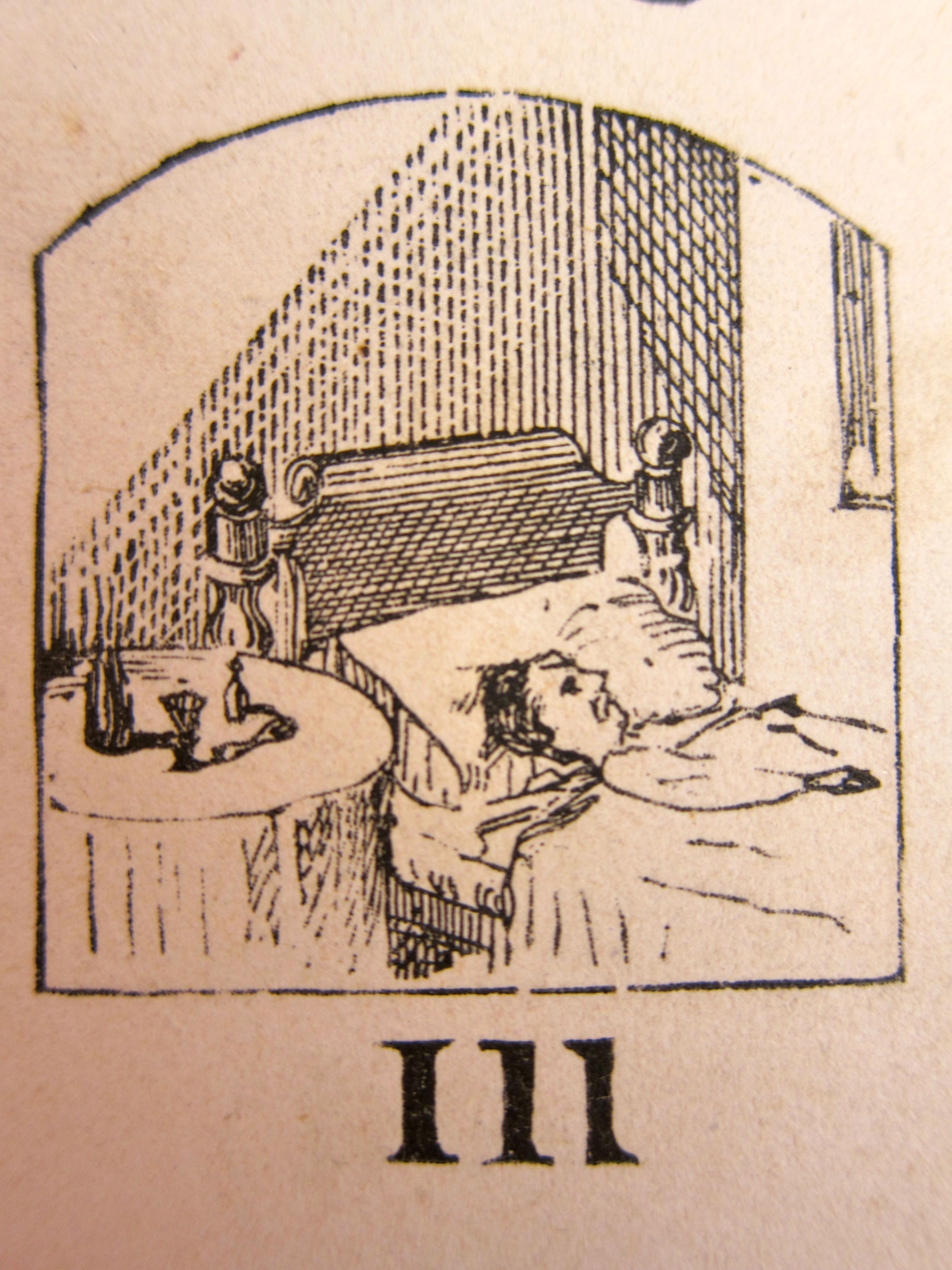
Ill

1852

Tuesday April 13th  Watched with Mrs Brett last night

She is quite low seemed to like my being there and

urged my coming to see her often and said she meant

to come to see me and be more friendly if she ever

gets well  said her Mother told her in her last hours

to come to me for advice and regretted that she

had not done so but meant to in future  The rain of 

the morning has turned into a heavy snowstorm  Susan & self

carried our work and stopt a couple of hours with Mrs W

A young neighborhood wife named Eveline Brett was ill, probably with childbed fever. Evelina went to stay with her during the night, taking her turn with family members and other neighbors to watch, suggesting that some must have thought that the new mother wouldn’t survive.

Modern historian Jack Larkin has described this neighborly service as “one of the commonest of rituals.”* In towns across New England, when someone was seriously ill, or “dangerously sick,” as Evelina noted a few days ago, “neighbors took turns staying through the night at the sick bed to allow exhausted family members to sleep. Watchers could administer medicine when needed, but, far more important, they provided a continuous comforting presence – as well as witnesses who could quickly gather the family around if death seemed imminent.” *

Evelina’s personal experience on this occasion was especially rewarding. The young mother confided that Evelina’s presence was truly comforting and that if she recovered, she hoped she could go to Evelina for advice. Happily, Eveline Brett would indeed survive her illness and, in the future, bring her baby by to visit the understanding woman who had given her such comfort.


*Jack Larkin, The Reshaping of Everyday Life, New York, 1988, p. 93

March 31, 1852

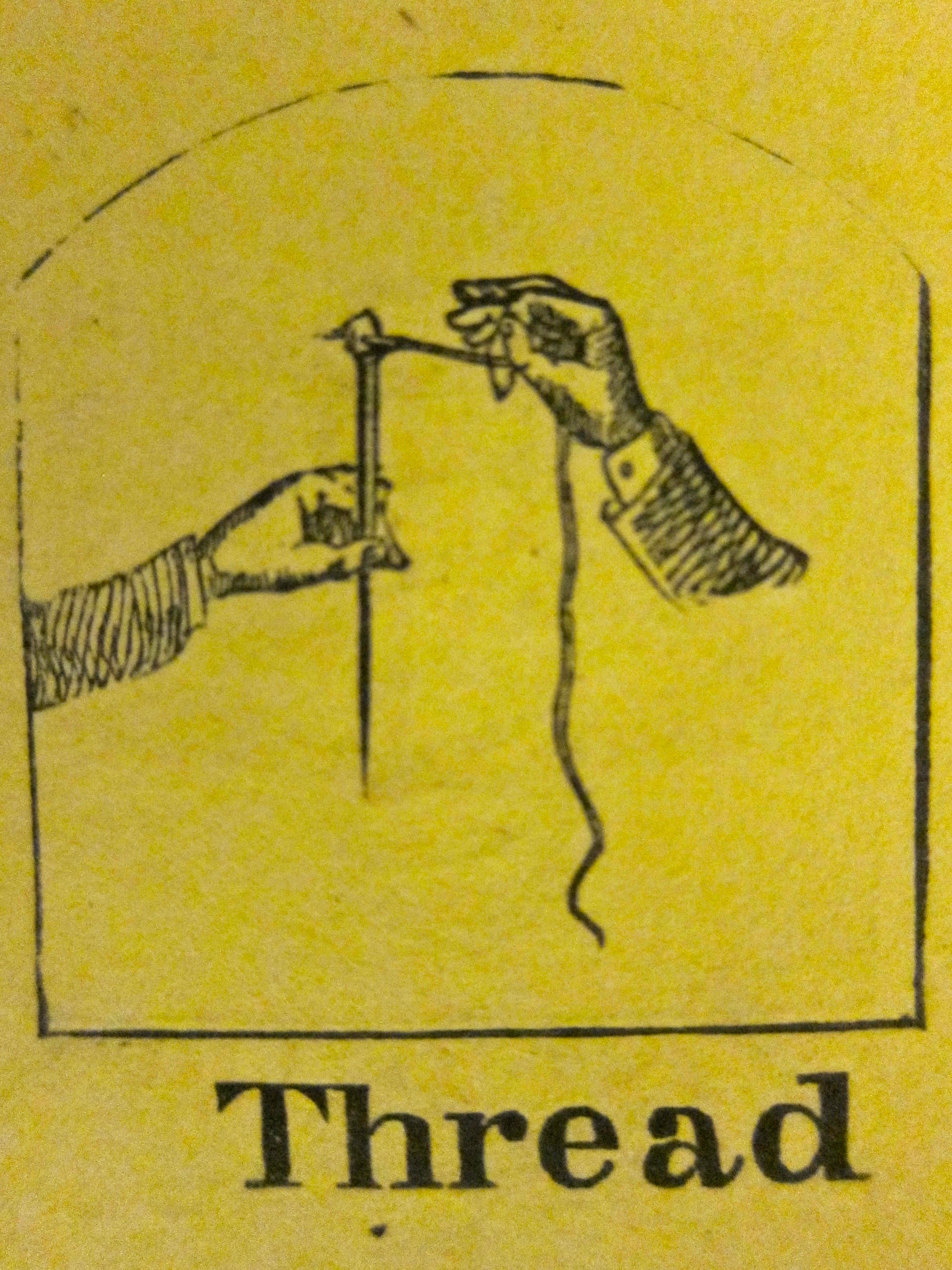
Thread

1852

March 31st Wednesday  Have been to the sewing circle

at Mr Harrison Pools.  Mrs S Ames & Augusta

went and we took Orinthia with us from Mrs Howard

Mother Henrietta Lavinia Rachel Mrs Nahum & Horace Pool

& Ann Pool were there   It rained very fast as we were

coming home  I left two shirts to be made that I

put in the circle last fall

The Sewing Circle was back.  Female parishioners from the Unitarian Church had begun once again to meet on a monthly basis to sew. Like other sewing circles around the country, they met for fellowship, guidance from the local clergy, and the sewing of clothes and linens for one another or others. They hadn’t met – officially, anyway – since December.

On this weekday the group met at the home of Mary and Harrison Pool in southeastern Easton. From North Easton came Evelina, Sarah Lothrop Ames, and Augusta Pool Gilmore, the young bride who was returning to the area of town where she had grown up. The women stopped en route at Nancy and Elijah Howard’s to pick up Orinthia Foss. Hostess Mary Pool, who had three young children underfoot, welcomed them. Others who attended included Evelina’s mother, Hannah Lothrop Gilmore; Henrietta Williams Gilmore, Lavinia Gilmore, Rachel Gilmore Pool, Lidia Pool, Abby Pool and Ann Pool. It was a veritable family reunion.  Except for Orinthia Foss, every women present was related by blood or marriage to at least one other woman there.

Such a gathering must have been good amusement, with less formality than the social calls that some of the women had paid the day before. But spirits may have been dampened by the “very fast” rain that pummeled the carriages when the meeting ended and the women returned home.

March 29, 1852

 d2a4da_a34883211bc64e72a561a89b7ee3091d.jpg_srz_299_239_75_22_0.50_1.20_0

Moreen Fabric*

1852

March 29 Monday.  Orinthia returned with us from meeting

yesterday  She helped Susan wash the dishes and

I cleaned the sitting room and afterwards sat down

to our sewing  Have new bound my moreen skirt

Orinthia and self went into Edwins this evening

had a pretty lively call making fun of Orinthia’s spelling

Evelina may have “had a pretty lively call making fun of Orinthia’s spelling,” today, but her own orthography was far from perfect. Neither woman, evidently, could have won a spelling bee – and Orinthia was a school teacher!  To be fair, however, spelling in the 19th century was not as standardized as it became later. Spelling has long been a fluid practice, actually, however often periodic efforts were made by different groups and individuals – Teddy Roosevelt among them – to reform and standardize it. So the two women would have had plenty of company with their wayward pens. Just consider the various ways that Old Oliver Ames spelled (or spelt) slate: sleight, slaight and slayt.

Presumably unworried about her own grammatical shortcomings, Evelina pursued her usual agenda for a Monday. She cleaned part of the downstairs while daughter, Susie, washed the breakfast dishes and servant, Jane McHanna, started the weekly laundry and prepared midday dinner. After Evelina had finished dusting, sweeping and tidying, she and guest Orinthia Foss, the poor speller, sat down to “our sewing”.

Evelina was working on a skirt of moreen, a ribbed fabric of cotton or wool that today serves more often for upholstery or curtains. In the 19th century, however, its stiffness lent itself to the voluminous skirts that defined the era. It would have been a thick, tough fabric to work on by hand. But Evelina was nothing if not an excellent needlewoman.

*Image courtesy of http://www.eatonhilltextiles.com


March 22, 1852

Sweep


1852

March 22  Monday  Have been sweeping dusting &

cleaning all day  Have put in order parlour

entries, parlour & sitting room chambers and back

& shed chamber, nearly dusk before I got through

Orinthia & Susan washed the dishes in the 

morning  Orinthia has written another two or three 

letters has not done much  beside  Ain’t she lazy?

It was Monday. Evelina spent her day “sweeping dusting & cleaning,” and Jane McHanna washed tubs of clothes and hung them out to dry, but “lazy” Orinthia only helped wash the breakfast dishes and wrote a couple of letters. In comparison to quiet, helpful Amelia Gilmore, whose visit Evelina had enjoyed, Orinthia Foss and her spirited but indolent company was a come-down.  We should remember that Orinthia was single and only in her early twenties (although in that era, some would have said she was already a spinster) while Amelia, a widow, was in her early thirties and Evelina, a matron, in her early forties. The age gap between Evelina and Orinthia was beginning to wear thin on Evelina’s part, and perhaps on Orinthia’s as well.

Spring had officially arrived two days earlier on March 20. No buds or blossoms were yet in evidence, however, and more snow had yet to fall. The industry that Evelina demonstrated today with her broom and dust rag suggests that she was rehearsing for spring cleaning, perhaps wanting to get it out of the way so that the moment anything came up in her flower beds, she’d be free to go outside and garden. Perhaps she looked at the still-frozen ground and imagined her flowers in full bloom. It was getting to be that time.


March 18, 1852

images-2

1852

March 18th  Thursday  A very heavy rain storm to day

Amelia Orinthia & self have had a quiet day

but mine has not been pleasant work, have

mended Mr Ames old shop coat have put new

cloth in the under part of the sleeves, mended

button holes so, think it will last some time.

Also mend Franks pants  Orinthia has been 

to work on her delaine dress

The women at the Ames residence stayed indoors today, held inside by “a cold driving rain storm.”* They sewed, naturally, but Evelina didn’t particularly enjoy herself. Orinthia got to work on a new dress, but Evelina had to mend her husband’s shop coat and her son Frank’s pants. Mending was never as much fun as sewing, but it was essential. As we have noticed before, Evelina was devoted to making things last. Like other Yankee housewives, she had been brought up to: “Eat it up, wear it out, make it do or do without.”**

Yet as the family grew more wealthy, Evelina began to enjoy the luxury of not doing without. She shopped in Boston for fashion accessories and household items that she would never have had in her youth. As modern historian Jack Larkin has pointed out, a “household’s furnishings constituted a material world that defined the limits of comfort, heating and lighting, and filled functional needs for sitting, sleeping and eating, but they also spoke of Americans’ economic status and aspirations.”***

Old habits die hard, as we know. The Ameses had money, and Evelina didn’t have to mend her husband’s shop coat; she could have insisted that he buy a new one, or she could have sewn one for him, perhaps. Her ingrained sense of economy, however tempted by the changing world around her, wouldn’t allow it. William L. Chaffin, the town historian who knew the Ames family, described Evelina as “economical” in his late-life remembrance of Oakes Ames, and shared the tale that Oakes joked about Evelina at the dinner table, suggesting to guests that his wife wanted them to help themselves to preserves that were going bad so she could use them up.

On this day, rather than demand that her husband purchase a new work coat – which we can surmise he had no interest in doing – Evelina fixed up the old one, and sighed that she wasn’t sewing a new dress instead.

*Oliver Ames, Journal, Stonehill College Archives, Arnold Tofias Collection

** A 20th century, World War II-era version of this maxim was “Use it up, wear it out, make it do or do without.”

***Jack Larkin, The Reshaping of Everyday Life, 1988, p. 264


March 14, 1852


Preach

1852

March 14th Sunday  Amelia & self went to hear

Willard Lothrop preach as he calls it

at this methodist meeting house but he

was not able to make out much  We called

at Mr Torreys & Augustus’ at noon

Edwin & wife were here to supper but

went home before dark.  Have read the

white Rover in Gleasons pictorial


With the factory shut or, in this case, with the carpenters away, Sunday was a quiet day in North Easton. This particular Sunday “was cloudy all day + in the evening + night there was considerable rain – wind north east.”* The Ames family usually went to church at a meeting house in Easton Center, but on this Sunday Evelina did something different.

Her family may have gone to the usual Unitarian service with Reverend Whitwell, but Evelina and her sister-in-law, Amelia Gilmore, stayed in the village and attended a service at the Methodist meeting house. This tiny church, since moved to another location, sat in an intersection of North Easton now known at The Rockery. So small was it that one visiting preacher declared he could “spit into the gallery from the pulpit.** Its intimate dimensions were just right for another session of Spiritualism with Willard Lothrop, who preached in his own personal way.

Evelina and Amelia may have been motivated to try to communicate with departed family members, but they came away disappointed. Lothrop failed “to make out much.”  Although Lothrop and others in Easton continued to advocate for their belief, Evelina pulled away from it. This is her final entry on the topic of Spiritualism.


*Oliver Ames, Journal, Stonehill College Archives, Arnold Tofias Collection

**William L. Chaffin, Oakes Ames, Easton, early 20th c., p.3