October 18, 1852

apples-easy-stewed-lrg


Monday Oct 18th  Ann Shinkwin commenced working

for wages this day, and she does very well

got the washing out with Catharines help

quite early not much past ten. This afternoon

she has been putting some apples to stew

I have been puttering about house and 

sewing some but my work does not amount

to much any way.

The new servant, Ann, was going right to work. She and Catharine Murphy did the laundry, of course, it being Monday. The two women then presumably cooked and served the midday meal, and did the washing up, while Evelina was “puttering about the house.” In the afternoon, Ann began to pare and slice apples to cook.

Evelina says that Ann was going to stew the apples, which sounds like a sensible way to process some of the surfeit of apples that she clearly had on hand. Sarah Josepha Hale, ever ready to advise women on sensible practices in the kitchen, offers the following recipe for stewing fruit:

The best way to stew any kind of fruit is to put the quantity you wish to cook into a wide-mouthed jar, with enough brown sugar to sweeten it; then cover the jar close, set it in a kettle of cold water, and boil it till the fruit is tender. This preserves the flavor of the fruit.

Evelina or her servant may have followed their own recipe for cooking sliced apples. But there’s no question that along with applesauce, apple butter, dried apples and apple pies, stewed apples was one more way that the nineteenth century housewife could serve fruit to her family now and over the winter and spring.

*Sarah Josepha Hale, The Good Housekeeper, 1841, p. 91


October 17, 1852

The knife and fork. Old with white bone handle.

Sunday Oct 17th  

Went to church all of us.  Came home

at noon with Mr Ames and had a cup

of tea and lunch in the buttery

Catharine Middleton left this evening

and I paid her five dollars for the

three weeks that she has been here now

and one week some time since

This may be the first time that Evelina uses the word “lunch” in her diary. Usually, the meal in the middle of the day was dinner, and it was the big meal. But on Sundays, the routine was changed because, ostensibly, housewives didn’t cook. It was a Day of Rest. The women were at church and had no time to prepare a hot meal between services. Instead there was a cup of tea and a piece of cake at the parsonage or, in good weather, there might be a bread and fruit picnic on the lawn of the church, near the carriages. Early tail-gating, if you will. If a housewife were at home on a Sunday, as Evelina sometimes was, she might end up cooking, especially if she had houseguests. But the norm was no cooking.

Lunch, per se, was something different. The word itself was a shortened version of “luncheon,” which was generally accepted to be a small meal that might be held at any time of day, in between two larger meals. For most of the 19th century, luncheons were considered to be the province of middle- to upper-class ladies – hence the phrase, “ladies who lunch.” Cold meats, fruit, pastries and tea might make up the menu for the female meal.

Yet as industrialization of the workday took over, replacing the former agrarian practice of a substantial meal in the middle of the day, lunch as we know it became more accepted. Men took their cold meals to work, or warmed up a can of something over a stove or a radiator at the workplace. By the 20th century in America, lunch happened in the middle of the day and dinner moved to the evening.

In her diary, Evelina was only suggesting that the meal she and her husband shared at a scrub-top table in the pantry was no regular dinner. Little did she know that this simpler midday meal would one day be the norm.


October 16, 1852

darning-egg-designs

Darning Egg Designs, from Godey’s Lady’s Book

Sat Oct 16th Have made more barberry sauce to day

have three girls here now Ann came

Wednesday night but I am not to commence

paying her wages untill Monday and Catharine

Middleton is to leave to night  I have been

mending to day


Bad weather kept Evelina and her servants indoors. As Old Oliver recorded, “the ground froze some last night and it is verry cold to day for the season wind high from north west and some cloudy.” It was a good day for making barberry sauce, especially with three young women to help. The shelves in Evelina’s pantry – or buttery – and cellar must have been nearly full of jars of preserved fruit. There would be plenty to go around come winter. And winter was coming.

It was a good day, too, to catch up on mending. At least some of the mending consisted of darning the holes in the socks – or hose – worn by everyone in the family. Darning eggs, such as the ones in the illustration from Godey’s, were found in most homemakers’ sewing kits or work baskets. They were held on the inside of a sock to keep it firm while the stitching was done on the outside. Some intricate darning eggs also held needles, thimbles, and other tiny sewing utensils on the inside.

The prosaic simplicity of the day’s chores would not have raised any suspicion on Evelina’s part that seven years from this day, John Brown and a band of cohorts would lead a raid at Harper’s Ferry, Virginia. The incident would shock and alarm the nation as it realized that even in the civilized “Old Dominion” – as opposed to places on the wild frontier, like Kansas or Missouri – arms would be raised to eradicate slavery. None of the Ameses knew, of course – no one could – but a civil war between the states of the North and South was drawing near.


October 8, 1852

bushel-and-peck

Friday Oct 8th  Have been making barberry sauce

to day only 1 peck but a great many more apples

Julia was here and altered the skirt of my 

Delaine dress.  She scarcely got the skirt

right  Augusta has gone to her fathers this

afternoon to pass a week or so her father came after

her  I have sewed but very little again to day

Why is it that I cannot find more time to sew?


Evelina was spending so much time in the kitchen lately that she had “but very little” time for sewing. So it went during harvest season. Fruits and vegetables came piling into the kitchen in all manner of measures, and Evelina and her servants had to cook and store them, or lose them. She writes today of using up a peck of barberries for sauce and even more apples, though it’s unclear if the apples went into the barberry sauce or were used in something else. A year ago at this time, Evelina was doing exactly the same thing, cooking barberries and other fruit in her kitchen, except that at the time, she was ill with nettle rash.

We get pints, quarts, pecks and bushels from our English heritage. No metric system for them, or us. A peck is a dry measure equivalent to eight quarts; four pecks make up a bushel. Modern grocery shoppers don’t often see food sold in a quantity of one peck in a regular supermarket. This time of year, one can find displays of five-pound paper bags of fresh apples in the produce department; one of those bags is equivalent to half a peck. With that in mind, think of how many pounds of apples, barberries and more Evelina had to process in the fall. She had no choice, either. Even a family as wealthy as the Ameses needed that food for the winter.

A half-bushel, by the way, was once called a kenning.


October 6, 1852

IMG_0444

Oct 6th  Wednesday  Miss Alger came to day to give Emily

& Susan their first lessons in music  Made

tomato ketchup and doing one thing and another

about house  Have sewed but very little

Mrs Swain called and invited me to visit her

tomorrow  I called on Mrs Milo Williams

to inquire about the girl that has been living with her

Ketchup, or catsup, was on the stove today. The tomatoes from the garden were ripe and ready to be preserved. The resulting ketchup would be bottled and put in the cellar or the buttery for use at the dinner table over the winter. Sarah Josepha Hale approved of the condiment:

This is a very good and healthy flavor for meats, sauces, &c.  Take two quarts of skinned tomatos, two table-spoonfulls of salt, two of black pepper, and two of ground mustard; also one spoonful of allspice, and four pods of red pepper.  Mix and rub these well together, and stew them slowly in a pint of vinegar for three hours.  Then strain the liquor through a sieve, and simmer down to one quart of catsup. Put this in bottles and cork tightly.*

While the aroma of tomatoes filled the house, Susie Ames and Emily Witherell sat down at their pianos today for their first music lesson. Aside from singing that must have happened from time to time, the sound from the new piano keys would have been the first music ever to be heard in the Ames parlor. As far as we know, no one else in the house played an instrument. We in the 21st century take for granted our ability to access and listen to a broad range of music in our homes via stereos or ITunes, on CDs or over the radio. In 1852, in a small parlor in a clapboard house on the main street of a country village, making music must have been almost magical. Only at church or at an occasional band concert would Susie or Emily have otherwise listened to live music, and now they were learning to make it themselves.

* Sarah Josepha Hale, The Good Housekeeper, 1841, p. 71

September 14, 1852

Grapes

Tuesday Sept 14th  Alson came this forenoon and carried

mother home  I have ironed 13 fine shirts made

grape jelly and have been hard at work all

day  Mr Torrey came and staid a long while

talking over the news of the neighborhood

Mrs Stevens & self called on Augustus & wife and

went over [to] Mr Carrs where they have commenced

mowing  Mr Torrey & Abby were away, door fastened

New carriage & Buggy chaise came to night


Evelina didn’t stop moving today. She saw her mother depart for home, ironed a baker’s dozen of shirts, made grape jelly, did her usual picking up around the house, entertained guests, and paid a call on her nephew and others. It’s hard to imagine that her kitchen could accommodate the ironing of white shirts and the boiling of purple jelly at the same time, yet we read that this was so.

We readers should also note that for once, it’s Evelina, and not her father-in-law, who tells us that there is mowing going on in the neighborhood. The men were working quickly, one imagines, as “there was Some frost last night.”* Officially, it was still summer, but winter was on the far horizon, and preparations were underway.

And there was new equipage! A carriage and a buggy or chaise arrived. Who had just bought them?  Old Oliver?  Oakes or Oliver, Jr., or one of the sons, or all of the above? How, exactly, might the ownership of the vehicles have worked?


*Oliver Ames, Journal, Stonehill College Archives, Arnold Tofias Collection


September 7, 1852

Cucumber

Tuesday Sept 7th

1852  I have not sewed much again to day

I was at work on pickles  swept the parlour

washed the windows &c &c and did not sit down

to work untill after dinner.  This afternoon 

Mrs Seba Howard  Miss M J Alger called

& Abby passed the afternoon.  We called 

to see Augusta.  Julia Pool is there taking

care of her she is not able to sit up much


“Pickles are very indigestible things, and ought rarely to be eaten,”* declared Sarah Josepha Hale, editor** of Godey’s Lady’s Book, and author of many poems, novels, cookbooks, and household guides. Respectful as Mrs. Hale invariably was of women’s domestic virtues and products, she clearly had no love for pickles, a kitchen staple. Their only value “in cookery,” according to her, was the flavor they added to vinegar.

Evelina and most other housewives and cookbook writers disagreed with Mrs. Hale. Pickles were standard fare, and this time of year many a housewife in many a kitchen was busy turning a cucumber harvest into pickles for the winter ahead. Lydia Maria Child, another popular 19th century writer, offered a detailed recipe in The American Frugal Housewife:

Cucumbers should be in weak brine three or four days after they are picked; then they should be put in a tin or wooden pail of clean water, and kept slightly warm in the kitchen corner for two or three days.  Then take as much vinegar as you think your pickle jar will hold’; scald it with pepper, allspice, mustard-seed, flag-root, horseradish, &c., if you happen to have them; half of them will spice the pickles very well.  Throw in a bit of alum [ammonium aluminum sulfate] as big as a walnut; this serves to make pickles hard. Skim the vinegar clean, and pour it scalding hot upon the cucumbers. ***

The last step in the process was to store the pickles in glass jars. as opposed to ceramic containers. Most 19th century pantries and cellars held tall, slightly blue or green glass pickle jars on their shelves. So it was at the Ames’s.

After the morning’s work and midday dinner, Evelina welcomed Eleutheria Howard, Miss Alger and niece Abby Torrey into the parlor. How strong the smell of pickles in the house must have been! The ladies then left to call on poor Augusta Pool Gilmore, who was still ailing from an intestinal disorder. Her sister Julia was staying with her.


*Sarah Josepha Hale, The Good Househkeeper, 1841, p. 71

**Mrs. Hale actually preferred the term “editoress.”

***Lydia Maria Child, The American Frugal Housewife,” pp. 61-62

September 6, 1852


OLYMPUS DIGITAL CAMERA

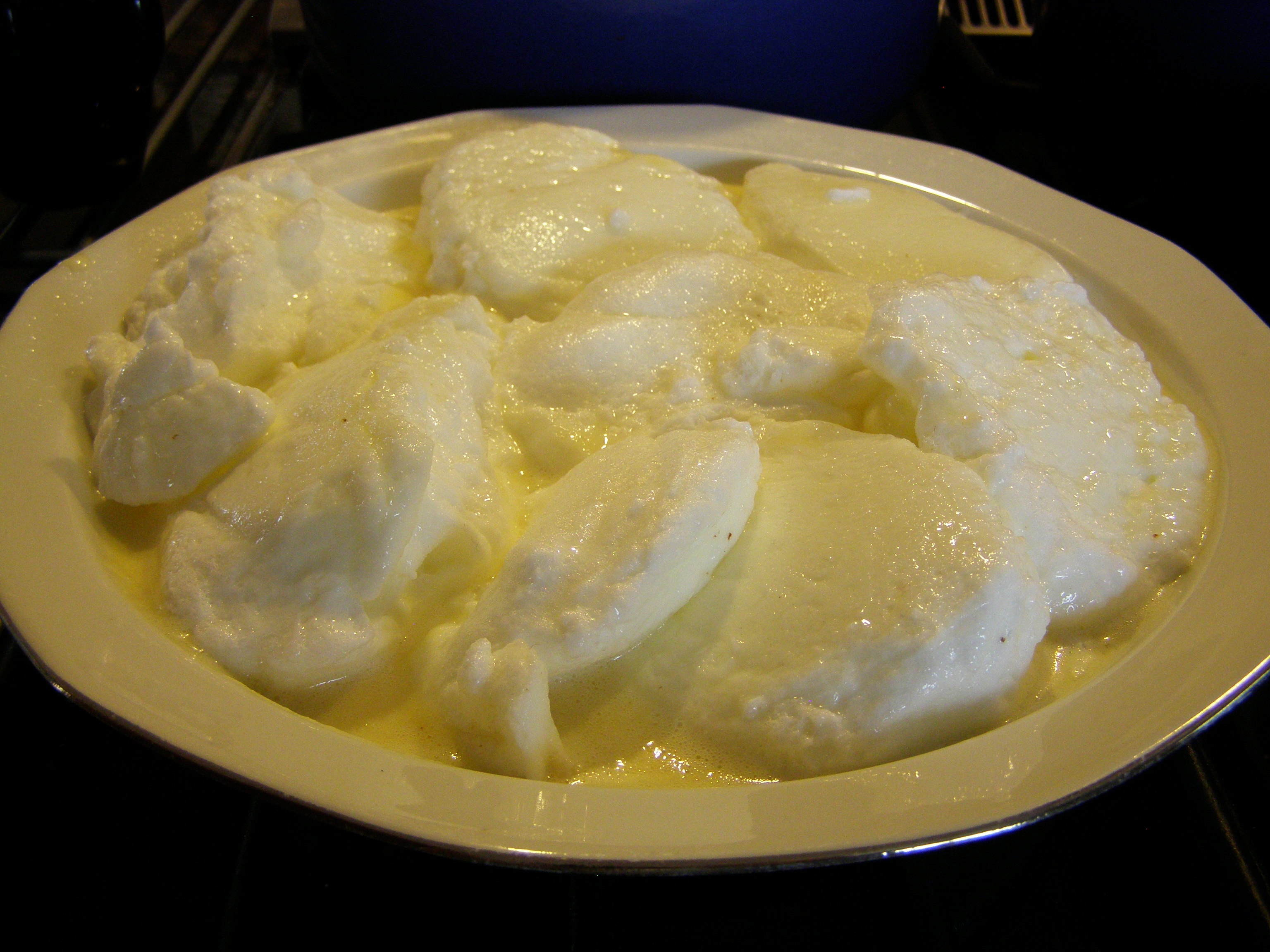
Floating Island


Monday Sept 6th  Hannah & Catharine washed

and I had to be about house most of the 

forenoon  made floating island &c &c Mr

Plymton & another man here from Walpole

to dine  Sewed some on shirts  Called

with Mrs S Ames & Mrs Stevens on Abby &

Hannah.  Called on Mrs Wales Sampson Holmes &c


“Oeufs a la Neige” is the French name for this lovely dessert, but Americans took their floating island from its Italian name, “Ile flottante.” Whatever one might call it, the basic recipe for the soft custard filled with floating ovals of poached meringue requires milk or cream and eggs.  It would have been a special occasion for Evelina to serve it, which suggests that she wanted to impress the gentlemen from Walpole who came to dinner. It also tells us that she had eggs to spare in her kitchen, which was unusual.

Recipes for this dish are varied, as one might expect. One 19th century “receipt,” printed in the 1870’s in Godey’s Lady’s Book of Receipts and Household Hints*,  tells us that making the dish was quite time consuming, especially when we remember that all that beating, stirring and frothing was done by hand.

Take six eggs, separate them; beat the yolks, and stir into a quart of milk; sweeten to taste; flavor with lemon or nutmeg. Put this mixture in a pan. Put some water in a saucepan, and set it on fire. When boiling, put in your pan, which ought to be half immersed. Keep stirring it until the custard gets thick, which will be in about thirty minutes. Whip the whites of the eggs to a strong froth. When the custard is done, put into a deep dish, and heap the frothed eggs upon it. Serve cold.*

No doubt Evelina’s dessert was a success at the dinner table. She could spend the afternoon in peace of mind, sewing and socializing. She, her sister-in-law, Sarah Lothrop Ames, and her guest, Mrs. Stevens, made a number of calls.

* Godey’s Lady’s Book of Receipts and Household Hints, 1870s, Recorded by Sarah Annie Frost, p. 237


August 6, 1852

sarudy4-R14-E422

Friday Aug 6th

1852 Sewed but very little this forenoon picked

some peas currants &c  Lavinia came to 

dinner  Edwin & wife to tea  Lavinia & I

called to Augustus’ to see their babe who 

is quite sick with the disentary  He looked

quite bright  Mrs Witherell & A L Ames

called a few moments

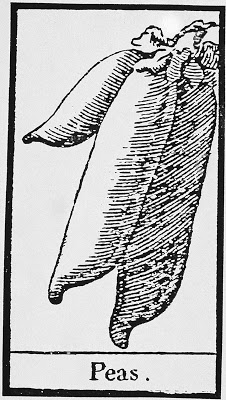
There were fresh peas at the Ames dinner table today.  We readers might not have enjoyed them, however, as the recipes of the time called for cooking peas – and other vegetables – much longer than our modern preferences allow. Domestic doyenne and editor of Godey’s Lady’s Book, Sarah Josepha Hale, declared that peas are “a most delicious vegetable,” but cautioned that “[i]t takes from half an hour to an hour to boil them.”* That seems overcooked to us, but, nevertheless, the Ames’s peas were fresh, untarnished by pesticides, and indisputably local.

With her niece Lavinia Gilmore, Evelina went to visit her nephew (and Lavinia’s half-brother) Alson Augustus Gilmore, who had lately been ill. He was now well, but his one-year old son, Willie, had become “quite sick” with dysentery. Had the child caught something from his father? Or was he suffering a condition not uncommon in children in the heat of the summer?  His bright red face suggests fever and dehydration. Augustus and his wife, Hannah, would have been worried about the little boy.

*Sarah Josepha Hale, The Good Housekeeper, 1841, p. 75


June 23, 1852

1852 Stove Ad 002

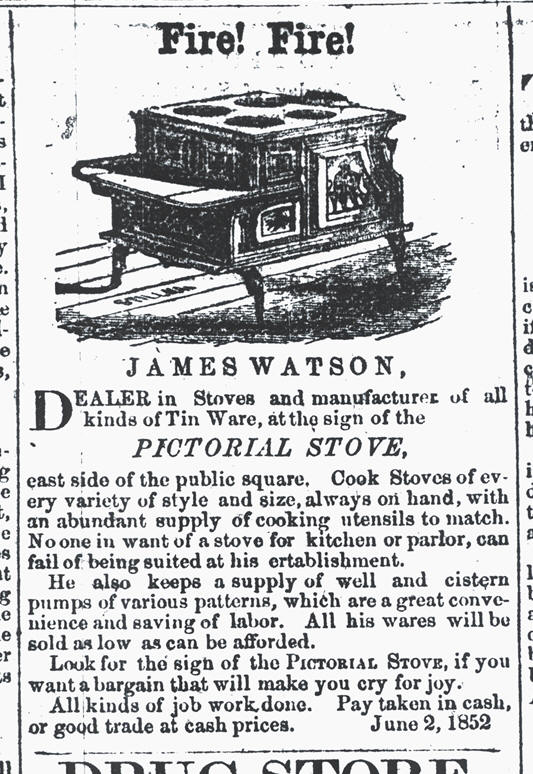
Advertisement for cook stove, June 1852*


Wednesday June 23d  Work again weeding the garden

untill nine or ten and then about house

attending to the new stove that was put up

last night  Passed the afternoon at Mr

Howard Lothrops with Mrs Witherell, S Ames

& Helen.  Got 4lbs of butter of Mrs Harvey &

Eggs of Mrs Howard & Pratt


Evelina had a new, cast-iron stove, a high-tech appliance in the new, industrial age. Cast iron was “the wonder material of the 19th century and led to a prolific industry in making stoves for cooking as well as heating. Cast iron could take the repeated temperature swings of hot and cold, and it was an ideal medium for casting into complex, prefabricated parts, as well as for decorative surface ornament.”** Coal and iron mines were kept busy providing the raw material as middle-class households bought cook stoves for their transformed kitchens.

The new stoves had various brand names, naturally; one model was even named for everyone’s favorite opera star: the Jenny Lind Double Oven Stove. The dominant design for cookstoves was called “step-top,” which allowed two separate levels for cooking on. The choice of cooking surface facilitated the preparation of several dishes. Evelina could be confident that her kitchen was state-of-the-art, whatever her father-in-law had to say about it.

Evelina may even have talked about her new stove as she was out and about this afternoon, picking up butter and eggs, and visiting with her two sisters-in-law at the elder Lothrops’ home.


*Advertisement from Charleston, Illinois newspaper, 

** http://www.oldhouseonline.com/history-of-the-kitchen-stove