February 13, 1851

Money

1851

Feb 13th  Thursday  This morning put the parlour in order

and went down to the store with the intention of calling

on Miss Eaton on my way back, but her Mother & brother

came last night and thought best not to see her but wait

until she was over the excitement of seeing them  Went into the

office with account of butter and other things sold.  Mr Peckham

gave me 30 dollars 78 cents  Augustus is still assisting him with

his books.  Very pleasant but ground rather wet.

Moving past yesterday’s humiliation, Evelina put her parlor back together first thing this morning and left the house, all by herself.  A walk to the little village on a fair day must have felt good, muddy ground notwithstanding.  She went right to the company store.

The Ames family made shovels, obviously, but their overall enterprise was never limited to manufacturing alone  – witness their eventual involvement with the Union Pacific.  They also made money from the operation of a company store, one that had been owned previously by a former partner of Old Oliver named Colonel David Manley.* The shop was right in the village of North Easton where shovel employees and others could purchase ordinary household items – muffin tins, for instance – dry goods like flour and personal articles. Evelina shopped there from time to time, and on this day she may have picked something up.  But she also sold things through the store, which explains why later that day she made her way to the Counting Office to collect $30.78 for “butter and other things sold.”  She had a little stream of income for herself, a source of satisfaction for any homemaker, and material consolation for a wounded spirit.

On her walking rounds, Evelina stopped in at the Holmes residence to call on Miss Eaton, a neighbor who is slowly declining. When she learned that Miss Eaton had family visiting, she deferred her call until another day.  Evelina and her sister-in-law Sarah Lothrop Ames have been looking after Miss Eaton from time to time and will continue to do so as her health fails.  The Ames women were dutiful in looking after the sick among the families of employees of the shovel shop.

* For more information on this store, you might want to read Easton’s Neighborhoods by Edmund C. Hands.  Among extensive historical information about the town, he offers some great context about early business days in North Easton.
February 12, 1851

Thread

1851

Feb 12th This was the day for the sewing circle & what a crowded

house! Not one here except Mr Whitwell and our own

families  Father Ames came in to tea & Sarah W

George, Emily & Oliver & wife  Poldens boy was buried

to day  Isabell & Ann went to the funeral & took tea

with Jane after they came back.  I prepared enough

for 40 and think it is very provoking to have none

 of the members  It is a delightful day.  Letter from Miss Foss

No one came to Evelina’s party.

“Very provoking,” indeed.  Mortifying, even, that not a single member of the Sewing Circle attended today’s meeting, unless you count Reverend Whitwell.  All the preparations, the baking, the cleaning, the spools of thread from Boston, all in vain.

Evelina took the rejection with a lacing of humor: “What a crowded house!”  Although disappointed and upset, she must have been grateful for the way the Ames clan filed in to partake of the feast. From Old Oliver (who almost never came to tea) and all three Witherells to Oliver Jr and Sarah Lothrop Ames to her own children and husband, presumably, the family closed ranks around her and filled her parlor with warm bodies.  Even the Irish servant girls on their way home from a wake partook of the spread of food – in the kitchen with Jane McHanna, of course.

So what happened?  Evelina said the day was delightful but her father-in-law, a dependable chronicler of the daily weather, described “the going” that day as “rough + bad” even though the weather itself was “fair”.  After days of terrible weather that had swung from rain to ice and back again, some of the absentee members probably couldn’t drive their wagons out of their own yards.  Bad roads might account for some, if not all, of the truancy.

Nevertheless, the incident raises questions about Evelina’s popularity and social standing.  She was married to one of the most important men in town, and she and Oakes enjoyed the friendship of many.  Is it possible that some of the women in the Unitarian Circle resented her, or felt themselves superior to her?  Where were the women she had grown up with? Were they jealous of her? Did she fail socially in comparison to her sisters-in-law, each whom had a more refined upbringing? Sarah Ames and Sarah Witherell never failed to attract a lively turnout for their Sewing Circles.

All these possibilities must have swirled in her mind.  The true test would come when the Sewing Circle met again at Evelina’s, many months from this day, this awkward day that Evelina surely hoped to forget.

February 11, 1851

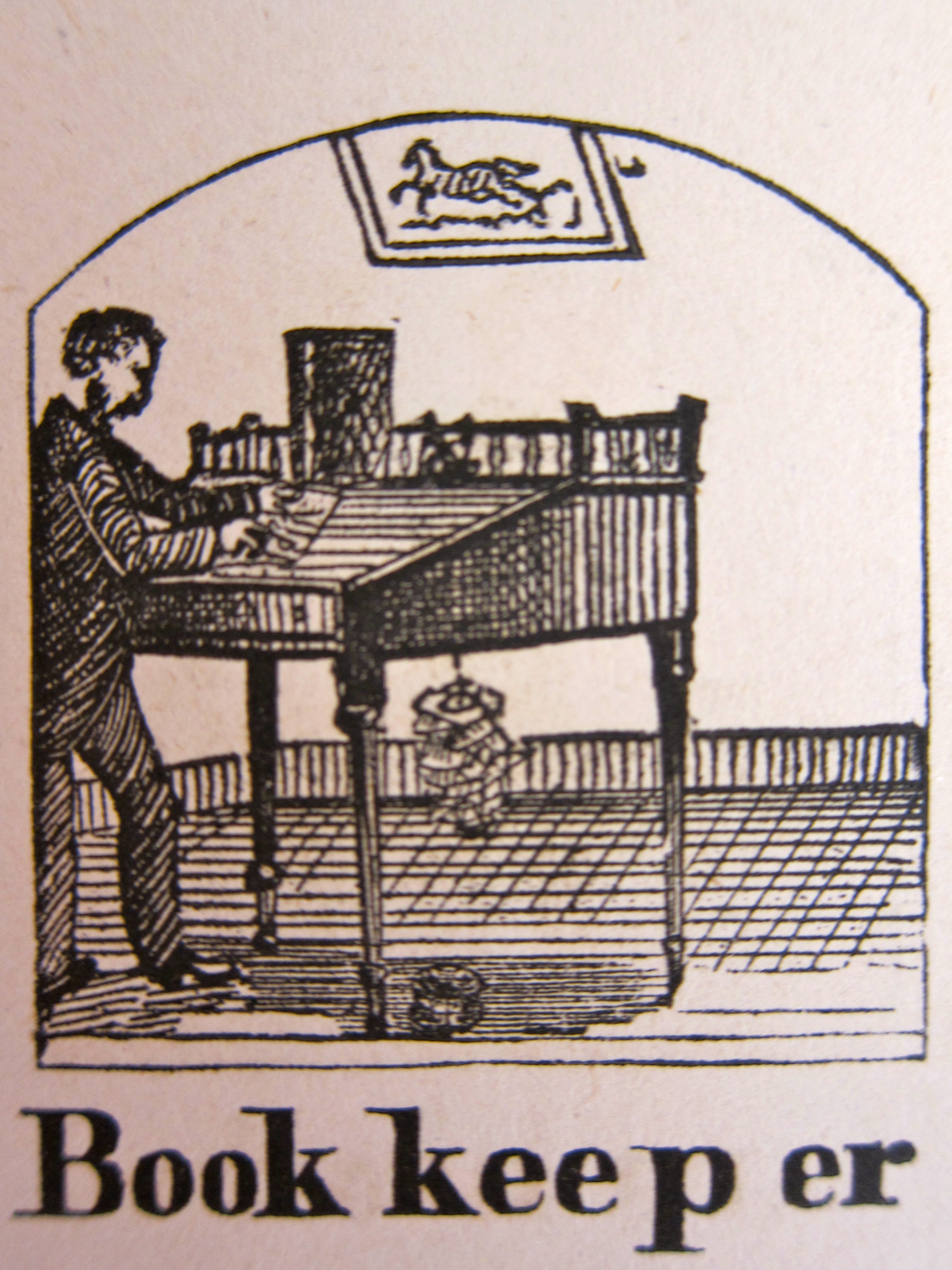
Bookkeeper

Feb 11th Tuesday  This day has been a very busy one

with me, getting ready for the sewing Circle.  Have

washed the front stairs & have been sweeping &

dusting.  Have got things pretty much in order for

tomorrow  It was very unpleasant this morning but this

afternoon it has cleared off very pleasant.  Augustus

is helping Mr Peckham post his books.  went home

with him to dinner & tea

Evelina seemed to feel better today and so went right to work.  Stairs got washed, carpet was swept, table tops were dusted, knick knacks, books and periodicals put in order.  The house would look spanky clean for the Sewing Circle tomorrow. Evelina herself was doing this work, while the servant Jane McHanna handled the regular chores: cooking the meals, washing the dishes and tidying up from the indoor laundry activity of yesterday.  Jane and/or Evelina may have ironed today, too, although it’s doubtful that they could have completed the task.   With all those men’s shirts to care for, ironing at the Ames house often lasted for several days.

In the office, or Counting House, next door, the company’s bookkeeper, John Peckham, was tending to business. Evelina’s nephew, Alson “Augustus” Gilmore, had started work there temporarily as Peckham’s assistant. Augustus is the nephew who has been looking for a place to rent for his growing family, all while beginning to set up a boot manufacturing company in the area. But meanwhile, nepotism being an acceptable, even laudable fact of life in a family-run business, Augustus was being kept afloat financially by work here and there for O. Ames and Sons.   Augustus, a man of robust build, would prove to be a well-known figure around town, especially once he accepted the role of moderator at town meetings, a position he would hold twenty-four times in the next 32 years.

February 10, 1851

Storm

Feb 10th Monday  Warm this morning but not pleasant  Jane 

put her clothes out but the wind commenced blowing quite

hard with some rain, so that the clothes had to be taken

in & were dried over the registers  Cut Susan a Chemise

out of the width of  1  1/4 yd wide cloth and partly made it

Worked about house as usual on washing days in 

the forenoon  Wind blows quite hard this eve.

What a jungle of white linens the Ames house featured this Monday, with Jane McHanna having to drape dripping laundry around the heat registers.  So much for Evelina’s cleaning the floors the other day.  Miserable winter weather – snow, rain, ice, wind and rain again – was wreaking havoc with the domestic schedule.

One person in the Ames household celebrated her 12th birthday today: Sarah “Emily” Witherell.  Emily was born in New Jersey where her parents had lived while her father, Nathaniel Witherell, Jr., worked with William Leonard Ames, her mother’s brother, at various Ames enterprises.  Tragedy had struck in recent years, though, with the death of her father and the subsequent “drounding” of her two year old brother, Channing.  Emily was stricken with loss at an early age.

With her mother, Sarah; older brother, George Oliver Witherell; and grandfather Old Oliver Ames,  Emily now lived in North Easton, Massachusetts in “the other part of the house”.  She probably still attended school, but she and Susie Ames were too far apart in age at this point to be close friends, although they would soon find themselves sharing  piano lessons.  Her cousin Oliver (3) found Emily to be outspoken and opinionated; she was, evidently, unafraid of speaking her mind at a time when candor in women was not prized.

Emily never married.  After Old Oliver died in 1863, when she was about twenty-four, Emily and her mother moved into Boston, eventually taking up residence in Back Bay at the Hotel Hamilton and living off of distributions from investments managed by her male cousins.  A spinster cousin, Amelia Hall Ames, the only daughter of William Leonard Ames, eventually moved in with Emily.  These two cousins, in turn, may have undertaken to raise yet another cousin, Eleanor Ames, a granddaughter of William Leonard Ames. All that is in the future; on this day in 1851, we can hope that Emily had a special birthday despite the weather. She deserved a happy moment.

February 9, 1851

Elizabeth Missing Sewell Gertrude 1866 ( American edition)

Elizabeth Missing Sewell
Gertrude
1866 ( American edition)

Feb 9th Sunday  I have such a cold today that I thought it best

not to go to church or to the funeral of Uncle Seth Hall.  who

died last Wednesday & is to be buried to day at 1 Oclock.

Commenced reading Gertrude by Rev W Sewell.  Edwin called

this Evening and staid an hour or more  Think it rather tiresome to read all day

although I like to do it, but seldom have the privilege.

Had Oysters to night for a rarity  Quite pleasant

Evelina described this day as pleasant, yet in his own journal Old Oliver mentioned “trees loaded with ice”.  Small wonder that Evelina opted to stay home from church to nurse a stubborn cold.  She used the quiet time to start a new novel, Gertrude, by Reverend William Sewell.

Gertrude was actually written by Rev. Sewell’s sister, Elizabeth Missing Sewell, an English author known as much for her religious tracts as for her fiction. She wrote it early in her career and, for publication purposes, gave credit for it to her Anglican brother. Neither she nor her brother were fans of Roman Catholicism, and her books usually featured the Church of England in some way. In this tale of a young woman named Gertrude Courtenay, Sewell examined a lively topic of the day: the claim of duty.  Was devotion to church more important than devotion to the home?  Spoiler alert: Sewell believed in both, but posited that duty begins at home.

The opening page of Gertrude featured a quote from Wordsworth’s poem, Excursion:

Turn to private life

and social neighborhood; look we to ourselves.

A light of duty shines on every day

For all.

This quote is an apt description of Evelina, for whom duty was an essential motivation in life.  She tried to do what was expected of her; she didn’t always succeed, but she did try. Even today, when she didn’t feel well, it must have been a struggle for her to miss both church and the funeral of a Gilmore cousin, to the point where the opportunity to indulge in reading all day eventually paled.  She needed the rest, though, and the oysters at tea in the evening were a treat, as was a visit from a nephew with whom she was particularly close: Edwin Williams Gilmore.

February 8, 1851

Spool

Feb 8th Saturday  Worked about house all the forenoon

sweeping & dusting.  Swept & dusted the parlor

ready for the Sewing Circle.  Put the closets in order &c.

Have a very bad cold and this afternoon took a warm

bath in hopes that it would benefit me but it is much

worse for it.  Mr Ames has been to Boston to day

and brought me a case of Scissors a present from Mr

Benson & 19 spools of Coats cotton  Very cold

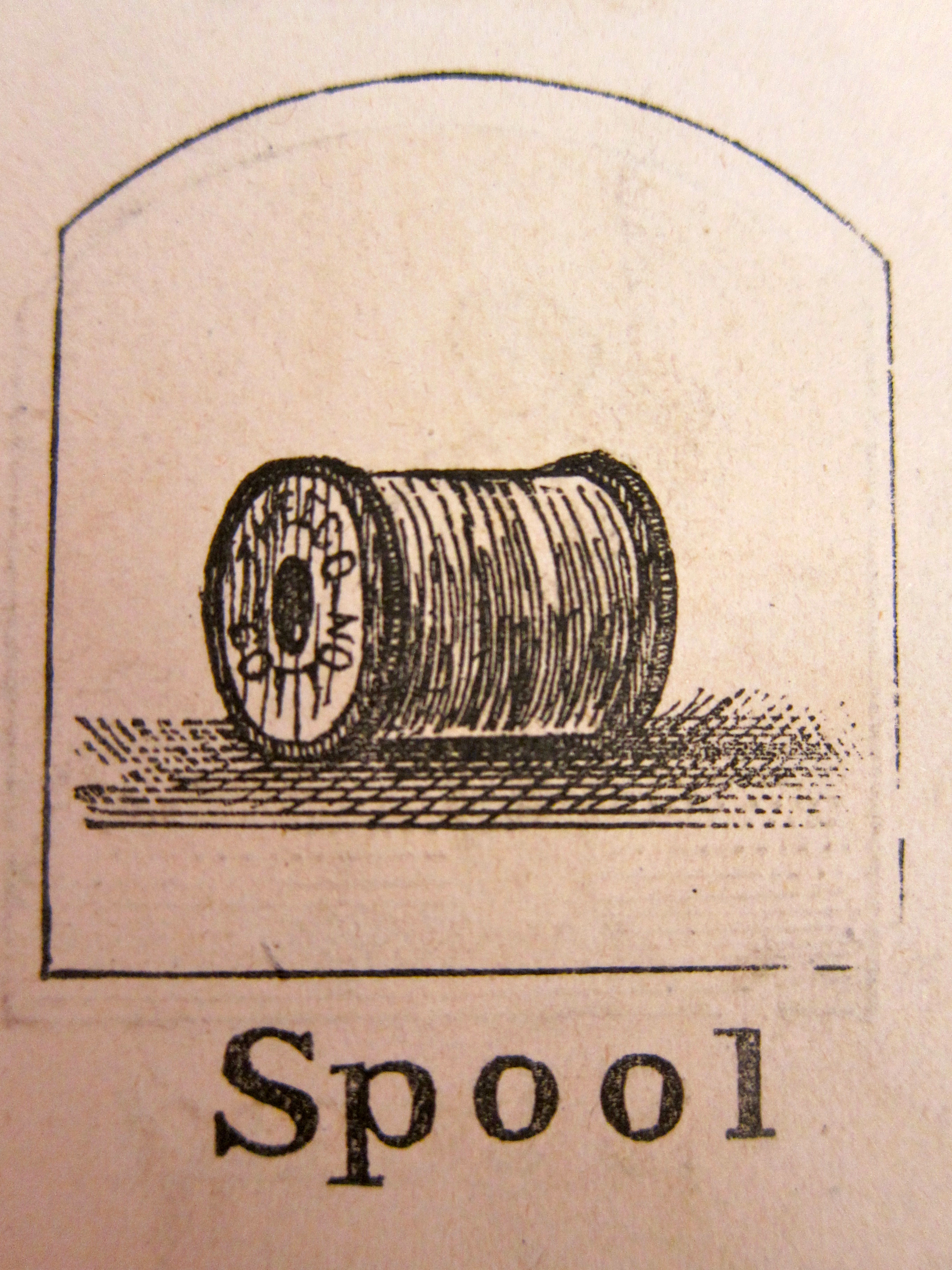
Oakes Ames made his usual business trip into Boston today and brought home scissors and thread for his sewing wife.  Nineteen spools of Coats cotton thread, in fact, all of which Evelina could probably use, being an excellent and dedicated needlewoman. It’s just possible, though, that those nineteen spools of thread were intended for the Sewing Circle, whose next meeting was being held at the Ames house.

J & P Coats cotton thread was originally manufactured in Scotland, but the company began selling their merchandise in the United States around 1830, meaning that Evelina had spent most of her married life with Coats thread in her needle.  In the middle of the 20th century, the company merged with Clarks Thread to become Coats & Clarks and today, under the name of Coats PLC, is still a viable manufacturer.

Despite feeling under the weather, Evelina cleaned house this morning.  Their home being right on a busy road near the center of the village, dust and dirt from the street was apt to float into the house, or be brought in on the soles of family feet, even in the winter.  Sweeping and dusting were repeated tasks and even as Evelina wielded her broom across the floor, she probably knew she’d have to do it again before the Sewing Circle ladies gathered in her parlor.  She was determined to have the house look presentable.

After her morning of chores and an un-therapeutic bath, Evelina may have sat down to read the last bit of David Copperfield.  Given its length – and her various obligations – she had moved quickly through the book.  Like countless other Americans, she was a devoted reader of the novels of Charles Dickens, whose own personal favorite was reputed to be David Copperfield.  Ten years or so from this day, in a diary that has since been lost, Evelina confessed to shirking her housework in order to read Dicken’s “newest book” (probably Great Expectations. ) She loved his work.

February 7, 1851

images

Feb 7th Friday  Have been baking this forenoon  Heat the

brick oven twice.  Baked brown bread mince 

squash & Apple pies & cup cake & ginger snaps.

This afternoon have been cutting out stripped shirts

for sewing Circle  I partly cut them out at Mr 

Whitwells, the afternoon we met there  There are ten of them

This evening have finished the last of the 5 prs of pantiletts

for Susan & cut out two prs more  Very cold.

Baking today, lots of baking. Evelina shared a brick oven with her sister-in-law, Sarah Witherell.  It took so much concentrated fuel to keep the oven hot that they typically baked together, in weekly or bi-weekly batches, producing multiple goods to be served all week long. Yankee kitchen practice was to bake on Fridays and/or Saturdays, in preparation for the Sabbath day when no cooking was supposed to take place.  Sunday meals were taken traditionally from food that had been prepared the day before. That custom was fading by the 1850s, but the practical rationale for concentrated baking still held.

Even by this standard, though, today’s output was prodigious.    Three kinds of pie, brown bread, cake and ginger snaps suggests that more than family was going to be fed – and it was. Evelina’s turn to host the Sewing Circle was coming up, and she wanted to have plenty of goodies to offer her guests.

The afternoon sewing, too, was accomplished with the Sewing Circle in mind.  Evelina cut striped cloth to be made into shirts, something she had begun at the January meeting at the home of William and  Eliza Whitwell.  It was evening before Evelina turned to her own sewing, in this case underclothes for her daughter.

February 6, 1851

Dance

Dance

Feb 6th Thursday  This forenoon was working about house & did

a little mending  Prepared some mince pie meat for baking

Have been into school this afternoon  There were but

about 50 schollars.  Mr Jackson appears to lack energy

Miss Lothrop appeared the best of the two.

There is a ball at Lothrop Hall to night for the first

time.  Oakes Angier & Frank have gone & Helen

Sarah A & Sarah W spent the evening here.  Pleasant but cold.

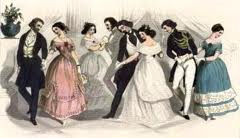
Thursday night seemed to be the night for dancing in southeastern Massachusetts. The Ames sons had already attended at least two Thursday evening assemblies in Canton during January and now in February they’re attending a gathering at Lothrop Hall (the location of which is uncertain: Eastondale, perhaps?  Does any reader of this blog know?) Tonight Oakes Angier and Frank Morton went. (Where was Oliver [3]?)  Evelina’s diary is unclear on whether their cousin Helen went with them or, more likely, stayed home with her mother and aunts – the latter option being more typical for shy Helen.

Earlier in the day, Evelina was evidently still involved with looking into local schooling, getting the lay of the land, perhaps, for the incoming Orinthia Foss.  By mid-century in Easton, there were four school districts, or “ricks” as they were known, in four different geographic areas of town.  Paid for by the occasionally reluctant Easton taxpayers, the schools taught local girls and boys up to grade eight or so.  Massachusetts, and New England as a whole, led the nation in its emphasis on education and, in Evelina’s time, Massachusetts had boasted a 96% literacy rate.

Susie was the only Ames child still attending school.  Oakes Angier, Oliver (3) and Frank Morton as boys had each attended school locally before being sent away to nearby private schools such as Leicester Academy.  On this night, however, dancing, not schooling, was foremost on their minds.

February 5, 1851

OLYMPUS DIGITAL CAMERA

Feb 5th Wednesday  This forenoon made a head dress trimmed

with cherry colour, ribbon & flowers.  Cannot say

much for my days work.  Have been doing a little

of everything & not much of any.  Jane has done

part of the ironing  Oakes Angier has been to Canton

to mark Iron  have been reading in David Copperfield

this evening.  I have been looking over my accounts

It is very warm for the season but cloudy

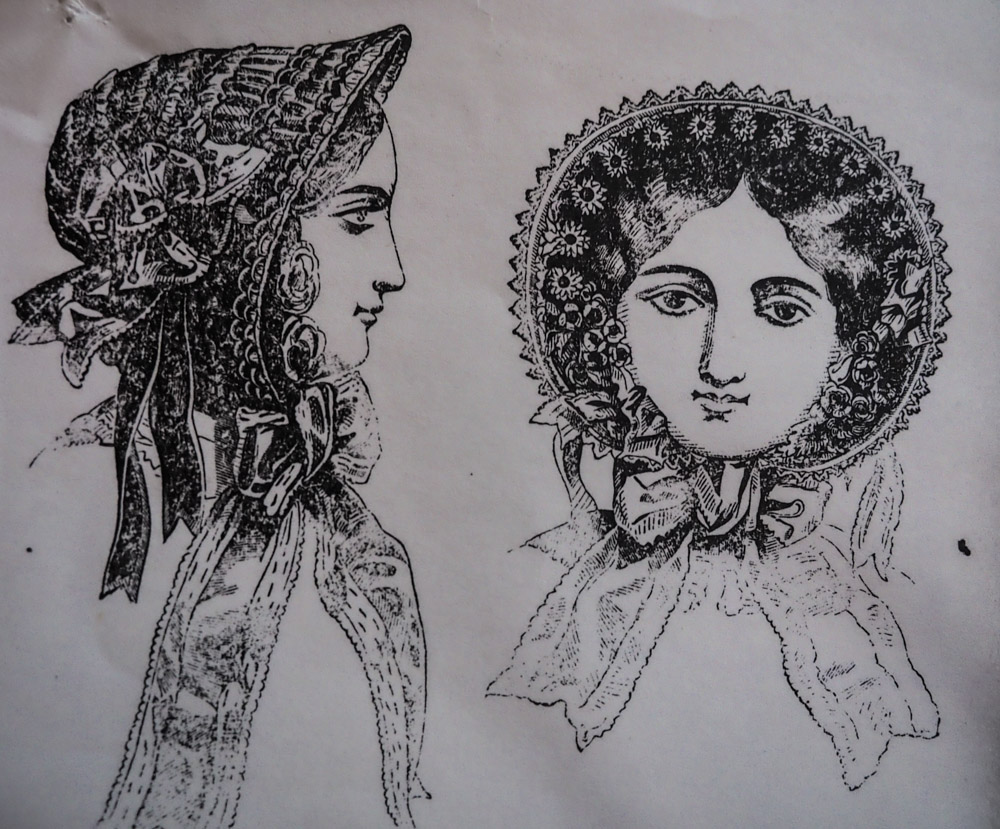
A ho-hum day for Evelina, warm but gray, and she still partly sidelined by a sore foot.  Small wonder that she chose a colorful project for the morning: trimming a head-dress, more commonly referred to as a bonnet.  She used red ribbons and fabricated flowers and although she deprecated her own handiwork, the task must have been a nice change of occupation.

In the 19th century, no lady’s outfit was complete without a bonnet; it played the accessorizing role that shoes and purses play today in women’s fashion.  Given that a woman’s form was covered from neck to toe by a voluminous dress or cloak, the bonnet was an inevitable point of interest atop the whole outfit.  Not only did it stand out like the star on a Christmas tree, it also served to cover hair that was seldom washed.  It rarely kept a head warm, however – that’s what cloaks with hoods were for.

Most women had at least two bonnets, one for winter and one for summer.  Winter bonnets were made of wool, silk or even horsehair, while bonnets for warm weather were typically made of straw or “chip,”  a fine wood splint.  As the 19th century progressed, the transition from winter to summer bonnet solidified around Easter, thus introducing the notion of the Easter bonnet and competition for the prettiest headdress on that important Sunday.

In other news of the day, Oakes Angier Ames rode to Canton on shovel business to “mark Iron.”  Does this mean he looked through a supply of smelted ingots to select the best for the Ames shovels? Anyone out there care to elaborate on what Oakes Angier did?  Was the Kinsley Iron Company the forge that he visited?  Certainly probable.

February 4, 1851

Governor Oliver Ames (Feb. 4, 1831 - Oct. 22, 1895)

Governor Oliver Ames

Tues Feb 4  Had my morning work done about nine Oclock just

as A A Gilmore & wife came to pass the day.  About eleven

we called to see Simeon Randalls house.  This afternoon

called at Mr Torreys and at Mr Peckhams.  While

we were at tea Mr Torrey called to talk about letting his

house to Augustus.  Received a letter from O Foss.

Passed this evening with Sarah W in the other part

of the house finished another pair pantletts  Pleasant

Evelina’s nephew, Alson “Augustus” Gilmore, and his wife, Hannah Lincoln Gilmore, came to North Easton today to search for a house to rent.  A young couple with one child, Eddie, they were expecting a second child in July, although they may not have shared that information with their aunt.  Even if they had, she would never have spoken of it.  The increasingly prim culture of the day forbid it, but the high rate of infant mortality, too, caused many expectant parents and their relatives to downplay “the blessed event.”  Evelina carried Augustus and Hannah around to look at available properties.

Although Evelina doesn’t mention it, today is the birthday of her middle son.  Oliver Ames (3) turned 20 today.  Like his older brother, Oakes Angier, and his younger brother, Frank Morton, Oliver worked at the shovel shop, learning the business in the expectation that he would one day help run the company.  He had attended school at Leicester Academy and had hoped to go on to college, as his cousin Fred Ames was planning to do, but his father had insisted that he return home to work. Oakes Ames was no fan of formal education, having despised learning in his own youth.

The eldest son, Oakes Angier, naturally stood first in line to superintend the shovel business, but Oliver (3), would be a partner. Like his father, he was ultimately slated to travel as the company’s salesman.  Third son Frank, on the other hand, would be given an auxiliary administrative position in a related family-owned business, the Kinsley Iron Works Company in Canton.

But on this day, those occupations were in the future, as was Oliver (3)’s more memorable service as Governor of Massachusetts from 1886 to 1889. On this birthday, he was a brand-new twenty year old who worked hard all day, read alot, and enjoyed attending “sings”.