February 23, 1851

Map of Maine, 1850

Map of Maine, 1850

1851

Feb 23  Sunday  Have not been to church to day on account

of my cough, although it is a great deal better.

Orinthia staid at home too, having a bad cold and 

being a good deal fatigued.  We have had a nice 

quiet time talking over Maine affairs.  She spent

Thursday night at Mr Mowers.  Have written a long

letter to Louise J. Mower to day.  Mr Whitwell exchanged

with Mr Bradford of Bridgewater.  It is a lovely day.

This was the second Sunday in a row that Evelina missed going to meeting.   She stayed behind ostensibly to keep the new boarder company and to nurse the lingering cough that she admitted to herself was much better.  Was she still avoiding certain people at church, or had she gotten past the Sewing Circle incident?  Whatever her reasoning, she had a pleasant visit with young Orinthia Foss, the new schoolteacher.

Orinthia seems to have hailed from the state of Maine, where the Ames family had vital business connections.  The wooden handles of the Ames shovels came from Maine, where good wood like ash was still plentiful. Massachusetts, on the other hand, in 1850, was fairly well devoid of decent stands of hardwood after two centuries of settlement and development.  Wood from Maine was a critical resource for the Ames enterprise and over the years, one or other of the Ames men made a periodic trip north to examine the supply and cultivate the connections. Oliver Jr., for instance, made a trip to Wayne, Maine, near Augusta, in the mid-1860s.

On her journey to North Easton, Orinthia Foss spent a night with the Warren Mower family in Greene, Maine, a town near today’s Lewiston-Auburn area. Quite wooded, and close to the Androscoggin River as well.   Mrs. Warren Mower was the former Louisa Jane Gilmore born in Leeds, Maine, in 1820. Was she a relative, perhaps? Evelina’s eldest brother, John Gilmore, lived in Leeds, having moved there from Easton in the 1840s.  What was the connection? Whether or not they were related, Evelina and Louisa were clearly friends who corresponded regularly.
February 22, 1851

Rubbers

Feb 22nd  Saturday  This morning sat down to sewing

quite early to work on Susans apron.  Mr Torrey called 

to see about Augustus having his tenement.  Augustus

has engaged Mr Wrightmans house for the present.

Lavinia & myself passed this afternoon at Mr Torreys.

Called at the store, met Mrs. Peckham & Miss

Georgianna Wheaton there  Miss Foss came to night.  Mr

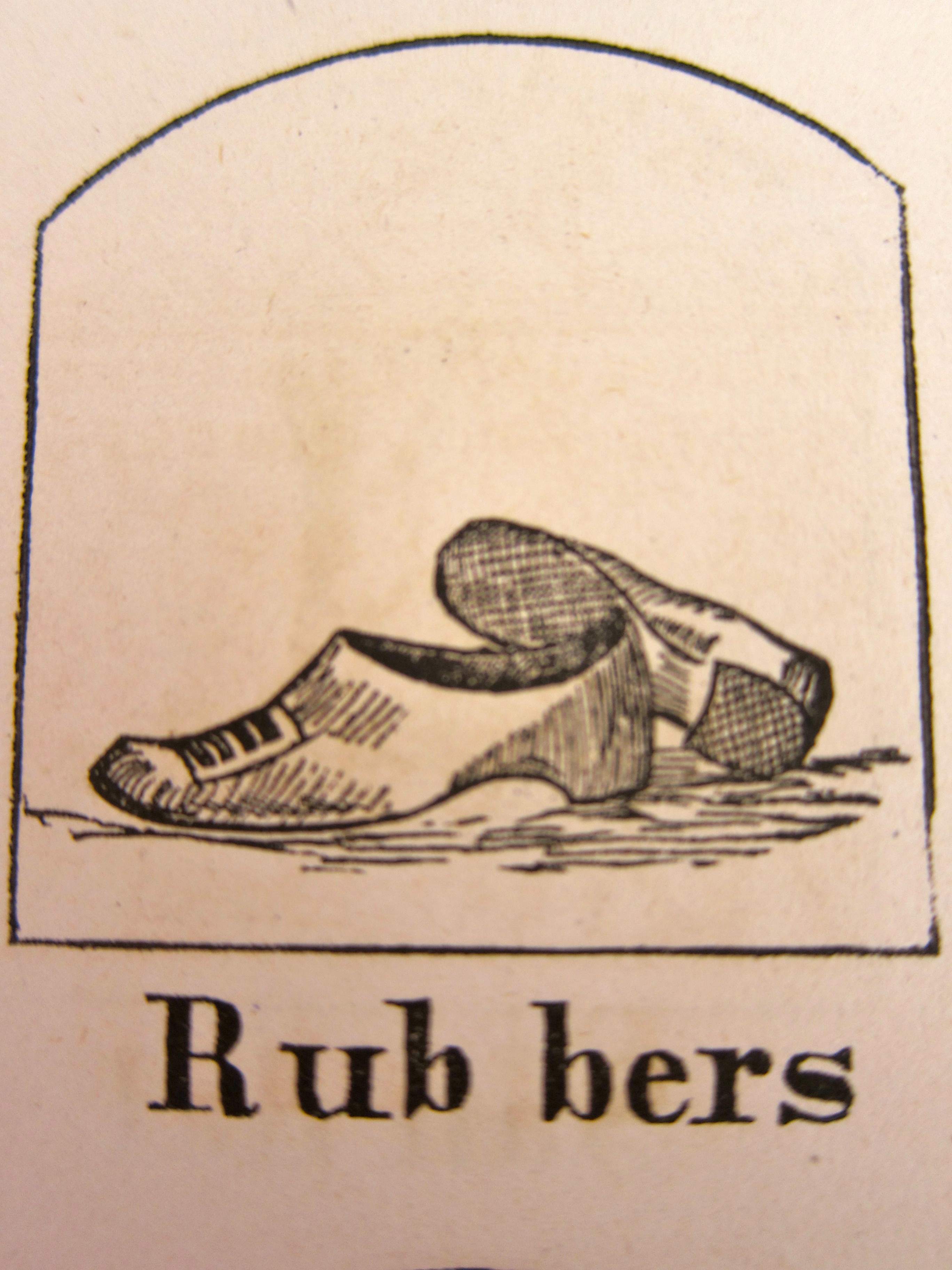
Ames has been to Boston brought Susan Rubbers.

Cleared off pleasant to night

In his journal today, Old Oliver noted that “It’s pretty muddy now,” which explains why Oakes Ames returned from Boston with overshoes, known as rubbers, for his daughter.  Probably everyone in the household donned rubbers during this late winter wetness.

Evelina negotiated the streets just fine, it seems, as she and her niece traveled the short distance to the center of town to call at the company store and at her brother-in-law’s house.  Their mutual nephew, Augustus Gilmore, had decided not to rent from Col. Torrey and would be settling his family instead at a Mr. Wrightman’s house.  And at the end of the day, a new person entered the domestic scene.  Miss Orinthia Foss, the new schoolteacher, arrived from Maine.

February 22 is a date that people acknowledged in 1851 in a manner similar to the way people do in 2014, because it’s George Washington’s birthday.  In this year of Evelina’s diary, President Washington had only been dead for a little over fifty years.  People were alive who could still remember him; Old Oliver was one of them.  Old Oliver was born in 1779, while the Revolutionary War was being fought.  He was two years old when the British surrendered at Yorktown, and eight years old when representatives of the new states assembled in Philadelphia to write a constitution.  George Washington was elected to head that convention and became the country’s first president in 1789, when Old Oliver turned ten.  When Washington died in 1799, beloved and mourned, Old Oliver was a twenty-year old bachelor just making his way in the world.  Much about that world would change over Old Oliver’s lifetime, but the reverence that citizens of the United States felt for their first leader would hold strong.

February 21, 1851

Bed

1851  Feb 21  Friday  It stormed so hard & so dark that Mr & Mrs

Whitwell spent last night with us & returned

home about 8 Oclock this morning  Lavinia &

myself have been sitting quietly sewing.

Susan is all engaged making Labels for the shop

has cut quite steady all day.  Helen brought her work in, and staid two

or three hours but I could not prevail on her to stop to tea

Bridget has hired a bed & bedstead

The family business, O Ames and Sons (as it had been known since 1844 when Old Oliver handed over two-thirds of the reins to his sons Oakes and Oliver Jr.) was just that: a family business.  The Ames men all had rolls to play in its operation, from manufacturing to sales to management.  On this day in 1851, it appears that an Ames female had a roll to play, too.  Little eight-year old Susie Ames spent the day making labels for the shop.  Presumably, this meant she was cutting out printed labels to be affixed to individual shovels.  Did she sit at a table in the kitchen or the dining room, paper and scissors in hand?  Was she paid for this effort, or was this just a rainy day game for her?  Who thought this up?

While Susie wielded scissors, the women wielded needles, of course.  Evelina and her niece, Lavinia Gilmore, kept each other company as they sewed and were joined for a few hours by Helen Ames from next door.  Although Lavinia, aged 19, lived in the country and Helen, aged 14, lived in town, the two young women, distantly related by marriage, were friends.

Lavinia was in town visiting her aunt Evelina.  Last night, Mr. and Mrs. Whitwell stayed over, unable to return home because of bad weather.  A new servant, Bridget, had just ordered a bed and bedstead for herself. In a two-family house already filled with ten people, not including servants, where did everybody sleep? People surely doubled up; Oakes Angier and Oliver (3), for instance, shared a bedroom and probably a bed. Although this practice, too, was disappearing, many houses of the period still kept beds in their parlors; apparently the Ames did this, so perhaps that was where the Whitwells spent the night.

The difference between a bed and a bedstead was simply that the former included only the mattress and linens (also known as bedding), while the latter was the frame on which to put the mattress.  This verbal distinction was beginning to disappear at the time, but it was still useful in an era when some people – servants, particularly – only had bedding on which to sleep.  A mattress could be rolled up and moved around, a wooden frame could not.  Bridget showed hope or confidence in her place in the household when she ordered a bedstead as well as a bed.

February 20, 1851


images-1

Feb 20th  Thursday  This morning sat down to sewing quite

early with Lavinia.  worked for Susan and she

sewed some with us  Sent George after Mr & Mrs

Whitwell about one Oclock.  Mr Whitwell attended 

the funeral of James Wells child  Commenced 

raining quite hard & this evening is very dark

The boys & Lavinia & Susan have gone to the 

dancing school at Lothrop Hall

The Thursday evening assemblies, or dancing school, continued. On this occasion, Oakes Angier, Oliver (3) and Frank Morton took their cousin, Lavinia Gilmore, and little sister, Susie, with them.  How exciting for Susan to go along to watch the young men and women dance; probably exciting for Lavinia, too.  She was at the marriageable age of nineteen and, in the manner of the day, was probably hoping to marry soon.  Getting off the farm for a week to stay with her aunt Evelina in the village of North Easton was an opportunity to socialize and perhaps meet someone special.  Did anyone ask her to dance?  Did her male cousins watch out for her?  Did she like what she wore?

Elsewhere in Easton life was not so light-hearted.  Reverend Whitwell officiated at a funeral for the infant son of James and Celia Wells.  James and his brother John, for whom the little boy was named, worked at the shovel factory.  They were originally from Maine.

And, being February, the weather took a dive for the worse.  The young people’s ride home from Lothrop Hall must have been disagreeably wet.  Mr. and Mrs. Whitwell, who had evidently stayed for tea after the funeral, were unable to get home and had to spend the night at the Ames’s house. Young George Witherell was spared the challenge of carrying them back to the parsonage in the dark, windy downpour.

February 19, 1851

Farm

Feb 19  Wednesday  A[u]gustus & wife came this morning in

the stage  We had our breakfast about six Oclock

and I had my morning work most done

We went to Mr Torreys to make a call met Alson

and Lavinia coming.  Alson went back to the poor

farm & Lavinia went with us to Mr Ts  Alson came

here to tea.  Augustus has engaged Mr Torreys

tenement if he concludes to take it   Beautiful weather.

Breakfast at six a.m., at work by seven.  That was the way it was done in the small industrial town of North Easton. By the time Augustus and Hannah Lincoln Gilmore arrived, the men of the house were at the factory and Evelina had washed the dishes, dusted the parlor and instructed Jane McHanna on the menu for dinner and  tea, probably adding additional directions on finishing up the ironing or some other piece of housework.

Off she went, then, to the home of her old brother-in-law, Col. John Torrey, with their mutual nephew, Augustus, only to meet her brother (and Augustus’s father,) Alson Gilmore, en route.  Alson had brought one of his daughters, Lavinia Eveline Gilmore, into town for a visit with the Ameses.  Evelina was fond of her niece, so the visit promised to be pleasant.

Alson soon drove off.  Evelina said he was headed to the “poor farm,” which may have been a jest expressing her opinion of the old family place or perhaps an expression of concern over the economics of the Gilmore homestead.  Or Alson may actually have been on an errand to an Almshouse located in the center of Easton*, near the church that the family attended.  Perhaps Alson was in search of temporary laborers for his farm, although why he would need help in the middle of winter is questionable.  Maybe he had an official role in its oversight.

Many towns had poor houses where the indigent lived; Worcester, Massachusetts established one in the late 1830s in alarmed response to a rising influx of immigrants.  Some citizens were afraid of the diseases that immigrants might be bringing with them, so part of the impetus for setting up a poor farm or poor house or Almshouse, as they were also known, was to establish a discrete site for new arrivals, pending further inspection.

Incidentally, today was an anniversary that probably went unnoticed in the Ames family.  On this date in 1810, a baby named Angier Ames was born.  He was the fourth son of Old Oliver and Susanna Angier Ames, coming along after Oliver Jr. and before William Leonard.  He only lived to be fifteen months old, dying in the summer of 1811 of an unrecorded cause.  Old Oliver wrote no record of this child; did he think of him on this day, some forty years later?

*A shout-out to Frank Mennino, Curator of the Easton Historical Society, for his capable sleuthing about the “poor farm.”  As he pointed out to me, the Almshouse can be identified on an 1855 map of the town. Thank you, Frank!

February 18, 1851

yoke-of-oxen

Feb 18  Tuesday  After doing my usual mornings work sit

down to sewing on Susans work   She sewed with me

and counted stiches again  She will do pretty well

and keep quite steady when we count stiches

This afternoon went into Olivers to assist on Helens

quilt but found it most done.  Was called home

to see Mr Whitwell   Abby & Malvina Torrey & their 

cousin Mrs Fullerton  called  Pleasant

Sewing lessons for eight-year old Susie Ames continued today.  She seemed to be getting the hang of the needle as long as she counted her stitches.  This meant calculating and maintaining an equal number of stitches per inch of sewing. After the lesson was through, Evelina tripped next door to help with the making of a quilt. She discovered that the work was pretty well complete, however, which was just as well as she was called back home to sit with Reverend Whitwell, who came to visit.  More follow-up to the Sewing Circle meeting?

Outside, away from this cozy domesticity, Old Oliver was clomping around looking at oxen to buy.  He found a pair that he particularly admired and seemed pleased with his purchase:

“this was fair day  wind about west and not cold   I bought a yoke of oxen to day of a Mr Whitcom of East Randolph for $125-00 they are a handsom red + look a good deal alike.  he said they would be 6 years old this spring comeing   the off one girts 7 feet + 2 inches + the nigh one 7 feet   they weighed after drinking with yoke on 3220 lb.  the man  said he had them for twins”

And while Old Oliver dealt with the farming side of the Ames enterprises, Oakes and his three sons were no doubt busy at the shovel works, the young men continuing to learn the ins and outs of manufacturing, much as little Susie was learning to be domestic.   The futures of all four offspring were being lined up.

February 17, 1851

Hem

Feb 17th  Monday  Washed the dishes and worked about

house most of the forenoon  This afternoon cut out some

work for Susan & set her to hemming, counted

stiches with her.  Helen came home from

New bedford.  Spent the evening at Olivers with

Sarah W.  Worked on an apron of Susans but

had so much talking to do that […] I accomplished

but a little sewing  Pleasant but cold

Sewing was a necessity, but it was also a sociable occupation, which is perhaps one of the reasons that Evelina enjoyed it so. Her visit next door with her two sisters-in-law, Sarah Lothrop Ames and Sarah Witherell, turned into an evening of conversation with “but a little sewing,” which she didn’t seem to mind.  What did the women discuss?  Did they revisit the tender issue of the failed Sewing Circle meeting?  Or did they steer toward safer topics like Helen’s return from New Bedford? What had the fourteen-year-old been doing there?  Had she been in school? Why did she return home at the start of a week?  Susie Ames was home from school this week, too.  Was mid-February a typical time for schools to close?

At this time in our history, almost every woman knew how to sew. Sewing was a skill handed down from one generation to the next. Evelina, Sarah Ames and Sarah Witherell had each learned their stitches from their mothers or grandmothers; now it was Susie Ames’s turn to learn.  How could the women know that sewing was about to be transformed by the arrival of the domestic sewing machine, and that a forthcoming civil war would introduce mass-produced, “ready-made” clothing on an unimagined scale?  They, who in their youth had probably watched a elderly relative work a spinning wheel, would experience a dramatic trajectory in the making of apparel.  By the time Susie reached adulthood and became a housewife, some of what she was being taught would be obsolete.  But not all: hemming, mending, quilting, and neat hand-sewing would always have a place in the domestic arts, even though few women today practice the skills.

Young girls of the antebellum period like Susie and Helen and Emily Witherell  sat by their mothers’ sides and struggled to manage a needle and thread, basting or hemming or working cross stitches.  Some of them created the hand-wrought samplers that hang now in textile collections, featuring alphabets or numbers or biblical quotations with colorful, tiny stitches painstakingly wrought by stubby little fingers at age eight or twelve or fourteen. Sewing was a necessity, but it was an art form as well.

February 16, 1851

Hoarhound or horehound

Hoarhound or horehound

Sun Feb 16  Did not go to church to day on account of a bad

cough  Boiled Molasses, honey, & sugar and a little 

hoarhound for it.  Jane has been to meeting at the

boarding house.  Michael & sister called to see her.

Have been reading some in Margaret by Mr Judd

do not like it at all I believe I shall not finish it

but can spend my time for a better purpose

Mr Whitwell exchanged with Mr Lovell  Very pleasant

Evelina’s cold was long gone, but her cough lingered.  To make it better, she cooked up a nostrum that included hoarhound (or horehound), a medicinal herb cultivated for its efficacy as an expectorant.  She likely grew it in her kitchen garden, or knew where to find it wild.  Brewed with honey, sugar and molasses – the latter being recommended by many household guides as good for the throat –  Evelina’s dose of medicine was warm and comforting.

Her cough may have been real, but it probably wasn’t the only reason Evelina avoided going to meeting this morning.  At church, she would have had to face some of the women who had not attended her Sewing Circle meeting. Her feelings may still have been too hurt to do so and her cough made an excellent excuse for her absence.

Everyone else seemed to be practicing their faith today. The Ames family presumably all went to church and heard Reverend Stephen Lovell stand in for Reverend Whitwell; the two men had finally swapped meetings as originally planned a few weeks ago.  Jane McHanna, the Ames servant originally from Ireland, attended a Catholic service held in the dining room of the Ames boarding house, and apparently came home with fellow-countrymen Michael Burns, the Ames coachman, and his sister.

Today’s new book, Margaret by Reverend Sylvester Judd, did not pass muster.  Evelina started the novel, a story about a young woman raised in the wilds of Maine, and emphatically did “not like it at all.”   Reverend Judd, a Unitarian minister, was a peripheral member of the Transcendental circle; his book is considered one of a very few works of Transcendental fiction.  Margaret Fuller, author of Woman in the Nineteenth Century,  described it as a “work of great power and richness” but critics and other readers such as Evelina found the book incomprehensible.

February 15, 1851

Chemise

Chemise

Sat Feb 15  This morning mended a pair of pants for Frank

and some other things.  Finished two chemise for Susan

made her a skirt out of an old quilted one of mine.

It has been a very stormy day.  the public school

finished this afternoon.  Oakes A, Mr Pratt, Davidson,

Barrows, R. Willis, Lillie & one or two others visited the 

school.  There were no ladies on account of the rain

Mr Ames went to Boston.  Brought Miss Eaton some maple sugar

While her husband went into Boston today despite poor weather, Evelina stayed in, mended clothes and completed two chemises for Susan. The chemise, a forerunner of today’s slip, was a standard undergarment for women and girls in the 19th century, worn right under the dress (and under the corset, when corsets were worn.)  As Evelina suggests, some undergarments were quilted for warmth, an essential consideration in cold New England. On stormy days like this one, women needed all the padding they could accommodate under their wide skirts.

Oakes Angier Ames visited the local schoolhouse today with men from the school’s superintending committee: Amos Pratt, a teacher; Thomas Davidson, the town’s postmaster; Joseph Barrows, a “shovelmaster” with legal training who lived in a house built by Old Oliver; Rufus Willis, a shoe manufacturer; and Daniel Lillie, another employee of O. Ames & Sons.  Daniel and Oakes Angier were in their early twenties, while the other men were older.  Daniel would be close to the Ames family over the years, and ultimately serve as a pallbearer at Oakes Ames’s funeral in 1873.  Today, however, in the rain, without their wives, the men appeared at the public school on the last day of this session.  Why was Oakes Angier along?  He wasn’t a member of the committee, but perhaps he was developing an interest in local politics.

Oakes Ames, meanwhile, returned from Boston in the evening, bringing with him a gift of maple sugar – a sign of spring – for the failing Miss Eaton.   He may also have returned with news of a serious incident in the city.  Shadrach Minkins, a fugitive slave living and working in Boston, was arrested today by federal marshals at a coffeehouse on Cornhill Street. Minkins would be taken to court, only to be rescued by an anti-slavery group, the Boston Vigilance Committee, who hid him and helped him escape to Montreal.  The controversial new Fugitive Slave Law was being tested.  Had Oakes witnessed any of this?

February 14, 1851

Valentine from the 1870's by Esther Howland

Valentine from the 1870’s by Esther Howland

Feb 14th Friday  Mended a pair of pants for Oakes Angier & 

cut out some work for Susan.  Went to the store for a

pair of shoes for self & Susan.  Called on Miss Eaton

on my return met the Dr there.  He thinks she will 

live into March.  Has failed very much since I saw her

Passed the afternoon with Mrs Wales & Miss Lothrop in

the other part of the house.  Mr Jackson called here this eve.

Pleasant this morning, afternoon cloudy & a little rain

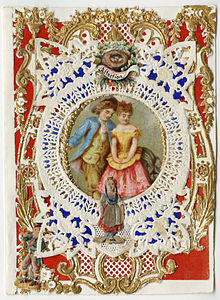
The 19th century descendants of the Puritans weren’t known for their celebratory spirit, so we shouldn’t wonder that Valentine’s Day went unrecognized at the Ames’s house.  Although the practice of sending a sweet message to one’s beloved had thrived in England for several decades, the concept was just gaining traction in the United States. Personal Valentine greetings in the form of hand-written poems were familiar to many young people, but nothing was mass-produced until mid-century when a graduate of Mount Holyoke named Esther Howland, whose father was a stationer in Worcester, Massachusetts, developed and sold a lacy Valentine card, America’s first.  The idea took off and shortly thereafter, Graham’s American Monthly noted that “Saint Valentine’s Day […] has become, a national holyday.”   The idea hadn’t caught on at the shovel works, though; if it had, Oakes Ames probably would have seized the opportunity to buy one for his wife.

Evelina took a small step back into her social life today.  Not only was she able to call on Miss Eaton at the Holmes’s house, but she also got an update from the doctor, who confirmed that Miss Eaton was dying.  Miss Eaton did not yet have a “watch” on her, but the time would come when different friends and relatives would take turns sitting with her until she passed.

After her visit with Miss Eaton, Evelina relaxed into a sociable afternoon in “the other part of the house.”  With her sister-in-law Sarah Witherell, she chatted with two female acquaintances while rain returned outside.  In the evening, Mr. Jackson came to call.  He was probably the school master whose teaching had “lacked energy” last week when Evelina visited the local school.  Why was he calling?  Had he learned that Evelina was involved in the establishment of a private school?