December 9, 1851

21e3fa70a71cf1a247c917909a88dc2f Dec 9th Tuesday.  Have been painting all day.

Got some putty from Edwins house to stop

the cracks in the hearth and painted that 

and then went to work in the storeroom

chamber finished that and the porch 

and this evening Mr Scott has painted

the floor & stairs.  Have quite a bad

cold felt it first Sunday morning

Mrs Holmes called about her milk has stoped taking

Despite having a “bad cold,” Evelina was up and working.  She walked over to her nephew’s new house and borrowed some putty which she used to fill some cracks on her own hearth. She “went to work in the storeroom chamber,” painting there and on the porch as well. It was a chilly time of year to be working in those areas, and not at all conducive to getting the better of a new cold, but Evelina seemed to have a goal in mind that she was determined to meet.

Mr. Scott was painting in the house as well, going over the floor and stairs. What kind of paint were he and Evelina using? The ingredients would have included pigment and a binding agent, such as milk or animal glue; the paint was meant to last as long as possible. Whitewash had prevailed on the plaster walls of early American homes, but other colors had since become popular. We don’t know what color Evelina picked. Mr. Scott would have mixed the paint up himself; there was no going down to a hardware store to pick up a gallon – at least not yet. Commercial house paint wouldn’t become available until after the Civil War, when Henry Sherwin and Edward Williams began to manufacture and sell ready-mixed paint.

In addition to the painting she did, Evelina mentioned a visit from her neighbor, Harriet Holmes, who came over to discuss “her milk” which “has stopped taking.”  This last sentence doesn’t quite make sense, and may be incomplete; if so, there’s no telling how the thought was intended to conclude. If we only consider what’s written, however, it sounds as if Harriet’s breast milk had just dried up. Yet there’s no commentary anywhere about Harriet Holmes having had a baby recently.  It’s a mystery.

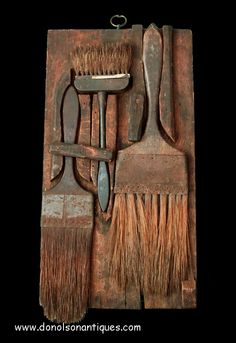
*19th century painter’s caddy, Courtesy of http://www.donalsonantiques.com

December 8, 1851


381-1233891708GdW7


Dec 8th Monday.  Another unpleasant windy day

and we could not put our clothes out

Alson came after Mother this afternoon

and it has cleared off quite pleasant.  he is

better but is not able to work yet.  I have been

cutting out some cotton flannel for Jane to work on

last week she worked for herself.  It is three

weeks since she has been able to work much

Another Monday morning with weather too “unpleasant” to hang the wash out to dry. It rained in the morning, and “took the snow all of[f]” according to Old Oliver. The newest servant, Mary, possibly with the help of the still-recovering Jane McHanna, must have resorted to hanging wet articles over various registers around the house to dry.

Besides the weather being crummy, Evelina’s husband, Oakes, was still away; her brother Alson, though improved, couldn’t yet work his farm; her servant, Jane McHanna, hadn’t fully recovered from an illness of three weeks running and she, herself, was coming down with a cold. Evelina’s week was off to a poor start; she must have been anxious by this time to have her husband return home. On the bright side – perhaps – she saw her mother, Hannah Lothrop Gilmore, return to the family farm, where the elderly woman was always the most comfortable.

The weather “cleared off” in the afternoon, bringing back the sunshine. Did the full moon that night cheer Evelina up with its wintry light or keep her awake worrying about various domestic aggravations?


December 7, 1851

Locomotive

Dec 7th Sunday.  This has been an uncomfortable stormy

day but we have all been to meeting  Mother

was expecting to go home but none of Alsons

family were out and she came back with us

Edwin called this evening.  We passed the

noon very pleasantly though there were but 

few ladies out.  We are to meet Wednesday

at Mr Wm Reeds to quilt


A snow storm today did not keep Evelina or her children home from church. Her husband, Oakes, may have been away and thus not present to drive the carriage, but anyone of Evelina’s three grown sons would have driven it for her. Propriety and patriarchy aside, she herself could have driven it, former farm girl that she was.

Not many others ventured to the Unitarian church in the bad weather, including her brother Alson, who was to have taken elderly Mrs. Gilmore back home to the farm. There were “but few ladies,” but those who did attend got the word that the Sewing Circle would reconvene the following Wednesday. Evelina herself felt a cold coming on as she traveled through the falling snow, which Old Oliver reported eventually accumulated to “about an inch + a half of snow southerly but cold.

Exactly ninety years from this quiet day, on another ordinary Sunday, an American navy base on a Hawaiian island was bombed by Japanese planes. Evelina could never have imagined such an event. Although she was certainly familiar with the U. S. Navy and, too soon, would become familiar with war, she had probably never heard of Pearl Harbor.  Nor could she have fathomed the flying machines that attacked it.  A speedy carriage ride along an unpaved road behind Old Kate or a trip into Boston on a train car moving maybe 20 miles per mph was about as fast as she ever went. How things changed in the century ahead.

December 6, 1851


Picking apples 1880

Farm hands fill an oxen cart with apples in the late fall

Dec 6th Saturday  Mr Scott & Holbrook have finished

the first coat of paint in the storeroom &

stairway and porch.  They commenced yesterday P.M.

Have been mending stocking pants &c &c

all day and waiting upon the painters   they have

varnished the graining in the dining room

and painted the inside windows for the sitting room

Yesterday Evelina had sought Mr. Scott to do some painting for her.  He and another workman, Randall Holbrook, had responded quickly, arriving at the Ames’s house by the afternoon.  They continued their work today, painting and varnishing various areas inside the house. The day being “fair”  if “cold,”*  the men were also able to paint a porch outside. One might have thought that Evelina had already gotten everything painted; this kind of work had been going on for months.

Old Oliver noted in his journal that “the ground is frozen hard + carting is good”  The unpaved roads in the village and beyond had hardened, enabling carriages, carts and wagons to move steadily around. There was no sinking into half-thawed, muddy ruts. As modern historian Jack Larkin has noted, “[W]henever it was cold enough to freeze hard, ‘winter was the time…for making journeys.’ The hazards of cold and storm were outweighed by leisure from farm work and greater speed.” **Pulled by teams of oxen, carts full of finished shovels could get moved to market to be shipped out, and raw material for the factory could be shipped in.


*Oliver Ames, Journal, Stonehill College Archives, Tofias Collection

** Jack Larkin, The Reshaping of Everyday Life,” New York, 1988, p. 221.


December 5, 1851

tumblr_mbsy6tKaeV1r5pmqlo1_r1_1280

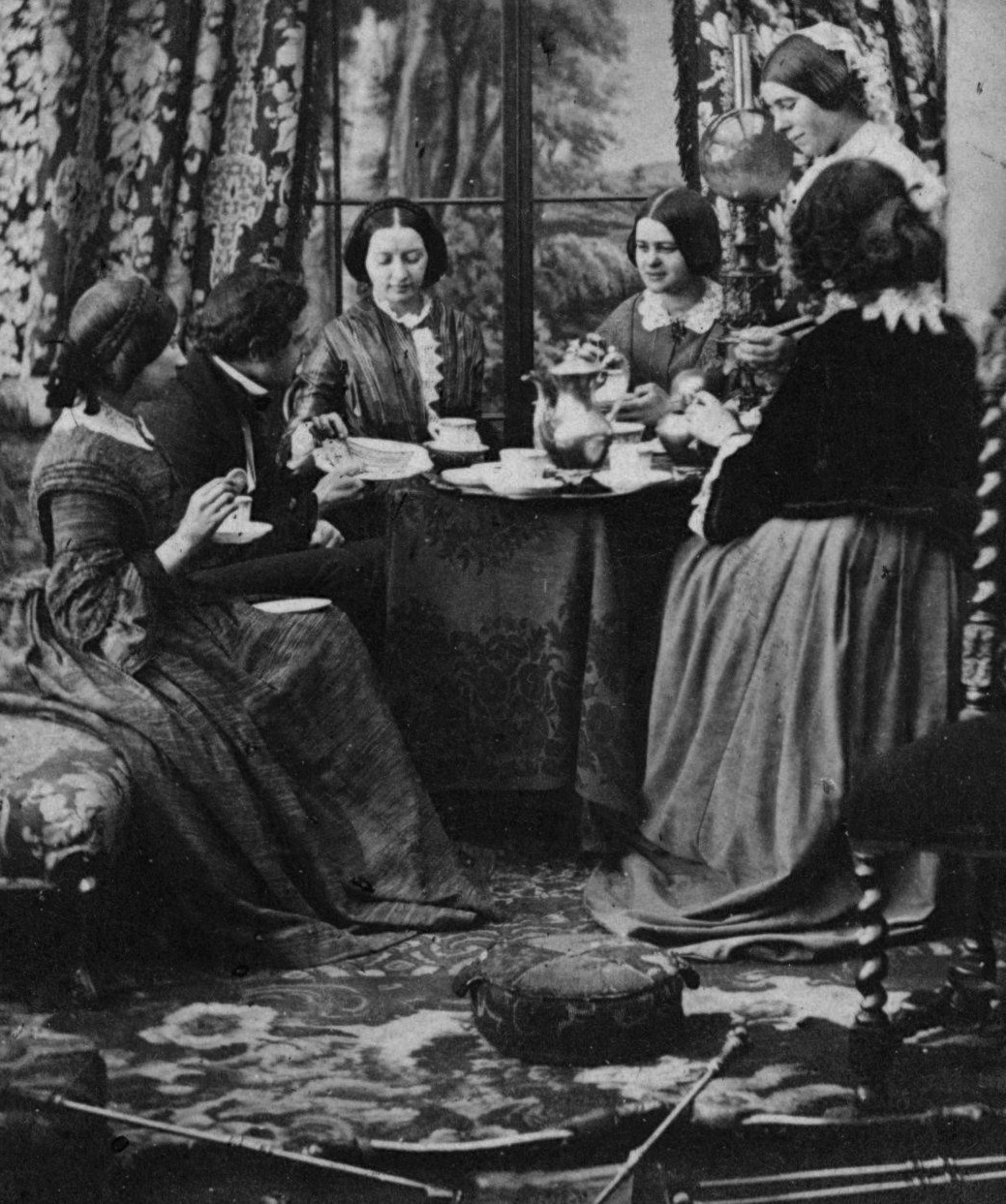
Unidentified group having tea


Dec 5th Friday  As usual this morning after being in

Boston felt tired & lazy did not get my

room in order very early.  Before it was

cleaned Mrs S Ames came in and we chatted

awhile.  Went into Edwins to get Mr Scott

to paint the porch & thus the forenoon passed

Have passed the afternoon in father Ames

with Mrs J R Howard her sister & Mrs Whitwell

With her husband away, and only her four nearly-grown children to look after, Evelina chose to relax this morning rather than make her bed, tidy up and get to her chores and sewing. “As usual,” she felt lethargic after her Boston shopping trip, but uncharacteristically, she didn’t try to overcome this lazy spell. An early morning visit from Sarah Lothrop Ames gave her some excuse to take it easy and hang out, as we might say today.

Most of the rest of her day was spent socializing.  In the afternoon Evelina went to the other part of the house to visit with sister-in-law, Sarah Ames Witherell, and other ladies who had gathered: Eliza Whitwell, Caroline Howard and the latter’s sister.  The women may simply have sat and chatted, teacups in hand, but Evelina, perhaps, had some sewing or mending at the ready as she visited.

The one piece of business that Evelina managed to do today was walk down the street to the new house being built by her nephew, Edwin Williams Gilmore, to track down Mr. Scott, a painter who was working there. He and another painter, Randall Holbrook, came over in the afternoon and began working for her. The presence of painters at Edwin’s house suggests that it was nearing completion.  Perhaps Edwin was getting ready to move in, if he hadn’t already.


December 4, 1851

Clerk

Dec 4th  Thursday.  Returned from Boston to night

Have got the greater part of the things

I wanted.  could not suit myself in all.

Mother spent yesterday with Augustus & to day

at Mr Torreys returned here this evening

Left Mr Orrs this morning did not dine there

it takes so much time  Julia is at home

It is three weeks [entry ends here]


After seeing her husband off on his business trip to New York, Evelina spent yesterday and today shopping in Boston. She seemed satisfied with her purchases, though she confessed that she “could not suit myself in all.” Was she buying cloth or ribbon or other fashion accessories, or decorative items for the refurbished parlor, or foodstuffs for the pantry? It was early December, a time in our own culture when we modern folks are apt to be out (or online) shopping for Christmas presents. Evelina may have been buying Christmas gifts for her family, although that is unlikely, as the Ameses barely recognized Christmas, let alone celebrated it.

Although public opinion in New England was changing, a poor opinion of Christmas prevailed among the Yankees of Evelina’s generation, and certainly of Old Oliver’s. It was based on a Puritan tradition that considered Christmas as “an emblem of popery.”  Yankees “were strongly influenced by the traditions of Calvinism and the routine of the established Congregational church, honoring a certain stoicism, hard work, and stern independence.”  Instead of Christmas, “Thanksgiving was the most important day of the year.”* That would change.

But Evelina must have caught the train back to Stoughton, or the stage home to Easton, empty-handed of the kind of Christmas plunder that her favorite author, Charles Dickens, so famously described.


*Jane Nylander, “Our Own Snug Fireside,” 1993, New Haven, p. 8


December 3, 1851


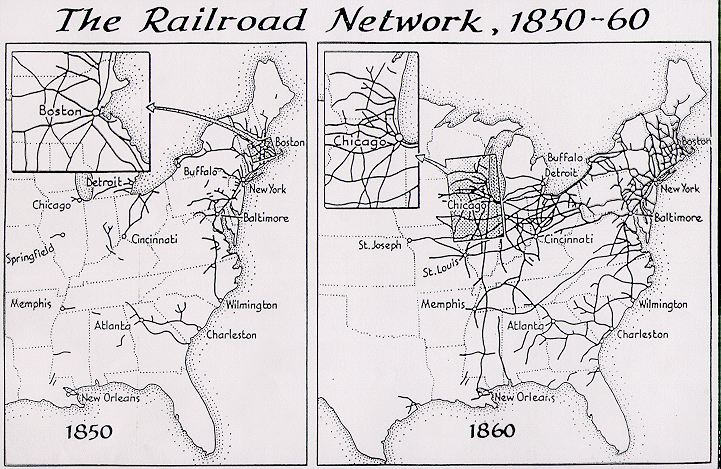
railnet1850

Dec 3d  Wednesday.  Mr Ames started for New York by

way of Boston.  I went to Boston with him dined

at Mr Orrs  Melinda went for Selina and

she passed the night there with me.  I was very

busy shopping all day  In the evening Mr & Mrs

Norris  Selina & self played cards  Past eleven

when we retired.  Mr & Mrs Byram were there


As Old Oliver wrote at one point in his journal, “Oakes went to New York the 3rd of this month to settle up our accounts.”  With his natural bonhomie and sharp talent, Oakes was the best salesman on the Ames team.  On this trip, he would be away for eight days, delivering invoices, collecting payments, checking on inventory and bringing new orders back home.

Evelina accompanied her husband into Boston, where they stopped for midday dinner at the Orrs’ before Oakes boarded his train. He would have traveled to New York by way of Springfield, or else taken the Old Colony line down to Fall River where steamboats picked up passengers to complete the trip to New York City.  Evelina, meanwhile, stayed in Boston to shop and enjoy a bit of socializing with the extended Orr family. She played cards past her bedtime.

Back in Easton, shovel making and farm work went on as usual.  Old Oliver, as always, noted the weather: “this was a fair day wind north west + cold. ”  He added that  “we kild 4 hogs to day everage wate 356 lb sold to the workmen at 7 cents a pound those we sent to boston sold for 7 ¼ cents”.  He sold some of the fresh pork to his workmen, probably through the Ames store, and sent the surplus to Boston to be sold.


December 2, 1851

 FillmorePresident Millard Fillmore

Dec 2d  Tuesday.  It has been cold to day but not near as

cold at yesterday or as windy  Mary has put

her clothes out.  Jane has ironed some shirts

for Mr Ames & I have ironed some collars

cuff & handkerchiefs &c for self  Mother & self

have passed the afternoon at Mr Whitwells

Mr & Mrs John R Howard were there.  Had

a pleasant visit

While the servant Mary – whose last name we never learn – put out most of yesterday’s wet laundry to dry, Jane McHanna rose from bed to iron some of Oakes Ames’s shirts.She had spent part of yesterday placing them in a tub of starch. Evelina took to ironing as well, looking after her own collars, cuffs and handkerchiefs. Ironing, which required a small fleet of flatirons being kept warm on a hot stove, was a welcome chore on a cold day. We don’t often read of Evelina doing the ironing herself.

In Washington, D. C., President Millard Fillmore’s State of the Union address was delivered in writing to Congress.  His speech was quite literal, full of specific details about foreign policy, exports, mining, gold in California, the acquisition of Texas and the surveying and improvements necessary for the territories and frontier.  He lauded the importance of agriculture, noting that “four fifths of our active population are employed in the cultivation of the soil,” and argued for a Bureau of Agriculture.

Fillmore also could not help but write of the growing differences between North and South and the 1850 legislation that was designed to address various aspects of the problem of slavery. He began his address optimistically, writing “the agitation which for a time threatened to disturb the fraternal relations which make us one people is fast subsiding…” but later admitted “that it is not to be disguised that a spirit exists, and has been actively at work, to rend asunder this Union which is our cherished inheritance from our Revolutionary fathers.”

In closing, Fillmore urged patience and reconciliation.  He counseled his countrymen to honor the Compromise of 1850.  “Wide differences and jarring opinions can only be reconciled by yielding something on both sides,” he cautioned.

December 1, 1851

20130117__anchor-ice~p1

*

Dec 1st Monday.  Oliver left again this morning

for Brown University.  Jane was able to do the 

housework this morning & Mary has washed

I have been sewing with Mother  Gave the

furnace up to Ann this morning  It has been 

so windy that we could not dry our clothes

Jane has starched the fine clothes to have

them ready to Iron tomorrow  Cold room all day


It’s not surprising that Evelina got Sarah Witherell’s servant, young Ann Orel, to start the coal furnace this morning, for it was a chore she disliked and the weather was so cold that there was no fooling around with getting heat into the house.  Old Oliver reported that “this was a fair day wind verry high from the north west + cold – a verry disagreeable day to be out in – there was an anchor frost this morning”

Anchor frost is a term for “a frost which causes ice to form along the bed of a running stream […] An anchorfrost can only occur when the temperature of the running water and the bed over which it flows is below freezing point. When this is the case, the rapidity of the stream is sometimes sufficient to prevent the swifter upper current congealing, while the lower current, which moves more slowly on account of the friction, becomes frozen to the bed.” *  Old Oliver knew all about running water and was probably not happy to see anchor ice forming in the Queset.

*Image of anchor ice, courtesy of The Aspen Times

** Arthur Benoni Evans, Leicestershire Words, Phrases, and Proverbs, Volume 11, English Dialect Society, 1881.


November 30, 1851

Church


Nov 30th Sunday  We have all been to church except

Susan. She did not get ready in season

and I did not hurry her to break her of being so

tardy.  Mother Henrietta & self went to Mr Whitwells

at noon.  Mrs Whitwell insisted on our taking a

cup of tea, squash pie, &c &c  Mother came home

with us from church  Augustus & wife have passed

the evening here


Punctuality is a trait much prized by the Ames family; as it is in 2014, so it was in 1851. Evelina liked to be on time. She was probably familiar with the proverb that “People count the faults of those who keep them waiting.”

Susan Eveline Ames, nine-years-old, was often tardy.  In particular, Susie wasn’t fond of going to meeting, something her mother tried vainly to cure her of.  On this Sunday in 1851, Susie dawdled and missed the carriage, so to speak. The family left for the morning service without her. Evelina clearly saw this as a good punishment for her daughter, but it’s entirely possible that Susie enjoyed staying behind.

The lesson about tardiness, or, at least, the importance of going to church, didn’t stick. Ten years later, circa 1861, Susie was still finding ways to escape going to meeting. According to Winthrop Ames:*

“[M]y grandmother [Evelina] notes with suspicion in her diary that the headaches of her nineteen-year-old daughter, Susan, seemed to occur rather oftener on Sundays than on other days, especially when there was to be a second sermon in the afternoon.”*

“In season”, by the way, was a 19th century phrase meaning “in time.”


*Winthrop Ames, The Ames Family of Easton, Massachusetts, privately printed, 1937, p. 130