January 7, 1852

weddinga_cake1

*

/52

Wednesday Jan 7th

Heat the brick oven baked a loaf

of brown bread two loaves of fruit cake for

Augusta & mince pies  A & L were at Edwins

this forenoon. This afternoon have sewed for me on 

Susans dress.  I have been making frosting for

the cake  Helen has been in and the girls have had

a nice time over it  Frank carried them home


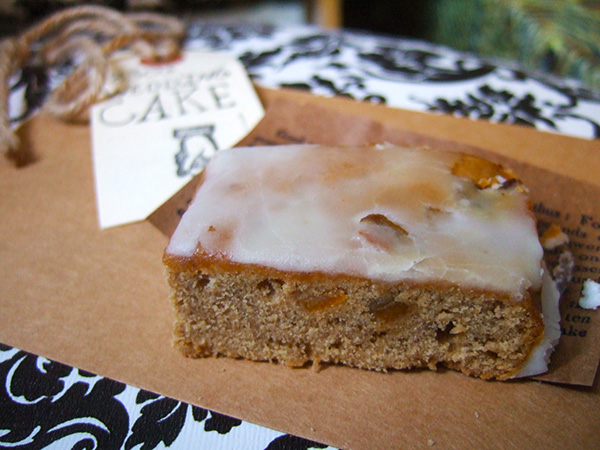
Augusta Pool and Lavinia Gilmore were once again helping Lavinia’s Aunt Evelina. Helen Angier Ames, too, came over from next door, and the young maidens had “a nice time over it.” They did a little sewing for Evelina – that must have pleased her – and helped prepare frosting for Augusta’s wedding cake, which Evelina had kindly undertaken to make, along with all the regular baking she was doing for her family. Augusta was to be married the next day to Evelina’s nephew, Edwin Williams Gilmore.

If the women were following the instructions of Sarah Josepha Hale, they would have made “Iceing for Cakes,” according to the following instructions:

Beat the whites of four eggs to a stiff foam, and add gradually three quarters of a pound of the best double-refined loaf sugar, pounded and sifted; mix in the juice of half a lemon, or a tea-spoonful of rose water.  Beat the mixture till very light and white; place the cake before the fire, pour over the iceing, and smooth over the top and sides with the back of a spoon.”**

When it got late, Frank Morton Ames took Augusta and Cousin Lavinia back to their respective families in the countryside. The light of a full moon guided them along in a sleigh over snow that was “now about a futt deep.”***

* Image of 19th century wedding cake courtesy of http://www.fourpoundsflour.com

**Sarah Josepha Hale, The Good Housekeeper, 1841, p. 101

***Journal of Oliver Ames, Courtesy of Stonehill College Archives


January 6, 1852


OLYMPUS DIGITAL CAMERAOLYMPUS DIGITAL CAMERA

Augusta Pool                                       Lavinia Gilmore
                    

1852

Tues Jan 6 th

A heavy snow storm commenced about

10 Oclock  Mrs Witherell & her children have been

to the funeral in a waggon had a hard time getting

home.  Augusta and Lavinia have been at Edwins

house getting it in order for housekeeping.  This

evening have helped me stone raisons for cake  Edwin

came with them to tea

The bad weather continued, bringing snow that Sarah Witherell and her children, George and Emily, had to fight their way through as they returned from a funeral in a wagon. As Sarah Witherell’s father, Old Oliver, noted, it “snowd all day and in the evening. it was a damp snow and fell level.

Evelina was safe inside, out of the weather. With her were her 19-year-old niece, Lavinia Gilmore, and Augusta Pool, a 22-year-old who was about to marry Lavinia’s brother, Edwin. The two young women had been at Edwin’s house for much of the day, “getting it in order.” How exciting, and perhaps a little scary, for Augusta to be getting married and moving into a new house in the village of North Easton.  She had always lived out in the country, not far from the Gilmore farm, which is how she got to know Edwin.  In fact, Augusta’s older brother, John Pool, was married to Rachael Gilmore, Lavinia and Edwin’s older sister. They would be double-siblings-in-law. (There must be a more official word for the relationship when a brother and sister from one family marry a sister and brother, respectively, from another family.)

When they finished today’s work at Augusta’s new home, the two girls walked over to Evelina’s to help her stone raisins for the wedding cake.  Evelina may have put the raisins in a little warm water to plump them up before popping the seeds out.  Edwin, groom-to-be, joined the women and the rest of the family for tea once the men all arrived home from work.


* Photographs courtesy of The Easton Historical Society, with thanks to Frank Mennino, curator


January 5, 1852

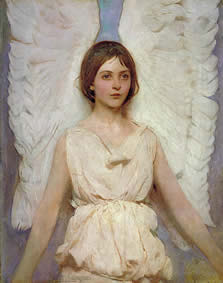
Abbott H. Thayer, Angel, 1887, oil Smithsonian American Art Museum Gift of John Gellatly

Abbott H. Thayer, Angel, 1887, oil
Smithsonian American Art Museum
Gift of John Gellatly


/52

Monday Jan 5 th

Another stormy Monday and we have not been 

able to put our clothes out  Susan washed the

dishes this morning and Jane has done the rest

of the work.  I have finished Susans hood and 

it looks very nice  Mrs Witherell came from

Boston to night  Mr Witherell died about six

yesterday morning


Old Oliver was keeping track of the stormy weather, noting that “it raind + snowd all last night. the snow fell about 2 inches deep + is a snowing now wind north east but it does not blow so hard as it did yesterday. it snowd untill about 3 O clock but was cloudy all day.” One imagines that he had his face close to the window panes of his sitting room – or accounting office, perhaps – as the snow fell outside.

Sarah Witherell returned from Boston in that same snow and wind, having managed to reach her father-in-law’s bedside before he passed away. She would gather her children and return to the city for the funeral.

Evelina, meanwhile, sewed and supervised household chores. “Another stormy Monday” meant that wet laundry was dried in the kitchen and around the house, near heat registers and the air tight stove that helped keep Evelina’s plants from freezing. Parts of the house were draped with white sheets and garments, the floors or carpets wet beneath them. Susie Ames helped some by doing the dishes, a chore that was becoming her regular responsibility. Jane McHanna, of course, bore the lion’s share of the work, with the laundry and “the rest.”


January 4, 1852

cdn-media.nationaljournal

1852

Sunday Jan 4th

Another stormy day and no one been to meeting

Mr Swain called & got some of Harpers Magazines

I have spent the day as I perhaps ought not in looking

over my accounts.  Have been taking off the boys accounts

for the last year and Susans.  Mr Ames gave me

one hundred dollars.  It has been a long dull day

with me  Mr Ames has been in part of the time

Evelina focused on money today, as she “perhaps ought not” to have done. It was Sunday, after all, and reviewing one’s personal account was too much like doing work on the day of rest. But she couldn’t get to church because of the weather, so she found a useful way to spend time in an otherwise “dull” day.

The gift (or allowance?) that Oakes Ames gave Evelina may have provided the impetus to examine the family finances. The $100 was most likely given in the form of specie, or coins. At this period in American finance, gold and silver coins contained their exact value in metal. Thus Evelina would have received precisely $100 in gold or silver, at least for the time being. That equation of value would soon change, as the influx of gold from California was upsetting the market. Gold prices would go down and silver would go up.

Paper money at this time was limited to bank notes, and the government-issued $100 “greenback” in the illustration above would only come into existence during the Civil War, when the U.S. needed to generate cash to fund the Union Army.  That $100 bill, controversial in its day, laid the foundation for a permanent U. S. currency not based on a silver or gold standard.


January 3, 1852

OLYMPUS DIGITAL CAMERA

*

1852

Jan 3d Saturday 

Finished my old hood and ripped Susans

old one & washed the lining and have partly quilted

it once again  Have spent all the afternoon in 

mending Franks shop coat.  Sewed this evening

untill nearly ten have not read at all

Mrs Witherell received news last night that her

father Witherell is not expected to live and she has gone

to see him.

Three-and-a-half years earlier, Sarah Ames Witherell had lost her husband, Nathaniel Witherell, Jr.  Now, she had the sad duty of traveling to Boston to say goodbye to her husband’s father, Nathaniel Witherell, Sr. Someone must have written a letter to tell her he was ill and, ever dutiful, Sarah Witherell responded quickly to the news.  Off she went.

Better news was that today was the birthday of one of Evelina’s many nieces, Mary “Melvina” (or “Malvina” as Evelina spelled it) Torrey. The youngest daughter of Evelina’s late older sister, Hannah Howard Gilmore Torrey, Melvina turned 11. Her father was Col. John Torrey, a high-profile personage in North Easton, of whom Evelina often writes. Melvina and her sister, Abby Torrey, were great favorites of Evelina; Melvina is the niece to whom Evelina gave a bloomer hat the previous summer.

In another ten years, Melvina would marry an older man, Sanford Blake Strout, who also lived in the village of North Easton, on Center Street. She would bear two sons, Byron Howard Strout and Havilen Torrey Strout.


Illustration from Godey’s Lady’s Magazine, 1851


January 2, 1852

Tea


1852

Jan 2d Friday  Seated myself quite early this morning to work

on Susans hood & finished item about ten Oclock

then ripped my old blue hood and washed the

lining & turned the outside have got it nearly done

We all went into the other part of the house to tea

Mr & Mrs Oliver & Helen there  Frank has a sore

ankle as [sic] does not go to the shop  Dr Swan called there

to see Helen & left Jane some medicine

The family gathered for tea today in “the other part of the house,” meaning that Evelina, Oakes, and their children, Oakes Angier, Frank and Susan went into the southern half of the shared house where Old Oliver and his widowed daughter, Sarah Witherell, lived with her two children, George and Emily. Joining them was the family next door: Oliver Ames, Jr, his wife Sarah and their daughter, Helen Angier Ames, who made an appearance despite being home from school with a cold. Other than missing Oliver (3) and Frederick Lothrop, the sons who were off at college, the group was a normal configuration for a gathering at the homestead.

Evelina’s grandson, Winthrop Ames, would one day describe such a family gathering from less than a decade later, by which time daughters-in-law and grandchildren had arrived:

“Supper, always called Tea, at seven, was the sociable occasion. It usually consisted of cold meats, hot biscuits, preserves and cakes – an easy menu to expand for unexpected guests.  Every week at least, and usually oftener, one household would invite the others and their visitors to tea; and the whole Ames family might assemble, even infant children being brought along and tucked into bed upstairs.  Fifteen or twenty was not at all an unusual gathering.”*

The family was as tightly-knit as any of Evelina’s knitted worsted hoods.

One other note about today’s entry: Dr. Swan left some medicine off for Jane McHanna, the servant, who had been ailing for much of the fall and winter. What did she suffer from?

* Winthrop Ames, The Ames Family of Easton, Massachusetts, privately printed, 1937, p.128


January 1, 1852

OLYMPUS DIGITAL CAMERA

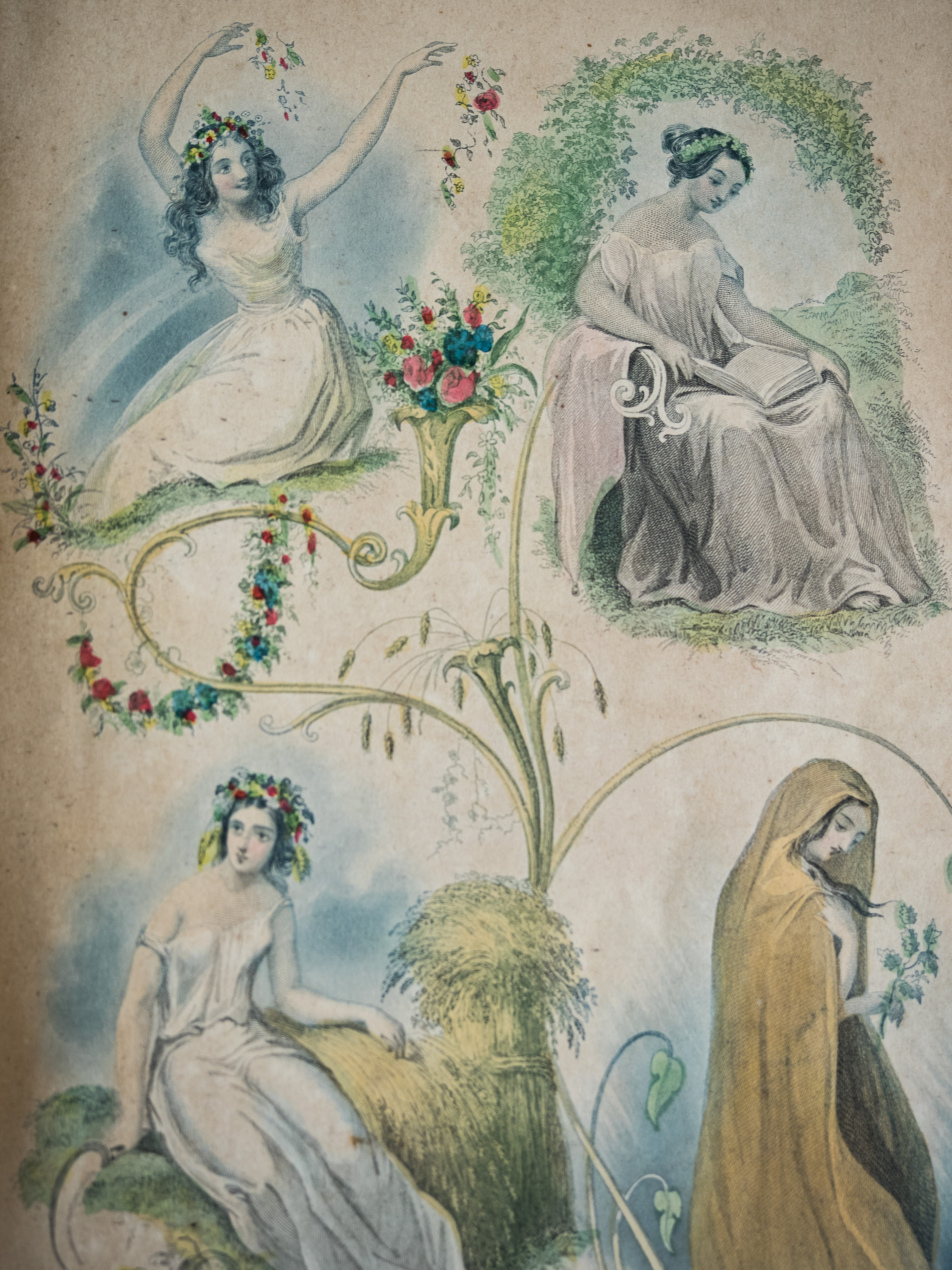
The Four Seasons, from Godey’s Lady’s Book, 1851

1852

Jan 1st Thursday.  It being very stormy last night Alson &

wife came home with us from Olivers & spent the night

and forenoon.  Cooked a turkey for dinner.

Went with them to Augustus this afternoon and 

evening called on Mrs J C Williams, found her

making some shop shirts for Oakes Angier.  The weather

is very warm & unpleasant


The new year began with rain and high water in the ponds, pleasing Old Oliver Ames.  He may have been retired from the shovel shop, but he kept close watch on how the business was doing, and how the business was doing depended heavily on how the water power was running. Evelina herself found the rain “unpleasant.”

Evelina and her family marked the day with a turkey dinner, making it an occasion. Evelina’s brother, Alson Gilmore, and his wife, Henrietta, had stayed the night, unable to get back to their farm in the driving rain. They were rewarded with a feast. After the midday meal ended, Evelina went with them to see Alson’s eldest son, Alson Augustus Gilmore, and his young family.

Back in the village, Evelina visited a seamstress about making shirts for her son, Oakes Angier Ames. Mrs. Williams, who was probably a widow, would sew a number of work or shop shirts for the Ames men over the course of the year.  Evelina herself had sewn multiple shirts the previous spring, a task that took her weeks to finish. Much as she enjoyed sewing, she must have been thrilled to pass the chore on to someone else. This would free her up to concentrate on dresses and accessories, as well as tend to the mending basket that always had work in it.

The New Year

What is a diary as a rule? A document useful to the person who keeps it. Dull to the

contemporary who reads it and invaluable to the student, centuries afterwards, who treasures it.

Sir Walter Scott


January 1, 2015

Dear Readers,

If you’re like me, you have treasured the 1851 diary of Evelina Gilmore Ames. Some of you have even participated with comments that have added depth to the consideration of a time gone by. Your additions have enhanced the small tale of a Yankee housewife who marked her modest days with regular notations of dresses sewn, flowers planted and fruits preserved, who wrote of short trips into Boston, visits to the family farm, and errands of mercy into the homes of sick neighbors.

Without meaning to, Evelina preserved a picture of life from antebellum New England, a life that has disappeared and evolved into a world she’d be hard-put to recognize. Her children, grand-children, and great-grandchildren have lived and died. Her house itself is gone, though the grander dwelling of her in-laws, Oliver, Jr. and Sarah Lothrop Ames, still stands proudly next door. Automobiles drive where oxen carts and horse carriages moved, and the significant architecture of certain stone buildings in the center of the village memorializes relatives she loved. The very factory whose noisy production of world-famous shovels led the local economy for decades moved away more than sixty years ago. She couldn’t have imagined it.

Yet some things remain the same. People are still people, solicitous or mean, content or down-hearted, eager or indifferent. The true characters we read about in the pages of her diary are recognizable and familiar to us in their essential humanity. We can find ourselves and our own families somewhere in these pages; we all behave so similarly. In Easton, Massachusetts, many descendants of the people Evelina wrote about still live. Last names like Ames, Gilmore, Randall, Tisdale and others can be found in the local telephone book (which itself is in danger of becoming as obsolete as Evelina’s tin stove.)

Evelina continued to keep a diary after 1851, but only the 1852 diary is extant. Her journals from the Civil War period have been lost. We’ll just have to treasure the one that remains. And so, ahead of us is the last available year of Evelina’s tiny aperture on the Ames family of old.

Thank you for reading!


Sarah Lowry Ames

(wife of John S. Ames III, great-great-great-grandson of Oliver and Susanna Angier Ames)


December 31, 1851

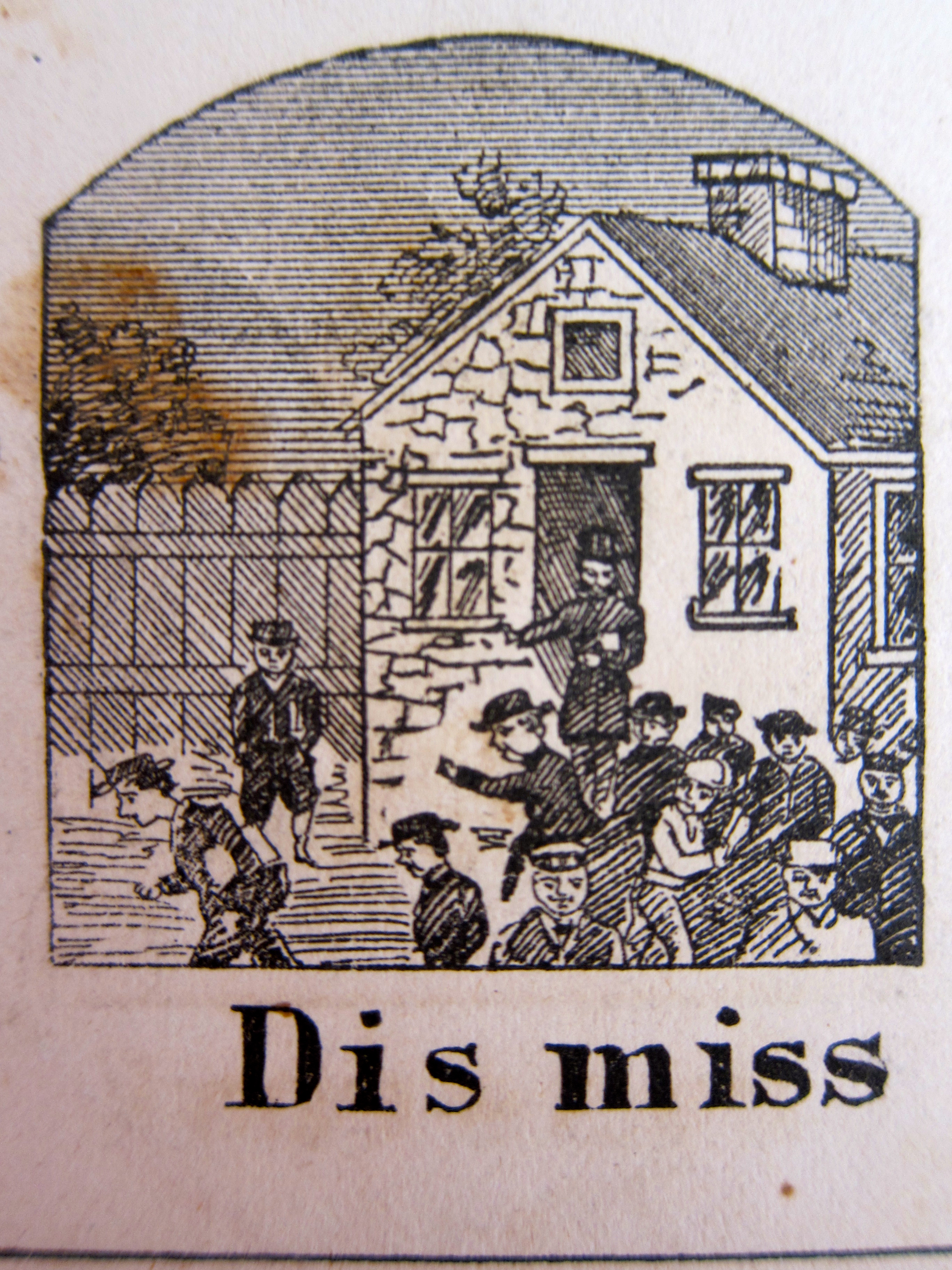
Dismiss


Wednesday Dec 31st  This morning sit down early to knitting

my hood  Have it all finished ready for the lining.  About ten 

Oclock went into the school with Mrs. Witherell.  Mr Brown

has closed his school to day.  Passed the afternoon & evening at Olivers

Mr & Mrs Wm Reed  Mr & Mrs J Howard, Whitwell & A Gilmore were there.

Susie Ames and Emily Witherell may have been happy today to reach the end of their school term. Class, dismissed!  1851, dismissed!

Just how the Ames family celebrated the departure of the old year and arrival of the new, we don’t know. Old Oliver, with his usual terse assessment of the day, merely noted that “this was a cloudy day and some cooler + misty + foggy.” The cool mist he saw would develop into a huge rain storm over night, preventing folks from moving around much.

A group of friends and relatives gathered for tea next door at the home of Oliver Ames, Jr. and his wife Sarah Lothrop Ames. Besides Evelina and Oakes, at the party were Reverend William Whitwell and his wife Eliza, Reverend William Reed and his wife Abigail, Jason Guild Howard and his wife Martha, and Evelina’s brother Alson Gilmore and his wife Henrietta.  In just a few more years, a group like this might have sung the beloved  Auld Lang Syne to mark the occasion. In fact, a version of Auld Lang Syne, written in 1855 and called Song of the Old Folks would become “the tradition of the Stoughton Musical Society to sing […] in memory of those who had died that year.”*

Out with old, in with the new. What a year it would be for the Ames clan.

http://www.americanmusicpreservation.com/SongoftheOldFolks.htm

December 30, 1851

SwedishRunnersC

*

Tuesday Dec 30th  This forenoon worked about the house

again. Have put the drugget down in the 

parlour and dusted the room thoroughly.

Made Susan the second pair of sleeves to her blue

cotton & wool Delaine  Finished the letter to Lucy Norris

Commenced knitting the border to the bottom of my hood

It is a beautiful warm sunny day like the spring of the year


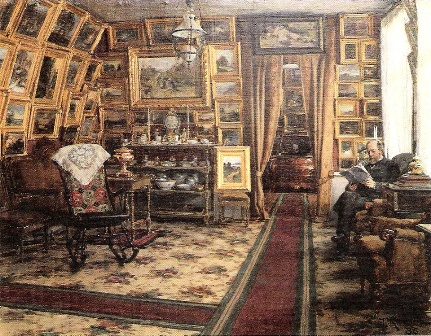
Nor surprisingly, the carpet that Evelina used in the house was inexpensive. Drugget, as it was known, was “a sort of cheap stuff, very thin and narrow, usually made of wool.”**  Drugget is an English term for “a coarse fabric having a cotton warp and a wool filling,” ** the kind of quick carpeting one might have found in a first class railway carriage. It probably had a design or a border printed on it.

Evelina has written here and elsewhere of putting carpeting down, taking it up and outside to clean, and putting it down again. She has written of stitching the carpeting together, which suggests that she may have used drugget runners side by side to make an over-all covering for her parlor floor. She may have been more conventional, though, and placed the drugget as runners on top of an area rug, or on top of a bare floor. Whatever she did, the work was repetitive and dusty.

It’s a shame that Evelina spent so much time indoors today when the weather was “fair warm + pleasant,” as Old Oliver reported. She herself made note of its similarity to spring; she should have known it wasn’t going to last.


** Wikipedia, “Drugget”, as of December 26, 2014


Scandinavian Room with drugget runners “Bibliotekarien Segersteen i sitt hem,” 1886, by Johan Fredrik Krouthen, Courtesy of http://www.burrows.com