April 5, 1852

images-4


1852

April 5th Monday  Went into the garden this morning and

found my tulips were coming up through the coal

scraped it off and set out a few that I got in

Olivers garden.  Went with Orinthia to Edwin

Manlys garden about three Oclock. he had gone

to Mr Clapps.  We rode there and met him on

the way stoped awhile and had a chat on plants

in general  The school commenced this morning

by Mr Brown & C Clark

Tulips! How welcome was the sight of the curl of green shoots “coming up through the coal.”

Forget the laundry.  Never mind the sweeping and dusting. Someone else could do the breakfast dishes. Without so much as a glance at her sewing workbox or the pile of mending, Evelina was in her garden.

She scraped the coal covering away and “set out a few” more plants. After midday dinner, she and Orinthia headed to Edwin Manley’s nursery north of the village only to find that Mr. Manley had himself headed out to look at plants at the home of Lucius Clapp in Stoughton. The two women rode on and finally came across Mr. Manly en route. With carriage and on horseback, the three avid gardeners paused in the roadway and “had a chat about plants.” Spring had truly begun.

April 4, 1852

Crucifix


1852

April 4th Sunday.  Orinthia and self went to the

Catholic meeting this forenoon after waiting more than

an hour the priest came and driveled over a mess

of nonsense in latin, they distributed palm as they called

it being nothing more than cedar & pine twigs.

Sat there three tedious hours, came home and

went to our church in the afternoon. since have

written a letter to Sister H. &c  Susan went over to Anna.

Evelina’s ill-tempered condescension continued today when she and her sidekick, Orinthia Foss, attended a morning service at the little Catholic church on Pond Street. It was Palm Sunday. Father Thomas was late – not unusual for an itinerant priest – and the service was in Latin, a language that Evelina didn’t understand, all for a holy day that Unitarians didn’t acknowledge. Most vexing of all, perhaps, was that the palms weren’t even real.

By her own account, Evelina was better satisfied by a service in the afternoon at her own church. The question is, why did Evelina attend the Catholic service to begin with? Out of curiosity? Out of respect for her own Catholic servant, Jane McHanna? Was this Orinthia’s idea?

Whatever her motive, Evelina came away from her “three tedious hours” as anti-Catholic as ever. Such feelings would not have been encouraged by her husband, Oakes, who was more welcoming of the Irish newcomers. But Evelina would have found reinforcement at home from her father-in-law, Old Oliver, who was no fan of the Irish Catholics in Easton, for all the work they did at the shovel shops.

In Easton, in Boston and all over New England, differences between the old Puritan customs and the transplanted Irish culture were pronounced and, for many, unyielding. In strictly religious terms, Unitarians couldn’t imagine a religion that kowtowed to a foreign leader, as they deemed the pope, while Catholics were incredulous that Protestants could just shake off the time-honored and revered practices of the original church. The melding of the two cultures would be a long time coming, and in some circles is still a work in progress.

April 3, 1852

Tablespoon

1852

March [sic] 3rd Saturday  Have made a ribbon head

dress for sister Amelia  Orinthia & self went into

Edwins this noon for some fish chowder.  She gave us

some platters and a great iron spoon to eat with and we

had to wait upon ourselves. We excused her knowing

she was a young housekeeper and knew no better.  She

ought to come here and learn politeness  Called on Mrs

Brett.  her babe is nearly two weeks old. she is not very

comfortable  Called on Abby  Hannah & Mrs J. C. Williams

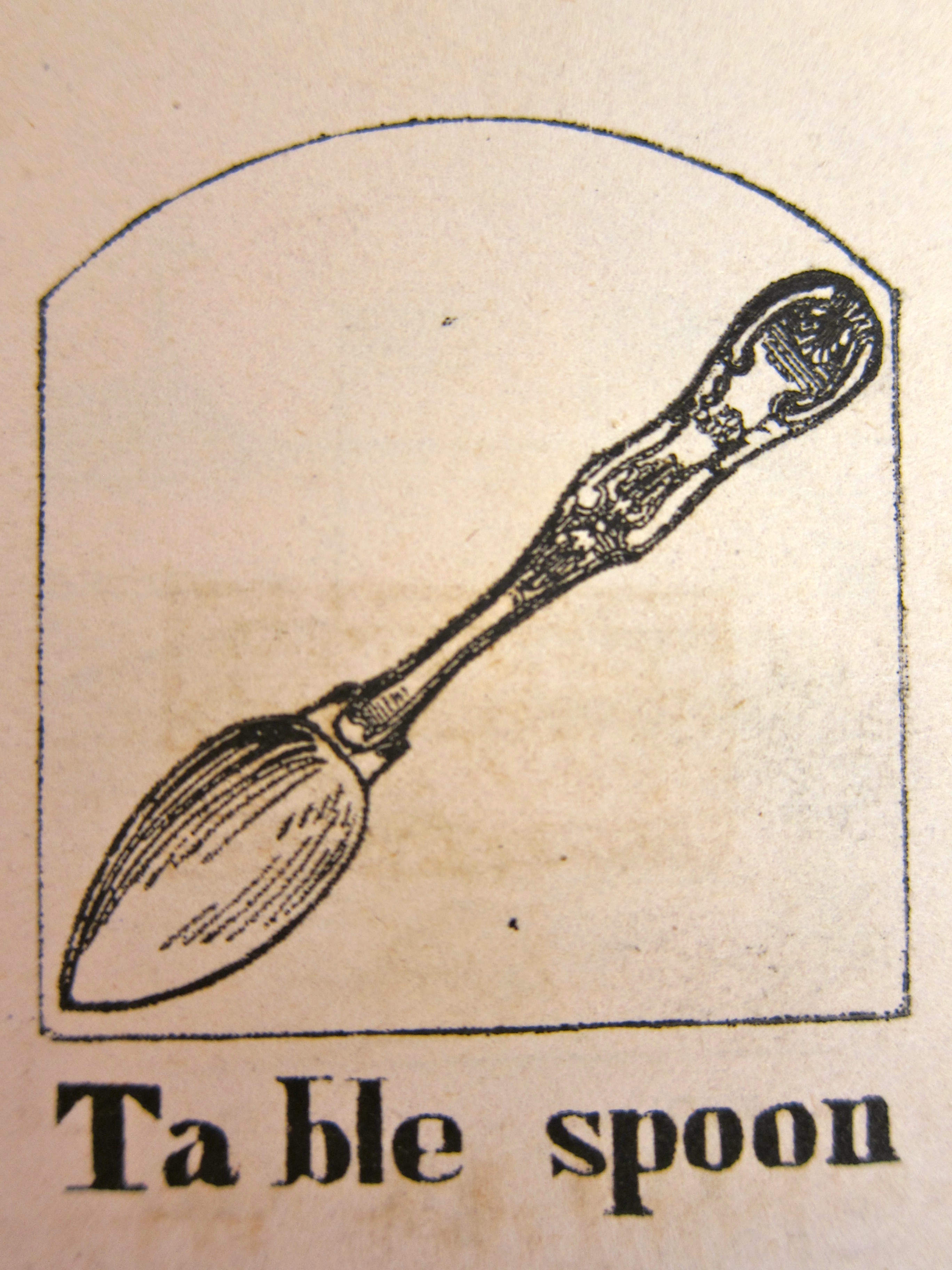
Young neighbor Augusta Pool Gilmore invited Evelina and Orinthia Foss to midday dinner. This was a sweet gesture, perhaps intended to thank Evelina for her many kindnesses in welcoming Augusta to the village. The young bride may have been excited to debut her skills as a hostess.

However well-meant the invitation was, Augusta still had a lot to learn about entertaining. Evelina, a matron who had welcomed many guests to her dinner table over the years, saw much to judge wrong and in her diary took a snide swipe at the young woman. She criticized Augusta’s faux pas in laying out the wrong cutlery and failing to serve them properly.

While Evelina forgave Augusta her missteps, because the young bride “knew no better,” she also condescendingly noted that Augusta needed to spend time with the Ameses to “learn politeness.” Such scorn was perhaps exacerbated by the presence of Orinthia, who was always looking for ways to laugh. Innocent, inept Augusta was an easy target.

Evelina’s natural empathy returned in the afternoon. She visited other friends and called on another young woman in the neighborhood, Eveline Brett, who was doing poorly after having given birth.

April 2, 1852

Ox

1852 March [sic] 2d Friday  Have been mending pants for Frank

Made a long call on Mrs S Ames in the morning

Have been sweeping and dusting.  Mrs S Ames dined

in the other part of the house  I carried my sewing

in there a couple of hours this afternoon  Oakes A

went to Mr Howards after Orinthia this evening

Frank is not well and did not go  Have

written a letter to Mrs Norris  Augusta here this evening

After yesterday’s April Fool’s fun, Evelina resumed her domestic routine. She swept, dusted, mended, sewed and wrote a letter to a friend. Same old, same old. Her son Frank Morton, however, was under the weather, but her oldest son, Oakes Angier, was fine and even went out for the evening after work.

Old Oliver Ames, meanwhile, also resumed some of his routine, most of which had been disrupted by the shovel shop fire a month earlier. He was occupied by planning for the new stone factory buildings, but as he listened to the rain fall, he knew it was almost planting time. The farmer in him was getting ready for a new growing season. Perhaps in recognition of that, he “bought a yoke of oxen to day of Samuel Clap for $117-50.”*


April 1, 1852

140

*

1852 April 1st  Thursday.  Another April fool day and I don’t 

know of a bigger one than myself except Orinthia

She made some beet & pepper pies for the boys but instead of

making a fool of them she made one of herself for they would not taste them

Oakes A carried Orinthia & self to Mr Elijah Howards on his way

to N Bridgewater & spent the evening there  Orinthia will spend the

night We went into Augustas this forenoon to fool her  

Her sister Emeline is there


Evelina enjoyed April Fool’s Day, or All Fools Day, as people often called it at the time. The previous year she had played a prank on her sisters-in-law; this year, she tried to trick her young neighbor, Augusta Gilmore. And this time, it would seem that someone played a trick on her, as “she didn’t know a bigger fool..” than herself. But she stifled her embarrassment, deflecting it off onto her friend, Orinthia Foss, whose trick on the Ames boys failed. They wouldn’t eat her trick pies, making Orinthia the greater fool of the day.

There were a few guidelines that most people understood about jokes played on April 1st. They had to be harmless pranks, for one.  The jokes were meant to embarrass, not to injure or insult. They lacked the menace that pranks later played on Halloween typically carried, for instance. They were meant as fun, the only cost of which was someone else’s dignity.

Another, more particular rule was that tricks could only be played in the morning. After the clocks had struck noon, the pranks were no longer fair play. Anyone playing a prank in the afternoon was considered foolish, and one playground retort to anyone who tried it was: “April’s gone and May’s come; You’re a fool and I’m none!”**Orinthia’s trick on the Ames boys would have happened right at midday and, with the clock striking twelve, she missed the morning window.

Part of the rationale behind the half-day rule may be as simple as people being more susceptible to the pranks at the start of the day, when they weren’t focused on the April date. They were easier to surprise then. Yet the genesis of the half-day rule may also have been based in the long history of the holiday. One modern historian has suggested that: “[t]here’s probably an element of ancient folk belief lurking behind the rule. April Fool’s Day honors the spirit of Folly, which is a powerful force. And as such, it needs to be contained within strict temporal limits, lest it overspill its boundaries and cause chaos throughout the rest of the year.”**

*Image courtesy of http://www.gutenberg.org **British journal Notes and Queries (Aug 11, 1855), from http://www.hoax.org, accessed March 23, 2015

March 31, 1852

Thread

1852

March 31st Wednesday  Have been to the sewing circle

at Mr Harrison Pools.  Mrs S Ames & Augusta

went and we took Orinthia with us from Mrs Howard

Mother Henrietta Lavinia Rachel Mrs Nahum & Horace Pool

& Ann Pool were there   It rained very fast as we were

coming home  I left two shirts to be made that I

put in the circle last fall

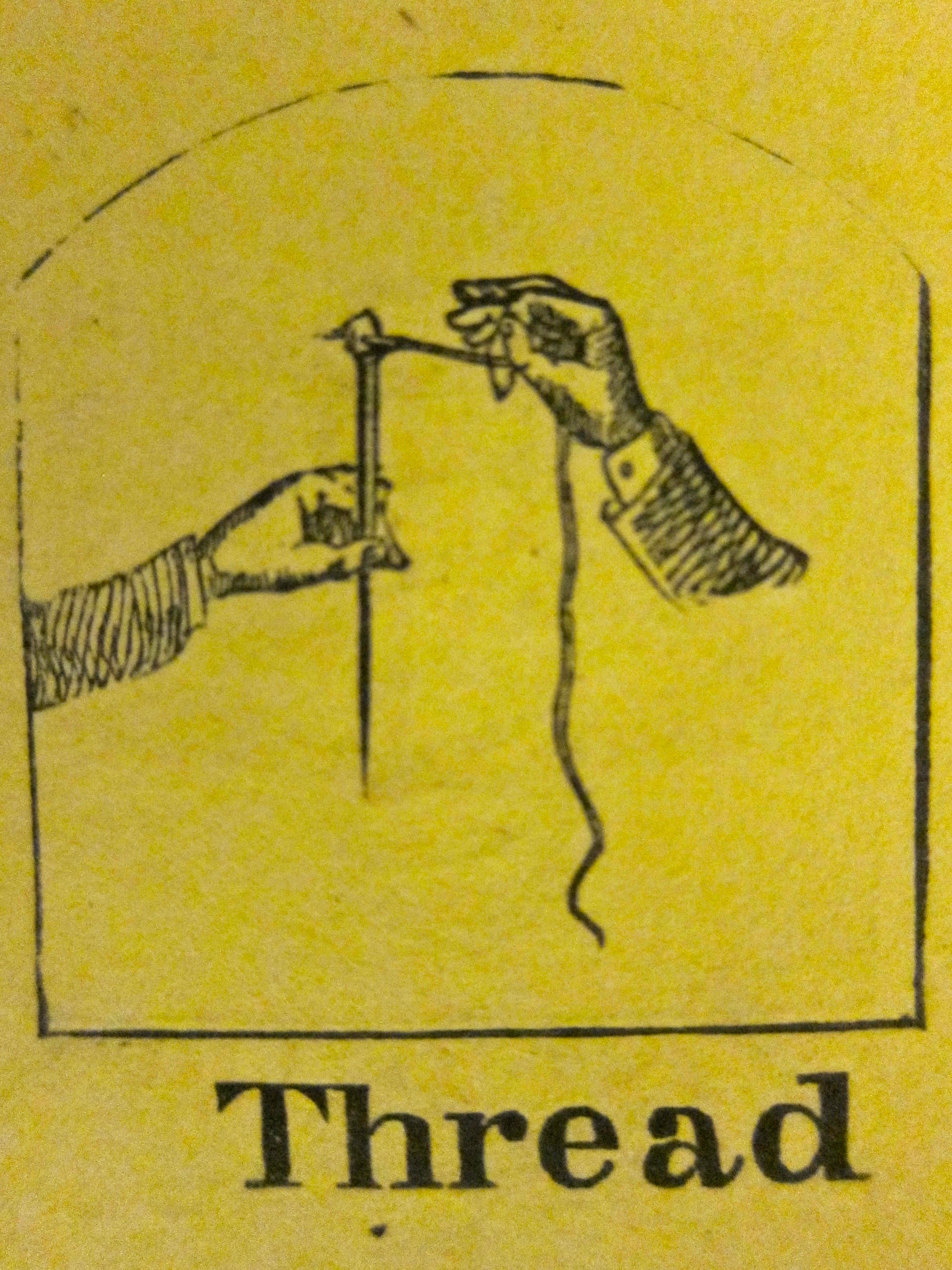
The Sewing Circle was back.  Female parishioners from the Unitarian Church had begun once again to meet on a monthly basis to sew. Like other sewing circles around the country, they met for fellowship, guidance from the local clergy, and the sewing of clothes and linens for one another or others. They hadn’t met – officially, anyway – since December.

On this weekday the group met at the home of Mary and Harrison Pool in southeastern Easton. From North Easton came Evelina, Sarah Lothrop Ames, and Augusta Pool Gilmore, the young bride who was returning to the area of town where she had grown up. The women stopped en route at Nancy and Elijah Howard’s to pick up Orinthia Foss. Hostess Mary Pool, who had three young children underfoot, welcomed them. Others who attended included Evelina’s mother, Hannah Lothrop Gilmore; Henrietta Williams Gilmore, Lavinia Gilmore, Rachel Gilmore Pool, Lidia Pool, Abby Pool and Ann Pool. It was a veritable family reunion.  Except for Orinthia Foss, every women present was related by blood or marriage to at least one other woman there.

Such a gathering must have been good amusement, with less formality than the social calls that some of the women had paid the day before. But spirits may have been dampened by the “very fast” rain that pummeled the carriages when the meeting ended and the women returned home.

March 30, 1852

Exif_JPEG_PICTURE

1852

March 30th  Tuesday  Spent the forenoon puttering about

the house doing nothing at all.  Have been to

carry Orinthia to Mrs John Howards.  Mrs S Ames

went with us and we called at Mrs Reed, Whitwell

J. Howard  Mrs Merrill and Mrs Hills  Mrs Ames

stoped here to tea and spent the evening.  Louisa

Swan was at home and Ann Johnson.  Augusta called

Hannah called for a moment this forenoon

Apparently, there was no sewing today; perhaps Evelina’s fingers were sore from working the heavy moreen fabric the day before. She hardly seemed to mind “doing nothing at all,” however, and gave the afternoon over entirely to calling, an occupation she enjoyed. She, her sister-in-law Sarah Lothrop Ames, and guest Orinthia Foss called on Caroline Howard, Abigail Reed, Eliza Whitwell, Mrs. Merrill and Mrs. Hills. They may have called on some younger fellow Unitarians, too: Louisa Swan (daughter of Dr. Caleb Swan) and Ann Johnson.

Calling was an essential component of social life in the 19th century, as we’ve noted before.  Some women thrived on it, others only tolerated it, but just about every woman exercised the obligation to call on their friends and neighbors, as due. In Louisa May Alcott’s classic novel, “Little Women,” an entire chapter is devoted to two of the March sisters, Amy and Jo, making calls. Amy enjoyed them, but had to persuade Jo to join her:

“Now put on all your best things, and I’ll tell you how to behave at each place, so that you will make a good impression.  I want people to like you, and they would if you’d only try to be a little more agreeable. Do your hair the pretty way, and put the pink rose in your bonnet; its becoming, and you look too sober in your plain suit.  Take your light kids and the embroidered handkerchief. […]

“Jo […] sighed as she rustled into her new organdie, frowned darkly as she tied her bonnet strings in an irreproachable bow, wrestled viciously with pins as she put on her collar, wrinkled up her features generally as she shook the handkerchief, whose embroidery was as irritating to her nose as the present mission was to her feelings; and when she had squeezed her hands into tight gloves with two buttons and a tassel, as the last touch of elegance, she turned to Amy with an imbecile expression of countenance, saying meekly, –

“‘I’m perfectly miserable; but if you consider me presentable, I die happy.'”*

*Louisa May Alcott, Little Women

March 29, 1852

 d2a4da_a34883211bc64e72a561a89b7ee3091d.jpg_srz_299_239_75_22_0.50_1.20_0

Moreen Fabric*

1852

March 29 Monday.  Orinthia returned with us from meeting

yesterday  She helped Susan wash the dishes and

I cleaned the sitting room and afterwards sat down

to our sewing  Have new bound my moreen skirt

Orinthia and self went into Edwins this evening

had a pretty lively call making fun of Orinthia’s spelling

Evelina may have “had a pretty lively call making fun of Orinthia’s spelling,” today, but her own orthography was far from perfect. Neither woman, evidently, could have won a spelling bee – and Orinthia was a school teacher!  To be fair, however, spelling in the 19th century was not as standardized as it became later. Spelling has long been a fluid practice, actually, however often periodic efforts were made by different groups and individuals – Teddy Roosevelt among them – to reform and standardize it. So the two women would have had plenty of company with their wayward pens. Just consider the various ways that Old Oliver Ames spelled (or spelt) slate: sleight, slaight and slayt.

Presumably unworried about her own grammatical shortcomings, Evelina pursued her usual agenda for a Monday. She cleaned part of the downstairs while daughter, Susie, washed the breakfast dishes and servant, Jane McHanna, started the weekly laundry and prepared midday dinner. After Evelina had finished dusting, sweeping and tidying, she and guest Orinthia Foss, the poor speller, sat down to “our sewing”.

Evelina was working on a skirt of moreen, a ribbed fabric of cotton or wool that today serves more often for upholstery or curtains. In the 19th century, however, its stiffness lent itself to the voluminous skirts that defined the era. It would have been a thick, tough fabric to work on by hand. But Evelina was nothing if not an excellent needlewoman.

*Image courtesy of http://www.eatonhilltextiles.com


March 28, 1852

Ames-Shovel-Handle-2

Ames Shovel Handle Factory, Oakland, Maine*


March 28 Sunday  Went to church this morning and

at noon called at Mrs Wm Reeds with Henrietta

Hannah came at noon but was faint and

I carried her home and got back to church about

the time the services were over  After went down

to the new shops with Mrs W, S Ames Augusta Orinthia

found Mr. Ames, Oliver & Cyrus L there returned by Edwins

and all called there  Mr Ames & self went to Augustus’ this evening

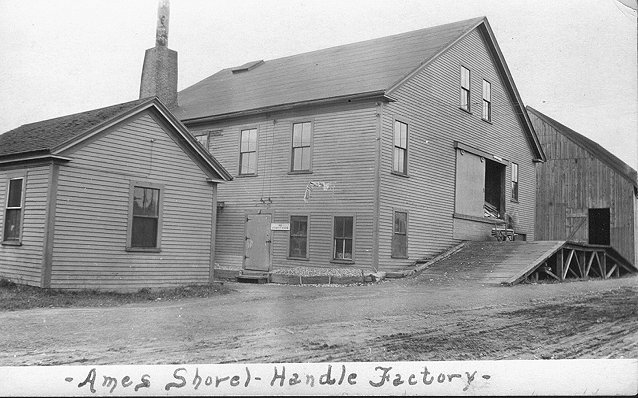
The new shops were up, and various family members rode by to see them after church. No more “dismal ruin”, as reported by Evelina only three weeks earlier. Risen like a phoenix from the ashes of the old shops, the shovel works were about to begin operations in new, if temporary, quarters.

It was a large group that gathered to consider the new buildings. Evelina, who had missed the afternoon service in attending to her ailing niece, Hannah Lincoln Gilmore, nonetheless rode back from church to the site. Accompanying her were her sisters-in-law, Sarah Witherell and Sarah Ames; another niece, Augusta Pool Gilmore; and sometime boarder and frequent companion, Orinthia Foss.  At the site, by accident or design, they found Oakes Ames and his brother, Oliver Ames Jr., and Cyrus Lothrop, a brother of Sarah Lothrop Ames who often resided with his sister. The group must have marveled at the swift reincarnation of the shovel works.

Perhaps a celebratory spirit inspired the crowd to assemble en masse at the nearby home of newlyweds Augusta and Edwin Gilmore.

*Image of Ames Shovel Handle Factory, Oakland, Maine courtesy of the Oakland Maine Area Historical Society. Included to illustrate what the rebuilt shovel factory could have resembled.

March 27, 1852

north-bridgewater-mass-1844-sm

1852

March 27  Sat  Have been mending again to day and painted

some spots in the back entry chamber  Mrs Witherell

& Mrs Lovell from Bridgewater came to see Mrs Witherell

& spent the day.  Mrs Lovell called on Hannah.

Mrs S Ames came in soon after dinner and staid

most of the afternoon  We called to see Mrs

Witherell & Lovell  Have read in the papers this

evening

Sarah Ames Witherell, Evelina’s sister-in-law, had visitors today from Bridgewater. Sarah’s mother-in-law, Lydia Witherell, and a Mrs. Lovell called. Mrs. Witherell was a recent widow, more recent even than her daughter-in-law, Sarah, who had been widowed three years earlier. Where Sarah’s late husband, Nathaniel Witherell, Jr. had died in October, 1848, his father, Nathaniel Witherell, Sr., had passed away in January of this year. Sarah and her two children, George and Emily, had traveled through a snowstorm to attend the funeral.

The Mrs. Lovell who came to call may have been Emeline Perry Creasy Lovell,  wife of Reverend Stephen Lovell, former resident of Easton and one-time pastor of the recently defunct Protestant Methodist church in Easton. But the clergyman and his wife possibly lived in Boston, too, so this Mrs. Lovell “from Bridgewater” may have been someone else. Yet her extra visit to see Hannah Lincoln Gilmore, who was still ailing, suggests that this Mrs. Lovell was familiar with at least some of the residents of North Easton.

While this visiting was going on, Evelina stayed on her side of the house with her other close sister-in-law, Sarah Lothrop Ames.  How did it work to have two separate social conversations going on under one roof, one on each side of divided parlor walls? One imagines that Evelina and Sarah Ames were curious about the nature of the call in “the other part of the house.”