February 18, 1851

yoke-of-oxen

Feb 18  Tuesday  After doing my usual mornings work sit

down to sewing on Susans work   She sewed with me

and counted stiches again  She will do pretty well

and keep quite steady when we count stiches

This afternoon went into Olivers to assist on Helens

quilt but found it most done.  Was called home

to see Mr Whitwell   Abby & Malvina Torrey & their 

cousin Mrs Fullerton  called  Pleasant

Sewing lessons for eight-year old Susie Ames continued today.  She seemed to be getting the hang of the needle as long as she counted her stitches.  This meant calculating and maintaining an equal number of stitches per inch of sewing. After the lesson was through, Evelina tripped next door to help with the making of a quilt. She discovered that the work was pretty well complete, however, which was just as well as she was called back home to sit with Reverend Whitwell, who came to visit.  More follow-up to the Sewing Circle meeting?

Outside, away from this cozy domesticity, Old Oliver was clomping around looking at oxen to buy.  He found a pair that he particularly admired and seemed pleased with his purchase:

“this was fair day  wind about west and not cold   I bought a yoke of oxen to day of a Mr Whitcom of East Randolph for $125-00 they are a handsom red + look a good deal alike.  he said they would be 6 years old this spring comeing   the off one girts 7 feet + 2 inches + the nigh one 7 feet   they weighed after drinking with yoke on 3220 lb.  the man  said he had them for twins”

And while Old Oliver dealt with the farming side of the Ames enterprises, Oakes and his three sons were no doubt busy at the shovel works, the young men continuing to learn the ins and outs of manufacturing, much as little Susie was learning to be domestic.   The futures of all four offspring were being lined up.

February 17, 1851

Hem

Feb 17th  Monday  Washed the dishes and worked about

house most of the forenoon  This afternoon cut out some

work for Susan & set her to hemming, counted

stiches with her.  Helen came home from

New bedford.  Spent the evening at Olivers with

Sarah W.  Worked on an apron of Susans but

had so much talking to do that […] I accomplished

but a little sewing  Pleasant but cold

Sewing was a necessity, but it was also a sociable occupation, which is perhaps one of the reasons that Evelina enjoyed it so. Her visit next door with her two sisters-in-law, Sarah Lothrop Ames and Sarah Witherell, turned into an evening of conversation with “but a little sewing,” which she didn’t seem to mind.  What did the women discuss?  Did they revisit the tender issue of the failed Sewing Circle meeting?  Or did they steer toward safer topics like Helen’s return from New Bedford? What had the fourteen-year-old been doing there?  Had she been in school? Why did she return home at the start of a week?  Susie Ames was home from school this week, too.  Was mid-February a typical time for schools to close?

At this time in our history, almost every woman knew how to sew. Sewing was a skill handed down from one generation to the next. Evelina, Sarah Ames and Sarah Witherell had each learned their stitches from their mothers or grandmothers; now it was Susie Ames’s turn to learn.  How could the women know that sewing was about to be transformed by the arrival of the domestic sewing machine, and that a forthcoming civil war would introduce mass-produced, “ready-made” clothing on an unimagined scale?  They, who in their youth had probably watched a elderly relative work a spinning wheel, would experience a dramatic trajectory in the making of apparel.  By the time Susie reached adulthood and became a housewife, some of what she was being taught would be obsolete.  But not all: hemming, mending, quilting, and neat hand-sewing would always have a place in the domestic arts, even though few women today practice the skills.

Young girls of the antebellum period like Susie and Helen and Emily Witherell  sat by their mothers’ sides and struggled to manage a needle and thread, basting or hemming or working cross stitches.  Some of them created the hand-wrought samplers that hang now in textile collections, featuring alphabets or numbers or biblical quotations with colorful, tiny stitches painstakingly wrought by stubby little fingers at age eight or twelve or fourteen. Sewing was a necessity, but it was an art form as well.

February 16, 1851

Hoarhound or horehound

Hoarhound or horehound

Sun Feb 16  Did not go to church to day on account of a bad

cough  Boiled Molasses, honey, & sugar and a little 

hoarhound for it.  Jane has been to meeting at the

boarding house.  Michael & sister called to see her.

Have been reading some in Margaret by Mr Judd

do not like it at all I believe I shall not finish it

but can spend my time for a better purpose

Mr Whitwell exchanged with Mr Lovell  Very pleasant

Evelina’s cold was long gone, but her cough lingered.  To make it better, she cooked up a nostrum that included hoarhound (or horehound), a medicinal herb cultivated for its efficacy as an expectorant.  She likely grew it in her kitchen garden, or knew where to find it wild.  Brewed with honey, sugar and molasses – the latter being recommended by many household guides as good for the throat –  Evelina’s dose of medicine was warm and comforting.

Her cough may have been real, but it probably wasn’t the only reason Evelina avoided going to meeting this morning.  At church, she would have had to face some of the women who had not attended her Sewing Circle meeting. Her feelings may still have been too hurt to do so and her cough made an excellent excuse for her absence.

Everyone else seemed to be practicing their faith today. The Ames family presumably all went to church and heard Reverend Stephen Lovell stand in for Reverend Whitwell; the two men had finally swapped meetings as originally planned a few weeks ago.  Jane McHanna, the Ames servant originally from Ireland, attended a Catholic service held in the dining room of the Ames boarding house, and apparently came home with fellow-countrymen Michael Burns, the Ames coachman, and his sister.

Today’s new book, Margaret by Reverend Sylvester Judd, did not pass muster.  Evelina started the novel, a story about a young woman raised in the wilds of Maine, and emphatically did “not like it at all.”   Reverend Judd, a Unitarian minister, was a peripheral member of the Transcendental circle; his book is considered one of a very few works of Transcendental fiction.  Margaret Fuller, author of Woman in the Nineteenth Century,  described it as a “work of great power and richness” but critics and other readers such as Evelina found the book incomprehensible.

February 15, 1851

Chemise

Chemise

Sat Feb 15  This morning mended a pair of pants for Frank

and some other things.  Finished two chemise for Susan

made her a skirt out of an old quilted one of mine.

It has been a very stormy day.  the public school

finished this afternoon.  Oakes A, Mr Pratt, Davidson,

Barrows, R. Willis, Lillie & one or two others visited the 

school.  There were no ladies on account of the rain

Mr Ames went to Boston.  Brought Miss Eaton some maple sugar

While her husband went into Boston today despite poor weather, Evelina stayed in, mended clothes and completed two chemises for Susan. The chemise, a forerunner of today’s slip, was a standard undergarment for women and girls in the 19th century, worn right under the dress (and under the corset, when corsets were worn.)  As Evelina suggests, some undergarments were quilted for warmth, an essential consideration in cold New England. On stormy days like this one, women needed all the padding they could accommodate under their wide skirts.

Oakes Angier Ames visited the local schoolhouse today with men from the school’s superintending committee: Amos Pratt, a teacher; Thomas Davidson, the town’s postmaster; Joseph Barrows, a “shovelmaster” with legal training who lived in a house built by Old Oliver; Rufus Willis, a shoe manufacturer; and Daniel Lillie, another employee of O. Ames & Sons.  Daniel and Oakes Angier were in their early twenties, while the other men were older.  Daniel would be close to the Ames family over the years, and ultimately serve as a pallbearer at Oakes Ames’s funeral in 1873.  Today, however, in the rain, without their wives, the men appeared at the public school on the last day of this session.  Why was Oakes Angier along?  He wasn’t a member of the committee, but perhaps he was developing an interest in local politics.

Oakes Ames, meanwhile, returned from Boston in the evening, bringing with him a gift of maple sugar – a sign of spring – for the failing Miss Eaton.   He may also have returned with news of a serious incident in the city.  Shadrach Minkins, a fugitive slave living and working in Boston, was arrested today by federal marshals at a coffeehouse on Cornhill Street. Minkins would be taken to court, only to be rescued by an anti-slavery group, the Boston Vigilance Committee, who hid him and helped him escape to Montreal.  The controversial new Fugitive Slave Law was being tested.  Had Oakes witnessed any of this?

February 14, 1851

Valentine from the 1870's by Esther Howland

Valentine from the 1870’s by Esther Howland

Feb 14th Friday  Mended a pair of pants for Oakes Angier & 

cut out some work for Susan.  Went to the store for a

pair of shoes for self & Susan.  Called on Miss Eaton

on my return met the Dr there.  He thinks she will 

live into March.  Has failed very much since I saw her

Passed the afternoon with Mrs Wales & Miss Lothrop in

the other part of the house.  Mr Jackson called here this eve.

Pleasant this morning, afternoon cloudy & a little rain

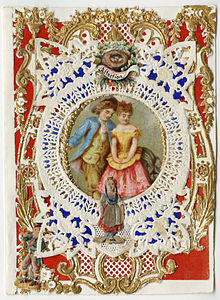
The 19th century descendants of the Puritans weren’t known for their celebratory spirit, so we shouldn’t wonder that Valentine’s Day went unrecognized at the Ames’s house.  Although the practice of sending a sweet message to one’s beloved had thrived in England for several decades, the concept was just gaining traction in the United States. Personal Valentine greetings in the form of hand-written poems were familiar to many young people, but nothing was mass-produced until mid-century when a graduate of Mount Holyoke named Esther Howland, whose father was a stationer in Worcester, Massachusetts, developed and sold a lacy Valentine card, America’s first.  The idea took off and shortly thereafter, Graham’s American Monthly noted that “Saint Valentine’s Day […] has become, a national holyday.”   The idea hadn’t caught on at the shovel works, though; if it had, Oakes Ames probably would have seized the opportunity to buy one for his wife.

Evelina took a small step back into her social life today.  Not only was she able to call on Miss Eaton at the Holmes’s house, but she also got an update from the doctor, who confirmed that Miss Eaton was dying.  Miss Eaton did not yet have a “watch” on her, but the time would come when different friends and relatives would take turns sitting with her until she passed.

After her visit with Miss Eaton, Evelina relaxed into a sociable afternoon in “the other part of the house.”  With her sister-in-law Sarah Witherell, she chatted with two female acquaintances while rain returned outside.  In the evening, Mr. Jackson came to call.  He was probably the school master whose teaching had “lacked energy” last week when Evelina visited the local school.  Why was he calling?  Had he learned that Evelina was involved in the establishment of a private school?

February 13, 1851

Money

1851

Feb 13th  Thursday  This morning put the parlour in order

and went down to the store with the intention of calling

on Miss Eaton on my way back, but her Mother & brother

came last night and thought best not to see her but wait

until she was over the excitement of seeing them  Went into the

office with account of butter and other things sold.  Mr Peckham

gave me 30 dollars 78 cents  Augustus is still assisting him with

his books.  Very pleasant but ground rather wet.

Moving past yesterday’s humiliation, Evelina put her parlor back together first thing this morning and left the house, all by herself.  A walk to the little village on a fair day must have felt good, muddy ground notwithstanding.  She went right to the company store.

The Ames family made shovels, obviously, but their overall enterprise was never limited to manufacturing alone  – witness their eventual involvement with the Union Pacific.  They also made money from the operation of a company store, one that had been owned previously by a former partner of Old Oliver named Colonel David Manley.* The shop was right in the village of North Easton where shovel employees and others could purchase ordinary household items – muffin tins, for instance – dry goods like flour and personal articles. Evelina shopped there from time to time, and on this day she may have picked something up.  But she also sold things through the store, which explains why later that day she made her way to the Counting Office to collect $30.78 for “butter and other things sold.”  She had a little stream of income for herself, a source of satisfaction for any homemaker, and material consolation for a wounded spirit.

On her walking rounds, Evelina stopped in at the Holmes residence to call on Miss Eaton, a neighbor who is slowly declining. When she learned that Miss Eaton had family visiting, she deferred her call until another day.  Evelina and her sister-in-law Sarah Lothrop Ames have been looking after Miss Eaton from time to time and will continue to do so as her health fails.  The Ames women were dutiful in looking after the sick among the families of employees of the shovel shop.

* For more information on this store, you might want to read Easton’s Neighborhoods by Edmund C. Hands.  Among extensive historical information about the town, he offers some great context about early business days in North Easton.

February 12, 1851

Thread

1851

Feb 12th This was the day for the sewing circle & what a crowded

house! Not one here except Mr Whitwell and our own

families  Father Ames came in to tea & Sarah W

George, Emily & Oliver & wife  Poldens boy was buried

to day  Isabell & Ann went to the funeral & took tea

with Jane after they came back.  I prepared enough

for 40 and think it is very provoking to have none

 of the members  It is a delightful day.  Letter from Miss Foss

No one came to Evelina’s party.

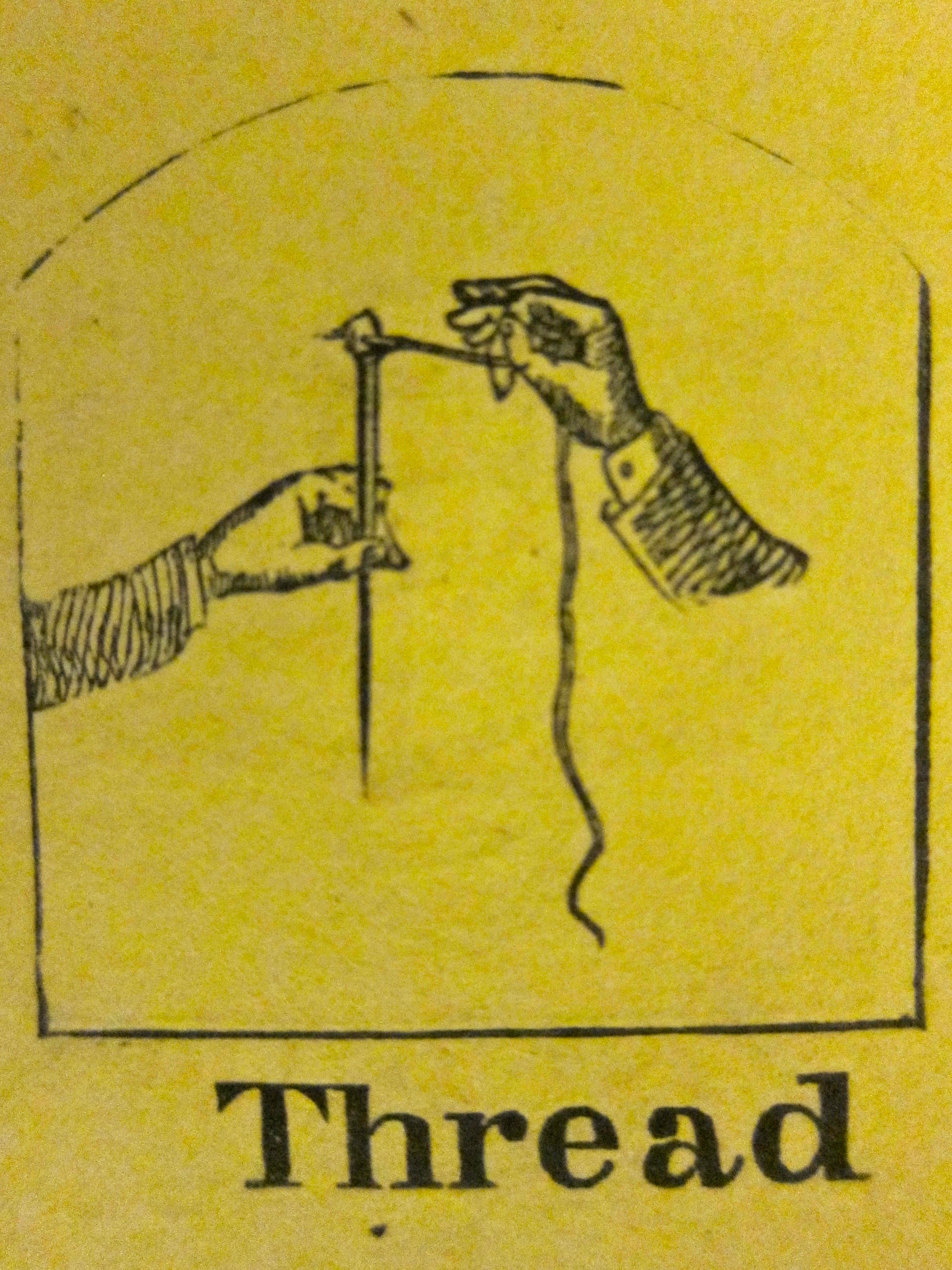
“Very provoking,” indeed.  Mortifying, even, that not a single member of the Sewing Circle attended today’s meeting, unless you count Reverend Whitwell.  All the preparations, the baking, the cleaning, the spools of thread from Boston, all in vain.

Evelina took the rejection with a lacing of humor: “What a crowded house!”  Although disappointed and upset, she must have been grateful for the way the Ames clan filed in to partake of the feast. From Old Oliver (who almost never came to tea) and all three Witherells to Oliver Jr and Sarah Lothrop Ames to her own children and husband, presumably, the family closed ranks around her and filled her parlor with warm bodies.  Even the Irish servant girls on their way home from a wake partook of the spread of food – in the kitchen with Jane McHanna, of course.

So what happened?  Evelina said the day was delightful but her father-in-law, a dependable chronicler of the daily weather, described “the going” that day as “rough + bad” even though the weather itself was “fair”.  After days of terrible weather that had swung from rain to ice and back again, some of the absentee members probably couldn’t drive their wagons out of their own yards.  Bad roads might account for some, if not all, of the truancy.

Nevertheless, the incident raises questions about Evelina’s popularity and social standing.  She was married to one of the most important men in town, and she and Oakes enjoyed the friendship of many.  Is it possible that some of the women in the Unitarian Circle resented her, or felt themselves superior to her?  Where were the women she had grown up with? Were they jealous of her? Did she fail socially in comparison to her sisters-in-law, each whom had a more refined upbringing? Sarah Ames and Sarah Witherell never failed to attract a lively turnout for their Sewing Circles.

All these possibilities must have swirled in her mind.  The true test would come when the Sewing Circle met again at Evelina’s, many months from this day, this awkward day that Evelina surely hoped to forget.

February 11, 1851

Bookkeeper

Feb 11th Tuesday  This day has been a very busy one

with me, getting ready for the sewing Circle.  Have

washed the front stairs & have been sweeping &

dusting.  Have got things pretty much in order for

tomorrow  It was very unpleasant this morning but this

afternoon it has cleared off very pleasant.  Augustus

is helping Mr Peckham post his books.  went home

with him to dinner & tea

Evelina seemed to feel better today and so went right to work.  Stairs got washed, carpet was swept, table tops were dusted, knick knacks, books and periodicals put in order.  The house would look spanky clean for the Sewing Circle tomorrow. Evelina herself was doing this work, while the servant Jane McHanna handled the regular chores: cooking the meals, washing the dishes and tidying up from the indoor laundry activity of yesterday.  Jane and/or Evelina may have ironed today, too, although it’s doubtful that they could have completed the task.   With all those men’s shirts to care for, ironing at the Ames house often lasted for several days.

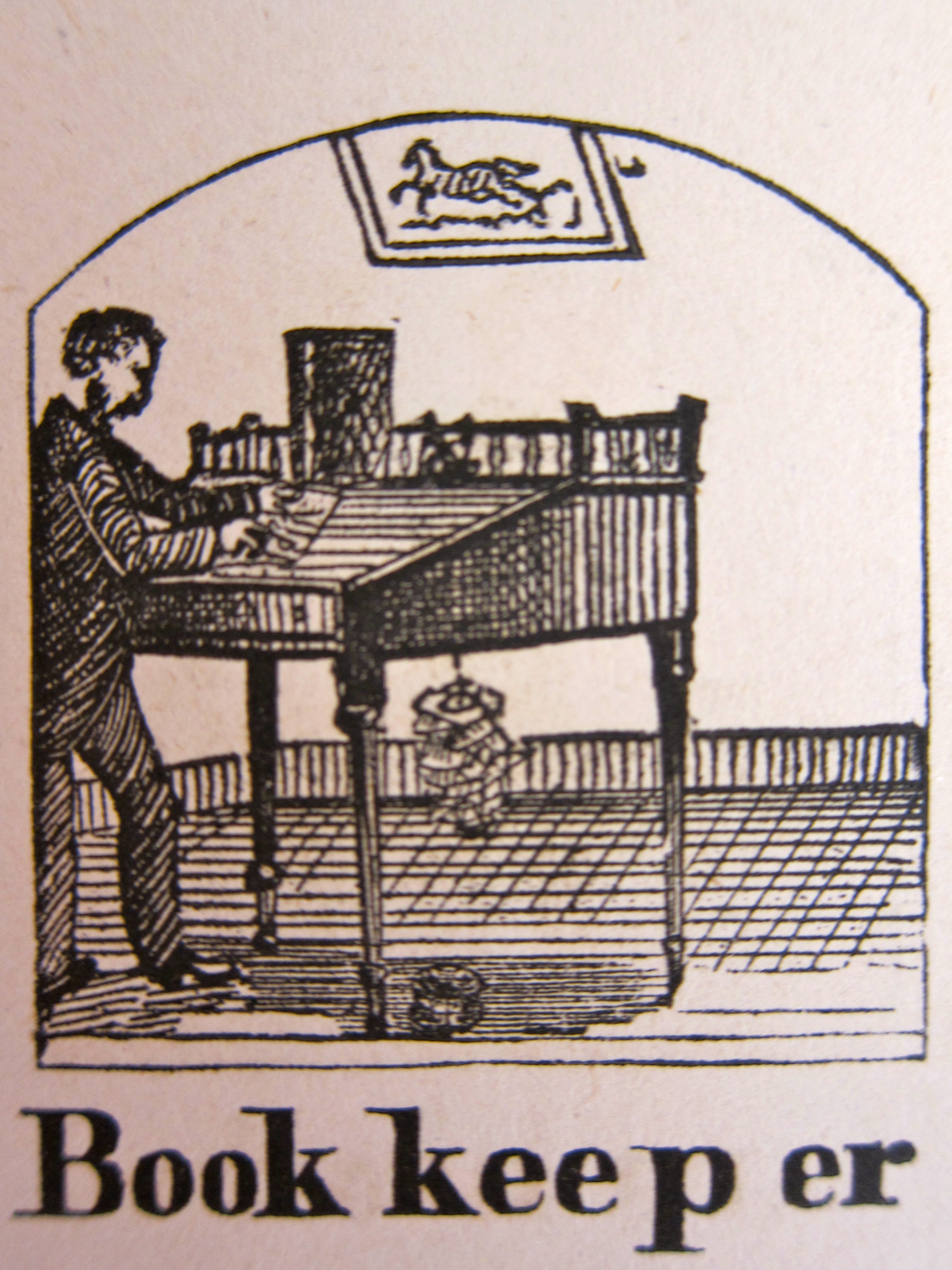
In the office, or Counting House, next door, the company’s bookkeeper, John Peckham, was tending to business. Evelina’s nephew, Alson “Augustus” Gilmore, had started work there temporarily as Peckham’s assistant. Augustus is the nephew who has been looking for a place to rent for his growing family, all while beginning to set up a boot manufacturing company in the area. But meanwhile, nepotism being an acceptable, even laudable fact of life in a family-run business, Augustus was being kept afloat financially by work here and there for O. Ames and Sons.   Augustus, a man of robust build, would prove to be a well-known figure around town, especially once he accepted the role of moderator at town meetings, a position he would hold twenty-four times in the next 32 years.

February 10, 1851

Storm

Feb 10th Monday  Warm this morning but not pleasant  Jane 

put her clothes out but the wind commenced blowing quite

hard with some rain, so that the clothes had to be taken

in & were dried over the registers  Cut Susan a Chemise

out of the width of  1  1/4 yd wide cloth and partly made it

Worked about house as usual on washing days in 

the forenoon  Wind blows quite hard this eve.

What a jungle of white linens the Ames house featured this Monday, with Jane McHanna having to drape dripping laundry around the heat registers.  So much for Evelina’s cleaning the floors the other day.  Miserable winter weather – snow, rain, ice, wind and rain again – was wreaking havoc with the domestic schedule.

One person in the Ames household celebrated her 12th birthday today: Sarah “Emily” Witherell.  Emily was born in New Jersey where her parents had lived while her father, Nathaniel Witherell, Jr., worked with William Leonard Ames, her mother’s brother, at various Ames enterprises.  Tragedy had struck in recent years, though, with the death of her father and the subsequent “drounding” of her two year old brother, Channing.  Emily was stricken with loss at an early age.

With her mother, Sarah; older brother, George Oliver Witherell; and grandfather Old Oliver Ames,  Emily now lived in North Easton, Massachusetts in “the other part of the house”.  She probably still attended school, but she and Susie Ames were too far apart in age at this point to be close friends, although they would soon find themselves sharing  piano lessons.  Her cousin Oliver (3) found Emily to be outspoken and opinionated; she was, evidently, unafraid of speaking her mind at a time when candor in women was not prized.

Emily never married.  After Old Oliver died in 1863, when she was about twenty-four, Emily and her mother moved into Boston, eventually taking up residence in Back Bay at the Hotel Hamilton and living off of distributions from investments managed by her male cousins.  A spinster cousin, Amelia Hall Ames, the only daughter of William Leonard Ames, eventually moved in with Emily.  These two cousins, in turn, may have undertaken to raise yet another cousin, Eleanor Ames, a granddaughter of William Leonard Ames. All that is in the future; on this day in 1851, we can hope that Emily had a special birthday despite the weather. She deserved a happy moment.

February 9, 1851

Elizabeth Missing Sewell Gertrude 1866 ( American edition)

Elizabeth Missing Sewell
Gertrude
1866 ( American edition)

Feb 9th Sunday  I have such a cold today that I thought it best

not to go to church or to the funeral of Uncle Seth Hall.  who

died last Wednesday & is to be buried to day at 1 Oclock.

Commenced reading Gertrude by Rev W Sewell.  Edwin called

this Evening and staid an hour or more  Think it rather tiresome to read all day

although I like to do it, but seldom have the privilege.

Had Oysters to night for a rarity  Quite pleasant

Evelina described this day as pleasant, yet in his own journal Old Oliver mentioned “trees loaded with ice”.  Small wonder that Evelina opted to stay home from church to nurse a stubborn cold.  She used the quiet time to start a new novel, Gertrude, by Reverend William Sewell.

Gertrude was actually written by Rev. Sewell’s sister, Elizabeth Missing Sewell, an English author known as much for her religious tracts as for her fiction. She wrote it early in her career and, for publication purposes, gave credit for it to her Anglican brother. Neither she nor her brother were fans of Roman Catholicism, and her books usually featured the Church of England in some way. In this tale of a young woman named Gertrude Courtenay, Sewell examined a lively topic of the day: the claim of duty.  Was devotion to church more important than devotion to the home?  Spoiler alert: Sewell believed in both, but posited that duty begins at home.

The opening page of Gertrude featured a quote from Wordsworth’s poem, Excursion:

Turn to private life

and social neighborhood; look we to ourselves.

A light of duty shines on every day

For all.

This quote is an apt description of Evelina, for whom duty was an essential motivation in life.  She tried to do what was expected of her; she didn’t always succeed, but she did try. Even today, when she didn’t feel well, it must have been a struggle for her to miss both church and the funeral of a Gilmore cousin, to the point where the opportunity to indulge in reading all day eventually paled.  She needed the rest, though, and the oysters at tea in the evening were a treat, as was a visit from a nephew with whom she was particularly close: Edwin Williams Gilmore.