May 1, 1851

Basket


1851

May 1st Thursday  Have cleaned the shed chamber to

day and a long dirty job it is  there is so much in it.

I got through just in time to go to Mr Torreys

after some plants when Orinthia came out of

school.  She went with me and we brought home

three baskets full and have set them out in

the garden This morning it was quite unpleasant

and Susan was disappointed in her walk

May Day! In our modern world, the first day of May means many things to many people, among them International Workers’s Day, the Roman Catholic Celebration of the Blessed Virgin Mary Day, even a day for the 21st century Occupy Movement. May Day has ancient iterations, too, most of them having to do with pagan rites of spring.

In 1851, the first of May meant “maying.” Young people like nine-year old Susie Ames filled small baskets with flowers, ribbons, or other little treats and left them, anonymously, on doorsteps around the town. The game was to leave a basket, ring the doorbell, and run away.  If the recipient caught you, he or she was allowed to chase you for a kiss; at least, that was one version. Another version was to leave the basket as a surprise at the home of an elderly person. On this particular May Day, the weather was too disagreeable for the traditional maying walk, so Susie and her friends were unable to deliver their baskets.

Evelina dealt with baskets, too. She and Orinthia Foss filled three of them with plants from John Torrey and put them in her garden. It was her reward for having spent most of the day cleaning out the “shed chamber.”  Spring cleaning was still underway.

April 26, 1851

Spade

Sat Apr 26th  This morning a man came from the shops 

to spade my flower garden & hoe the currant

bushes Miss Foss Susan & self rode to Edwin Manlys

to speak for some plants and then went to Mothers

got there about half past twelve. Brought

home some Horseradish, Carraway roots & some

few plants Made the skirt to Susans green 

borage Delaine Miss Foss has finished the two shirts.

At last, gardening in earnest. A shovel shop employee was taken off his usual task to go up to the Ames homestead to turn over the soil in Evelina’s flower beds.  He used an Ames shovel, no doubt, and also an Ames hoe to loosen the dirt around the currant bushes behind the house.

Evelina celebrated the spring day with her daughter Susie and boarder Orinthia Foss; the three took a wagon, most likely, north to the home of Edwin Manly.  At the time, Manly lived close to the town line with Stoughton, and was employed at the shovel shop. He was obviously interested in plants and kept an informal nursery on his farm, raising flowers to sell.  His green thumb brought in customers like Evelina. Not too long after this, however, he hurt his hand and had to leave his job at O. Ames & Sons. Fascinated by biology, chemistry and science in general, he studied medicine at Harvard, became a physician and set up an office in North Easton in the early 1860s. Later he moved to Taunton, where he worked as the town librarian for a number of years. Eventually, he moved to California.

Flowers weren’t all that the women brought home in the wagon.  They drove south to the other end of Easton to visit Evelina’s mother, Hannah Gilmore, at the Gilmore farm, where they picked up the horseradish and caraway roots and “some few plants.”   That Evelina and Orinthia had time to sew after all that riding around says a lot about their stamina and work ethic.

April 5, 1851

Store

1851

April 5th  Saturday  Was choring about the house an

hour or two this morning and then went to sewing

on a shirt for Mr Ames.  Mrs S Ames is quite

sick to day has not been able to sit up much.

This afternoon called to see her but did not stay

long as Mrs Connors came to get some butter.  I then

went to the store & got Susan a dark print dress.

Have returned it again.

Sarah Lothrop Ames was sick today; perhaps she caught Evelina’s cold of the week before.  Evelina went to sit with her but was called home to parcel out some butter to a Mrs. Connors.  Although we never hear of Evelina or Jane McHanna churning it, Evelina evidently made household money through the sale of butter. The making of butter was probably one more chore on Jane’s plate.

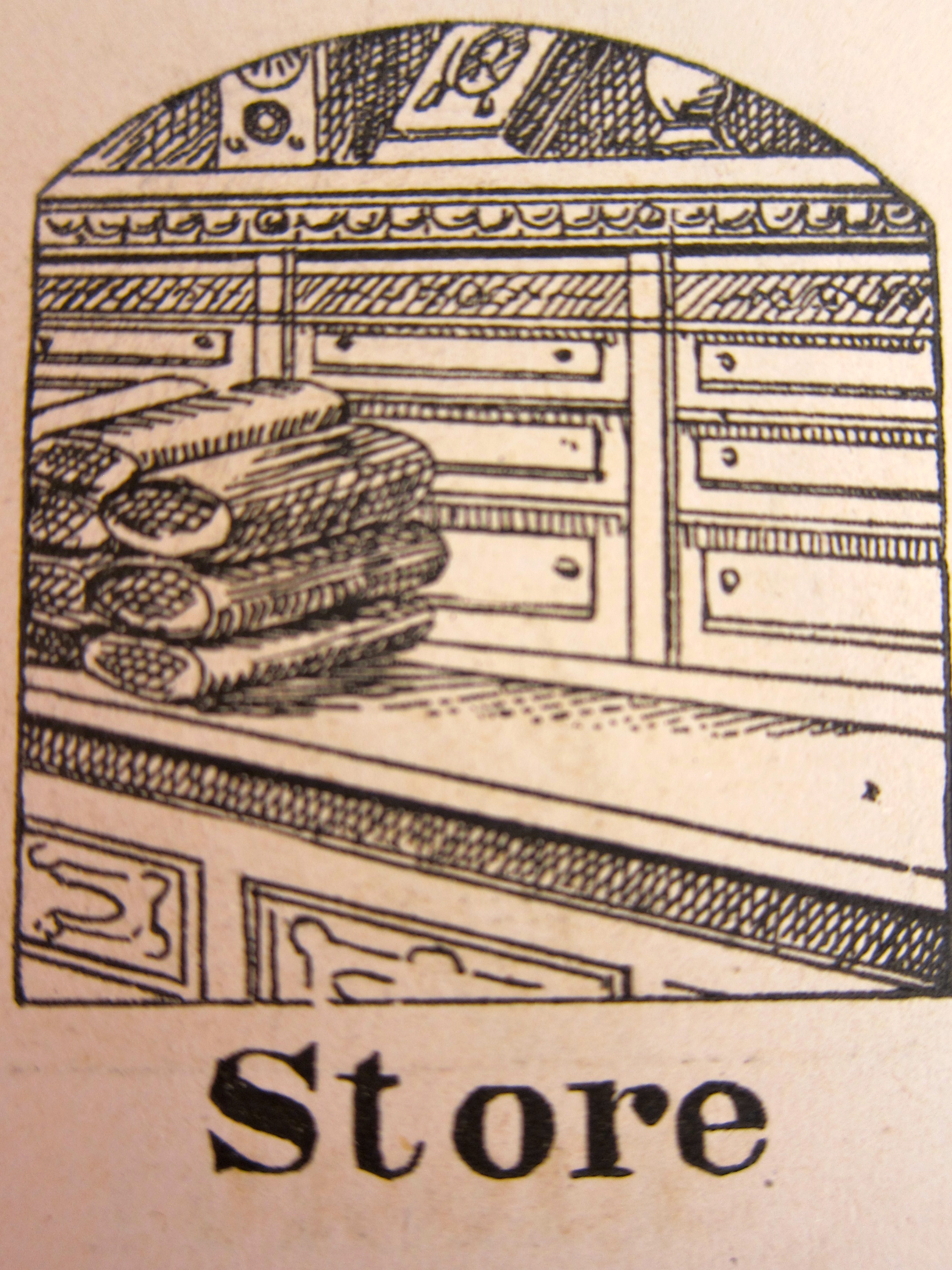
The Ameses didn’t just sell butter, or just make shovels, for that matter. They also ran a dry goods and general mercantile store in the village, as we have mentioned before. Evelina sometimes shopped there, although it’s uncertain whether or not she had to pay for items she selected.  Today she found a dress for her daughter that she took home and then promptly returned.   Did Susie try the dress on only to find that it was too small?  Or did Evelina want to examine the dress to see how it was made?  And once having captured the overall style and pattern, did she return it?  Had Evelina already determined that she wasn’t going to keep it? Was she, perhaps, treating the store a little bit like a personal closet?

This was a period, too, when “ready-made” clothes were barely on the market. What was this little dress?  Was someone in the village making dresses and selling them there?

March 15, 1851

Rein

1851

March 15th Saturday  This morning Orinthia & myself gave the sitting

room &c a thourough cleaning & afterwards sat down to 

sewing.  Mended a number of articles  Orinthia put some

new sleeves into an old shirt of Franks that were small

This afternoon Orinthia Susan & I went down to Mothers with Charley,

called at Mr Guilds & Howards to see about her school and at Major Sebas & Mrs R

Howards.  Mr Ames brought from Boston Velvet chalk.  Pleasant

Charley was a horse, one of several that the Ames family owned.  Today Charley was put to work pulling Evelina, her daughter Susan and the new teacher, Orinthia Foss, in a carriage along the rough road from North Easton to the Gilmore farm near the Raynham town line. This, after Evelina’s mentioning only the day before the “bad traveling” on the local roads. They must have had a bumpy ride.  The weather was nice, though, so on they went.

Coming back from the Gilmore farm, they made several calls, the first two at Mr. Guild’s and at Elijah and Nancy Howard’s on school matters.  Evelina continued to act with or for Orinthia Foss “about her school.”  The ladies were on a roll with their visiting and stopped in at Seba and Eleuthera Howard’s farm.  Their last stop was a visit to Mrs. Roland Howard, a widow who was also a member of the Sewing Circle.

Evelina, Orinthia and Susan weren’t the only travelers out this day.  Oakes Ames made his usual Saturday trip into Boston on shovel business and brought back some “Velvet chalk” for dressmaking.

February 24, 1851

School

Feb 24th Monday.  This morning Orinthia commenced a

private school at the school house had twenty

scholars.  Was choring about house all the forenoon

This afternoon made over a valance for

Franks bed and did some mending.

Martin Guild was burried at two Oclock.  None

of us attended the funeral  Helen & Sarah Ames

called a few moments this evening.  Heavy rain.

Looks like little Susie was back in school today, this time under the tutelage of Orinthia Foss, the new teacher.  Not only would Susie see Miss Foss in the school room every day, but also at home for breakfast, dinner, and tea. During her tenure in Easton, Orinthia would take turns boarding with different families in town beginning with the Oakes Ameses. The exact location of the schoolhouse where she taught is undetermined, but it may have been located right in the heart of the village, at the Rockery.*

As usual, Evelina spent this busy Monday doing housework, or “choring,” as she called it, in the morning, or “forenoon,” while Jane McHanna labored with the weekly washing. What do you suppose was served for midday dinner on Mondays, when the women of the house were preoccupied with everything except cooking?  Perhaps the family ate one of those mincemeat pies that had been prepared days in advance and kept very cold somewhere. Yankee housewives were known to keep some baked goods frozen for months, either by placing them on shelves in an ice house, or simply by storing them in unheated spaces not far from the kitchen. A risky practice, one might think, especially with the varied temperatures and rainy weather that has characterized this particular February.

Also as usual, Evelina turned in the afternoon to her mending and sewing. She refurbished a valance for Frank Morton’s bed.  Although his brothers Oakes Angier and Oliver (3) shared a bedroom, Frank had a space, if not a room, to himself.  A valance was an essential component of his bedstead, naturally offering some warmth and privacy that might otherwise be lacking.

* Information from Frank Mennino, Curator of the Easton Historical Society.  Thank you, Frank.

February 22, 1851

Rubbers

Feb 22nd  Saturday  This morning sat down to sewing

quite early to work on Susans apron.  Mr Torrey called 

to see about Augustus having his tenement.  Augustus

has engaged Mr Wrightmans house for the present.

Lavinia & myself passed this afternoon at Mr Torreys.

Called at the store, met Mrs. Peckham & Miss

Georgianna Wheaton there  Miss Foss came to night.  Mr

Ames has been to Boston brought Susan Rubbers.

Cleared off pleasant to night

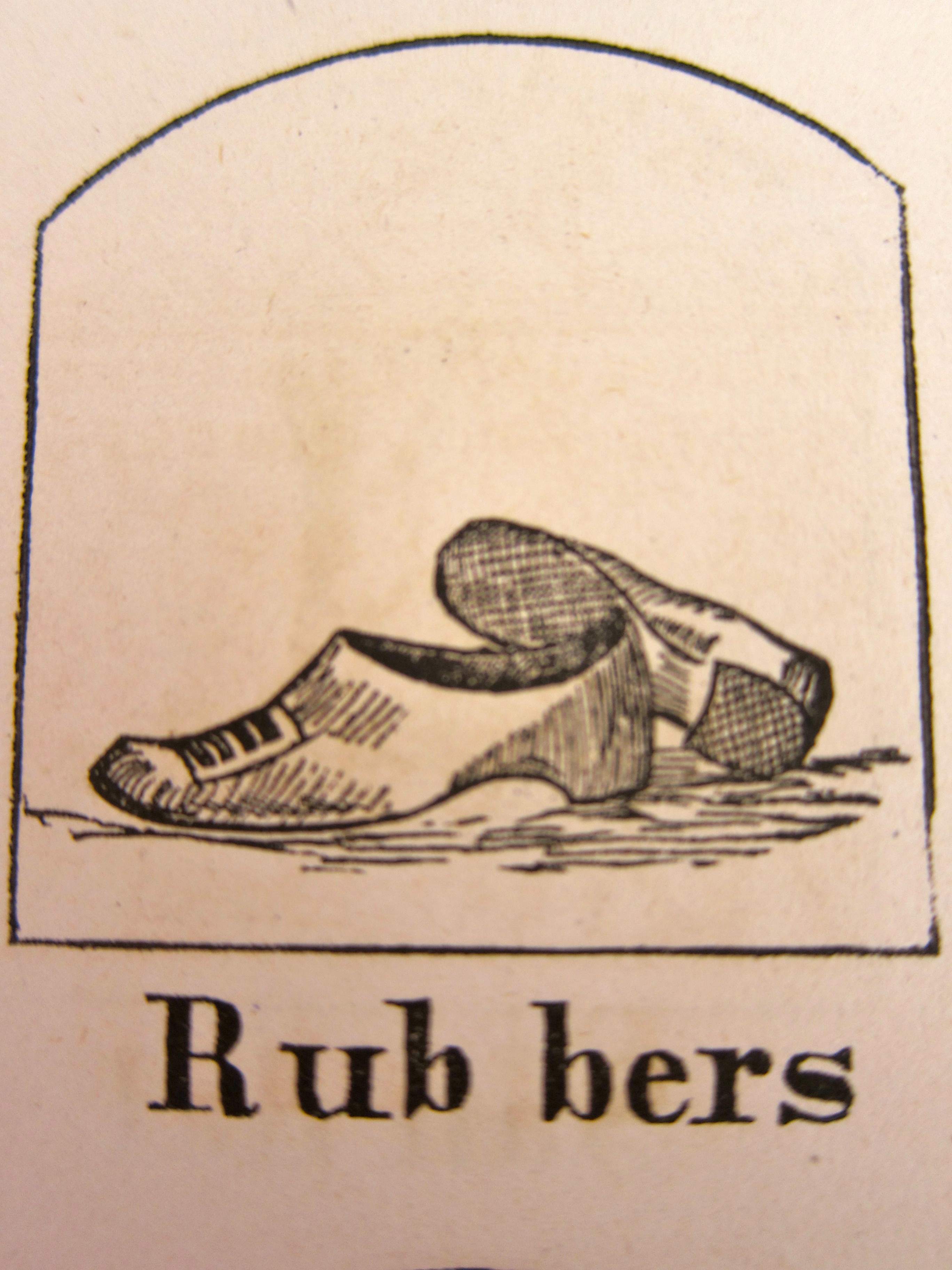
In his journal today, Old Oliver noted that “It’s pretty muddy now,” which explains why Oakes Ames returned from Boston with overshoes, known as rubbers, for his daughter.  Probably everyone in the household donned rubbers during this late winter wetness.

Evelina negotiated the streets just fine, it seems, as she and her niece traveled the short distance to the center of town to call at the company store and at her brother-in-law’s house.  Their mutual nephew, Augustus Gilmore, had decided not to rent from Col. Torrey and would be settling his family instead at a Mr. Wrightman’s house.  And at the end of the day, a new person entered the domestic scene.  Miss Orinthia Foss, the new schoolteacher, arrived from Maine.

February 22 is a date that people acknowledged in 1851 in a manner similar to the way people do in 2014, because it’s George Washington’s birthday.  In this year of Evelina’s diary, President Washington had only been dead for a little over fifty years.  People were alive who could still remember him; Old Oliver was one of them.  Old Oliver was born in 1779, while the Revolutionary War was being fought.  He was two years old when the British surrendered at Yorktown, and eight years old when representatives of the new states assembled in Philadelphia to write a constitution.  George Washington was elected to head that convention and became the country’s first president in 1789, when Old Oliver turned ten.  When Washington died in 1799, beloved and mourned, Old Oliver was a twenty-year old bachelor just making his way in the world.  Much about that world would change over Old Oliver’s lifetime, but the reverence that citizens of the United States felt for their first leader would hold strong.

February 21, 1851

Bed

1851  Feb 21  Friday  It stormed so hard & so dark that Mr & Mrs

Whitwell spent last night with us & returned

home about 8 Oclock this morning  Lavinia &

myself have been sitting quietly sewing.

Susan is all engaged making Labels for the shop

has cut quite steady all day.  Helen brought her work in, and staid two

or three hours but I could not prevail on her to stop to tea

Bridget has hired a bed & bedstead

The family business, O Ames and Sons (as it had been known since 1844 when Old Oliver handed over two-thirds of the reins to his sons Oakes and Oliver Jr.) was just that: a family business.  The Ames men all had rolls to play in its operation, from manufacturing to sales to management.  On this day in 1851, it appears that an Ames female had a roll to play, too.  Little eight-year old Susie Ames spent the day making labels for the shop.  Presumably, this meant she was cutting out printed labels to be affixed to individual shovels.  Did she sit at a table in the kitchen or the dining room, paper and scissors in hand?  Was she paid for this effort, or was this just a rainy day game for her?  Who thought this up?

While Susie wielded scissors, the women wielded needles, of course.  Evelina and her niece, Lavinia Gilmore, kept each other company as they sewed and were joined for a few hours by Helen Ames from next door.  Although Lavinia, aged 19, lived in the country and Helen, aged 14, lived in town, the two young women, distantly related by marriage, were friends.

Lavinia was in town visiting her aunt Evelina.  Last night, Mr. and Mrs. Whitwell stayed over, unable to return home because of bad weather.  A new servant, Bridget, had just ordered a bed and bedstead for herself. In a two-family house already filled with ten people, not including servants, where did everybody sleep? People surely doubled up; Oakes Angier and Oliver (3), for instance, shared a bedroom and probably a bed. Although this practice, too, was disappearing, many houses of the period still kept beds in their parlors; apparently the Ames did this, so perhaps that was where the Whitwells spent the night.

The difference between a bed and a bedstead was simply that the former included only the mattress and linens (also known as bedding), while the latter was the frame on which to put the mattress.  This verbal distinction was beginning to disappear at the time, but it was still useful in an era when some people – servants, particularly – only had bedding on which to sleep.  A mattress could be rolled up and moved around, a wooden frame could not.  Bridget showed hope or confidence in her place in the household when she ordered a bedstead as well as a bed.

February 20, 1851


images-1

Feb 20th  Thursday  This morning sat down to sewing quite

early with Lavinia.  worked for Susan and she

sewed some with us  Sent George after Mr & Mrs

Whitwell about one Oclock.  Mr Whitwell attended 

the funeral of James Wells child  Commenced 

raining quite hard & this evening is very dark

The boys & Lavinia & Susan have gone to the 

dancing school at Lothrop Hall

The Thursday evening assemblies, or dancing school, continued. On this occasion, Oakes Angier, Oliver (3) and Frank Morton took their cousin, Lavinia Gilmore, and little sister, Susie, with them.  How exciting for Susan to go along to watch the young men and women dance; probably exciting for Lavinia, too.  She was at the marriageable age of nineteen and, in the manner of the day, was probably hoping to marry soon.  Getting off the farm for a week to stay with her aunt Evelina in the village of North Easton was an opportunity to socialize and perhaps meet someone special.  Did anyone ask her to dance?  Did her male cousins watch out for her?  Did she like what she wore?

Elsewhere in Easton life was not so light-hearted.  Reverend Whitwell officiated at a funeral for the infant son of James and Celia Wells.  James and his brother John, for whom the little boy was named, worked at the shovel factory.  They were originally from Maine.

And, being February, the weather took a dive for the worse.  The young people’s ride home from Lothrop Hall must have been disagreeably wet.  Mr. and Mrs. Whitwell, who had evidently stayed for tea after the funeral, were unable to get home and had to spend the night at the Ames’s house. Young George Witherell was spared the challenge of carrying them back to the parsonage in the dark, windy downpour.

February 18, 1851

yoke-of-oxen

Feb 18  Tuesday  After doing my usual mornings work sit

down to sewing on Susans work   She sewed with me

and counted stiches again  She will do pretty well

and keep quite steady when we count stiches

This afternoon went into Olivers to assist on Helens

quilt but found it most done.  Was called home

to see Mr Whitwell   Abby & Malvina Torrey & their 

cousin Mrs Fullerton  called  Pleasant

Sewing lessons for eight-year old Susie Ames continued today.  She seemed to be getting the hang of the needle as long as she counted her stitches.  This meant calculating and maintaining an equal number of stitches per inch of sewing. After the lesson was through, Evelina tripped next door to help with the making of a quilt. She discovered that the work was pretty well complete, however, which was just as well as she was called back home to sit with Reverend Whitwell, who came to visit.  More follow-up to the Sewing Circle meeting?

Outside, away from this cozy domesticity, Old Oliver was clomping around looking at oxen to buy.  He found a pair that he particularly admired and seemed pleased with his purchase:

“this was fair day  wind about west and not cold   I bought a yoke of oxen to day of a Mr Whitcom of East Randolph for $125-00 they are a handsom red + look a good deal alike.  he said they would be 6 years old this spring comeing   the off one girts 7 feet + 2 inches + the nigh one 7 feet   they weighed after drinking with yoke on 3220 lb.  the man  said he had them for twins”

And while Old Oliver dealt with the farming side of the Ames enterprises, Oakes and his three sons were no doubt busy at the shovel works, the young men continuing to learn the ins and outs of manufacturing, much as little Susie was learning to be domestic.   The futures of all four offspring were being lined up.

February 15, 1851

Chemise

Chemise

Sat Feb 15  This morning mended a pair of pants for Frank

and some other things.  Finished two chemise for Susan

made her a skirt out of an old quilted one of mine.

It has been a very stormy day.  the public school

finished this afternoon.  Oakes A, Mr Pratt, Davidson,

Barrows, R. Willis, Lillie & one or two others visited the 

school.  There were no ladies on account of the rain

Mr Ames went to Boston.  Brought Miss Eaton some maple sugar

While her husband went into Boston today despite poor weather, Evelina stayed in, mended clothes and completed two chemises for Susan. The chemise, a forerunner of today’s slip, was a standard undergarment for women and girls in the 19th century, worn right under the dress (and under the corset, when corsets were worn.)  As Evelina suggests, some undergarments were quilted for warmth, an essential consideration in cold New England. On stormy days like this one, women needed all the padding they could accommodate under their wide skirts.

Oakes Angier Ames visited the local schoolhouse today with men from the school’s superintending committee: Amos Pratt, a teacher; Thomas Davidson, the town’s postmaster; Joseph Barrows, a “shovelmaster” with legal training who lived in a house built by Old Oliver; Rufus Willis, a shoe manufacturer; and Daniel Lillie, another employee of O. Ames & Sons.  Daniel and Oakes Angier were in their early twenties, while the other men were older.  Daniel would be close to the Ames family over the years, and ultimately serve as a pallbearer at Oakes Ames’s funeral in 1873.  Today, however, in the rain, without their wives, the men appeared at the public school on the last day of this session.  Why was Oakes Angier along?  He wasn’t a member of the committee, but perhaps he was developing an interest in local politics.

Oakes Ames, meanwhile, returned from Boston in the evening, bringing with him a gift of maple sugar – a sign of spring – for the failing Miss Eaton.   He may also have returned with news of a serious incident in the city.  Shadrach Minkins, a fugitive slave living and working in Boston, was arrested today by federal marshals at a coffeehouse on Cornhill Street. Minkins would be taken to court, only to be rescued by an anti-slavery group, the Boston Vigilance Committee, who hid him and helped him escape to Montreal.  The controversial new Fugitive Slave Law was being tested.  Had Oakes witnessed any of this?