September 10, 1851

Thread

Wednes Sept 10th  Cousin Harriet spent the forenoon with

us & dined here.  I cut some shirts this

forenoon for Mr Ames, carried two to be made

at the sewing circle.  Met at John R

Howards this afternoon quite a number

there.  Carried mother down and she went 

home with Henrietta.  Mrs Stevens went into

Olivers with H. Mitchell


The monthly Sewing Circle, a gathering of women from the Unitarian congregation, met at the home of Caroline Howard, wife of John R. Howard, a book agent who lived near the geographic center of Easton.  Half a year had gone by since Evelina had had her turn hosting the group, back on February 12, when bad weather – and bad feelings, perhaps – prevented anyone from attending. By this time, she seemed to have forgotten that embarrassment and forgiven the friends who had failed to show up.

There was plenty of attendance at today’s meeting, however, including Evelina’s mother, Hannah Gilmore and sister-in-law, Henrietta Gilmore. The Ames sisters-in-law, both named Sarah, probably were there as well. All the women, as the saying went, set great store by these regular gatherings. Did they dress up for the meetings? They might well have, knowing that their fellow females would recognize and appreciate good sewing and fine material better than the men at home were likely to.

The only other regular gathering where women might pay particular attention to their attire would be church, where one’s “Sunday best,” was expected. Surely the Ames women were susceptible to this practice, even if one of the Ames men – Oakes – was not. Yet Evelina, for all the sewing she did, rarely described what she wore on any given day. Did she save her best outfits for Sewing Circle, or church, or both?

September 2, 1851

Cloth

Tuesday Sept 2d  Again this morning sat down quite early to 

sewing for Oliver cut him out 5 dickeys & finished 

one that was cut last autumn.  Mrs Stevens stiched

2 of them.  Mrs Stevens Pauline & self passed the

afternoon with Mrs Witherell  The weather is

very unpleasant & cold and this evening it rains

hard

The northeast wind of yesterday brought no good weather with it.  The ladies stayed indoors and sewed clothes for Oliver (3), only breaking stride enough to move in the afternoon to the other part of the house to do more of the same. Most likely, Sarah Witherell sewed with them.

Evelina noted today that she worked on dickeys, or shirt fronts, for her son.  She finished one that she had cut out almost a year earlier, which begs the question: Where had she kept it all that time?  Where did she store the fabric, thread and trim for her multiple projects? She had a workbasket, certainly; any sewing woman in that time and place would have had one.  But a workbasket was just that, a basket, or a box.  It might hold a thimble, scissors, needles, a bodkin, an emery bag, plus “tapes, and buttons, and hooks and eyes, and darning cotton, and silk winders, and pins, and all sorts of things,* but it wouldn’t hold bolts of cloth or unfinished, flounced skirts. The yards of fabric and dickeys-in-progress, the aprons to be hemmed and the chemises to be sewn together, would be stored elsewhere. Where?

Perhaps Evelina had shelves in a corner closet to hold her projects, or maybe she laid claim to a particular chest of drawers in the sitting room. When she was working on large projects, such as the cover for the lounge she made earlier in the summer, perhaps the piece simply lay out in one of the rooms until completed. Was she tidy or messy? How did she manage? She may have wished for a room that could be just hers for her projects.  With that large family, and all the houseguests they welcomed, an extra room wasn’t likely to be available.


* Susan Warner, The Wide, Wide World, p. 40


September 1, 1851

000100849[1]

*

Sept 1st Monday  Jane & Ellen washed and have done most

of the housework and I have been to work on Olivers

clothes have sewed pretty steady to day.  Pauline has

been sewing on a pr of Muslin undersleeves that

I gave her but has not finished them.  Mrs Stevens

covered some button and sewed them with Olivers vest

& mended the buttonholes


Sewing was “pretty steady” today as the date of her son Oliver (3)’s departure for college loomed nearer. Evelina was mending everything and making new items like collars and dickeys. She tried to mark Oliver’s clothes so that they wouldn’t get lost – a time-honored effort by many a mother when a child leaves for college. How did she mark the clothes, though, in those days before indelible ink markers?  There were certainly no “iron-ons” and probably no manufactured name-tags that would have been sewn in by hand, either.  Her most likely solution would have been to embroider Oliver’s initials or name on the inside or underside of each piece of apparel. That sounds like a lot of work.

Houseguest Pauline Dean accompanied Evelina and sewed some on a pair of new undersleeves while another guest, Mrs. Stevens, helped cover the buttons of a vest belonging to Oliver. Clothes must have been everywhere, as laundry was being washed while all this sewing went on. It was Monday, and Jane McHanna and another servant named Ellen had the stove going and the tubs full. The “fair day” and north east wind that Old Oliver noted in his journal would have helped dry the clothes.

Old Oliver also noted that he “went to Canton to day with Mr Clark + others to put in the stone bridges below the shop.” Can any of our local historians identify these bridges?  Are they still in place? The shop, which was originally built in 1847 to supplement the factory in North Easton, is no longer standing. The image above was taken circa 1965.

* Ames Shovel Shop on Bolivar Street, Canton, Canton Historical Society, from Arthur Krim’s Historical Buildings of Canton, Vol. II.

August 30, 1851

OLYMPUS DIGITAL CAMERA

*

Sat Aug 30th Have been marking Olivers clothes and fixing

them.  Called to Mr Whitwells Major Seba Howards

Mr Samuel Dunbars and at Alsons with Pauline

Took tea at Alsons brought Orinthia home with us

All of Mr John Pools family were there or rather

Rachel Augusta & Elisabeth.  Mrs Stevens came

there yesterday  Alson & Mr N Hall here to

dinner & tea

Another sociable Saturday was enjoyed by many throughout Easton, as friends and neighbors rode here and there calling on one another. As one modern historian has noted, “formal and informal forms of socializing were the most common amusements throughout the period. Then, as now, folks liked to visit one another, usually after supper and on weekends. The middle class gathered in their parlors, talked, sang, played games, and so on.”**

Evelina certainly did her part. With her friend Pauline Dean, she paid calls on various friends, including the Howards, the Dunbars, and the dependable Reverend Whitwell and his wife Eliza. At her brother Alson’s farm, where they took tea and visited with old Mrs. Gilmore, they chatted with three daughters of the John Pool family, including Rachel, Augusta and Elizabeth.  Rachel and Augusta had visited Evelina earlier in the month and accompanied her to the company store and the shovel shop.  Evelina was a friend to young women – especially to Orinthia Foss, the schoolteacher, whom they scooped up and took back to North Easton.

On their way home, as they likely rode past fields of Queen Anne’s Lace and Goldenrod, did they acknowledge that summer was coming to an end?


Photograph by John S. Ames III

** Marc McCutcheon, Everyday Life in the 1800s, Cincinnati, 1993, p. 200.


August 26, 1851


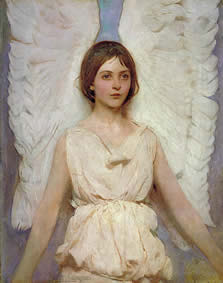
Abbott H. Thayer, Angel, 1887, oil Smithsonian American Art Museum Gift of John Gellatly

Abbott H. Thayer, Angel, 1887, oil
Smithsonian American Art Museum
Gift of John Gellatly


Tues Aug 26th  Clinton Lothrop died about ten Oclock

last night  Has been sick a long time with

the Typhus fever  Mrs Witherell & I made the

shroud for him  Mrs Mitchell went to Taunton

to get Bonnets &c for Mrs Lothrop

Rebecca White came after Pauline this morning

Alson here to Dinner and tea is drawing stones for

Edwins cellar.  Oakes A and Frank returned this evening


Dewitt Clinton Lothrop finally died.  He had been suffering from typhus, “an acute infectious disease caused by the parasite Rickettsia prowazekii, transmitted by lice and fleas [,and] marked by high fever, stupor alternating with delirium, intense headache and dark red rash.”* It’s not the same disease as typhoid fever, although the two conditions have some similarities. Clinton, as he was known, had probably been bitten by a flea.

One of nine sons of Howard and Sally Lothrop, Clinton was a brother of Sarah Lothrop Ames. While most of his surviving brothers had moved away from Easton in pursuit of their own lives, Clinton was the duty son who had stayed home with his parents. Only 26 years old and married with two small sons, he had tended the family farm.

Evelina and Sarah Witherell quickly prepared a shroud for the body, while Harriett Mitchell rode off to Taunton to find mourning clothes for the young widow, Elizabeth Howard Lothrop (or for the mother, Sally Williams Lothrop.) That no one had purchased the mourning clothes before now suggests that, despite the probability of death, everyone had hoped that Clinton would recover.

It was a busy day for Evelina.  Besides helping sew the shroud, she saw her friend Pauline Dean depart to visit elsewhere in Easton and welcomed her brother Alson to midday dinner. Alson was working nearby, helping his son, Edwin Williams Gilmore, build a house.  Jane McHanna washed clothes, and she and Evelina probably continued to set the house to rights after a weekend of guests. Oakes Angier and Frank Morton returned home from their fishing trip.

* Craig Thornber, Glossary of Medical Terms Used in the 18th and 19th Centuries, http://www.thornber.net

August 22, 1851

1024px-The_Yacht_'America'_Winning_the_International_Race_Fitz_Hugh_Lane_1851

*

Friday Aug 22nd Aug  This morning stormy and Pauline sat with me

sewing made the button holes in Susans pink apron

This afternoon went with Pauline to mothers to

tea.  Called at Col Whites & at Orinthias school.

Mr Pratt & White and several ladies at the examination

On our return home found Cousin Jerry &

Warren Lothrop here  Pauline & Warren were very sociable with each other

Morning sewing and afternoon socializing were the order of the day, with houseguest Pauline Dean demonstrating a marked preference for the latter. The weather in the morning was “stormy”; Old Oliver reported a tornado in Cambridge. But the afternoon was calm, so Evelina and Pauline went out. When they returned, Pauline zeroed in on a visiting Lothrop cousin named Warren, and the two flirted.

Meanwhile, Orinthia Foss’s performance as a teacher was reviewed by the local school superintending committee. Amos Pratt, a fellow teacher, and Col. Guilford White, a shoe manufacturer who eventually became a lawyer in Boston, evidently led the examination.  They were accompanied by several unnamed ladies.

On this very same day, across the pond and around the Isle of Wight, a new yacht, “America,” that had been commissioned by members of the New York Yacht Club raced against 15 other boats in the Royal Yacht Squadron’s annual regatta.  “America” won, and from that victory sprang a competition known as the America’s Cup that now boasts the world’s oldest international sporting trophy. Doubtless, the race was reported in the papers; perhaps Oakes and Evelina read about it.


* Fitz Henry Lane, “The Yacht ‘America’ Winning the International Race,” 1851


August 21, 1851

PINEAPPL-h

*

Thurs 21st Aug  This morning sat down to work quite early

finished my purple morning dress and 

Susans pink print that was made over

Pauline is not willing that I should work

much  She has had the offer of marriage

from a Mr Stowe of Concord Mass & the same

is an offer from John Reed, an old man of

70 years  She is very fascinating  Mrs Witherell

& Mitchell went to Boston for paper for parlour

Evelina had a houseguest who wasn’t interested in sewing, but that didn’t prevent her from finishing two dresses she’d been working on. She was caught up with the romantic dilemma of her friend, Pauline Dean, who was considering two offers of marriage. Evelina’s daily life was so far from being romantic that she found Pauline’s tales “very fascinating.”

We don’t know much about Pauline Dean, except that she corresponded with Evelina and visited periodically. We don’t know where or how Pauline lived, but we can surmise that she was originally from the Easton area. She was familiar with the town and several of its inhabitants; perhaps she was related to one of the Dean families in the area.

While Evelina and Pauline visited, sisters Sarah Witherell and Harriett Mitchell went into the city in search of wallpaper. Sarah was looking to replace the wallpaper she had only recently put up in her parlour; she didn’t like it or the way it had been hung. The wallpaper in the illustration above is circa 1845 and demonstrates the prevailing ornate taste of the time.

Adelphiapaperhanging.com 

August 16, 1851

Tub

Sat 16th Aug  Have been to work on my white loose dress

that Julia cut out some time since and it is ready for

the washtub  Frank and Oliver came from Bridgewater about

three and brought home Charles Mitchell & Sister Harriet

Mr Brett two Miss Tolmans from New Bedford Jane & William

Howard & Orinthia came & went to the shop about 5 Oclock

The party at Robbins Pond in Bridgewater may have ended, but the festive mood continued.  Oakes Angier Ames headed into Boston, but his brothers Oliver (3) and Frank Morton returned from Bridgewater with their Aunt Harriett and her brother-in-law, Charles Mitchell and, perhaps, others. At the same time or maybe just a short while later, Orinthia Foss and a spill of friends to whom Evelina had been introduced only a few days earlier arrived and went to the factory.

Why this sociable group visited the shovel factory at the end of the day is a mystery. Were they delivering the Ames brothers back to work? Were they visiting someone else there? Did Oakes or Oliver Jr. find it amusing? Was Old Oliver privy to this after-party?

Evelina, meanwhile, was working on her wardrobe and was ready to put a new dress into the washtub.  She might have looked up from her sewing to see the young people drive by.


August 15, 1851

Vintage Ames Shovel

Vintage Ames Shovel

Friday 15th Aug  Julia here to work to day cutting me

a purple loos dress & cutting a pink french

calico for Susan.  Made a childs waist to it.

Oakes Frank & Oliver went this afternoon

to Robbins pond in E Bridgewater to a party.

Oakes A is to go from there to Boston tomorrow

I have passed the afternoon at Mr Peckhams

had a pleasant visit

Robbins Pond, where the Ames sons and their Aunt Harriett went today for a party, is in Bridgewater and is known today for its bass fishing.  Who hosted the party there in 1851 isn’t known, but all the Ameses, including Evelina, were invited.  Evelina declined, however, suggesting yesterday that she might enjoy herself too much if she went. She went to call on the Peckhams instead.

On a much more serious note, today marks the one year anniversary of a terrible accident at the shovel factory. According to Old Oliver, an employee named William Loftis “was hurt so bad yesterday by leting a shovel catch in the polishing wheel that he dyed.” Loftis was an illiterate laborer in his late twenties. Like the Middleton and Maccready families with whom he lived, he had immigrated from Ireland.

Old Oliver seemed to blame Loftis for getting caught in the machinery, perhaps through inattention or carelessness. He doesn’t suggest that the factory was at all at fault, or that the machinery could be reconfigured in a way to make it less dangerous. As far as Old Oliver and most factory owners at the time were concerned, employment carried a certain level of risk, risk that was assumed by any man who received a pay check.

It’s doubtful that the Ames family was indifferent to the fate of William Loftis, however. It’s likely that Evelina or one of her sisters-in-law sewed a shroud for the body for a proper burial. Knowing Oakes Ames’s instinctive kindness to strangers and employees, he probably would have reached out to Loftis’s family. The absence of a widow and children, however, suggests that Loftis was simply buried and simply forgotten.


July 26, 1851

SE003586small

Saturday July 26th  This day is very pleasant and we should

have had fine weather to be in Boston  Mr

Ames has gone as usual  I feel quite disappointed

that we did not go but I presume it is for the 

best  The school does not keep to day & […Susan]

is sewing some but she does not like it & I fear

she will never learn at this rate

Stuck at home when she had planned to be in Boston, Evelina was clearly sorry to have misjudged the weather and missed the trip. Oakes was in town and she wasn’t, and she had little choice but to turn to her sewing.  She coped with her disappointment by handing it over to providence and accepting the change of plans as “for the best.” God knew better than she did.

Susan Ames was possibly less philosophical about the change of plans.  Her mother put her to work sewing, for which Susie had neither inclination nor aptitude.  In an era when society decreed that a “woman who does not know how to sew is as deficient in her education as a man who cannot write,”* Susie was expected to acquire at least the fundamentals of needle and thread whether she liked it or not.

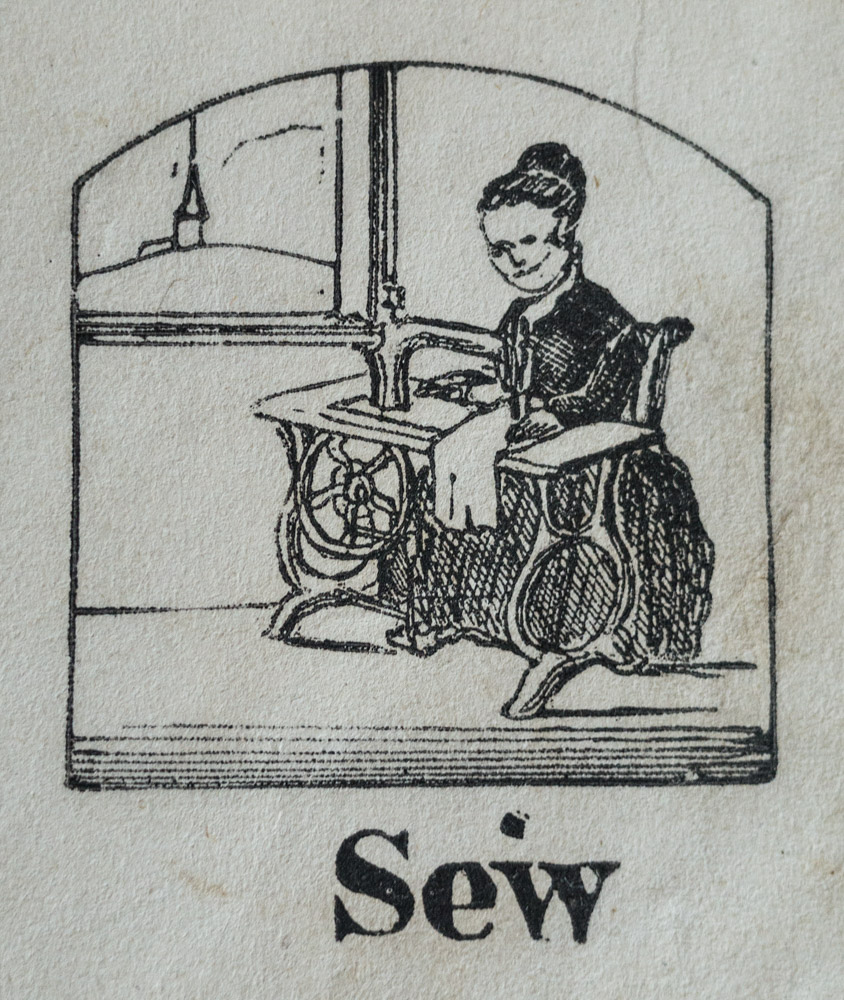
Neither Susan nor her mother could know that mechanical machines for sewing would soon be introduced that would obviate hand-sewing. The illustration above, from 1877, a quarter-century later, suggests how readily the sewing machine would replace hand-sewing and how quickly the production of clothing would become an industry.  Although bespoke clothing would never disappear, and many women for personal or economic reasons would continue to sew their own clothes, ready-to-wear clothing would become more and more available in Susie’s lifetime. No one in the Ames sitting room could envision that development on this sunny summer Saturday ten years before the Civil War.


* Eliza Ware Farrar, The Young Lady’s Friend, Boston, 1836 (from Judith Sumner, American Household Botany, Portland, Oregon, 2004)