January 1, 1852

OLYMPUS DIGITAL CAMERA

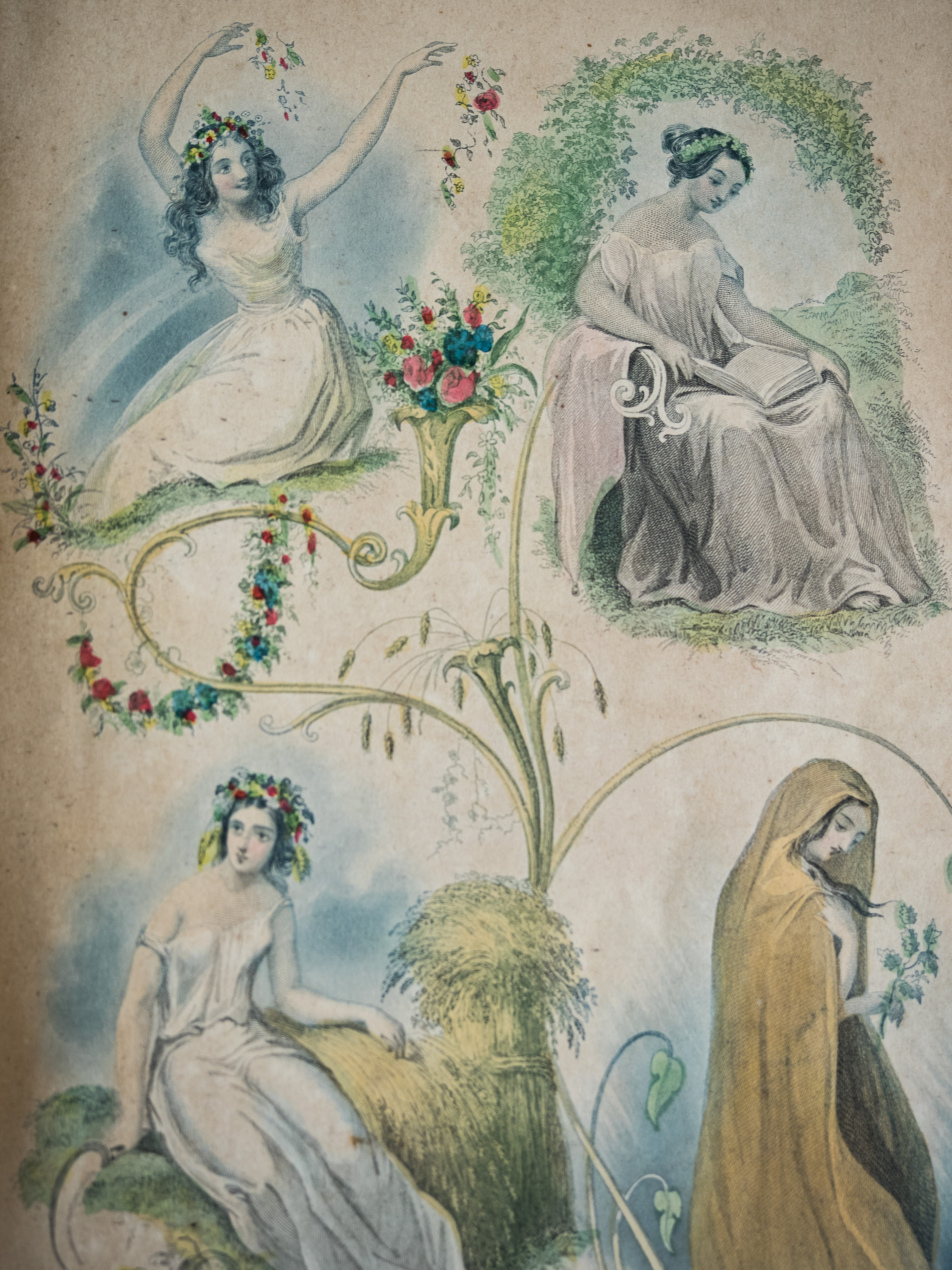
The Four Seasons, from Godey’s Lady’s Book, 1851

1852

Jan 1st Thursday.  It being very stormy last night Alson &

wife came home with us from Olivers & spent the night

and forenoon.  Cooked a turkey for dinner.

Went with them to Augustus this afternoon and 

evening called on Mrs J C Williams, found her

making some shop shirts for Oakes Angier.  The weather

is very warm & unpleasant


The new year began with rain and high water in the ponds, pleasing Old Oliver Ames.  He may have been retired from the shovel shop, but he kept close watch on how the business was doing, and how the business was doing depended heavily on how the water power was running. Evelina herself found the rain “unpleasant.”

Evelina and her family marked the day with a turkey dinner, making it an occasion. Evelina’s brother, Alson Gilmore, and his wife, Henrietta, had stayed the night, unable to get back to their farm in the driving rain. They were rewarded with a feast. After the midday meal ended, Evelina went with them to see Alson’s eldest son, Alson Augustus Gilmore, and his young family.

Back in the village, Evelina visited a seamstress about making shirts for her son, Oakes Angier Ames. Mrs. Williams, who was probably a widow, would sew a number of work or shop shirts for the Ames men over the course of the year.  Evelina herself had sewn multiple shirts the previous spring, a task that took her weeks to finish. Much as she enjoyed sewing, she must have been thrilled to pass the chore on to someone else. This would free her up to concentrate on dresses and accessories, as well as tend to the mending basket that always had work in it.
December 30, 1851

SwedishRunnersC

*

Tuesday Dec 30th  This forenoon worked about the house

again. Have put the drugget down in the 

parlour and dusted the room thoroughly.

Made Susan the second pair of sleeves to her blue

cotton & wool Delaine  Finished the letter to Lucy Norris

Commenced knitting the border to the bottom of my hood

It is a beautiful warm sunny day like the spring of the year


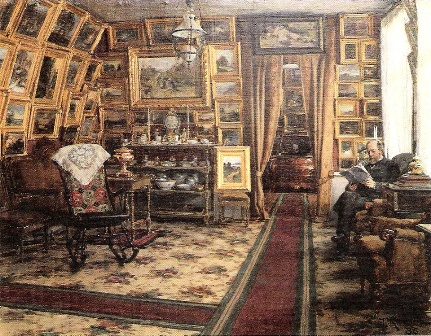
Nor surprisingly, the carpet that Evelina used in the house was inexpensive. Drugget, as it was known, was “a sort of cheap stuff, very thin and narrow, usually made of wool.”**  Drugget is an English term for “a coarse fabric having a cotton warp and a wool filling,” ** the kind of quick carpeting one might have found in a first class railway carriage. It probably had a design or a border printed on it.

Evelina has written here and elsewhere of putting carpeting down, taking it up and outside to clean, and putting it down again. She has written of stitching the carpeting together, which suggests that she may have used drugget runners side by side to make an over-all covering for her parlor floor. She may have been more conventional, though, and placed the drugget as runners on top of an area rug, or on top of a bare floor. Whatever she did, the work was repetitive and dusty.

It’s a shame that Evelina spent so much time indoors today when the weather was “fair warm + pleasant,” as Old Oliver reported. She herself made note of its similarity to spring; she should have known it wasn’t going to last.


** Wikipedia, “Drugget”, as of December 26, 2014


Scandinavian Room with drugget runners “Bibliotekarien Segersteen i sitt hem,” 1886, by Johan Fredrik Krouthen, Courtesy of http://www.burrows.com


December 27, 1851

imgres-1

Sat Dec 27th  Have put more sugar lemon & ginger to the syrup

of the citron  swept and dusted the rooms got

the lining ready to quilt to Susans hood quilted

the lining to Susans bonnet and fixed the collar

to my cloak  A[u]gustus Lothrop brought me a 

bushel of cranberries.  A Augustus called to bring

soap shoes &c that he got me in Boston


The cold temperature continued, Old Oliver noting in his diary that “the thermometer according to the papers was down to 8 in some places.”* Such temperatures wouldn’t have harmed the bushel of cranberries that Evelina received today. As author Mrs. Cornelius advised in her 1846 household guide, “cranberries keep well in a firkin of water. If they freeze, so much the better.”**

Cranberries were common in New England.  There is debate over whether they were served at the earliest Thanksgiving dinners, but there’s no debate that both Native Americans and English settlers consumed the fruit in season. Botanist Judith Sumner notes that: “Wild cranberries were originally hand-picked, but efficient New-Englanders soon crafted scoops that could be used to rake the berries from the lax stems.  During the nineteenth century, bogs carpeted with wild cranberries transformed into cultivated sites that were raked systematically each fall.”***  Augustus Lothrop, the youngest brother of Sarah Lothrop Ames, evidently cultivated cranberries at his farm in Sharon.

Henry David Thoreau enjoyed cranberries, finding them in the wild and eating them raw.  He considered them “a refreshing, cheering, encouraging acid that literally puts the heart in you and sets you on edge for this world’s experiences.”***

*Oliver Ames, Journal, Stonehill College Archives, 1848-1863

**Mrs. Cornelius, The Young Housekeeper’s Friend, New York, 1846

*** Judith Sumner, American Household Botany, Portland, Oregon, 2004, p. 124


Ed. note:  Horace “Augustus” Lothrop was the youngest brother of Sarah Lothrop Ames.  He lived in Sharon.

Alson “Augustus” Gilmore was a nephew of Evelina Gilmore Ames, son of her brother Alson. He lived in Easton.

December 23, 1851

4-currier-ives-winter-scene-granger


Tuesday Dec 23  Julia has been here to day to make Susans cotton

& wool Delaine  I have not sewed much with her

was choring about the house most all the forenoon

painted over some boxes for Mr Scott to grain.  made

the skirt & cuffs to Susans dress then went to knitting

on my hood which I commenced last evening.  Julia

cut and made and gathered the skirt and basted 

it on to the waist, the sleeves are not made


Old Oliver’s wintry weather report for this day suggests a scene worthy of Currier & Ives:”[T]his was a cloudy day + a verry little fine snow. wind north west it cleard of[f] about sunsett. what snow fell to day + last night was 1 ½ inch.” The countryside was covered with snow, appropriate enough for the first full day of winter.  And winter was a season much illustrated by the 19th century printmakers, Nathaniel Currier and James Ives.  Working out of New York, the firm produced enormously popular hand-colored lithographs of mostly American scenes. Currier began the prints in 1835 and was joined by Ives, who had been the firm’s bookkeeper, in 1856. The men soon developed a stable of artists and produced prints through the rest of the 19th century and into the early 20th. Evelina would have been familiar with Currier & Ives images, in the same way that many mid-20th century Americans were familiar with the illustrations of Norman Rockwell. The images were everywhere.

Many, if not most, Currier & Ives prints were scenes of the outdoors. On this day at the Ames’s, however, the action was all indoors, as the women chored, painted, sewed and knitted. Dressmaker Julia Mahoney was at the house to sew a wool dress for nine-year-old Susan Ames. That a child Susie’s age was having a dress made by a “professional” rather than her own mother was certainly a sign of the Ames’s wealth. Helen Ames, Susie’s fifteen-year-old cousin next door, often had her dresses made by Julia. Evelina was keeping up with her sister-in-law, Sarah Lothrop Ames, in providing the best for her daughter.


December 20, 1851

unnamed Dec 20 Saturday  Have been very busy all day working

on different articles  Mended some clothes

for Frank, the stockings and mended the

places that were cut & bound the end of

some pieces of carpeting Jane finished the 

second robin that she has made for Frank

Mr Ames brought home some marble rubber

and lining & ribbon for Susans bonnet   ”


[T]his was a fair day and not verry cold” was the weather report from Old Oliver Ames. It was a normal Saturday at the Ames’s house in all respects. Evelina mended clothes, darned socks and repaired some carpeting.  Jane McHanna sewed, too, having recovered from an acute indisposition caused by coal the day before. She finished a “robin” (which one reader suggests was a kind of tough work pants) for Frank Morton Ames, Evelina’s youngest son.

Oakes Ames went into Boston, as usual, for a weekly check-in with shovel customers, after which he went shopping for his wife. From a list Evelina must have given him, he made his way along Washington Street and around Faneiul Hall, probably knowing just which shop to go to for such-and-such ribbon or a well-priced bolt of flannel. He returned to North Easton laden with parcels wrapped in paper and tied with string.

December 18, 1851

62834-004-ED8B9BE0


A Delaine Sheep

Dec 18 Thursday  Finished the back of Susans hood

and finished the blue and orange deLaine

for self that Julia cut a new waist for last spring

Mary left this morning said she was going

to Bridgewater for her clothes   It is bitter cold and 

I fear she will suffer  Jane has finished two

prs of cotton flannel drawers for me that she

has been sewing on since she was sick

Another “fair cold day;”* not an ideal time for the servant, Mary, to travel from North Easton to her home in Bridgewater.  Whether she rode or walked, she must have been quite exposed and have become sick, for she didn’t return to the Ames household for the rest of the winter. She only reappears in Evelina’s diary the next July, working by that time for Alson and Henrietta Gilmore at their farm.  What prompted her departure?  Was she homesick for family in Bridgewater, or tired of working at the Ames’s house?

Sewing was today’s occupation of choice for Evelina and her remaining servant, Jane McHanna. Evelina picked up an unfinished project from the previous spring, one that she had nearly finished with help from local dressmaker, Julia Mahoney.  It was a “blue and orange deLaine,” meaning that it was a print or plaid, fine-weave, challis-like wool dress, one that would be of service in this cold weather. The wool itself came from a type of Merino sheep known as a Delaine (as in, “of wool” in French.) Jane, meanwhile, sewed some flannel underclothes for Evelina, who would be warmly dressed once these articles were finished.

Next door, in the other part of the house, a man named Holman Johnson, probably visiting on shovel business, stayed the night.

*Oliver Ames Journal, Stonehill College Archives, Arnold Tofias Collection


December 16, 1851

OLYMPUS DIGITAL CAMERA


From Godey’s Lady’s Book, October, 1851, Outfits for the Fair 

Tuesday Dec 16  Have finished the hood for the fair

Mrs Witherell has made a Dolls hood & half

dozen linen collars.  Mrs Ames a hood & childs apron

Mr & Mrs Reed called on Mrs Witherell for the 

things and made a long call  Mrs S Ames

& self went to see her.  She brought some

things she made such as dolls comforters bonnets &c

Mrs Howard & Miss Jarvis made eight straw hats

How productive the Unitarian women had been lately.  Sarah Witherell, Sarah Ames, Abigail Reed and others had sewn or knitted many small items like collars and doll clothes to sell at what must have been a church fair. Both Sarahs were planning to work, or perhaps preside, at the event.  Why wasn’t Evelina going to work at it? Had she been asked? Had she declined? Did she care particularly?

For whatever reason, Evelina was less involved in the church fair than either Sarah.  Her sisters-in-law had sewn a number of articles between them to donate, while she herself only made one small hood.  Was her small contribution a reflection of disinterest in the event?  Was she too busy at her domestic responsibilities to take the time?  Was it against her inclination to make things to give away?

Evelina admired the pieces that others had made, but it would seem that either the fair itself didn’t interest her or she felt left out of the goings-on. She never mentioned the fair again, which suggests that she didn’t even attend it.


December 1, 1851

20130117__anchor-ice~p1

*

Dec 1st Monday.  Oliver left again this morning

for Brown University.  Jane was able to do the 

housework this morning & Mary has washed

I have been sewing with Mother  Gave the

furnace up to Ann this morning  It has been 

so windy that we could not dry our clothes

Jane has starched the fine clothes to have

them ready to Iron tomorrow  Cold room all day


It’s not surprising that Evelina got Sarah Witherell’s servant, young Ann Orel, to start the coal furnace this morning, for it was a chore she disliked and the weather was so cold that there was no fooling around with getting heat into the house.  Old Oliver reported that “this was a fair day wind verry high from the north west + cold – a verry disagreeable day to be out in – there was an anchor frost this morning”

Anchor frost is a term for “a frost which causes ice to form along the bed of a running stream […] An anchorfrost can only occur when the temperature of the running water and the bed over which it flows is below freezing point. When this is the case, the rapidity of the stream is sometimes sufficient to prevent the swifter upper current congealing, while the lower current, which moves more slowly on account of the friction, becomes frozen to the bed.” *  Old Oliver knew all about running water and was probably not happy to see anchor ice forming in the Queset.

*Image of anchor ice, courtesy of The Aspen Times

** Arthur Benoni Evans, Leicestershire Words, Phrases, and Proverbs, Volume 11, English Dialect Society, 1881.


November 25, 1851


kitchen

*

Tues Nov 25th  Mary has done the ironing to day except

the fine clothes and they look much better than usual

Jane is rather better to day and has washed the dishes

and assisted some about the housework.  I have made a

dickey for Mr Ames. Passed the afternoon at Father Ames

with Mr & Mrs Swain & Mrs Meader  Mrs S Ames,

Fred & Helen came home to night

Family members began to gather in anticipation of Thanksgiving. Fred and Helen Ames came home from their respective schools in Cambridge and Boston, adding animation to the quieter house next door.  Surely their parents, Sarah Lothrop and Oliver Ames, Jr., were pleased to see them.  Oliver (3), away at school in Providence, was getting ready for his travel home.

No one was making merry yet, however.  Everyone still had work to do. The new girl, Mary, did some ironing, evidently better than Jane McHanna usually did.  Jane herself, still recovering from an illness that had laid her low for almost ten days, was able to wash dishes and help out a bit. Evelina, after supervising Mary and Jane, was finally freed up to sew and socialize.  She was in a happier state of mind.

The men of the family were working as well.  While Oakes, Oliver Jr, Oakes Angier, and Frank Morton were at the shovel shop, Old Oliver and some of his men began “a building an ice hous.”**

“About sunsett,” it began to snow.


*Image of a mid-19th century kitchen, Courtesy of http://www.victorianpassage.com

**Oliver Ames, Journal, Courtesy of Stonehill College Archives, Tofias Collection


November 15, 1851


SUGARLOF

1851

Sat Nov 15th  Another day I have been about house all

day, this morning helped the gardener weigh out

a box of sugar that we bought in Boston

got my bags of cloth of different kinds

in order in the shed chamber  It has been

very stormy all day Mr Ames and Oliver Jr

in Boston Oliver went yesterday He looked 

at carriages but did not purchase one

Bridget gone to housekeeping

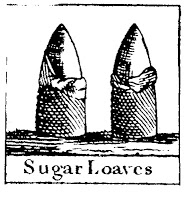
At the rate Evelina used sugar in her fruit preserves, she needed many loaves of it. Unable to purchase it at the family store in the village, she bought what they needed in Boston at Faneuil Hall.  On this day, she appeared to be breaking at least part of a sugar loaf into usable bits for her kitchen.  The family gardener helped her, perhaps because the sugar loaf was so heavy to hold.

Sugar wasn’t the only commodity that Boston had to offer.  Evelina’s husband, Oakes, and his brother, Oliver Ames Jr., had gone to the city, the latter in search of a new carriage. He – or they – didn’t purchase anything, just looked.  Oliver Jr. would have been very careful about the cost and quality of such a big item.  Both men would have admired the various coaches, chaises, gigs and traps they must have seen.

It’s worth noting that Evelina reveals today where she kept her “bags of cloth,” when not working on them: in the shed. As she organized them today, folding cloth and perhaps tossing any textiles that couldn’t be used, she would have heard steady rain on the roof.