July 29, 1852

stock-illustration-20625662-woman-on-death-bed-friend-at-bedside-1862-magazine

Thursday July 29th  Julia has been here again

to day worked for me untill about

three and cut Mary a dress  Mrs G

Ames Mrs S Ames Helen Emily & self

have passed the afternoon at Mr B

Algers coming home  Dr Wales stoped

the carriage & asked me to go there and watch with his wife

Evelina and her dressmaker sewed for hours today, presumably working on Evelina’s new traveling outfit but also cutting out a dress for the maid, Mary. In the late afternoon, Evelina joined the visiting Almira Ames, sister-in-law Sarah Lothrop Ames and two nieces, Helen Angier Ames and Sarah Emily Witherell at the home of the Algers in Easton.

Ephraim Wales, a young doctor in town, evidently crossed paths with Evelina as she, and probably some of the other ladies, traveled home after their call on the Algers. Dr. Wales wanted Evelina to watch with his wife, Maria. Maria must have been ill or possibly even in labor.  Subsequent records don’t reveal why a doctor wanted Evelina to tend to his wife. But it does seem that Evelina was becoming the go-to care-giver in various homes. She was clearly generous with her time, and her bedside skills must have been excellent.

July 28, 1852

Sharps

Sharp’s Pistol, 1848-1850


July 28th, 1852

Wednesday Julia Mahoney has been here

to work to day on my travelling dress

but I have sewed but very little

Was about house all the forenoon 

making cake & pies &c &c  Mrs Ames &

Witherell have been to Dover  Horatio

Ames Jr came last night & I expected

him & father to dine but they went to

Olivers  Horatio went with Mr Ames

to Canton this afternoon & was here to tea

Horatio Ames Jr., a grandson of Old Oliver and nephew of Oakes, had come to the other part of the house for a short visit. By contemporary accounts, he was a troubled young man. The second child of Horatio and Sally Ames, he was born in Albany when his father was working there, but grew up in Connecticut.  In 1849 and 1850, he attended Rensselaer Polytechnic Institute in Troy, New York, but evidently left after just one year.

Early in 1853, Horatio Jr. was in Boston where he married Sophronia Eliot Hill of Salem. He worked as an iron monger at that time, but by 1858 was working as a clerk. On October 27, 1858, he killed himself.

What happened between his year in college and his suicide less than a decade later may pivot on the scandalous divorce of his parents, proceedings for which got underway late in 1852. His mother cited her husband’s multiple infidelities and harsh treatment to herself and her children. Horatio Jr. sided with his mother during and after the breakup. A 20th century account reports that Horatio Jr:

left home shortly after his parents’ divorce and so was out of touch with his father for some years. But he returned home in 1856 following his father’s remarriage. During an argument, he fired at his father in an attempt to kill him. Newspaper accounts of the incident, based on Horatio Sr.’s version of the events, depict him winning a heroic struggle for his life, but then magnanimously letting his son leave. Only after further warnings from his younger son, Gustavus, did Horatio finally have his son arrested. Horatio called his son ‘the worst hardened villain I have ever seen’, but then dropped the charges once Horatio Jnr. became contrite, begging forgiveness.*

The newspaper accounts on which this summation is based present only Horatio Sr.’s side of the story. We simply can’t know exactly what transpired between father and son, but we can know that the son eventually took his own life.  According to some 19th century records, Horatio Jr. is buried in Salem.

*John Mortimer, Zerah Colburn the Spirit of Darkness,2007


July 16, 1852

FullSizeRender

Traveling dresses*

1852

July 16th  Have been to Boston & Mt Auburn with

Mrs Witherell, S Ames & A L Ames had a 

very pleasant time  Returned from Mt

Auburn about one or two called on Mrs 

Stevens and the rest of the day shopping

bought me a travelling dress &c &c

Did not see any of Mr Orrs family except

Mr Norris  Mrs N is at Newburyport


The Ames women went to town today. Apparently they headed first to Mt.  Auburn, probably to take a turn around the cemetery, then on to Boston. It sounds as if the four women rode in a carriage or wagon all the way from Easton. One of the women may have driven the vehicle, but it’s more likely that a man, such as Old Oliver’s coachman Michael Burns, drove. Whoever held the reins guided the horse along what is today’s Route 138.  The carriage would have traveled a short distance east to get out of Easton, then headed straight north through Canton and Milton into the outskirts of the big city. Normally the vehicle would have taken Washington Street as it veered northeast into Boston, but today they went instead via Jamaica Plain to cross the Charles River.

After their tour of Mt. Auburn Cemetery, a popular destination for many pedestrians and riders, the Ames women crossed back across the Charles River into Boston, where they spent “the rest of the day shopping.” Evelina purchased material and a pattern, perhaps, for a “travelling dress,” such as the one in the illustration. She will spend the next few weeks making this new outfit at home.

Back in Easton, meanwhile, Old Oliver reflected on the week going by and noted that “the 14 – 15 + 16th were all warm good hay days + verry drying.”** He was satisfied with the weather.


Godey’s Lady’s Journal, November, 1852

**Oliver Ames, Journal, Stonehill College Archives, Arnold Tofias Collection

July 8, 1852


IMG_7790

1852

July 8th Thursday  This forenoon cut out a night dress

from Mrs Ames pattern and was busy in my 

chamber made some cake & ginger snaps and 

baked them in Mrs Witherells oven  This

afternoon Mrs Witherell S Ames & A Ames were

here & Helen & Emily  The gentlemen came to 

tea  Mrs Augustus Gilmore passed the evening

This was a hot day for baking, but Evelina nonetheless made “cake & ginger snaps” in her sister-in-law’s brick oven. No doubt she served some of the goodies later in the day when the Ames clan gathered for tea. There didn’t seem to be any special occasion for the tea, except that a cousin, Almira Ames, was visiting. Rather, it was perhaps Evelina’s turn to entertain the family. As Evelina’s grandson, Winthrop Ames, later pointed out, “[e]very week at least, and usually oftener, one household would invite the others and their visitors to tea; and the whole Ames family might assemble…”*

Ginger snaps were pretty standard fare at such occasions. Evelina baked them regularly. In recipes from that time, they’re often referred to as hard gingerbread. Sarah Josepha Hale includes a “receipt” for them in The Good Housekeeper from 1841:

Rub a half a pound of butter into a pound of flour; then rub in half a pound of sugar, two table-spoonfuls of ginger, and a spoonful of rose water; work it well; roll out, and bake in flat pans in a moderate oven. It will take about half an hour to bake. This gingerbread will keep good some time.**


Winthrop Ames, The Ames Family of Easton, Massachusetts, 1937, p. 128

**  Sarah Josepha Hale, The Good Housekeeper, 1841, p, 99


July 1, 1852


OLYMPUS DIGITAL CAMERA


Thursday July 1st  Transplanted some in the garden

this morning but there came up a shower

and put a stop to it  I then went to

mending on some of Susans clothes  Susan

was quite sick last night and not well

enough to go to school to day.  This afternoon 

Mrs Witherell S Ames A Ames rode to make calls

found all the ladies that we were to call on at Mr E Howards


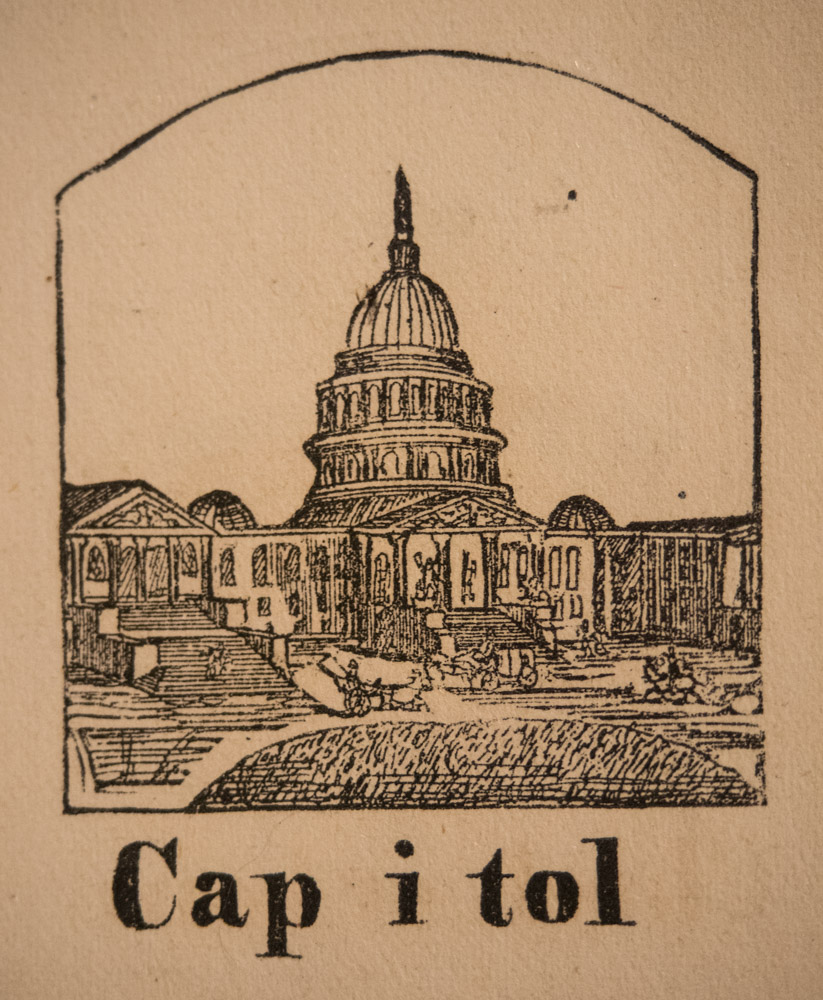
In Washington, D. C., Senator Henry Clay of Kentucky became the first person ever to lie in state in the Capitol rotunda.  A giant in his day, he had served in the House of Representatives, the Senate, and as Secretary of State. He was the man who had created the Whig Party and aspired to the presidency, who always spoke passionately for the Union and was willing to compromise to preserve it. As he himself noted in a speech in 1844, “It has been my invariable role to do all for the Union. If any man wants the key of my heart, let him take the key of the Union, and that is the key to my heart…”* He had dedicated his life to public service and the country thanked him.

The next such person to lie in state in the rotunda would be Abraham Lincoln.

Less august (but no less meaningful to Evelina) events transpired in North Easton today. Evelina, Almira Ames, Sarah Ames and Sarah Witherell “rode to make calls.” This activity marks the first time that Sarah Witherell had ventured out socially since the death of her son, George, six weeks earlier.

Old Oliver made note of the rain that had interrupted Evelina’s early morning work in the garden: “It raind a little last night + there was a little rain this forenoon it was a warm day + cloudy most of the time.”**

*Henry Clay, from 1844 speech, as quoted in “Henry Clay,” by Robert V. Rimini, New York, 1991

** Oliver Ames, Journal, Stonehill College Archives, Arnold Tofias Collection

June 30, 1852

Stage

Wednesday June 30th  Mr Ames left home this morning

for New York and Conn  Mrs James Mitchell

her mother & Grace came to father Ames & I

called into see them  Mrs Mitchell made 

quite a long call in here and at Olivers

Mrs Almira Ames came by the stage

to night from Conn she left New York

about four weeks since

Oakes Ames went to New York and Connecticut today on shovel business, as his father and wife each noted in their diaries. He wasn’t the only Ames on the road, either. Almira Ames, widow of cousin George Ames, arrived in North Easton from Connecticut and New York. Oakes probably went by “the cars,” as they called the railroad, while she definitely traveled in a stagecoach. Their separate modes of travel demonstrate the transformation that was taking place in transportation.

The railroad was moving in and would shortly become the dominant mode for long-distance transportation for the rest of the century and beyond. As Mrs. Penlimmon, a character developed by popular author Fanny Fern, opined only two years later:

‘The days of stage coaches have gone by.  Nothing passes for muster now but comets, locomotives and telegraph wires. Our forefathers and foremothers would have to hold the hair on their heads if they should wake up in 1854. They’d be as crazy as a cat in a shower-bath, at all our whizzing and rushing. Nice old snails!”*

How life was changing.

In more local traffic, Harriet Lavinia Angier Mitchell came to call with her mother and daughter on Old Oliver and Sarah Witherell in the other part of the house, on Evelina, and on Sarah Lothrop Ames next door. Mrs. Mitchell was a cousin of Old Oliver’s late wife, Susannah Angier Ames.

Fanny Fern, Fern Leaves from Fanny’s Port-Folio, ca. 1854, p. 50

June 28, 1852

Haymaking

1852

Monday June 28th  Have been about the house at

work most of the day  Swept most of the 

house except the parlour.  washed the

front stairs and have the house in pretty

good order  Mrs S Ames came in with her 

work and stoped an hour or two something

unusual for her  Hannah came to spend 

the evening but I had gone into Edwins and

she went in to see Mrs Witherell


Either Evelina felt better this morning, or her habit of working simply wouldn’t let her be idle. In the course of the morning, she swept most of the rooms and washed the stairs while her servant – Hannah Murphy, most likely- did the laundry and prepared the midday dinner. In the afternoon, Evelina at last sat down. Sarah Lothrop Ames came over – “something unusual for her” – and they visited and sewed together. Evelina was usually the one who went next door, not the other way around. In the evening, Evelina even felt well enough to go across the street to see Edwin and Augusta Gilmore.

The highlight of the day, however, had to be the commencement of haying. Old Oliver reported that “this was a fair warm day wind south west + verry dry We begun haying to day.”*  The calendar may have indicated that summer had barely begun, but everyone knew that fall and winter lay ahead. That hay would be essential. And now that haymaking had begun, perhaps Old Oliver would be less irritable with his family members.


Oliver Ames, Journal, Stonehill College Archives, Arnold Tofias Collection

June 23, 1852

1852 Stove Ad 002

Advertisement for cook stove, June 1852*


Wednesday June 23d  Work again weeding the garden

untill nine or ten and then about house

attending to the new stove that was put up

last night  Passed the afternoon at Mr

Howard Lothrops with Mrs Witherell, S Ames

& Helen.  Got 4lbs of butter of Mrs Harvey &

Eggs of Mrs Howard & Pratt


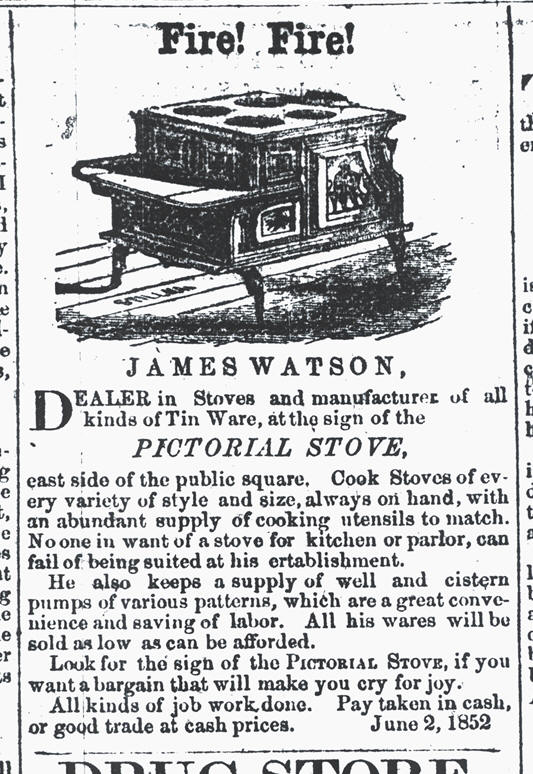
Evelina had a new, cast-iron stove, a high-tech appliance in the new, industrial age. Cast iron was “the wonder material of the 19th century and led to a prolific industry in making stoves for cooking as well as heating. Cast iron could take the repeated temperature swings of hot and cold, and it was an ideal medium for casting into complex, prefabricated parts, as well as for decorative surface ornament.”** Coal and iron mines were kept busy providing the raw material as middle-class households bought cook stoves for their transformed kitchens.

The new stoves had various brand names, naturally; one model was even named for everyone’s favorite opera star: the Jenny Lind Double Oven Stove. The dominant design for cookstoves was called “step-top,” which allowed two separate levels for cooking on. The choice of cooking surface facilitated the preparation of several dishes. Evelina could be confident that her kitchen was state-of-the-art, whatever her father-in-law had to say about it.

Evelina may even have talked about her new stove as she was out and about this afternoon, picking up butter and eggs, and visiting with her two sisters-in-law at the elder Lothrops’ home.


*Advertisement from Charleston, Illinois newspaper, 

** http://www.oldhouseonline.com/history-of-the-kitchen-stove

June 19, 1852

manx40rimwh


A “Visite”

Sat June 19th  Have been weeding in the garden and

transplanting   Spent the afternoon in 

Olivers with Mother  Mrs Witherell & Augusta

were there awhile  Finished Susans visite

quite late in the evening  It has not been

much of a job to make if I could have sat

down steady

Evelina worked in her garden today, weeding and moving some of her plants around. After midday dinner, she and her mother, who was visiting, “spent the afternoon” next door “in Olivers,” meaning at Sarah Lothrop Ames’s. In citing Oliver rather than Sarah as the owner of the house, Evelina was only following the norm of the time, whose patriarchal laws prevented women from owning property. Sarah and Evelina lived in homes that belonged solely to the males in the family.

Old Oliver, Ames patriarch above all the rest, reported that “this was a fair day wind southerly + quite warm we have bought two yoke of cattle this weeke one yoke of N Warrin of Stoughton, 6 years old for $110 and one yoke of Thomas Ames 9 or 10 years old for $100.” He was probably buying cattle to help with the approaching hay harvest.

Once indoors, perhaps even after others had gone to bed, Evelina finished a mantle for her daughter Susie. Also known as a visite or paletot or pardessus, a mantel (or mantilla, as Evelina labeled it the previous day) was a three-quarter length cloak with pagoda or cape-like sleeves. It was often adorned with lace, ruching, and especially fringe, which was very big about this time. Many visites were unlined, which no doubt simplified the process of making them. That may be why Evelina thought the garment had “not been much of a job.”


June 12, 1852

 3124164293_b3d771db50Lace bonnet

June 12th Sat  Jane has left and gone to Mr Savages

Mrs Patterson is here yet  Cousin Susan Orr

and Harriet Mitchell came to the other part

of the house this morning  I have spent the

afternoon there and Augusta stoped there awhile

Have finished my bonnet & lined & trimmed

Susans last summer bonnet

Jane McHanna, the Irish servant whom Evelina had fired the previous day, found immediate employment in the village at the home of William and Hannah Savage. Mr. Savage worked at the shovel factory; Mrs. Savage was a homemaker with a teenage daughter, Abby.  Mrs. Savage, unfortunately, was ailing, and needed help around the house.

That Jane found another position so quickly speaks not just to the circumstances of the Savage family, but also to her own capabilities.  She may have been more adept than Evelina had lately given her credit for, and others knew it. By 1855, Jane would be working for Oliver Ames Jr. and his wife Sarah Lothrop Ames, a couple with high standards. How would that play out for the two sisters-in-law?

But meanwhile, Evelina had Mrs. Patterson to depend on, and a whole afternoon in which to finish her – and Susan’s – latest bonnets.  She also got to sit and visit in the other part of the house with Sarah Witherell, where both were visited by Susan Orr, Harriett Mitchell and the young bride, Augusta Pool Gilmore.  Did Augusta share the information that she was now in her first trimester of pregnancy? Probably not, and impossible to know, but fun to imagine the conversation if she did.