January 6, 1852


OLYMPUS DIGITAL CAMERAOLYMPUS DIGITAL CAMERA

Augusta Pool                                       Lavinia Gilmore
                    

1852

Tues Jan 6 th

A heavy snow storm commenced about

10 Oclock  Mrs Witherell & her children have been

to the funeral in a waggon had a hard time getting

home.  Augusta and Lavinia have been at Edwins

house getting it in order for housekeeping.  This

evening have helped me stone raisons for cake  Edwin

came with them to tea

The bad weather continued, bringing snow that Sarah Witherell and her children, George and Emily, had to fight their way through as they returned from a funeral in a wagon. As Sarah Witherell’s father, Old Oliver, noted, it “snowd all day and in the evening. it was a damp snow and fell level.

Evelina was safe inside, out of the weather. With her were her 19-year-old niece, Lavinia Gilmore, and Augusta Pool, a 22-year-old who was about to marry Lavinia’s brother, Edwin. The two young women had been at Edwin’s house for much of the day, “getting it in order.” How exciting, and perhaps a little scary, for Augusta to be getting married and moving into a new house in the village of North Easton.  She had always lived out in the country, not far from the Gilmore farm, which is how she got to know Edwin.  In fact, Augusta’s older brother, John Pool, was married to Rachael Gilmore, Lavinia and Edwin’s older sister. They would be double-siblings-in-law. (There must be a more official word for the relationship when a brother and sister from one family marry a sister and brother, respectively, from another family.)

When they finished today’s work at Augusta’s new home, the two girls walked over to Evelina’s to help her stone raisins for the wedding cake.  Evelina may have put the raisins in a little warm water to plump them up before popping the seeds out.  Edwin, groom-to-be, joined the women and the rest of the family for tea once the men all arrived home from work.

 

* Photographs courtesy of The Easton Historical Society, with thanks to Frank Mennino, curator


January 2, 1852

Tea


1852

Jan 2d Friday  Seated myself quite early this morning to work

on Susans hood & finished item about ten Oclock

then ripped my old blue hood and washed the

lining & turned the outside have got it nearly done

We all went into the other part of the house to tea

Mr & Mrs Oliver & Helen there  Frank has a sore

ankle as [sic] does not go to the shop  Dr Swan called there

to see Helen & left Jane some medicine

The family gathered for tea today in “the other part of the house,” meaning that Evelina, Oakes, and their children, Oakes Angier, Frank and Susan went into the southern half of the shared house where Old Oliver and his widowed daughter, Sarah Witherell, lived with her two children, George and Emily. Joining them was the family next door: Oliver Ames, Jr, his wife Sarah and their daughter, Helen Angier Ames, who made an appearance despite being home from school with a cold. Other than missing Oliver (3) and Frederick Lothrop, the sons who were off at college, the group was a normal configuration for a gathering at the homestead.

Evelina’s grandson, Winthrop Ames, would one day describe such a family gathering from less than a decade later, by which time daughters-in-law and grandchildren had arrived:

“Supper, always called Tea, at seven, was the sociable occasion. It usually consisted of cold meats, hot biscuits, preserves and cakes – an easy menu to expand for unexpected guests.  Every week at least, and usually oftener, one household would invite the others and their visitors to tea; and the whole Ames family might assemble, even infant children being brought along and tucked into bed upstairs.  Fifteen or twenty was not at all an unusual gathering.”*

The family was as tightly-knit as any of Evelina’s knitted worsted hoods.

One other note about today’s entry: Dr. Swan left some medicine off for Jane McHanna, the servant, who had been ailing for much of the fall and winter. What did she suffer from?

* Winthrop Ames, The Ames Family of Easton, Massachusetts, privately printed, 1937, p.128


December 31, 1851

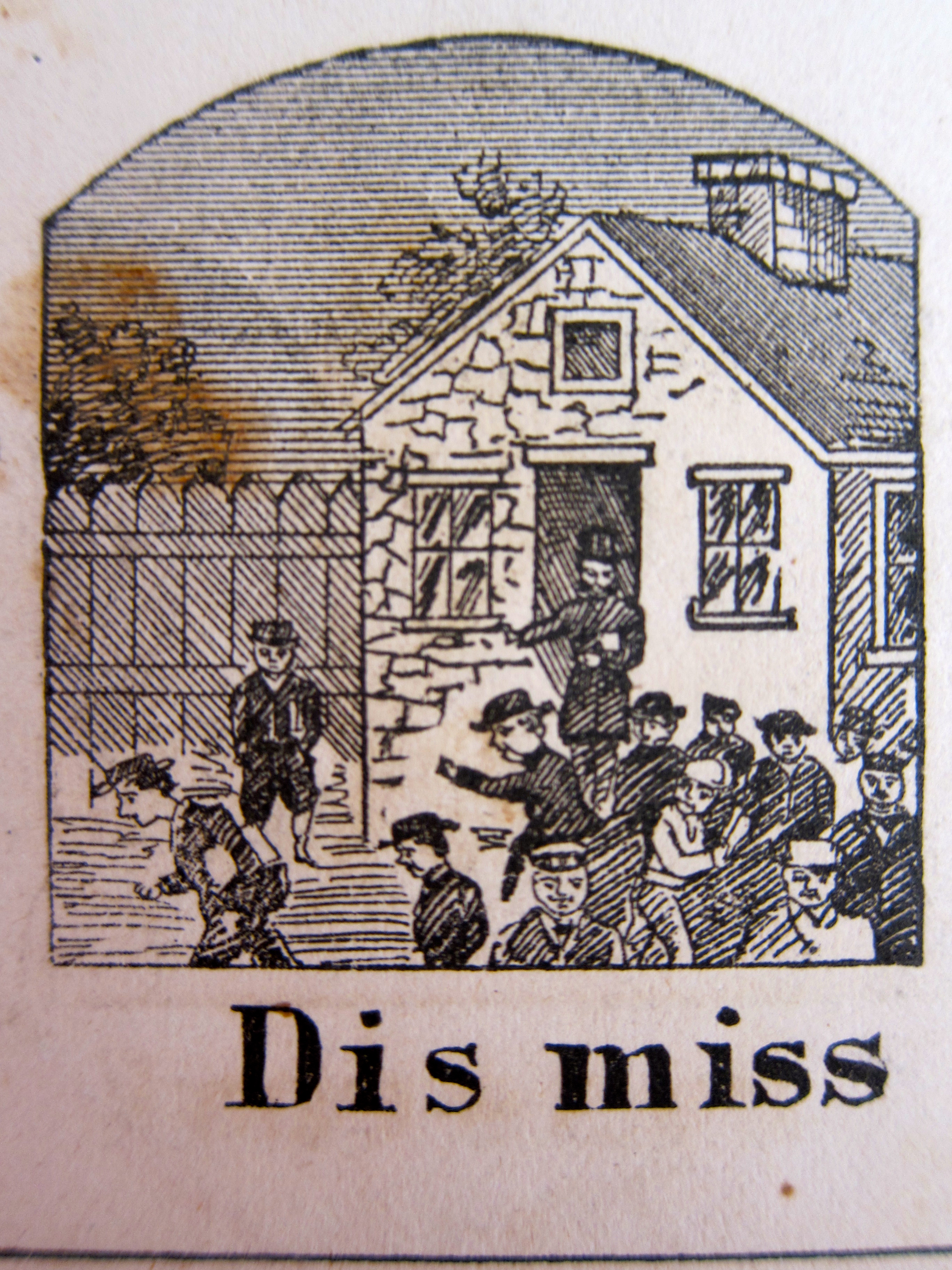
Dismiss


Wednesday Dec 31st  This morning sit down early to knitting

my hood  Have it all finished ready for the lining.  About ten 

Oclock went into the school with Mrs. Witherell.  Mr Brown

has closed his school to day.  Passed the afternoon & evening at Olivers

Mr & Mrs Wm Reed  Mr & Mrs J Howard, Whitwell & A Gilmore were there.

Susie Ames and Emily Witherell may have been happy today to reach the end of their school term. Class, dismissed!  1851, dismissed!

Just how the Ames family celebrated the departure of the old year and arrival of the new, we don’t know. Old Oliver, with his usual terse assessment of the day, merely noted that “this was a cloudy day and some cooler + misty + foggy.” The cool mist he saw would develop into a huge rain storm over night, preventing folks from moving around much.

A group of friends and relatives gathered for tea next door at the home of Oliver Ames, Jr. and his wife Sarah Lothrop Ames. Besides Evelina and Oakes, at the party were Reverend William Whitwell and his wife Eliza, Reverend William Reed and his wife Abigail, Jason Guild Howard and his wife Martha, and Evelina’s brother Alson Gilmore and his wife Henrietta.  In just a few more years, a group like this might have sung the beloved  Auld Lang Syne to mark the occasion. In fact, a version of Auld Lang Syne, written in 1855 and called Song of the Old Folks would become “the tradition of the Stoughton Musical Society to sing […] in memory of those who had died that year.”*

Out with old, in with the new. What a year it would be for the Ames clan.

http://www.americanmusicpreservation.com/SongoftheOldFolks.htm

December 24, 1851

new-england-for-web

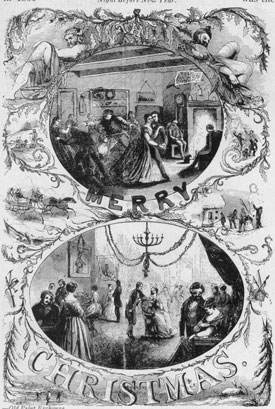
Christmas illustration from Godey’s Lady’s Book, December 1851

Wednesday Dec 24th  This morning gave the sitting room stairs

bedroom &c a thorough sweeping and was about the 

house at work a greater part of the forenoon

knit on my hood when I seated myself at work

read some in Ladys Book which I have

commenced taking for another year.  Emily brung

me a linen collar that her mother made for a

Christmas present


Emily Witherell delivered a Christmas gift from her mother, Sarah Witherell, to her Aunt Evelina, a gesture that may have caught Evelina off guard.  In practice, the Ameses had not been in the habit of observing Christmas, finding this religious celebration too festive for their Puritan-derived tastes. Yet times were changing and, in future years, Evelina would become both a recipient and giver of Christmas presents.

Evelina’s transition from being suspicious of Christmas to celebrating it was stimulated by various factors, not the least of which was its promotion in her favorite magazine, Godey’s Lady’s Book, the same magazine whose subscription Evelina renewed today. The periodical recognized and encouraged the holiday’s appeal to its well-heeled readers, many of whom would have read Charles Dickens’ A Christmas Carol, published less than a decade earlier. Unlike Unitarian (and one-time Congregationalist) Evelina, a growing number of Godey’s readers were less hide-bound to a doctrine devoid of celebration. The influx of Irish Catholics, who did honor the holiday, influenced some of this change, too.

While many in the nation made preparations for Christmas, a terrible fire at the Library of Congress in Washington, D. C., resulted in the destruction of nearly two-thirds of their holdings. Included in the loss was most of Thomas Jefferson’s original library.**

**http://www.accessible-archives.com/2013.01/the-other-fire


November 26, 1851

Rolling pin

Wedns Nov 26th  Have heat the brick oven three times

to day  Made Squash mince & apple pies

fruit & plain cake & seed cakes  did not

get the last oven in untill about four Oclock

Jane has assisted some about the work  Dr Swan

came to see her says she must exercise but

must not work hard  Oliver came home in the stage

The kitchen was humming today. Evelina baked pies and cakes to feed her family, now back at the full complement of six at table, as Oliver (3) arrived home from college for the holiday. She baked pies and maybe some side dishes to take to the other part of the house, where they would have Thanksgiving dinner the next day with Old Oliver, Sarah Witherell, and Sarah’s children, George and Emily. Jane McHanna “assisted some,” but was still sick enough to have a visit from the doctor – this time, the Ames’s personal physician, Caleb Swan.

In 1851, Thanksgiving was not yet a national holiday. That would happen in 1863, after lobbying by the indefatigable Sarah Josepha Hale convinced Abraham Lincoln to make an institution of a feast that was already celebrated in many – but not all – states. Although the country was suffering from the shock and carnage of a civil war, Lincoln saw good in the idea of a day of gratitude for “fruitful fields and healthful skies”** and, by Executive Order, proclaimed the last Thursday in November as a national Day of Thanksgiving, in perpetuity.

The tradition of Thanksgiving evolved from the Puritan practice of holding days of thanksgiving or fasting, according to immediate need. The Puritans were inclined to see God’s influence in every part of their daily lives. When they were good, God would reward them. When they were bad, He would punish them. Depending on how things were going, their ministers were either making sure to thank God or beg for help. In the 17th century, a local congregation could call for a day of thanksgiving or a day of fasting on its own. As time went on, the practice became more formal and by the 19th century, governors, at least in New England, would call for a day of fasting in the spring (before the planting) and a day of thanksgiving in the autumn (after the harvest). In 1851, this was still how it was done.

Toward the end of the 19th century, as immigration began to influence and de-homogenize American culture, some of the old guard became concerned. Like many an established group, its members wanted to preserve their culture and honor traditions such as Thanksgiving.  The fourth Thursday in November became more than just a feast of gratitude with family members. It became a post-Civil War symbol of America’s beginning, an annual celebration that would help new immigrants understand how the country was first settled by white Europeans. Teaching about the holiday in schools became a priority and thus, for more than a century, an account of a first Thanksgiving feast between the Pilgrims and the Indians has become an indelible, if occasionally controversial, feature of American history.

For Evelina and her family, Thanksgiving was the most important holiday of the year. They would celebrate it with Yankee gusto, which generally meant a gathering of family and a fine feast followed by a game of cards for the old folks and perhaps a dance for the young people.

* A wealth of information about Thanksgiving can be found in “Thanksgiving: A Biography” by James W. Baker, New Hampshire, 2009. 

** Abraham Lincoln, A Proclamation, October 3, 1863

September 18, 1851

1851_Fillmore_Boston_MA_USA_GleasonsPictorial

*

Thurs Sept 18  Went to Boston with Oliver & wife

& Helen to the railroad celebration.  In company

with Mr Orrs family went to see the regatta & about

nine Returned and dined at Mr Orrs with Mrs

Witherell Emily Mrs S Ames & Helen  Mrs Stevens

&c  Afternoon went out shopping with them  All

except Mrs Witherell spent the night at Mr Orrs

Evelina traveled to Boston today to join the crowds at the Great Railroad and Steamship Jubilee.  President Fillmore, Senator Daniel Webster and dignitaries from Canada as well as the United States had arrived the day before. Speeches were made and congratulations went all around for the new “railroad communication” between the two countries. On this, the second day of the festivities, races were held, one a “grand excursion in Boston Harbor” in which cutters from both countries raced; Canada won.

The Ameses attended a regatta out at Hull, near Point Alderton (better known today as Point Allerton.) It must have been interesting for the usually land-locked Evelina to be at the shore; she rarely got to see the ocean, as her trips to Boston were typically spent in the retail center of the city.It was to that retail center that she and other ladies in her party went in the afternoon. Time to shop.

Also on this date, some 200 miles southwest of this railroad jubilee, in another thriving retail and business center, a new newspaper was born. The New York Times was founded and sold for 2cents a paper.


Reception of President Fillmore at the Boston and Roxbury lines by the municipal authorities, 1851

July 10, 1851

IMG_1031

July 10th  Baked in the brick oven this morning

Cassander Gilmore engaged to come here to

day but did not  Mrs Horatio Ames Mrs Witherell

Mitchell and their children father Gustavus &c &c

were here to tea.  Had strawberries from 

Mr King, his last picking.  This afternoon

finished my dress  Alson called

Evelina was quite busy today.  She baked, probably making the usual bread, ginger snaps and a pantry’s worth of pies. Although she doesn’t specify what kind, this was the time of year for rhubarb and her pies may have been made of the very fruit she grew in her back yard. She culled through the last of the available local strawberries, too; there would be no more this season.

Much of this kitchen work was preparation for afternoon tea, which was served to a raft of Ames relatives.  Sally Hewes Ames, Horatio’s wife, was there with her son, Gustavus, along with the Witherells and Father Ames from the other part of the house.  Sister-in-law Harriett Ames Mitchell and her three children were there.  Where was Harriett’s husband, Asa Mitchell? Presumably Oakes, Susie and her three older brothers were at table, too.

When she did get out of the cook room, Evelina finally finished sewing her new dress, and had a visit from her brother, Alson Gilmore.

June 24, 1851

photo

*

June 24th  Tuesday  Emily is very much better this morning and

is quite rational  I was at work in the garden

awhile weeding and transplanting and then I

went to sewing on the hair cloth again.  Mother

is knitting a pair of coloured stockings for Susan

of yarn I bought at the factory yesterday

Mrs Sarah Ames stoped awhile here  I get along

very slowly with my work  Spent the afternoon picking hair

Everyone exhaled with relief today as young Emily Witherell recovered from her congestion of the brain. What exactly had been wrong with her? Had she fallen or spiked a fever or had an allergic reaction to something?

Evelina went back to her summer routine of morning work in the garden, midday dinner for the whole family, and sewing in the afternoon. The horse hair upholstery for the new lounge was taking a long time to make. She may have been skilled with a needle, but this project was proving difficult.  She had the company of her mother, however, who was visiting them in North Easton this week.

The elderly Hannah Gilmore was knitting some stockings for her granddaughter, Susie.  She was using yarn that Evelina most likely bought at the Morse factory shown in the photograph. Located in South Easton and owned at the time by E. J. W. Morse, the business produced high quality thread and yarn.

* Photo borrowed from Edmund C. Hands, Easton’s Neighborhoods, 1995, p. 28

June 23, 1851

Chaise

1851

Monday 23  Emily is no better.  The Dr calls her

disease congestion of the brain  About ten Oclock she

was in great distress & I sent for the Doctor.  He was

just stepping into his chaise to go to Taunton

He came up immediately  found her asleep and easier.

Mrs James Mitchell & Miss Sarah Mitchell from

Freeport came to spend the day.  they passed the 

afternoon in Olivers.


Twelve year old Emily Witherell, only daughter of widowed Sarah Witherell, had been taken suddenly and seriously ill. Her symptoms seemed to worsen this morning, so much so that Evelina sent someone for the doctor, perhaps Dr. Samuel Deans who had stopped in yesterday. He or Dr. Caleb Swan, the two doctors who usually tended to the Ames family, diagnosed the illness as “congestion of the brain.”

Congestion of the brain was, by some modern accounts, a 19th century catch-all phrase for any number of illnesses that caused swelling of the brain. Known in the medical world as encephalaemia, it could be caused by a head injury or an infection.  Symptoms would include headache, fever and confusion.  Emily certainly seemed to be confused.

Why did Evelina send for the doctor, and not Sarah Witherell herself? Who went for the doctor on a Monday morning, when everyone was at work? Perhaps Michael Burns, who worked for Old Oliver? Good that the doctor was caught before he had left in his chaise for Taunton, and even better that he found Emily marginally better.

June 22, 1851


strawberry

1851

Sunday 22nd June  Have been to meeting to day Heard two

very good sermons from Mr Whitwell  Mother came

home with us to spend a few days.  Since meeting

mother Mr Ames & myself rode to the ponds and to 

Mr Manlys garden  Mother was delighted with her ride

seemed to enjoy it as much as a child  When we

returned we found Emily sick  She is very much

out of her head  Dr Deans called but did not come in

Went to Mr Horace Pools at noon for strawberries


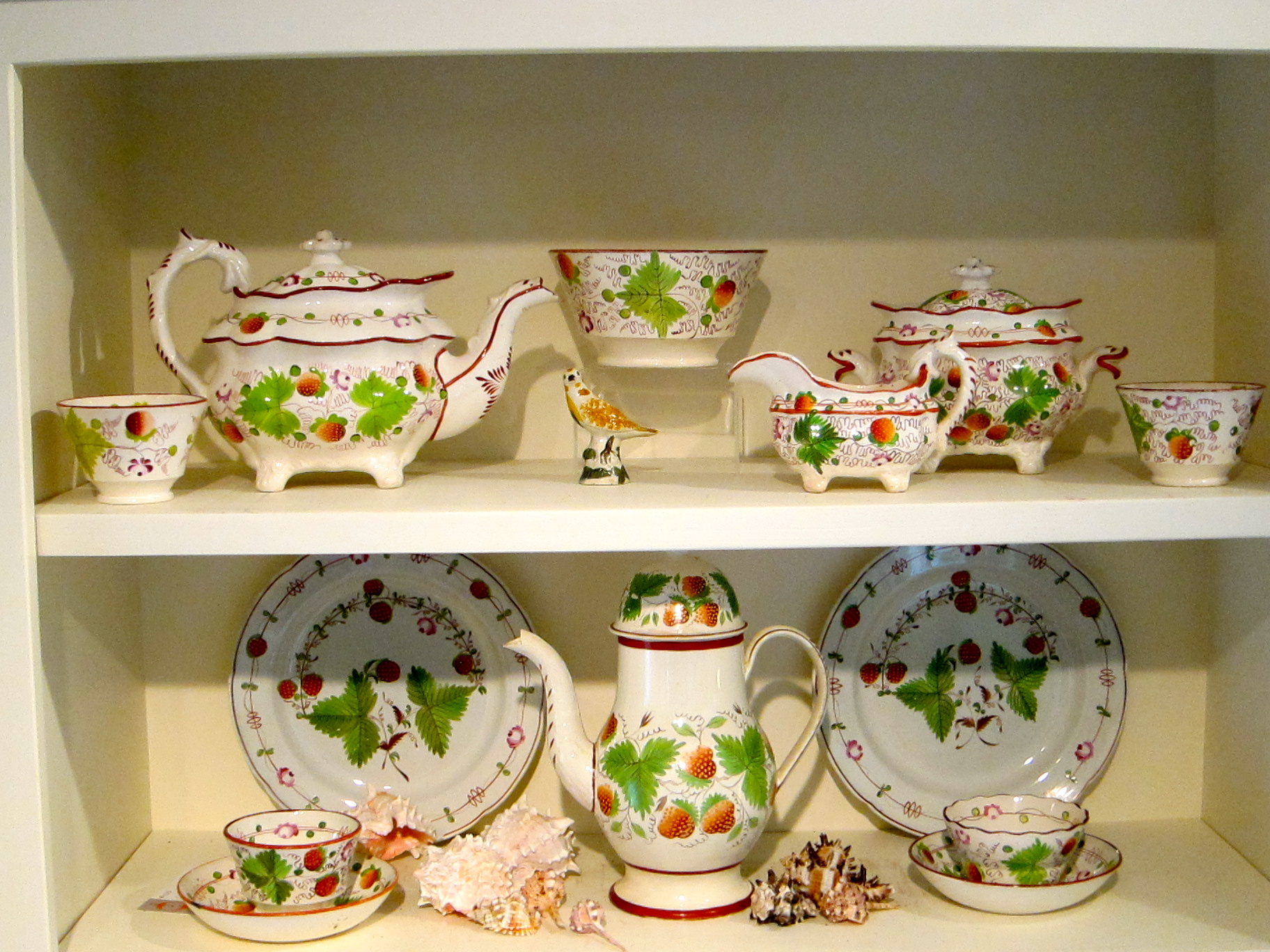
“Doubtless, God could have made a better berry, but doubtless God never did,” was a well-known remark about strawberries made in the 17th century by William Butler. Unlike today, when modern agriculture has developed a system that brings us strawberries any time of year, in 1851, the fruit was still strictly seasonal and short-lived. Strawberry season was much looked forward to.

Horace and Abby Pool evidently had a good strawberry patch at their home in south Easton, to which they invited a few fellow parishioners during the intermission at church.  Had the strawberries already been picked, or did folks wander through a strawberry patch in their Sunday finest, a la Emma Woodhouse at Donwell Abbey? Was the fruit served with cream and sugar, or taken home to be eaten later?

The fine day continued after church when Oakes and Evelina took old Mrs. Gilmore for a ride north to see the ponds and visit Edwin Manley’s garden. On a less delightful note, Sarah Witherell’s daughter, Emily Witherell, suddenly took sick. “Out of her head,” Evelina described her, suggesting perhaps that Emily had a high fever. The doctor was called.