November 13, 1851

Drum


Thursday Nov 13th  Have been cleaning the draws in

the beaureaus and have papered the closet beside

the fire place and painted some boxes &c

Ellen Meader […] has been making Susan a visit

this afternoon  The Stoughton band have been

in the neighborhood this evening. They marched 

and played up as far as the house and back to the

school house.  Went to Mr Swains and had coffee &c &c

Mr Ames has been to Boston

Stoughton, Massachusetts, has a wonderful musical legacy, most famously the Old Stoughton Musical Society, a choral group that has been active since 1786. Known in its first hundred-twenty years simply as the Stoughton Musical Society, some of its members referred to it as the “Grand Club”*. When it celebrated its centennial in 1886, Lt. Governor Oliver Ames and Governor George D. Robinson were two notable attendees at a celebratory concert. Oliver (3) was very fond of music; he even took singing lessons in his youth. He must have enjoyed the musical evening.

The long and revered history of the Old Stoughton Musical Society sheds no light on the existence of a Stoughton marching band, however. Evelina’s entry may be the only known mention – at least to date – of such a band.  On this day in 1851 it marched and played instruments through the village of North Easton, presumably after the factory had closed for the day. Why did it stop at the Ames’s house? What was the occasion? Surely the music it played was a welcome change from the usual clanging and hammering that emanated from the shovel shop.

Other than this pleasant interlude, Evelina’s day was ordinary.  While her daughter Susie had a friend over, Evelina cleaned, papered and painted.  Later in the day – perhaps as she accompanied little Ellen Meader home – she had “coffee &c &c” at the home of Ann and John H. Swain.  Oakes Ames spent the day in Boston.


Mary Swan Jones, The One Hundredth Anniversary Celebration, 1886


November 12, 1851

IcePond-732701

*

Wedns Nov 12th  Painted the closets in the sitting

room chamber which with other things has taken

me most of the day.  Susan has passed the 

afternoon at Mr Swains  Mr Whitwell called

this afternoon. I felt very sorry to stop my work as

I was very much engaged at the time  Have not

sewed at all to day  This evening have felt too much

fatigued


According to Old Oliver, “this was a fair cold day wind north west. the factory pond was frozen over this morning”  It was a good day to stay indoors, which Evelina did.  She still hadn’t completed all the refurbishments on the house, so she spent the day painting the shelves in the closet in the sitting room; the shelves in the parlor were already finished.  By evening, she was “too fatigued” even to sew.

Daughter Susie spent the day at the home of Ann and John Swain, perhaps playing with Ann’s niece, Ellen Meader.  Reverend William Whitwell braved the north west wind and paid a call on Evelina.  Much as she liked him and admired his Sunday sermons, she was less than pleased to set aside her painting for his visit.

And “the factory pond” – probably Shovel Shop Pond – had skim ice, at least, all the way across it.  What did that do to shovel production?  How did the dams, flumes, and wheels work when the water began to ice up?


*Photo courtesy of Kenneth Aisawa, http://www.theboundsofcognition.blogspot.com

November 11, 1851

Helen Angier Ames

Helen Angier Ames


Tues Nov 11th  Jane and Bridget washed this morning and I have

cleaned the front chamber closet and put things in

order in the chamber and worked about house untill about

four and went to tea in Olivers  Mr & Mrs Swain and 

Mrs Meader (Mrs Swains brothers wife) were there

Father & Sarah and her children dined there  They

had ducks for dinner

Post-election political discussions were no doubt rebounding in print news across the nation but in North Easton, Massachusetts, at the Ames compound, domestic concerns held sway. There was washing, cleaning and tidying up to be done. Laundry day had been postponed from its usual Monday slot; perhaps Evelina had waited for Jane McHanna to return from Mansfield. Evelina didn’t like doing laundry at all.

Today was Helen Angier Ames’s fifteenth birthday.  The only daughter of Sarah Lothrop Ames and Oliver Ames, Jr., she was at school in Boston, so not able to celebrate at home. Neither was her brother Fred at table, for he was at Harvard.  Perhaps the roast duck that Sarah and Oliver served to their dinner guests was in Helen’s honor, in absentia.

Helen Ames never married, choosing instead – or learning to accept – spinsterhood in North Easton and Boston.  She had a small social life with friends and family and when the railroads became more established, she traveled with her parents and cousins to places like Niagara Falls, Detroit, and points west. She played piano very well, occasionally playing the reed organ at the Unitarian church, where she was “acknowledged to be the best performer.”** Her uncle, Cyrus Lothrop, named one of his sailing vessels after her: the Schooner Helen A. Ames.

As a teenager, Helen enjoyed the company of Evelina’s niece, Lavinia Gilmore, another young woman from Easton who would never marry. Helen also was in school with a friend from Bridgewater named Catherine Hobart, the youngest daughter of a family well known to the Ameses.  Catherine, or Cate, would one day become her cousin Oakes Angier’s wife.

Helen’s father died in 1877, her mother not until 1894.  In 1882, at the age of 46, she herself “died suddenly in the prime of a life of thoughtful and generous service, deeply honored, loved, and lamented.”* Her brother, Fred, commissioned John LaFarge to create a stained-glass window, the Angel of Help, for Unity Church in memory of a sister he had loved.


*William L. Chaffin, History of Easton, Massachusetts, 1886, pp. 411-412

**Winthrop Ames, The Ames Family of Easton, Massachusetts, privately printed, 1937, p. 130


November 5, 1851

Thread

Wednesday Nov 5th  This forenoon I painted the water pails and 

several kegs or butter firkins  Looked over my sheets

and put them in order.  Afternoon went to the sewing 

circle at Mr Horace Pools our last meeting for the 

season  Mrs Elijah Howard had the bag and we

had no work  We were invited to Mr Sheldons Mrs

Hubbell Ames & Witherell went  Father has

changed Dominic for another horse of Nelson Howard

Evelina demonstrated her range of housekeeping skills today.  She put fresh paint on wooden pails, kegs and firkins for her pantry, cellar and shed, and organized her linen closet.  Her house was in order for the coming winter.

The last Sewing Circle of the year met this afternoon at Abby and Horace Pool’s house.  As always, the Unitarian ladies gathered in fellowship to sew and have tea, probably in the company of Rev. William Whitwell.  Today, however, they had no shared sewing to do, as Nancy Howard, whose turn it was to bring “the bag” of work, failed to deliver it.  No matter; the women seemed to cope.  Some went on to visit Luther Sheldon and, presumably, his wife Sarah.

The Reverend Luther Sheldon was the minister of the local Orthodox Congregational Church. A conservative and devout man in his mid-sixties, Sheldon had been involved two decades earlier in a controversial schism within Easton’s Congregational Church that resulted in the splitting off of a new congregation of Unitarians – including the Ameses.  Old Oliver and his sons had taken a leading role in encouraging Unitarianism, and made some enemies in the process.  Rev. William Chaffin, who came to town many years later, included an extensive examination of the controversy in his 1866 town history.

What did Old Oliver think of his daughter, Sarah Witherell, and their houseguests paying a call on the Sheldons? Or did he pay any attention at all to their socializing?  He may have been too busy horse-trading.


October 31, 1851

apple_barrel

*

Friday 31st  Have taken up the bedroom and stair carpets

and Bridget has cleaned the front entry

I have been very busy all day about the house

Mrs Hubbell, Ames, and Mrs S Ames have been

to Sharon  Mrs Witherell called at Mrs Swains

this afternoon but I was so busy that I could 

not accompany her.  Passed the evening in

the other part of the house.  Mr Scott painting

Mr Hawkins lectured at the methodist meeting house


Evelina’s autumn version of spring cleaning continued today as she tackled the upstairs carpets. Mr. Scott was still in the house, painting, and servant Bridget O’Neill cleaned the front entry which had also undergone repainting. “Very busy all day about the house,” Evelina evidently didn’t even venture out of doors.

Others did go outside. Sarah Ames Witherell paid a call on new mother Ann Swain, while Sarah Ames, Almira Ames and Mrs. Hubbel rode to nearby Sharon. Old Oliver noted in his journal that “this was a fair day + some cooler wind north west +considerable of it.”

Some miles northward, in Concord, Henry David Thoreau noted in his journal that “The wild apples are now getting palatable. I find a few left on distant trees, that the farmer thinks it not worth his while to gather. He thinks that he has better in his barrels, but he is mistaken, unless he has a walker’s appetite and imagination, neither of which can he have.”**  Two farmers in Evelina’s life, her father-in-law, Old Oliver, and her brother, Alson Gilmore, might take exception to Thoreau’s characterization of them as men without imagination.

In the evening, a Mr. Hawkins gave a lecture at the Methodist meeting house, right in the village.

* Barrel of apples, http://nbarnett2.wordpress.com/2010/02/15/the-importance-of-good-packing/

**Henry David Thoreau, Journal, http://hdt.typepad.com/henrys_blog/2004/10/october_31_1851.ht

October 30, 1851

Closet

1851

Thursday Oct 30th  Mr Scott finished papering the 

parlour this morning and has painted some drawers

to be grained, and has drawn some of the windows

in the parlour  I have been doing a little of every

thing but cannot tell what.  Have got the carpet

down in the sitting room and the dishes into the

closet and we begin to look more comfortable


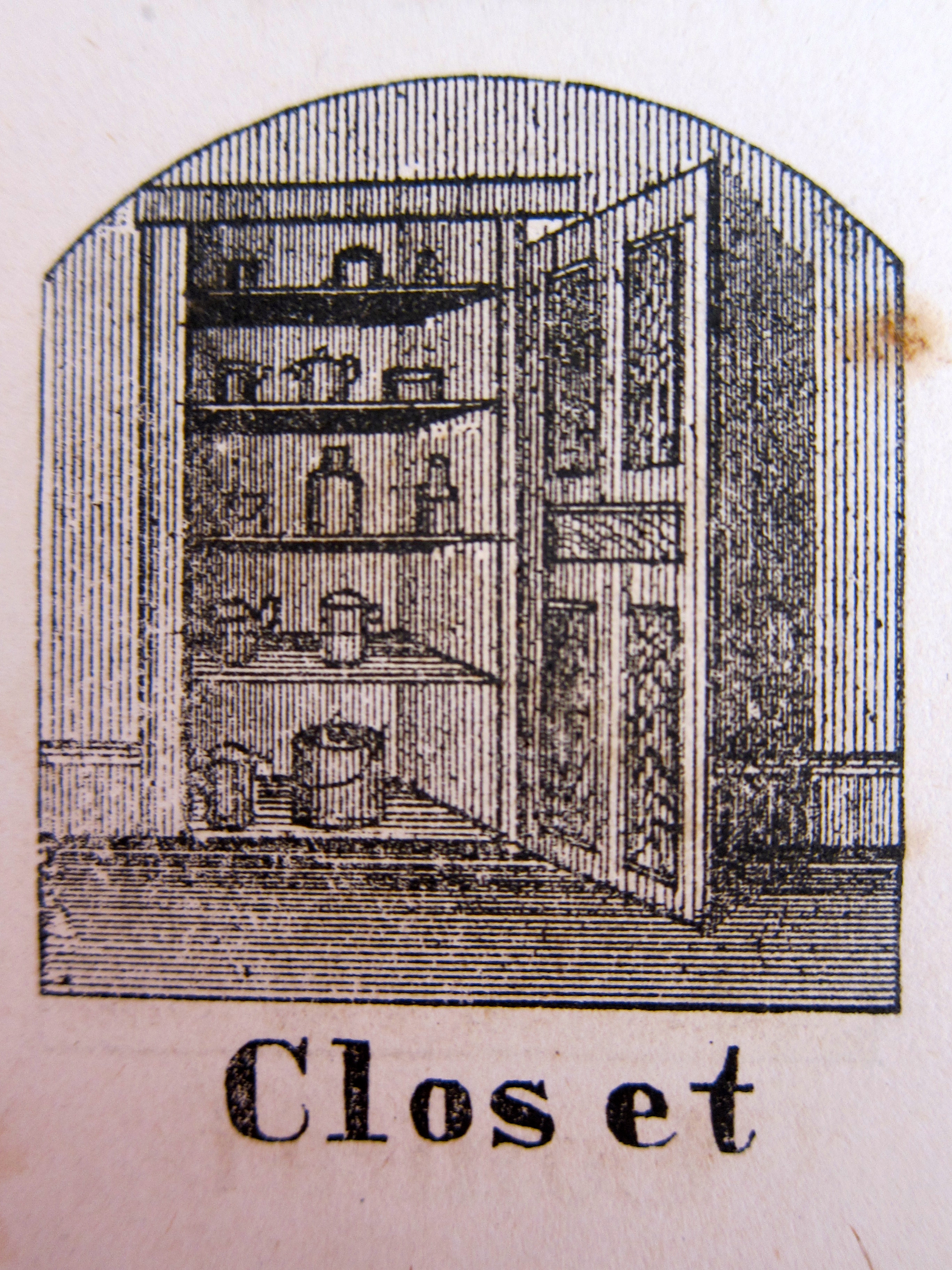
The redecorating of the downstairs began to wind down and the house became “more comfortable.” Getting the sitting room back in order was a big deal, for that was Evelina’s main domain for her daily sewing. It was her office, so to speak, more so than the kitchen.  She surely had missed her sewing routine while the house was disordered.

Putting the dishes back into the sitting room closet was also an accomplishment.  Jane Nylander, modern historian of 19th century domestic life, has written of the role of that closet:

“In most substantial households, parlors, sitting rooms, and dining rooms were furnished with a closet in which were stored cups and saucers, decanters of wines, glassware, and loaves of rich fruitcake, which was prized for its lasting quality as well as its flavor.  The shelves of these closets were grooved so that the small serving plates called ‘twifflers’ could be stood against the back wall and make a handsome show when the door was opened. ”  Twifflers – great name! – were about 9 1/2″ in diameter.

While Evelina set her house to rights, her father-in-law was busy about the factory. “began to work on the Flyaway Dam to day I went to Bridgewater + caried Clark + Keith to help Mr Phillips about fixing th bellows”** What had happened to the bellows? They were key to the manufacturing process.


*Jane Nylander, Our Own Snug Fireside, New York, 1993,  pp. 236 – 237.

**Oliver Ames Journal, Courtesy of Stonehill College Archives


October 27, 1851

winter_snowfall-t2

Monday Oct 27th  Mr Scott came this morning about nine

It being very stormy he could not get here before

Mr Smiley came just before and worked about

three hours.  After dinner went to Mansfield.

I have been helping Mr Scott paper the sitting

room  Have been busy all day about the 

papering.  Mr Ames went to Boston this afternoon

was also gone Thurs & Friday of last week


Snow! At least that’s what Old Oliver reported in his journal: “this morning the ground was coverd with snow and it snowd about all the forenoon, and was cold. wind north west + blowd hard, at night the fields are coverd with snow 2 or 3 inches deep – there has bin 1 ¼ inches of rain this time”  Evelina only reported that the weather was “stormy.”

Not only did the weather interfere with the travel of the workmen; it also surely challenged servant Jane McHanna as she attempted to wash and dry the weekly laundry. Yet it didn’t seem to prevent Oakes Ames from heading to Boston in the afternoon.  He had been there often of late.  Indoors, Mr. Scott continued to put up new wallpaper in the downstairs.  The redecorating and attendant removal of much of the furniture had been going for a week.

It was the 300th day of the year.

October 26, 1851

1421516038_22078acff3

*

Sunday Oct 26.  John Ames from Springfield is here at

fathers came last night.  We have all been

to meeting  Mr Whitwell preached two

excellent sermons.  Went at intermission

into Mr John R Howards with Mother and several

others  The first time I have called since

they moved.  It has rained since eleven this

morning, quite hard.

For the first time since September 21, Evelina attended church; even the “hard” rain couldn’t keep her away. She surely was pleased to be back in the family pew, head tilted up to listen to Reverend Whitwell’s “excellent” sermons, happy to visit with friends and acquaintances at intermission. The opportunity to congregate at church was central to Evelina’s social life, and she was quick to catch up.  Her visit at intermission with John and Caroline Howard was her first visit to their new home.

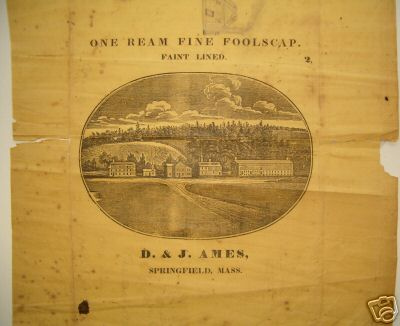
A cousin from Springfield, John Ames, was visiting in the other part of the house. There were several relatives named John Ames with close ties to Old Oliver, including his father and a brother. This John Ames was, most likely, a nephew of Old Oliver, the son of Old Oliver’s much older brother David. His dates were 1800-1890. He was famous for certain inventions pertaining to the manufacture of paper and with a brother, also named David, ran the Ames Paper Company in Springfield. According to one 20th century historian, “[f]rom the outset the firm, which became known as D. and J. Ames, prospered wonderfully, making money rapidly and growing until it was one of the largest and most powerful in the country.”**

A life-long bachelor, John Ames lived with a sister, Mary, and the two managed the family farm well into their old age. Oliver Jr. writes of visiting them in Springfield in 1871. The families stayed in touch.Yet Old Oliver made no mention of his nephew’s visit.  Instead, in his journal, he noted only that “it was cloudy all day to day + raind some in the day time + in the evening + night ther was considerable.” He was more interested in the rain which, given the fact that rain meant more water and more water meant more power for the factory, was perhaps understandable.

Image courtesy Benjamin L. Clark, Massachusetts Book Trade

**Lyman Horace Weeks, The History of Paper-manufacturing in the United States, 1690-1916, New York, 1916, p. 125

October 19, 1851

OLYMPUS DIGITAL CAMERA

Sunday Oct 19  Last night was very stormy, rained very fast

and heavy wind.  This evening is very pleasant

but it has rained all day so that none of the 

family went to meeting  Alson came after Lavinia

about three Oclock  I have been reading most

all day “Olive”  It is rather interesting but wish 

I had spent the day more profitably

Evelina’s father-in-law, Old Oliver Ames, also recorded the day’s bad weather in his daily journal: “it began to rain last night + this morning there is a north eas[t] storm + the wind blows verry hard. it stormed nearly all day but was clear at night – there was an inch + a half of water fell”

According to the weather record for 1851 – the first year that Atlantic hurricanes were officially tracked – the storm that Evelina and Old Oliver describe was Tropical Storm #6. It made landfall in Rhode Island, thus its impact on nearby North Easton would have been severe. Despite the rain and wind, the buildings in the Ames complex appear to have come through fine. Old Oliver would have mentioned it otherwise.

For the fourth week in a row, Evelina missed church. One Sunday, there had been no service; on two other Sundays, she had been ill and today, weather prevented attendance. She was probably missing her weekly dose of religious direction from Reverend Whitwell and social interaction with her fellow Unitarians.  She occupied herself by reading “Olive,” which was most likely a domestic novel in the genre that she often read.  It would have been the kind of book that Old Oliver called “love trash.”

October 17, 1851

OLYMPUS DIGITAL CAMERA

Friday Oct 17 Was working about house most of the

forenoon and have been sewing on Susans

and my dress.  Carried my work to Augustus

for a couple of hours this afternoon.  Lavinia

and Abby were there  Mr Ames has been quite 

unwell for a day or two and to night has taken

a warm bath  I have written a letter to Oliver

this evening  Mr Ames sent him a check for 25 Dls.


Oakes Ames had taken ill. Had he caught the nettlerash from his wife and daughter? Or was his illness something closer to a simple bad cold? He was “quite unwell.” Whatever he had, Oakes chose to palliate his ailment with a hot bath. Did he take a sitz bath, one that would alleviate itching from a rash?

That Evelina makes note of her husband taking a bath insinuates that his bathing was something out of the ordinary, which wouldn’t be unusual for the era. Regular bathing, which for many meant a weekly bath, was only just becoming the norm, and indoor plumbing was only just taking hold in urban areas.  Unlike the image in the illustration (which was published circa 1877), most bathtubs at mid-century were still free-standing.  The bath water was poured from buckets of hot water, which had been drawn from a well or cistern or kitchen pump and heated on the stove.  (Thus the expression, “to draw a bath.”)

The Ameses were fortunate in having their own indoor plumbing, a fact we know from Winthrop Ames’s mention in his family history of a “bathing room” in the house. Was this room shared by both families, as the brick oven was?

Oakes wasn’t too ill to write a check for his son, Oliver (3), who was away at college. Evelina wrote to Oliver and perhaps enclosed the check with her letter.  Had Oliver written home asking for money?  Such a scenario is certainly time-honored.