March 4, 1852

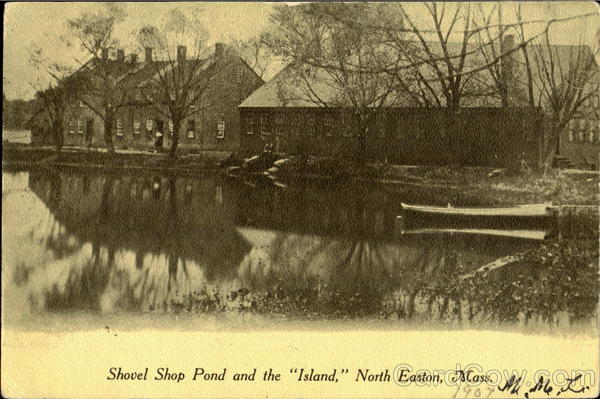
Shovel Shop Pond And The Island North Easton, MA

Replacement buildings on a section of the Ames shovel complex

1852

March 4 Thursday  Scott & Holbrook are setting glass at

the shop to day  They have the front entry partly

painted  I carried my work into Edwins this

forenoon  mended O Angiers shop coat  This afternoon

have been to Mr Torreys with Augustus & Lavinia

Called a few moments on Hannah  She has a 

sore mouth and is weaning her child

Evelina addresses her day calmly, as always keeping her distance from the goings-on at O. Ames & Sons. Most other residents of North Easton were still reeling, no doubt, from the huge fire that had burned down a majority of shovel factory buildings over the night of March 2. The sun was shining and the wind was out of the north west, pushing around remnant smoke still rising from the ruins of the complex of wooden buildings. Shovel shop employees had no regular job to go to and the owners had some serious decisions to make, fast.

Clean-up from the huge fire was underway, probably by the labor of the very men whose factory jobs had been temporarily eliminated. The men who had been painting and papering at the Ames’s house, for instance, were co-opted to set glass at the shop, suggesting that new panes of glass – the originals probably having been blown out by the fire – were going into the windows of the one or two buildings that had survived.

As town historian Ed Hands points out, “the Ames family and the neighborhood rebounded quickly.”*  Old Oliver and his sons Oakes and Oliver Ames Jr. made a two-fold decision. The first was to create temporary structures to house the manufacturing so that shovel making could resume as quickly as possible.  The second was to create “new, permanent stone shops,”* sturdy, nonflammable structures that could outwit any new fire.

There was insurance money to cover at least some of the rebuilding. Sources differ on the amount of damage that the fire inflicted, but suggest it was between $30,000 and $40,000. The amount of insurance coverage is also uncertain. Old Oliver “states that there was $3,000 worth of insurance on the buildings”** but, according to industrial historian Greg Galer, it’s likely that the Ameses had increased insurance coverage on the factory back in November, 1851. Whatever the actual dollar cost was, “[t]he company bounced back quickly from the devastation, and seemingly without significant financial trauma.”**

*Edmund C. Hands, Easton’s Neighborhoods, Easton, 1995, p. 163

** Gregory Galer, Forging Ahead, MIT, 1989, p. 249
 

March 3, 1852

Fire


1852

March 3  Wednesday  Last night the finishing shops

were burned to the ground by Quinns letting 

his lantern fall into the varnish  Oakes came

home from the fire about 4 Oclock much

more cheerful than I expected to see him and 

went to bed  OA and Frank came home to put

on dry clothes & went back and staid untill morning

Lavinia & Augusta were here awhile this afternoon


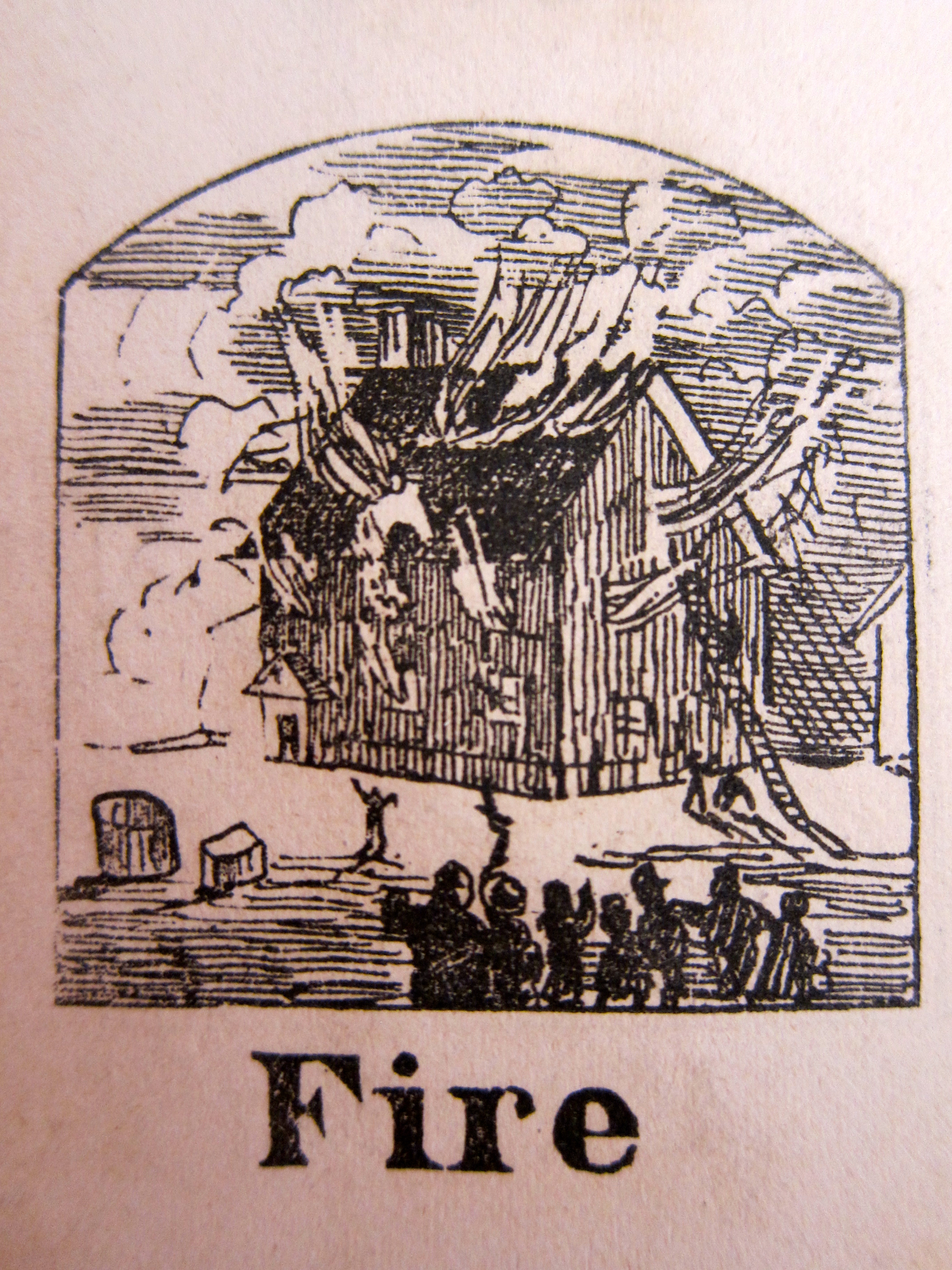
Fire! Most of the shovel company’s buildings, situated in”the most centralized areas of Ames production, ‘the island’ at the outfall of Shovel Shop Pond,”* caught fire and burned to the ground. On his nightly round, Patric Quinn, the watchman, dropped his lantern into the varnish. The subsequent explosion must have been quick and, given the nature of the combustibles, uncontainable from the outset.

Naturally, Old Oliver recorded the event as well: “last night about eleven O clock the finishing shop took fire and the shops adjoining it were burned down – Bisbes shop and the small one made out of the cole hous that was mooved from the hoe shop was saved – the fire took from the varnish …”**

O. Ames & Sons had caught fire before, once in 1844 and again in 1849.  After the 1844 fire, the family “had bought a used fire engine,”** which was brought to bear on the 1849 fire. In that case, Old Oliver credited the engine with saving the day, noting that “if we had have had no engoin I think it would have burnt up.” **

This latest conflagration was different. As modern historian Gregory Galer points out, “luck was not on their side…[the used fire] engine was no match for the blaze, fueled in part by 12,000 well-dried, ash shovel handles; oil and varnish used to protect completed shovels; and the wooden building itself.”*  The shovel shop was in ruins.

Evelina didn’t attend the fire, but she would have been able to see the flames from their front windows. The fire went on all night, her husband, sons and other townspeople present for most of it. There is no record of any injuries.


Gregory Galer, Forging Ahead, MIT, pp. 248-249

** Oliver Ames, Journal, Stonehill College Archives, Arnold Tofias Collection


February 28, 1852

image059

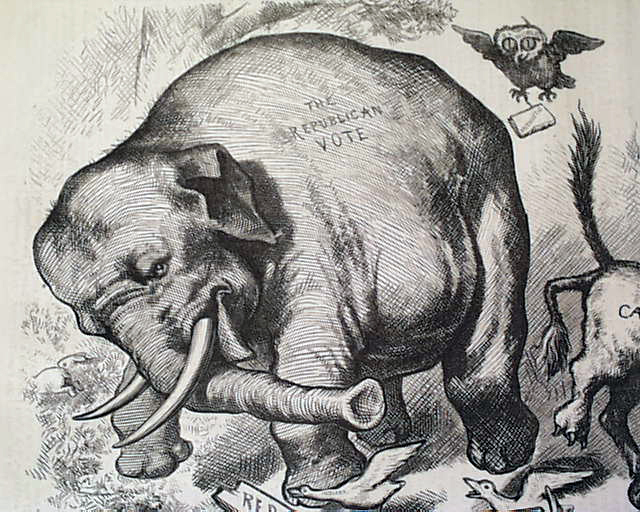
Thomas Nast’s first rendition of the Republican party’s symbol, early 1870s

1852

Feb 28th Saturday  It has been a stormy uncomfortable 

day  Mother is quite unwell & rather homesick

Mrs Witherell spent two hours here this

forenoon  I have finished the flannel

skirt that I commenced Jan 30th and put

a cape top to an old one  Mr Ames has

been to Boston as usual says the slab will be here Monday

Evelina stayed indoors today, sewing, of course, but also tending to her elderly mother, who seemed fretful and “unwell.” The whole town was subjected to what modern weather forecasters would call ” a wintry mix.”  According to Old Oliver, the day began “a snowing this morning wind south east but the snow is dry – it snowd + haild untill about 4 O clock + than began to rain + raind pritty fast untill some time in the night when it cleard of[f] with the wind north west and + cold and the wind blew verry hard”*

In another section of the country also known for its harsh winters, this date in history (plus two years) marks the genesis of our country’s Republican party. According to political historian Robert Remini, “[o]n February 28, 1854, a number of Free-Soilers, northern Whigs and antislavery Democrats met in Ripon, Wisconsin, and recommended the formation of a new party to be called “Republican.”**  Several months later, on July 6, after Congress passed the controversial Kansas-Nebraska act, the nascent group met again in Jackson, Michigan, where they “formally adopted the new name and demanded the repeal of the Kansas-Nebraska and Fugitive Slave Acts and the abolition of slavery in the District of Columbia.”

It wouldn’t take long for the Ames men, former Whigs, to join the new political party.

*Oliver Ames, Journal, Stonehill College Archives, Arnold Tofias Collection

Robert Remini, The House: The History of the House of Representatives, 2006, p. 150  

(NB: A source cited in Wikipedia in February, 2015, says that the date for this meeting in Ripon was March 20)

February 26, 1852

seance-circle-2


Feb 1852

Thursday 26  Mrs Solomon & Mrs Willard Lothrop spent

the afternoon here.  Willard & Abby Torrey

came this evening  He went into a trance

and preached  told Abby she was a sympathetic

medium  Mother & self had a nice quiet

time in the forenoon  Mrs Witherell

came in awhile  Altered some dickeys

After a quiet morning of sewing, Evelina and her mother were entertained at the end of the day by an unusual event in the Ames parlor.  Willard Lothrop, self-proclaimed Spiritualist, visited at the Ames home where he “went into a trance and preached.”  If it wasn’t a seance, it was close. Lothrop believed he could communicate with the departed. Was there a particular person from the past – a Gilmore relative, for instance – whom Lothrop was trying to reach?

According to historian William Chaffin, “modern Spiritualism” developed in upstate New York around 1848, and spread from there. As noted previously, Easton produced its own adherents who “displayed mediumistic powers,” including Willard Lothrop. “Circles were held.  There were knockings and table-tippings and experiments in the production of musical sounds, etc.  It was not found necessary to import trance speakers, for native talent in that direction was soon developed.”** Abby Torrey, Evelina’s twenty-one year old niece, was in the parlor, too, for this session. Lothrop reached out to her, believing that she had a gift for spiritual telepathy.

Meanwhile, the previous day’s thaw “turnd cold last night + froze the ground up rough”* Carts, wagons and carriages had bumpy roads to traverse.

*Oliver Ames, Journal, Stonehill College Archives, Arnold Tofias Collection

** William L. Chaffin, History of Easton, Massachusetts, 1866, p. 370


February 20, 1852

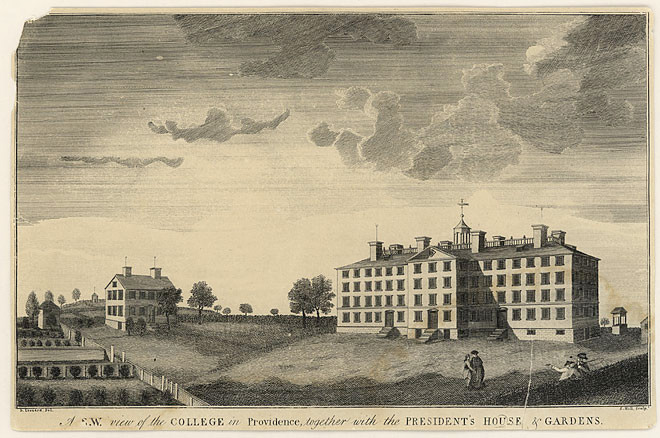
View of the College 1792

Brown University

1852

Friday Feb 20th Oliver returned to Brown University this

morning  Have given the sitting room a thourough

sweeping & have made the front chamber bed

and put the room in order.  Also the entry.

After dinner called into Olivers to see her mother

Mrs Solomon & Willard Lothrop spent the afternoon 

Willard said he wanted to come to tea but the spirits

would not let him.  Orinthia came this evening

The house was quieter this morning than it had been for some time.  Evelina’s middle son, Oliver (3), had returned to college. She tidied up, putting away at least some of the sewing things that had been pulled out for mending Oliver’s clothes. She swept and put various rooms “in order.” She must have felt a sense of accomplishment and, perhaps, that contradictory combination of relief, satisfaction and sadness that follows the departure of a child for school.

After midday dinner, Evelina walked next door to greet Sally Williams Lothrop, mother of Sarah Lothrop Ames. A different Lothrop came to call (whether at Evelina’s or Sarah’s is unclear): Mrs. Solomon Lothrop and her son Willard. Willard was invited to stay for tea but declined. As a medium and a follower of Spiritualism, he felt that “the spirits would not let him.”

Willard Lothrop was not alone in his belief that the possibility of communication exists between the living and the dead.*  William Chaffin makes note of the existence of Spiritualism in Easton, where “interest in this subject first appeared on the Bay road. In 1850 Asahel Smith, Amos Hewett, Willard Lothrop, and others became much interested in the matter. Several Easton people soon displayed mediumistic powers.” Evelina was clearly intrigued by the premise.

See also June 13, 1851.

*William L. Chaffin, History of Easton, Massachusetts, 1866, p. 370.

February 19, 1852

images-1


1852

Thursday Feb 19th  Have been to work on Olivers clothes getting

them ready to go back to school  Have spent the

whole afternoon mending a coat for him which he

has spoiled wearing it in the shop  Augusta was

here this afternoon did not stop to tea.  Lavinia called

came up to bring Mrs Lothrop & son to Willards

Susan & self have spent the evening at Willards

Oliver came after us about nine Oclock

Finally, Oliver Ames (3) was going back to Brown. He had been home in North Easton, on a break, since January 21st. Evelina had her hands full mending a coat “which he has spoiled” so he could take it back to Providence. He wore it while working at the shovel factory and damaged it somehow. There was no time – and probably little inclination – to get a new one made for him. His mother had to fix it.

As Caroline Healey Dall, a contemporaneous female in Boston during this era, commented at one point in her mid-19th century diary, it was “a lonely, dull day – stitch, stitch, stitch.”* For most of the 19th century, all women sewed, and sewed often. Sometimes sewing was fun or companionable or rewarding; sometimes it wasn’t.  It was more often a necessity, a chore, and for Evelina today, the uninteresting and obligatory side of sewing prevailed.

Fortunately, Evelina had a few visits today from her younger female friends and relatives to help the time pass. Augusta Pool Gilmore visited in the afternoon – possibly with her own needle in hand – and niece Lavinia Gilmore called, having come into town from the family farm. In the evening, Evelina and her daughter Susan spent the evening with one of Easton’s more eccentric characters,Willard Lothrop, a medium. Oliver Ames (3) “came after” them after dark, probably anxious that all was ready for his return to college in the morning.

*Caroline Healey Dall, Daughter of Boston: The Extraordinary Diary of a Nineteenth Century Woman , ed. Helen R. Deese, Boston, 2005, p. 314

February 16, 1852

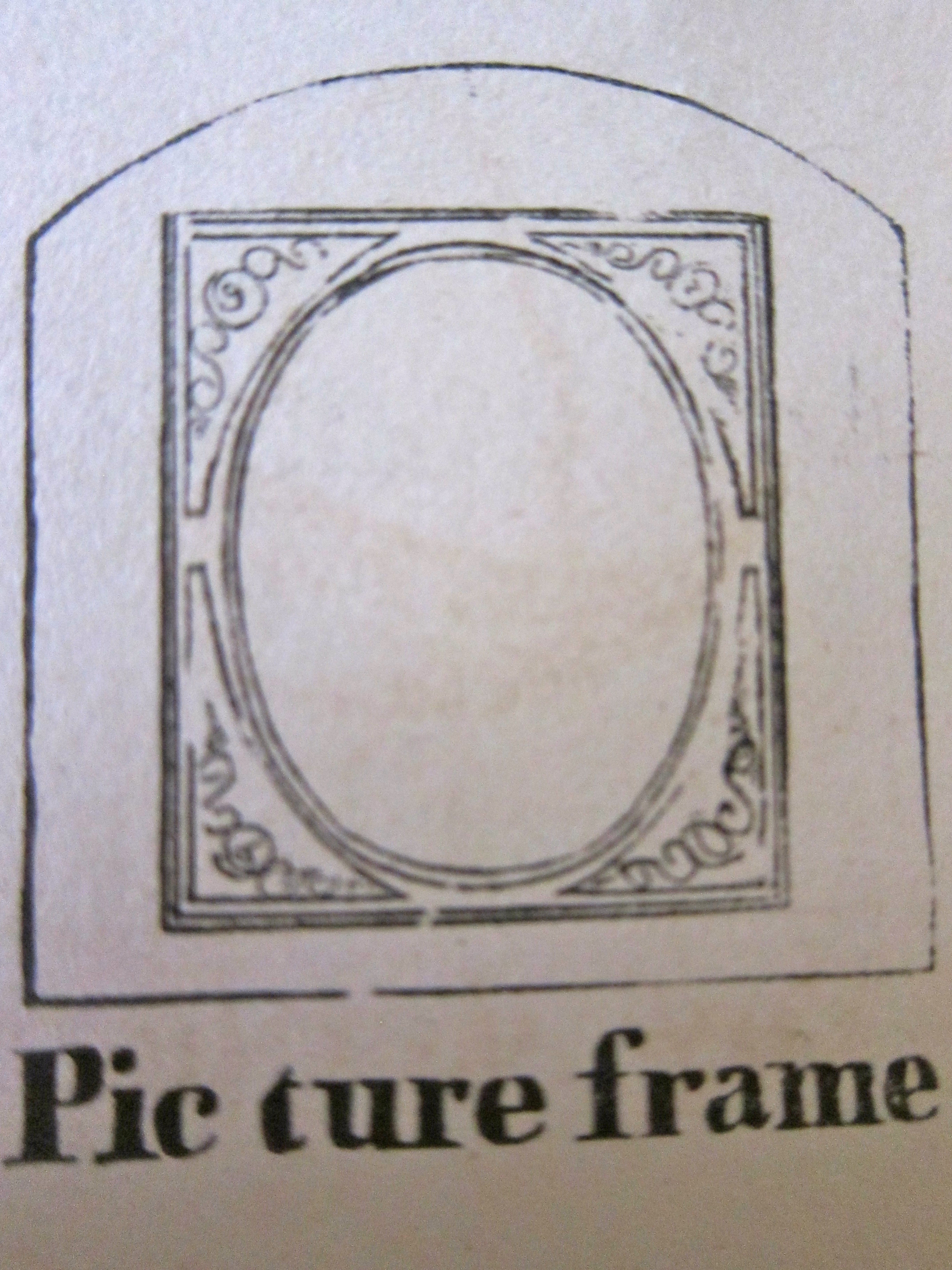
Picture frame

Monday Feb 16th

1852

Susan washed the dishes this morning and I was

at work about the house most of the forenoon

Mrs Mary Williams came about eleven Oclock and 

staid to dinner  Called into Olivers and Edwins

with her  She returned to Joshua C Wm about three

and went home in the stage  Oliver tried to get

the coloured engraving smooth in the frame but could 

not  Mended Oakes Angier a vest


The new week opened with the usual domestic arrangements: Jane McHanna doing laundry, Susie Ames washing dishes and Evelina choring “about the house” in the morning.  A visitor, Mary Williams, arrived and stayed for midday dinner, then departed mid-afternoon on the local stagecoach .

With her son Oliver’s help, Evelina finished hanging the prints she had bought the week before in Boston. The new pieces of art were quite au courant; etchings, lithographs, and engravings were appearing on parlor walls across the country.  New printing technology – the same that promoted the appearance of so many new periodicals and serial novels – made the production and distribution of art prints easy. The subject matters varied from historical (like the famous image by Emanuel Gottlieb Leutze of Washington Crossing the Delaware, first painted in 1851) to religious to geographical to sentimental.  They were decorative and affordable, and the middle class flocked to buy them.

Subject matter, of course, was important; Evelina had purchased one print about Halloween (or All Hallows Eve as it was known). The prints had to be attractive and look handsome on the wall. But the decorative frames that went around the art work counted, too, and “were often considered more important than the prints themselves.”* It’s too bad that Oliver was having difficulty making one new print fit properly in its frame.

* Pierre-Lin Renie, The Image on the Wall: Decoration in the Nineteenth Century Interior, Nineteenth Century Art Worldwide

February 14, 1852

 history

Detail of Cover of Gleason’s Pictorial, February, 1852

Sat Feb 14th  Finished Olivers shirt before dinner and did

some mending  About three went into Edwins and trimmed

a black silk cravat for Oliver  Mrs S Ames & Frederic

returned from New Bedford to night where they have been

since Tuesday  I spent most of the evening there

Evelina’s favorite periodicals, such as Gleason’s Pictorial, Godey’s Lady’s Magazine, and Graham’s, were full of allusions to Valentine’s Day this week. Gleason’s featured a valentine on its cover, in fact.  And while commercial Valentine cards hadn’t yet developed in the United States – that would happen in the 1870s – special letters and personal poems were popular on February 14. Yet Evelina makes no mention of receiving or sending a valentine, nor does she suggest that any of her children did, either.

Perhaps when Evelina went over to see Augusta Pool Gilmore, young bride of Evelina’s nephew Edwin Williams Gilmore, she found evidence of a valentine exchange between the newlyweds. Besides being in love and – presumably – open to sentimental expression, Augusta and Edwin were young enough to adopt new approaches to holidays that older Yankees like Evelina and Oakes ignored.

Meanwhile, winter was still very much present. As Old Oliver noted: “there was about half an inch of snow last night and it is cloud[y] + cold to day wind north west”

February 12, 1852

Abraham_Lincoln_by_Byers,_1858_-_crop

Abraham Lincoln (1809 – 1865)

ca. 1858

Feb 1852

Thursday 12th Had a number of calls quite early

Augustus Edwin & August[a] came to look at

the engravings and I began to think I never

should get the room in order.  This afternoon Oliver

hung the pictures.  Augusta came in and we called 

on Mrs J Wms about Olivers shirts that she is making

and at Augustus.  Mrs Lake called.  William returned home.

William Leonard Ames, brother of Oakes and Oliver Jr., “went home to day”*after a ten-day visit. William had most likely stayed with his sister Sarah Ames Witherell and father, Old Oliver, in the other part of the house. Yet today was the first day that Evelina mentioned his presence, suggesting, as before, that relations between Oakes and William were cool.  The men had had a parting of the ways over the demise of William’s iron company, and William had migrated to Minnesota.

Another person considerably west of North Easton was former U.S. Representative Abraham Lincoln who turned 43 today. He was practicing law. He had recently declined the offer of the Governorship of Oregon, and was beginning to settle back into a life away from politics. Future events – most notably, the passage of the Kansas-Nebraska Act in 1854 and his ongoing opposition to slavery – would reinvigorate his interest.

Evelina, meanwhile, concentrated on hanging her new engravings in the parlor, and showed them off to her nephews. She also checked on the status of some shirts she had ordered sewn for Oliver (3).

*Oliver Ames Journal, Stonehill College Archives, Arnold Tofias Collection


February 9, 1852


Boston_art_club_design_wm_emerson

Architectural Rendering of Boston Art Club, ca. 1882

Feb 9th  Monday  Went to Boston with Oliver  spent

the forenoon in looking at pictures.  dined at

Mr Orrs.  Afternoon Mrs Stevens & Mrs Morse

went with us to look at pictures.  purchased 

two engravings one of them painted  returned to

Mr Orrs and spent the evening in playing 

cards  Very fine weather

Evelina’s boring Sunday in North Easton gave way to a few fun days of shopping in Boston. Leaving Jane McHanna to manage the house in her absence, she traveled into the city accompanied by her middle son, Oliver (3), the only son who wasn’t working. The two of them spent the day looking at “pictures” – prints and paintings, probably – and ended up buying two engravings. That one was “painted” meant that it had been hand-colored.

Where did they shop? At a gallery? At an artist’s studio? Amory Hall on Washington Street was one facility that accommodated artists at the time.Who was selling engravings in 1852? Readers, do you know?

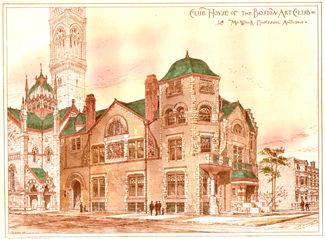
It’s hardly arbitrary that Oliver (3) was the son who shopped for art with his mother. Besides being the only male in the family at liberty to take his mother into town, Oliver (3) loved art. He would collect paintings, prints and sculpture all through his life, in fact, especially after he and Anna C. Ray had married and built their large homes in North Easton and Boston. Before becoming governor, Oliver (3) traveled a great deal as a salesman for O. Ames and Sons and, in the process, bought art for himself at galleries in New York City and elsewhere. In the 1880s, he was also president of the Boston Art Club, an artists’ consortium begun in 1854 – 1855 that expanded to include wealthy patrons such as Oliver Ames.