July 18, 1851

large-1053

1851

Friday July 18  This forenoon finished my Silk Muslin dress

made a chimisette for it  Mother is not at all well

and is not easy cannot stay in one place a great while

Oliver went with Mrs S Ames after Helen.  Got to

Dorchester about 5 Oclock and home about half past nine

The weather is hot and uncomfortable.  Fred returned

to night having passed a good examination


Fred Ames was accepted at Harvard!  He shared the good news with his relatives when he returned to North Easton this evening. He did well on his examination, which perhaps constituted some combination of interview and oral or written test of the depth of his knowledge. How proud his parents must have been, and what relief he must have felt to have the entrance hurdle behind him.

Fred’s life was now moving in a fresh direction but otherwise, things in North Easton were much the same as he had left them the day before. Under a hot and humid sky, Evelina was sewing and looking after her mother, Hannah Lothrop Gilmore, who wasn’t feeling well.  Fred’s parents, Oliver Jr. and Sarah Lothrop Ames, meanwhile, had driven off to fetch his sister, Helen, from school in Dorchester.

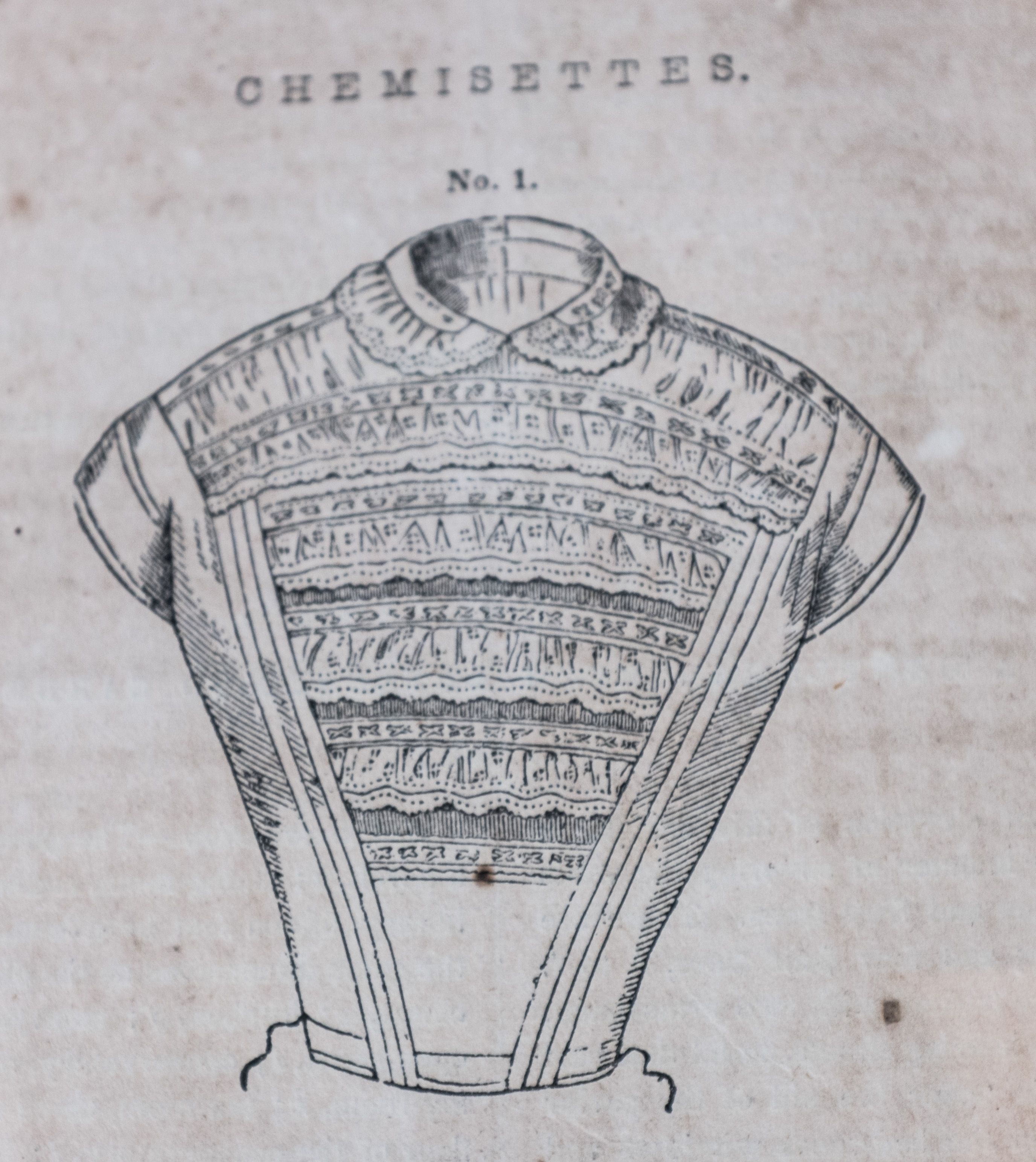
Today’s sewing project was a chemisette for Evelina’s newest dress, the silk muslin that she and dressmaker Julia Mahoney had been working on this week.  The chemisette was a light blouse designed to be worn under the jacket bodice of the dress.  Hers probably wasn’t as elaborate as the chemisette in the illustration.

 

June 27, 1851

weedy flower bed

*

June 27 Friday  John left here this morning

Worked a long time in the garden

this morning for the weeds were very plenty

afterwards finished picking over the hair and

a long job it has been.  This afternoon put the hair

into the hair cloth cover and just commenced tying

it when Mrs Clark and Mrs Stetson came from

Sharon and of course had to leave it and go

into the other house house to see them. Mother & I stoped to tea

Pigweed, thistle, crabgrass, and purslane: Such weeds – and more – are the collective bane of the flower gardener. Evelina tackled some of them this morning as she addressed the “very plenty” weeds that were pushing into her flower beds. Perhaps she ruminated about her brother John and his short visit while her fingers dug into the soil.

After midday dinner she turned to her sewing, as usual, going right to her haircloth slipcover project, but abandoned it with alacrity when an opportunity for socializing turned up.  “Had to leave it and go..” she noted, when two friends from nearby Sharon arrived next door.  She and her mother, Hannah Lothrop Gilmore, went over for tea.

Frank Ames Mitchell, a nephew of Oakes and Evelina, turned ten years old today.  One of two grandsons of Old Oliver named Frank (the other being Frank Morton Ames,) he was the eldest son of Oakes’ sister, Harriett Ames Mitchell. He, his mother, and two younger siblings were living temporarily in Bridgewater while their father, Asa Mitchell, was working in coal in western Pennsylvania.

Our knowledge about Frank Mitchell is limited, as he never married or had any known issue. We do know that he was the only Ames grandson to fight in the Civil War.  He served in both the 44th and the 56th Massachusetts Regiments, and ultimately made captain.  In 1864, he was wounded at Cold Harbor.  Hospitalized in Washington DC, where his mother rushed to his side, he eventually recovered but remained in indifferent health for the rest of his life.

After the war, Frank bought a plantation in Tallullah, Louisiana, an effort that was underwritten and ultimately bought out by his Uncle Oliver Ames, Jr.  Family records show that Frank subsequently depended on financial support from his cousin Fred Ames. The remainder of his life consisted of traveling from one healthful climate or resort to another in search of good health.


* A modern flower garden, full of weeds, from canoecorner.blogspot

June 17, 1851

DSCF1590small

1851 June 17th  Worked untill about nine Oclock in

the flower garden  Then cut the tick to the mattress

a[nd] basted it ready to make  Jane was ironing and 

I assisted about dinner  After dinner made three button

holes in Mrs S Ames dress.  Went to Mr

Wm Reeds to tea with Mr Ames, Oliver & wife

Mrs W, Mitchell & Mr & Mrs Whitwell & Alson & wife


Gardening, sewing, ironing and cooking made up today’s housework at the Ames’s home on Main Street.  Buttonholes, too, which could be challenging, were a particular specialty of Evelina; many people brought her their buttonholes.  The fact that Sarah Lothrop Ames took her buttonholes to Evelina rather than to a hired dressmaker underscores Evelina’s talent in this department.

William and Abigail Reed must have enjoyed Evelina’s company on Sunday between services, for they invited her back to a small tea party.  The whole Ames family was invited, in fact, and then some. Minus Old Oliver, and the young people, naturally, siblings Oakes, Oliver Jr., Sarah Witherell, and Harriett Mitchell, with wives Evelina and Sarah Ames, gathered at the old professor’s home for a “cuppa.” Reverend William Whitwell and his wife, Eliza, went too, as did Alson and Henrietta Gilmore. That was a good crowd for a 19th century parlor.

Tea was generally the most sociable meal of the day.


June 8, 1851

IMG_0139 2

June 8th  Have been to meeting all day  Heard Mr Dogget

of Ashby did not like him near as well as Mr.

Whitwell.  Came home at noon with Alson & wife.

Oakes Angier & Orinthia went to night to call on

Miss Perkins at Mr J Kimballs.  Mr Ames & self

called at Mr Peckhams.  It has been a cold cloudy

day for the season and to night rains some.


Today was a normal Sunday in Easton, which the Ames family spent at church listening to Mr. Dogget, a visiting preacher who probably had no chance of being as good as Reverend Whitwell, at least in Evelina’s eyes. After church Evelina and Oakes called on John Peckham, a clerk at the shovel works, and his wife Susan.

Things may have been more lively next door at the home of Sarah Lothrop and Oliver Ames, Jr. Their oldest child and only son, Frederick Lothrop Ames, turned 16 years old today. He may have been at home to celebrate, or he may still have been away at school.  Fred was just finishing a year of college preparatory study at Phillips Exeter Academy. Prior to that, he had studied at Concord Academy.  Young as he was, he and his parents expected his next year to be spent at college.

A brilliant business career lay ahead for Fred Ames. By all accounts, but best described by his personal friend Leverett Saltonstall, Frederick Lothrop Ames, “distinguished by his high character, was well known as one of the largest capitalists in the country.”* Not only was Fred a capable member of the management team of O. Ames & Sons, he was, like his father, an active investor and eventual director of the Union Pacific Railroad. He became a strong, competitive railroad man. At the time of his death in 1893, he was “officially connected to some seventy-five railroads,” and held oversight or investment positions in many other enterprises: banks, coal mines, elevators, and an innovative young company called General Electric.

Clearly capable in the world of business, Fred Ames was also a likeable fellow. “No one ever met him without being impressed by his uprightness, intelligence, and good judgment.” “A most kind and generous man,” he donated to and oversaw various charities and hospitals. He reportedly led a happy family life in North Easton and Boston, and created a lasting legacy through his support of the architecture of H. H. Richardson. “A devoted lover of horticulture,” also, he had a famous collection of orchids.

A star among the grandchildren of Old Oliver and Susannah Angier Ames, Frederick Lothrop Ames died too early, dropping of apoplexy – what we would now call a stroke – on the overnight train to New York. He was 58 years old. His legacy would live on.


* Leverett Saltonstall, Memoir of the Hon. Frederick Lothrop Ames, A.B.,  The Colonial Society of Massachusetts

June 5, 1851

e_gg_hook_organ2-291x440

*

1851

June 5th Thursday  To day I have been to Mothers, stoped at Orinthias

school and staid about an hour, left Susan there

and got to Mothers about noon.  Met A Augustus & wife

and her sister Elizabeth, John Pool & wife.  On my way

home stoped to Miss Louisa Howards & got some Asters

and at the meeting house to hear Elizabeth Clark play

Met Oliver & wife & Harriet, Mr Clark and

two daughters  A beautiful pleasant day


Several Ameses gathered this afternoon with others for a concert at the meeting house. Presumably, the new organ was featured again, played this time by a more proficient organist than Mr. Rotch from a few Sundays ago. Miss Elizabeth Clark, daughter of Daniel and Elvira Clark and barely 19 years old, treated the listeners to a recital. The Clarks were Unitarians, and Daniel was a capable carpenter who did occasional work for the Ames family. Elizabeth was evidently a fine pianist.

The new organ was possibly made by E. G. and G. Hook of Boston, whose factory was later in Weston, Massachusetts. Known by 1885 as Hook and Hastings, their firm was prominent in the 19th century in the production of church organs. Their first concert hall organ, no longer extant, was installed in the Tremont Temple across from the Boston Common. Their largest was placed in Boston’s Cathedral of the Holy Cross.  More common were smaller organs such as the one in the illustration that were installed in more modest meeting houses, like the Easton one used by the Unitarians in 1851.

The occasion for this particular recital is unknown, and how it came to be held on a weekday afternoon is also a puzzle.  It made sense to the townspeople, however, who turned out in full for the occasion.

*E. G. and G. Hook organ, Boston, Mass., circa 1848.  Athol Historical Society

May 25, 1851

Cemetery


25 May Sunday  Have been to church all day. Went to Mr

Whitwells at noon with Mother and Mrs Whitwell

made us take a cup of tea Also Mrs Elijah Howard & Miss

Louisa H.  Had quite a spirited chat about Mr

Wm Reed & Mr Dean. After meeting Mr Ames & Oliver

& wife rode to the burying grounds  Cannot 

feel reconciled to having it where it is. Oakes A Susan

& Orinthia went to a sing & Oakes carried Orinthia home.


A cup of tea and good, “spirited chat” among the women during intermission brightened Evelina’s Sunday.  Who were Mr. Reed and Mr. Dean that they evoked such consideration from the female population?  There were several men of either name who lived in Easton at the time.

When church was over, Evelina, Oakes, Oliver Jr. and Sarah Lothrop Ames drove together to look at the new cemetery in South Easton. Created by the Easton Cemetery Corporation, it was one of almost thirty graveyards in the town.  For reasons lost to history, this newest burial-ground had been deemed desirable and consequently established by men well-known to the Ameses, including Elijah Howard and Dr. Caleb Swan.  Perhaps their intention had been to create at burial place that would be tended to as time passed, as many smaller, family graveyards throughout the town were not. Perhaps they were responding to personal inclinations to group Unitarians together for eternity.

Whatever the thinking behind the new burial-ground, Evelina was dubious.  Did she look at it and think she and Oakes might be buried there someday?  Did she wish instead to be buried near her son Henry, wherever that was? Or did she think of another graveyard where her father and certain siblings were buried? Little could she imagine that twenty-five years hence, the Village Cemetery of North Easton would be created behind a Unitarian Church that hadn’t yet been built, both projects funded by Oliver Jr, and that there she, her husband, and all her children would eventually be laid to rest.


May 21, 1851

faneuil-hall


May 21

Wednesday  This day have been to Boston and had a hard days

work but accomplished very little  Had a green silk

bonnet made for me which fitted […] no better than the

other that I sent back. Mr Remick paid back the four

dollars and I was glad to get off so well after all my 

trouble.  Spent most of the time with Sarah [and] Oliver in

looking for her things.  Bought me a pair of cuff pins

Called at Martin Halls store about some sugar

The search for the perfect bonnet continued today. It was back to Boston, to Alfred Remick & Co. to pick up a bonnet that Evelina had ordered – green silk this time instead of blue plaid – and it still didn’t fit. She had left the instructions up to her husband, Oakes.  Had he gotten it wrong or was the milliner once again at fault? So much for “all my trouble.”

Like yesterday’s diary entry, the tone of this one is self-deprecatory, even grumpy. Gone is the light-hearted pleasure she had expressed earlier in the month when gadding about buying plants for the garden in the company of Orinthia Foss or her nieces. Evelina couldn’t seem to get things to go her way. Her inability to find a bonnet was proving irksome, and the best she could manage was to tag along with her sister-in-law, Sarah Ames, and brother-in-law, Oliver Ames Jr., while they did some shopping. She did buy a pair of cuff pins, however, which was consolation of a sort.

While they were at Faneuil Hall, Evelina purchased or ordered or, at the very least, inquired about some sugar from a grocer there. Faneuil Hall was – and is – a prominent, historic building in Boston. In the middle of the 19th century, it featured a spreading marketplace, called Market Square, where merchants such as Martin Hall sold their wares.  Upstairs there was a large hall for civic gatherings. The illustration above, by Winslow Homer, shows Faneuil Hall in 1861, at the very start of the Civil War, ten years after Evelina bought sugar there. The image of a regiment of Massachusetts volunteers famously marching off to Washington was published in Harper’s Weekly, a periodical to which Evelina and Oakes subscribed.


May 12, 1851

ServiceBerry1

Monday May 12th  Was about house all the forenoon but

cannot tell what doing  Jane has done the washing.

Orinthia washed the dishes for her. This afternoon

Orinthia and I have been out to plant the flower seeds

and I got some Shad berry & Burgundy Rose bushes

from Olivers & flowering Almonds from Alsons We 

were at work in the garden three or four hours

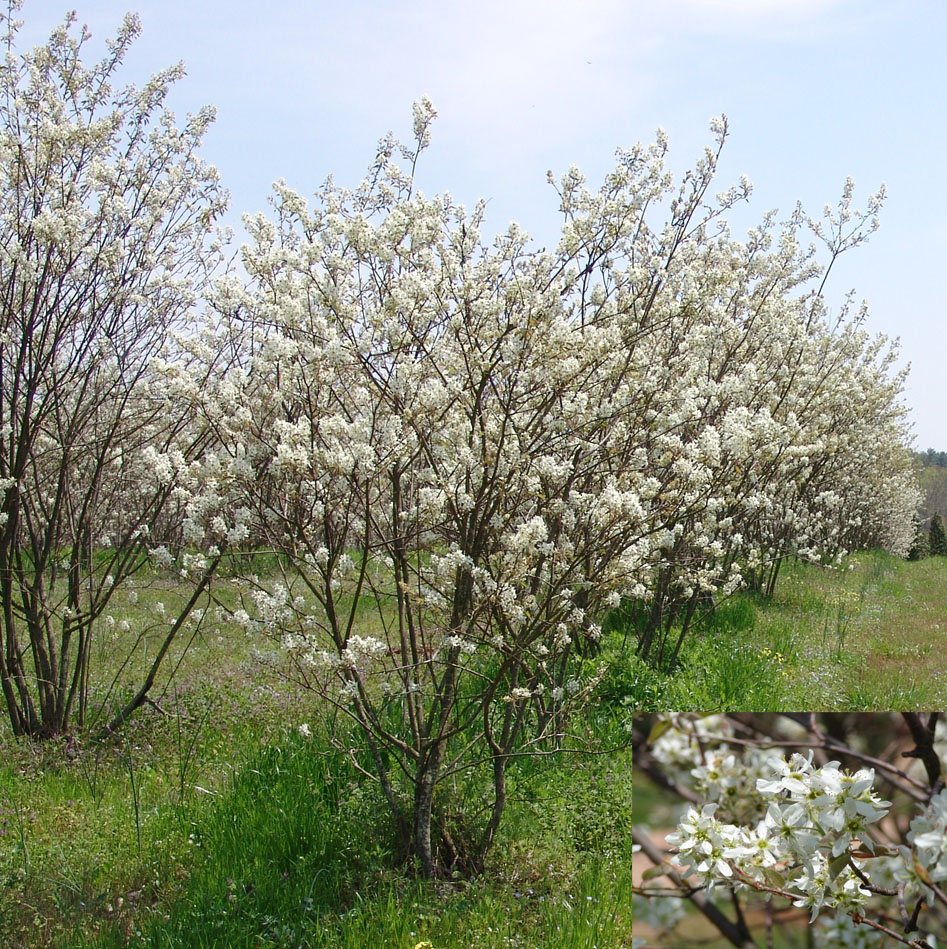
A sure sign of spring in New England is the blooming of the shadbush.  Because its little white flowers are among the earliest to be seen, its blossoms were often used at springtime funerals in the seventeenth, eighteenth and nineteenth centuries. Thus shadbush is also called the “serviceberry” bush for its appearance at funeral services; in some other locations it’s known as the “Juneberry” bush.  Wherever and whenever it grew, its presentation of blossoms was as welcome as the first robin.  The red berries it produced could be used in pies or, if not harvested, would be consumed by those same robins and other birds like cedar waxwings.

The shadberry bushes at Evelina’s were most likely planted out back behind the house near the Queset Brook, where they would tolerate the partial shade and indifferent soil.  However, the Burgundy Rose bushes that Evelina also obtained from her obliging brother-in-law, Oliver Jr., would have required a more selective location in the sun.  Were those roses planted right in Evelina’s flower beds?  Were they as red as their name sounds?

Her brother, Alson Gilmore, provided Evelina with flowering Almond bushes (Latin name is Prunus triloba.)  In contrast to the white serviceberry and the red roses, the flowering almonds produced pink blossoms.  Evelina was evidently aiming for a rosy spectrum in her yard. The flowering almonds like sun, so where might she have planted them?

The work of planting the various bushes took Evelina and Orinthia several hours to complete, and must have given them a real sense of accomplishment – not to mention sore backs.

April 19, 1851


rail_travel_leslies

*

1851

April 19  Harriet and her children came from Pittsburgh this

morning, came by the way of Stonington to Mansfield

and got someone to bring them.  It s too bad we did

not send for them, but Father thought the storm

might prevent their coming  Called in to see them this

afternoon.  Harriet does not look near as well

as she did before she went.  Augustus went to Boston

& Mr Ames  Tolerably pleasant


The youngest offspring of Old Oliver and Susannah Ames came back to town today.  Harriett (Ames) Mitchell, all of 31 years old, traveled by rail from Pittsburgh to Easton, finding her own way from the station in nearby Mansfield. (The railroad had not yet been built to North Easton.) In tow were her three children, Frank Ames Mitchell, John Ames Mitchell, and Anna Mitchell, aged 9, 6, and not quite 4, respectively. Given the rigors of traveling a long distance on a train with small children, it’s little wonder that Harriett did “not look near as well as she did before she went.”

Weather and travel conditions aside, the question is why Harriett returned home and left her husband, Asa Mitchell, behind. We know only a little about Asa Mitchell. He was a member of the well-regarded Mitchell family of Bridgewater. A coal dealer, he had recently moved west from Cambridge to Pittsburgh, Erie or someplace in Pennsylvania.  His employment seemed unsettled, and perhaps was driven by the vagaries of the coal industry.

Asa and Harriett had been married for eleven years and, like any of the Ames marriages, we can only conjecture what their relationship was like. We do know that Harriett and their children spent many months away from Asa, eventually staying in a house in Bridgewater that Old Oliver obtained for her. Asa spent some time there, too, but by 1867 he was an inmate at the Taunton Insane Asylum, where his expenses were met by Oliver Jr. We don’t know what his mental illness was; it may have been as debilitating as senility, as sudden as brain trauma or as complicated – and untreatable then – as schizophrenia or bipolar disease.  His condition would erase him from Harriett’s life and, by extension, the lives of his children. He died in June, 1877 in Taunton.

So on this cloudy day, with the “wind north east and cold,” and an uncertain future in front of her, Harriett brought her children home and was made welcome. She and her older sister Sarah Witherell were close and, no doubt, were glad to see each other.

* Leslie’s, 1878

March 26, 1851

Sweep

1851 March 26 This morning Orinthia & myself gave a thorough

sweeping & dusting to sitting room entry & then I 

went to mending stockings  Mother & myself passed

the afternoon at Olivers with Mr & Mrs Whitwell.

Mrs S Ames & Mrs Witherell spent the evening

here  I finished the shirt that I commenced 

for Oliver on Monday.  It has been a delightful day

Mud season, as they call it in New England, had arrived and thus a daily sweeping of the floor and carpet was essential. Dust and mud entered the house on the bottoms of boots and shoes when anyone came in the door.  Once this messy passage from winter to spring had safely passed, it would be time for spring cleaning.

Meanwhile, the ladies in the Ames compound on Main Street were socializing among themselves. Evelina took her mother next door to Sarah Lothrop Ames’s house in the afternoon and visited with William and Eliza Whitwell, who were calling.  In the evening, both sisters-in-law came over to visit with her.  The ladies sewed – Evelina still working on shirts, this one for her middle son – and chatted.

The men were not present for this girls’ night in.  Oliver Jr. was in New Jersey on business and, if Oakes were in town, he would have been over in the office, as was his wont.  Years later, Winthrop Ames, grandson to Oakes and Evelina, would note in his description of family life in Easton in 1861:

“Usually […] Oakes, Oliver junior and their sons went to the office in the evening to catch up with their correspondence (all letters were written and copied by hand), discuss business together and go over accounts with the head bookkeeper.”

Whether working or playing, the Ames family members spent this quiet evening en famille.