July 2, 1851

Thread


Wednesday July 2d  Have had quite a busy day.  This forenoon

cut out three shirts for the sewing circle and worked

a long while in the garden transplanting

Oliver went to Bridgewater and carried Mrs Whitwell

Mrs Witherell and me to the sewing circle at Alsons.

After I got home went to work on boquets

for Oakes & Frank.  Harriet assisted

Mrs S Ames went [to] Exeter this morning

Today is one of those instances when we can’t be certain which Oliver is being referred to.  Did Evelina’s brother-in-law, Oliver Jr., or son, Oliver (3) carry Evelina, Sarah Witherell and Eliza Whitwell to the Sewing Circle at Henrietta Gilmore’s?

Besides attending the monthly gathering of the Unitarian women to sew, Evelina also spent time in her flower garden.  She transplanted a number of flowers and picked several to fashion into two bouquets. Her sons, Oakes Angier Ames and Frank Morton Ames, planned to attend a party in Middleboro the next day and needed what we might call corsages to take to their dates (a modern word they wouldn’t have used.) She and her sister-in-law, Harriett, arranged the flowers appropriately.

Sarah Lothrop Ames had business of her own to attend to.  She went up to Exeter, New Hampshire, where her son Fred Ames was in school. Was she picking him up to bring him home or just visiting?

June 1, 1851

imgres

*

1851

June 1st Sunday  We have all been to church to day.

The young people went to walk to the hoe shop

& [illegible] before meeting.  Mr Ames Miss Linscot

Orinthia, Susan & self came home at noon.  After

meeting Lavinia came home with us  Oakes A

carried them to a sing to our meeting house

and then O & L home  I feel rather down

hearted to night & have been for two or three days

The young people gathered today for a sing at the meeting house.  Oakes Angier and his brothers, perhaps, accompanied Orinthia, her friend Frances, and Cousin Lavinia to the church for an evening that was probably more lively and joyous than the two sermons they had listened to earlier. They sang and socialized.

Evelina was neither lively nor joyous. She was “down hearted,” and no singing or June sunshine seemed to make it better. Where did her blues come from? Was she upset with Oakes for some reason? Did she reconsider her friendship with Orinthia and find their age difference suddenly unbridgeable? Was she tired from the spring cleaning? She doesn’t mention a particular instance that could have set off a mild depression.

In 1851, Evelina was in her early forties, an age subject to the physical effects of “change of life,” a condition that 19th century women wouldn’t have known much about, much less admitted to if they did. The formal and fastidious norms of the day abhorred words that alluded to specific female conditions. The word “pregnancy,” for instance, was indelicate; if they said anything at all, it was that a woman was “in the family way.” Some described childbirth as “being taken ill.” Menopause, a word that even some 21st century women are reticent to use, was not in Evelina’s vocabulary.

Yet a lack of understanding and the absence of social acceptance couldn’t obviate a real female condition.  Evelina was at a stage in her life when the onset of menopause could begin to influence her mental and physical state. The chemistry of her body could have made her feel down-hearted without her knowing why.

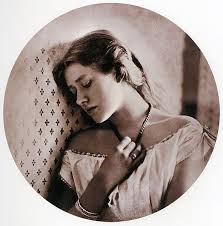
*  “Sadness” evoked by 19th century actress Ellen Terry.  Photograph by Julia Margaret Cameron.

May 30, 1851


Funeral


1851

May 30th Friday  Have been sweeping & dusting the

chambers put things in order in the shed chamber 

again.  Jane has cleaned the boys chamber  Frank left

their room last night.  Have sewed a very little

Frances Linscott came to see Orinthia in the 

stage to night and Frank went to Mr Howards

after her  It was past nine when they got

here  It is very cold for the season

Mrs Johnson buried to day in the new Cemetery


The first burial in the new cemetery in South Easton took place today. Catherine Lothrop Johnson, the wife of Thomas J. Johnson of Newtonville, and their infant son were buried there.  Catherine was 35 years old.  She would not have had a service in a church; rather, there would have been a gathering of friends and relatives at the Johnson home, after which some or all would have ridden or walked to the burial site for the committal ceremony.  To bury a mother and her baby was a double sorrow, obviously, but not all that unusual in a period when childbirth carried such risk.

Orinthia, meanwhile, came back to the Ames’s for a visit, bringing along a friend from out of town, Miss Frances Linscott.  The two young women arranged to stay at the Ames’s house. Certainly part of the reason for this was Orinthia’s fondness for the Ames family, especially Evelina.  Is it possible, however, that the Ames sons were also an attraction?

The three Ames sons who had been sharing one bedroom returned to previous sleeping arrangements today.  Oakes Angier and Oliver (3) stayed in the room they shared and Frank Morton Ames returned to his own smaller quarters.  After tea, Frank took a carriage south to Elijah Howard’s home, where Orinthia had been staying, to carry her and her friend to North Easton.


May 25, 1851

Cemetery


25 May Sunday  Have been to church all day. Went to Mr

Whitwells at noon with Mother and Mrs Whitwell

made us take a cup of tea Also Mrs Elijah Howard & Miss

Louisa H.  Had quite a spirited chat about Mr

Wm Reed & Mr Dean. After meeting Mr Ames & Oliver

& wife rode to the burying grounds  Cannot 

feel reconciled to having it where it is. Oakes A Susan

& Orinthia went to a sing & Oakes carried Orinthia home.


A cup of tea and good, “spirited chat” among the women during intermission brightened Evelina’s Sunday.  Who were Mr. Reed and Mr. Dean that they evoked such consideration from the female population?  There were several men of either name who lived in Easton at the time.

When church was over, Evelina, Oakes, Oliver Jr. and Sarah Lothrop Ames drove together to look at the new cemetery in South Easton. Created by the Easton Cemetery Corporation, it was one of almost thirty graveyards in the town.  For reasons lost to history, this newest burial-ground had been deemed desirable and consequently established by men well-known to the Ameses, including Elijah Howard and Dr. Caleb Swan.  Perhaps their intention had been to create at burial place that would be tended to as time passed, as many smaller, family graveyards throughout the town were not. Perhaps they were responding to personal inclinations to group Unitarians together for eternity.

Whatever the thinking behind the new burial-ground, Evelina was dubious.  Did she look at it and think she and Oakes might be buried there someday?  Did she wish instead to be buried near her son Henry, wherever that was? Or did she think of another graveyard where her father and certain siblings were buried? Little could she imagine that twenty-five years hence, the Village Cemetery of North Easton would be created behind a Unitarian Church that hadn’t yet been built, both projects funded by Oliver Jr, and that there she, her husband, and all her children would eventually be laid to rest.


May 11, 1851

photo

*

Sun May 11th  Have been to church this afternoon. Did

not feel like going in the morning It rained

this forenoon but cleared off quite pleasant

after dinner and after church Oakes A, Orinthia

and I called at Mothers, carried her a poplin

dress that I purchased in Boston.

Have not read any to day. Oakes Lavinia & Orinthia

called on Ann Pool

One item that Evelina brought back from Boston was a poplin dress – ready-made, presumably, or perhaps made to order – that she bought for her mother. It had to have been an item that her mother, an elderly country woman, would never have purchased for herself. Hannah Lothrop Gilmore had spent a lifetime sewing her own garments.  She was also unlikely to board a wagon or carriage to go into Boston to shop. The ride from the farmhouse to church on Sundays was about as adventurous as she got. How kind of Evelina to treat her mother in this extravagant way.

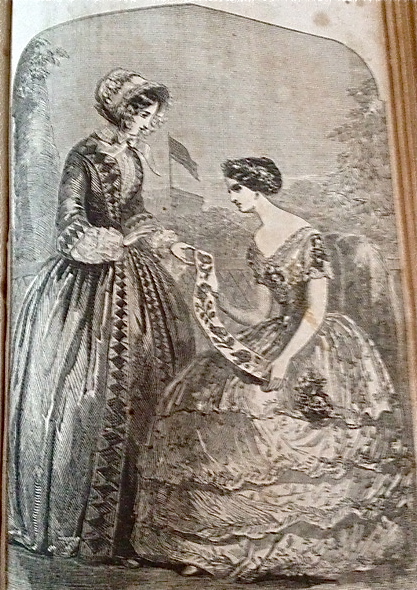
Poplin was a popular cotton fabric in the nineteenth century. It was smooth, lightweight and finely woven, more refined than broadcloth, although they were not dissimilar in weave. Both were sturdy and today both are often used for men’s shirts. The dress on the left in the illustration above was a day-dress and probably similar in shape and weight to the poplin dress Evelina bought, perhaps with less trim. The undersleeves were a particular feature of women’s dresses right before the Civil War.

The dress on the right was not something that Evelina would have purchased for her mother, or even for herself at this stage in her life. It was an evening dress with a stylish flounced skirt that would have been entirely too “jeune fille” for old Mrs. Gilmore.

* Spring fashions from Godey’s Lady’s Book, 1851


May 8, 1851


image


Thursday May 8  Went to Boston and walked around

all day trying to find a bonnet but could not get

one to fit me ready made. Engaged to have one

made of blue plaid silk at Alfred Remick & Co.

Went with Oakes Angier to call on Mrs Stevens

She spent the night with me at Mr Orrs

Julia was at home and a Miss Orr a cousin or hers,

was there & Miss Foule dress making


Evelina left off gardening today to go bonnet-hunting in Boston, for it was the season to switch from winter to summer headware.  She searched from store to store and must have visited a range of establishments running from small millinery shops to larger dry goods stores.  She would have seen bonnets displayed on mannequin heads such as the one in the illustration above.  Try as she might, however, she couldn’t find one she liked, so she ordered one instead.

Alfred Remick & Co was one of many dry goods merchants in the city. In 1851, Boston was a premiere center for the dry goods trade, according to the Boston Board of Trade, which reported years later that “according to our extensive New England domestic manufactures, Boston was from 1830 to 1850 the chief Dry Goods market of the country.” * Boston had lost that dominance by the outbreak of the Civil War and, with the ongoing and rapid settlement of the west, the competitive reach of rail freight traffic, and the impetus to widespread manufacturing brought on by the war, Boston never regained its preeminence.

Such concerns were not in Evelina’s mind, however, because she needed a new bonnet and couldn’t find one. After finally placing her order, she and Oakes Angier, the eldest son who carried her into town, called on a family friend, Mrs. Stevens.  As usual when staying in Boston, Evelina spent the night at the Orrs’ house.

*Annual Report of the Boston Board of Trade, Merchants Exchange, 1881, Vol. 128

May 3, 1851

_O7J0613


*

May 3d Saturday  Early Orinthia & I went to work on the flower

beds to lower them.  We cut the center bed down

about three or four inches and have got some of

the others done I worked most all the forenoon

moving plants Have been to N Bridgewater this

afternoon with O A & Frank Have engaged 

a new bedstead for my chamber and a small one

or a lounge in the dark bedroom  


Although we don’t know how Evelina arranged the flowers in her garden, she gives us a clue today about the overall formation of her plantings.  She and Orinthia Foss worked on a central bed with other beds placed around it.  This kind of design was very common in the 18th century and into the 19th. It could well have been the pattern of a garden that Evelina’s mother-in-law, Susannah Angier Ames, might have started in the yard.  Susannah had died five years earlier; Evelina could have inherited the design and was in the process of making it her own. Sarah Witherell, her sister-in-law who lived in “the other part of the house,” was apparently less interested in gardening than Evelina, so Evelina made most of the decisions about the flower beds on the property.

Any good gardener knows that personal flower gardens are as unique as snowflakes.  No one is exactly alike. Even a repetitious scheme with a central bed surrounded by a formation of other beds will differ from gardener to gardener.  Some central bed gardens have each bed replicate the plantings in the other beds, so that a particular pattern of flowers is repeated.  Other central gardens, such as the John Jay garden in the illustration above, feature different groupings in each square.

How did Evelina approach her garden?  We might guess that her taste was broad and reactive rather than predetermined.  She planted a wide variety of flowers, so her garden undoubtedly featured a sampler of colors, shapes and textures.  Certainly, her taste was less formal than her sister-in-law, Sarah Lothrop Ames.  At their property next door, particularly after they built their new house in 1863, Oliver Jr and his wife hired a gardener and cultivated more modern Victorian plantings. Their gardens were probably less rambunctious than Evelina’s, featuring formal walkways, lengthy borders and other haute designs.  Anyone who knows their house, Unity Close (which still stands today), will know that later generations of Ameses, under the guidance of landscape architect, Fletcher Steele, built upon that landscape.

On another front entirely, Ralph Waldo Emerson gave a speech today in Concord on abolition.  That speech is in the collection of the Concord Library, should anyone care to track it down.**


*18th-19th c. garden at John Jay Homestead Historic State Park, New York, from themarthablog.com

**concordlibrary.org/scollect.Emerson_Celebration/Em_Con_39.htm/ 

April 30, 1851

Boot

1851

April 30 Wednesday  Hannah came with Augustus in the stage

and Eddy came with them  I fear she did not 

have a pleasant visit Eddy was not well and very

troublesome. We called at the shoe shop and

at Mr. Torreys.  Abby came home with us to tea

I have sewed some on Susans borage dress but

have not been able to do much. The weather is

pleasant but rather windy


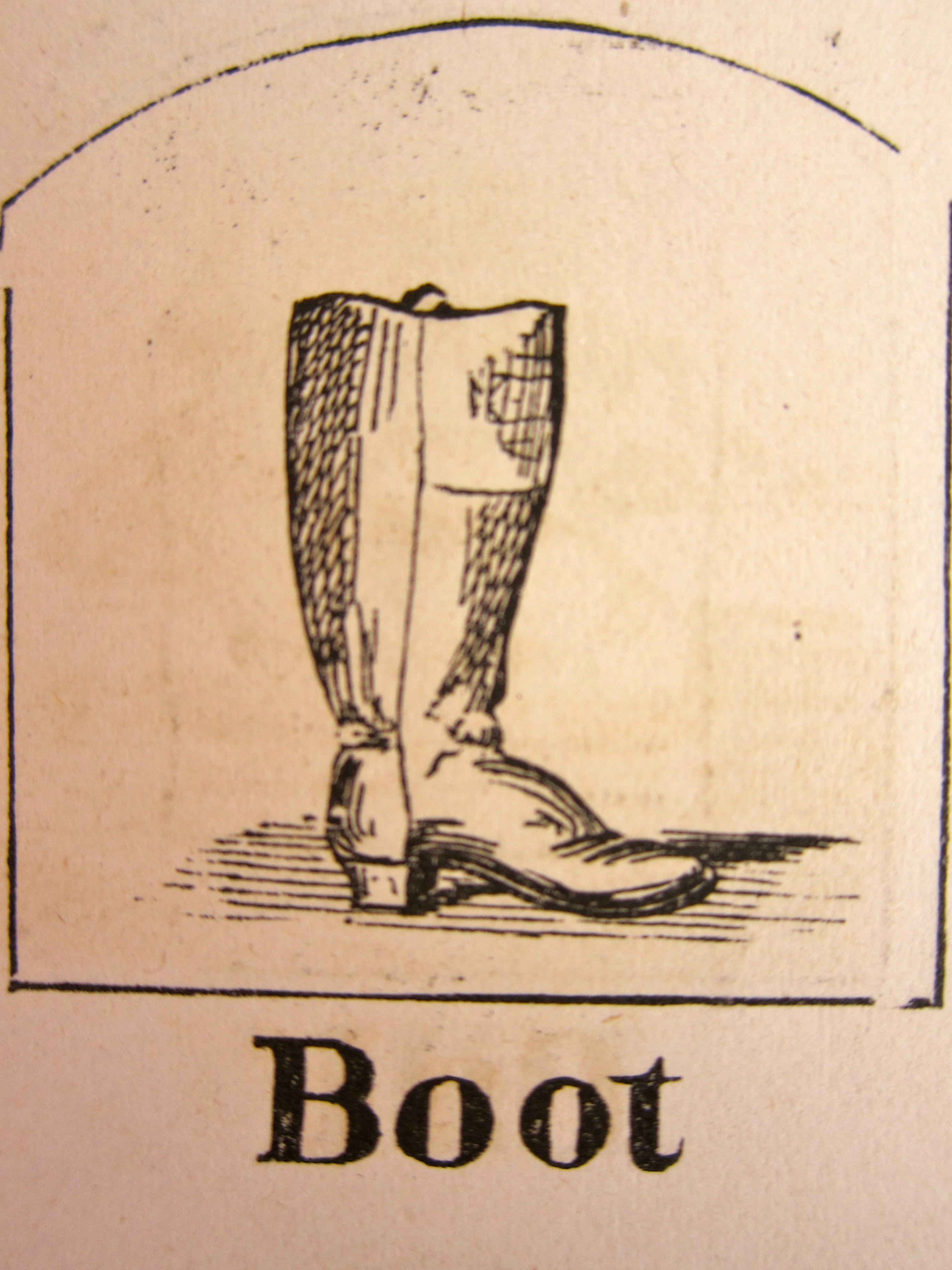
The reason for Augustus Gilmore’s continued presence at the Ames home became clearer today. The boot factory (or shoe shop, as Evelina called it) that Augustus had been working to establish was now up and running. Oakes Angier was an original partner, according to Chaffin’s History of Easton:

“In 1851 there was organized in North Easton the firm of A.A. Gilmore & Co., the other members of the firm being Elisha T. Andrews and Oakes A. Ames. They manufactured fine calf-skin boots in a building owned by Cyrus Lothrop. Oakes Ames succeeded to the interest first owned by Oakes A. Ames. In 1870, Messrs Gilmore and Andrews bought out Oakes Ames. This firm, which for some time did quite an extensive business, gave up the manufacture of boots in 1879; but the firm did not dissolve until death broke up the long partnership, Mr. Andrews dying in 1883.” *

The manufacture of shoes was an important industry in southeastern Massachusetts, particularly in the nearby towns of Randolph and North Bridgewater (soon to be known as Brockton). One theory is that shoe-making grew out of a cottage industry begun in the late 18th century, a thrifty, small, household-by-household effort to augment the meager income from subsistence farming by making shoes. It was one way to use the leather from the farm animals who were slaughtered.

New England as a whole was a major producer of shoes throughout the nineteenth century, “with Massachusetts alone responsible for over 50% of the nation’s total shoe production through most of the period.”** The trade continued well into the 20th century, with organizations such as the New England Shoe and Leather Association and the Boston Boot and Shoe Club championing the industry. Some leather manufacturing continues today in the region.

It only made sense that Easton, bustling as it was with the manufacture of goods such as shovels, mathematical instruments and, soon, hinges, would participate in the regional trade of shoe-making. That members of the Ames family were involved seemed to make sense, too.


* p.598

**http://www.albany.edu/history/ej/origins.html


April 15, 1851

images-1


1851

April 15 Tuesday  Oakes A 22 years old. This morning

tore the paper off the dark bedroom & had it cleared

ready for the paper.  Have been working about 

the house most of the day.  Cut of[f] the breadths of

the carpet for the bedroom and have partly 

made it.  Moved the stove from my chamber

& cleaned the dark bedroom chamber.  It is 

quite stormy & windy.  Cut two coarse shirts.


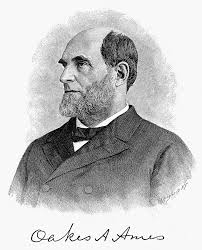
Oakes Angier Ames, eldest son of Evelina and Oakes Ames, was born on this date in 1829, when Evelina was 19 and Oakes was 25. The couple had been married for about a year-and-a-half and were already settled into their own quarters within the Ames family homestead. On this, his 22nd birthday, and as yet unmarried, Oakes Angier was still living in the house in which he had been born.

Oldest of all 24 grandchildren of Old Oliver and Susannah Ames, Oakes Angier grew up amid multiple siblings and cousins, among whom he retained primogeniture in an uncontested patriarchal hierarchy. His mother called him Oakes Angier; everyone else seemed to call him just plain “Oakes.” He was marked from birth to run the family business.

Although Oakes Angier had attended school locally and away, at Fruithill and Leicester academies, he left behind no indication that he longed to further his studies. After graduation, he went straight to work at the shovel factory. There, one 19th century historian noted,  “with a view to making himself master of the process of manufacturing shovels, he spent from three to six months in each of the various departments of the factory.”*

Reverend William Chaffin, Unitarian minister and town historian, knew Oakes Angier and his family well. He described Oakes Angier as “shrewd, conservative [and] sound in judgment.”* Although in their later years Oakes Angier shared the responsibility for O. Ames & Sons with his brother Oliver (3) and cousin Fred Ames, Chaffin makes a point of noting that to the shovel shop employees, Oakes Angier was the man who embodied management.  It was Oakes Angier who was on the ground overseeing the daily operations during the company’s most ambitious years, Oakes Angier who was “one of the superintendents who superintends.” He ran the place.

The same historian who wrote of Oakes Angier mastering the process of shovel manufacturing also described him as someone who stayed focused on his immediate responsibilities and did not, like his brothers, cousin and father, diversify his pursuits.  As the 19th c. historian saw it, Oakes Angier gave “his whole time to the demands of his business, and yield[ed] to no temptation to embarrass himself […] by the complications and annoyances which beset the paths of the politician, and of the projector of enterprises outside of his legitimate occupation.”* In other words, Oakes Angier learned to avoid both politics and risky investments.

On this particular birthday, Oakes Angier was on the cusp of adulthood, preparing to leave the nest. He spent many free evenings squiring different young women to and from the dances and sings that were available in the neighborhood, seemingly ready to find a young woman to settle down with. He and his brothers were what some parents would have described as eligible young men.


William Thomas Davis, ed., The New England States, Vol. I, 1897.
 

April 14, 1851

Coffin

1851

April 14 Monday  Julia Mahoney has been here to day

to work on my foulard silk It is bad to 

work on and she has not succeeded very well

but is coming again to finish it. Jane has

done the washing and her clothes dry

Orinthia has finished the shirt for Oliver that

was cut out March 31st Weather Pleasant

Mrs Witherell Mrs G Ames & Mrs S Ames called evening

In his journal today, Old Oliver noted that his son, Horatio Ames, was visiting. Although Horatio would have been, literally, under the same roof as Evelina and Oakes, Evelina didn’t mention his visit. She might not have seen him, of course, although she must have known he was in town and probably staying in the other part of the house.  Horatio, like their brother William, was on poor terms with Oakes and it appears that neither wanted to encounter the other.

Another heartfelt topic that found no tongue today was the anniversary of the birth of Henry Gilmore Ames, the son of Evelina and Oakes who did not survive childhood.  Henry would have been twelve years old today, but died at age two-and-a-half of an unrecorded cause.

In the future – 1876 in fact – family graves would be disinterred from their original locations and moved to a dedicated family cemetery behind the new Unitarian church on Main Street. Oakes Angier would oversee the relocation; among the graves moved would be the small one for Henry.  At the time, Oliver (3) made a few observations about the relocation, including one of the little brother they had lost: “Bro Henry was moved to day and his hair was as perfect as when he was buried. His hair was smooth and parted.”  Oliver (3) also noted that his father’s coffin was so heavy that it took seven men to lift it from its original resting place.

If Evelina remembered today’s date, she indicated nothing.  She was busy with overseeing laundry day (not that Jane McHanna needed any direction on what needed to be done,) as well as Orinthia Foss’s completion of one last men’s shirt, and Julia Mahoney’s sewing on her silk dress.  Many needles at work.