June 6, 1852

FullSizeRender

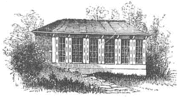
Office of Ames Shovels, ca. mid-to-late 1850s

1852

Sunday June 6th  Have been to meeting as usual

Mr Whitwell preached  Came home alone

with Mr Ames at noon Have read

but very little partly written a letter

to Oliver.  Mr Ames said he would go 

with me to Augustus’ to make a call but

he did not come from the office in season

Sermons, reading and writing filled Evelina’s day. She began a letter to Oliver (3), off at college.

It may have been the Sabbath, but that didn’t preclude Oakes and Oliver Jr spending time in the office next door to the house. The two men often met there at the end of each workday “to catch up with their correspondence (all letters were written and copied by hand), discuss business together and go over accounts with the head bookkeeper.”* That they met on a Sunday evening seems unusual, but it may not have been. The shovel firm was about to build a new, stone factory, one that would be more fire-resistant than the old one that burned down in March. These plans were being developed even as the business was in swing, making shovels and filling orders. Oakes and Oliver Jr. were extra busy.

As had happened before, Oakes Ames forgot to take Evelina out as promised, or came home too late to go, so she missed a visit to her nephew Augustus Gilmore and his family. Was Oakes’s chronic oversight just absent-mindedness, or was he more consciously choosing to ignore social obligations when they proved inconvenient? And how did he make it up to his wife?

Winthrop Ames, The Ames Family of Easton, Massachusetts, 1938, p. 129


June 5, 1852

tbl00064-2

1852

Sat June 5th  Mr Scott has been tinkering around in 

one place and another to day  has worked part

of the day here and this afternoon Holbrook

and another man came and put a coat of

paint on the plastering in the entry chamber

and whitewashed Franks chamber & painted

the closet I cut out two of the shelves and 

the shelves in my chamber closet.

Mrs Patterson here

Consul & slab came

and Olivers furniture


The dependable Mrs Patterson was on hand again today, as workmen tinkered, plastered and whitewashed different areas of the house. Evelina herself tinkered with the shelves of her closet in the master bedroom, cutting away two of them, perhaps to make room to hang clothes rather than fold them.

The arrival of new furniture from Boston was exciting for both Evelina and Sarah Lothrop Ames. Evelina and Oakes were to have a new console table – probably for the parlor – with a slab of stone – probably marble – on top. The Oliver Ameses next door got a delivery of new furniture, too.  The families were upgrading. It must have taken an industrial-strength wagon pulled by oxen to bring the pieces out from the city.

The delivery wagon had a “fair day”* for its route, and Old Oliver Ames had a good day to watch the new sills “for the cariage hous”* being laid down. He did enjoy building things, and his daughters-in-law enjoyed furnishing them.


*Oliver Ames, Journal, Stonehill College Archives, Arnold Tofias Collection

June 4, 1852

images-1

The El Dorado Gambling-Saloon and the Jenny Lind Theater, San Francisco, ca. 1852*


Friday June 4th  Mr Scott has varnished the Oilcloth

in the dining room this afternoon and painted

the cellar way and commenced on the entry

chamber  I have been all day waiting on

him and getting the rooms in order to paint

and varnish  Dining room whitewashed

I shall be thankful when we get through

with painting

Probably every member of the Ames family – not just Evelina – was going to be thankful to be “through with painting.” Lately there had been too much disruption at the Ames compound; getting the rooms back in shape would help life get back to normal.

Disruption being a part of life, it was happening on a civic scale in the city of San Francisco right at this time.  The newspapers called it the Jenny Lind Swindle, so disfavorably did they regard the situation. The city government had just purchased the recently established Jenny Lind Theater to be made over into their administrative offices, or “business chambers,”* the previous city hall having burned down the year before.

Built by an illiterate but entrepreneurial cabbie and bartender from New York named Tom Maguire, who was “profoundly ignorant of the stage,”* the Jenny Lind Theater had nonetheless opened the previous fall with much acclaim for its “handsome” interior. Within its “exquisite” walls, “the rowdy populace embraced” shows as diverse as Shakespeare and burlesque. Exactly why Maguire sold the building to the city is unclear – the need for money comes to mind – for he went on to build another elsewhere in town.

The cost of renovating the theater into office space was considerably greater than the acquisition of alternative sites, and the purchase of it with tax dollars was considered “scandalous.” “The public was growing very clamorous, the more so perhaps because it was impotent,” noted a contemporary commentator on the subject. In early June, a great crowd gathered in protest, and a heated debate ensued between a council member and a spokesman for the citizens. The venting was fractious, but didn’t change the plan. The city council moved into its new quarters as planned; ironically enough, the theater space was soon found to be too small.

Did Evelina read about this in the Eastern papers? Did Oakes? California and its politics must have seemed very far away, yet Oakes would soon play a key role in connecting California to the East Coast by way of a transcontinental railroad. Who knew?


*Annals of San Francisco, 1855  Image courtesy of foundsf.org


May 27, 1852

very_rare_miniature_19th_c_pennsylvania_stoneware_preserves_jar_perfect_cond_1_thumb2_lgw


Stoneware or “earthen” jar 

1852 Thursday May 27th  We have cleaned the buttery

to day and we have had a hard job of it.

I have scalded my preserves have several 

lbs of citron & some quince & peach and

this afternoon have given my chamber a

thorough sweeping and washed the paint where

needed.  Have set out some plants from the

house.  Mr Ames went to Canton

The buttery or pantry area off the cook room got cleaned today, and the cleaning wasn’t easy. The women surely had to contend with hardened spills, grease residue and hidden dust pockets. They also would have had to move every bottle, jar, bowl, plate and pan out of the way in order to properly clean the shelves.

In the midst of this domestic upheaval, the women inspected the store of preserves and found that “several lbs of citron & some quince & peach” hadn’t kept well. They were beginning to ferment. To be saved, they needed to be scalded.

Lydia Maria Child, a multi-talented and rather opinionated author, wrote about “Preserves &c” in her classic household guide, The American Frugal Housewife.*  To begin with, she disapproved of preserves, noting that “[e]conomical people will seldom use” them.  “Let those who love to be invalids drink strong green tea, eat pickles, preserves and rich pastry,” she scolded.

But while preserves (and jam and jelly) were expensive and unhealthy, Mrs. Child knew that housewives would persevere in making and serving them.  Preserving fruit with sugar was a practical way to extend the life of a favorite fruit after the crop had ended and to do it in a way that gratified the common human sweet tooth. Resigned to popular preference, she included instructions for dealing with preserves that were going bad:

“When you put preserves in jars, lay a white paper, thoroughly wet with brandy, flat upon the surface of the preserves, and cover them carefully from the air.  If they begin to mould, scald them by setting them in the oven till boiling hot.  Glass is much better than earthen for preserves; they are not half as apt to ferment.”* Evelina evidently disagreed with Mrs. Child about the value of preserves, but no doubt she followed a proper procedure for bringing the preserves back from the bad side of the pantry.


*Lydia Maria Child, The American Frugal Housewife, 1829, p. 59

May 26, 1852

Bird

1852

Wedns  May 26th  Jane has done part of the ironing  I have

put down the carpet in the front chamber & sitting

room and the bedroom carpet partly down and 

got the rooms in pretty good order  Mr Scott

& Holbrook commenced painting in the other

part of the house yesterday   Mrs Patterson

staid at home to do her washing & ironing

Mr Ames went to Bridgewater West


Spring cleaning continued; Evelina laid carpet today, often one of the last chores on the list. She could almost check the sitting room off the list, and seemed pleased that the house was “in pretty good order.”

Another spring ritual, this one involving bird hunting, may or may not have taken place on this date; by 1852, it may have been outlawed.  But the hunt, which always took place on the last Wednesday in May, was recent enough to have included various Ameses, if we assume they chose to participate.  Town historian William Chaffin describes the ritual in his 1886 History of Easton:

“At different times in the history of the town rewards were offered for killing crows and blackbirds, which were supposed to be very destructive to corn […]

“Scarcely two generations ago [which would place the event somewhere as late as the 1840s] the custom prevailed of young men choosing sides, and each side on a given day starting out and killing all the birds they could. The day chosen was the old ‘Election day’ so called, the last Wednesday in May, once the time for the convening of the State Legislature, and which came to be known as ‘Nigger ‘lection.’  It was one of the greatest holidays of the year for the boys. […] [T]hose taking part in the shooting started out at daybreak and killed as many birds as possible.  They usually met at some appointed place before dinner, to count the birds and see which side had won the victory.  In North Easton, the rendezvous was at Howards’ store […]

“The understanding was that only harmful birds should be killed; but it was easy to include nearly all birds in this category, because, it was argued, bobolinks and swallows destroyed bees, and robins stole cherries, etc. In some places the party beaten paid for the dinner and drinks of all.”*

In the 21st century, it’s difficult to fathom both the wanton waste of this offensively-nicknamed holiday, and the glee that evidently accompanied it. That hunting has an appeal, we don’t question, but that songbirds were the quarry is hard for modern folks to accept. **


William Chaffin, History of Easton, Massachusetts, 1886, pp. 776-777

** This editor freely confesses to being a birder and particularly fond of bobolinks.

May 17, 1852

180px-Beekman_greenhouse

Mid-19th century American Greenhouse*

1852

Monday May 17  Finished planting my flower seeds

Mr Blodget here to dine from Boston

This afternoon have been to Mr Kinsley with

Mr Ames.  Miss Nevill there from Salisbury.

Brought home twelve pots of flowers from

their green house.  The grapes & flowers look

finely  Had a very pleasant visit got home

about dark

Evelina enjoyed herself today. It was lovely outside, for “the sun shined about half the day + was pritty warm wind west + south west.”** She gardened for much of the morning and in the afternoon, rode with her husband, Oakes, to Canton to call on the Kinsley family.

Lyman and Louisa Kinsley, whom we’ve heard of before in Evelina’s diary, were about the same age as Oakes and Evelina. They had two children, Lucy Adelaide and Edgar Lyman, who were twelve years apart, suggesting that there may have been other children born between the two. Lucy was close in age to Oakes Angier, and Edgar was a year or so younger than Susie.

The Kinsleys were prosperous; Mr. Kinsley ran an iron business that had been started by his father and had long supplied material for Ames shovels. The Kinsley Iron and Machine Company would eventually be bought by the Ameses and managed by Frank Morton Ames. That being some years in the future, the Ameses could sit and admire the Kinsley place with little thought of acquisition – perhaps. Certainly, Evelina was much taken with the Kinsley greenhouse and the “twelve pots of flowers” she got to take home.

Greenhouses such as Mr. Kinsley’s were becoming more popular in the mid-19th century, particularly in England after the government there did away with the heavy tax on window glass. Hothouses had been known previously on this size of the Atlantic, also, appearing in the colonies as early as 1737, when wealthy Bostonian Andrew Faneuil built one. George Washington, too, had one built at Mt. Vernon to grow pineapple. Greenhouses would increase in size, status, and grandeur as the century progressed. Easton would see its share when the next generation of wealthy men reached maturity. Frederick Lothrop Ames, Edwin Williams Gilmore and probably others would raise orchids and more in the glass-walled wonders.

*Greenhouse from Beekman Estate in Manhattan, circa 1850

**Oliver Ames, Journal, Stonehill College Archives, Arnold Tofias Collection

May 16, 1852

lclapp-1

1852

Sunday 16th May Mr Whitwell preached a funeral sermon

and very good  At noon mother Henrietta

and self spent at Mr Whitwells  After meeting

Mr Ames Susan & I rode to Mr Clapps made

quite a long call  he has but a very few 

flowers in blossom, pansys were very pretty

Have engaged a trellis of him

The last formal recognition of the death of fourteen year old George Witherell took place in the Unitarian church this Sunday when the minister “preached a funeral sermon.”  Different from the ritual text that probably defined the graveside service just three days earlier, the sermon was presumably a collection of thoughts about death in general and the death of the young man in particular.  Reverend Whitwell knew the family well and, being an articulate and thoughtful wordsmith, must have offered the family some personal comfort and consolation.

Evelina appeared to be recovering her strength. With her husband and daughter, she rode to Stoughton after church to visit Lucius Clapp, where they made “quite a long call.” Evelina discussed flowers and a trellis. Was this trellis ordered in place of the one at the front door that was being built only ten days earlier?  Or was this a new trellis entirely, designed perhaps for the garden?  Was this the year of the trellis?

One imagines that Oakes Ames offered less direction about the trellis than his wife.  What he might have preferred to discuss with Lucius Clapp was their shared interest in the Whig party, or their mutual respect for temperance.  According to one nineteenth century historian, Mr. Clapp was a “kind-hearted”* man with a “modest and retiring nature.”* His politics were informed and liberal:

Formerly a Whig, Mr. Clapp has been identified with the most progressive political creeds. He was one of the original Free Soilers, and chairman of the first Free-Soil meeting held in Stoughton. Since its organization he has supported the Republican party. He has been [a] member of school committees several years, and selectman of Stoughton seven years, and now (1883) holds that position. He has always been pronounced in advocacy of temperance, and has been connected with every movement for the betterment and advancement of his native town. He is an attendant and supporter of the Methodist Episcopal Church.”*

Mr. Clapp and Mr. Ames would have had much to talk over.


*D. Hamilton Hurd, History of Norfolk County, Massachusetts, 1884, pp. 424-425

May 14, 1852

Susan Eveline Ames French

Susan Eveline Ames (French)

1852

May 14th  Susan ten years old to day.  Her father & 

I have promised her 10 dollars each if she will

be a good girl and keep herself neat till her

next birth day.  Have been to work some on

Susans delaine dress altering it The gardener

laid out my verbena and I set out some slips

From the house  Malvina came to stop the night

Helen had her face lanced  Not pleasant


Last year for her birthday, Susie Ames had a little party.  Not so this year, her birthday coming too close on the heels of the death of her cousin George Witherell. Instead, her parents made her a generous promise of “10 dollars each,” if she behaved well and kept “herself neat” for the next year. Those were high expectations for a child, even a Victorian one.

Next door, Helen Angier Ames was still suffering from her own difficult ailment, that of a swollen face. Was it an abscess, or a boil, or something else? The doctor came again to see her and this time lanced her face. Not a pleasant procedure, one imagines. Otherwise, in the main house, family members seemed to be settling back into the normal domestic routine.  Eveline sewed and gardened; her verbena and more went into the ground, despite the continued stormy weather.


May 4, 1852


IMG_0159

Trellis on the door of the home of Oakes and Evelina Ames and extended family, ca. 1860


Tuesday May 4th  Mr Healy & Morse commenced the trellis

for our front door  We had quite a consultation how it should

be made  I[t] was very cold & windy this morning & I fear I

have taken cold in being out so long  Have mended Olivers

sack and cut the pattern and have done some other mending

Augusta made a long call. It is really very pleasant to have

her so near.  Mrs S Ames went to Boston

The trellis that Evelina refers to today could very well be the modest trellis that graces one of the doors in the above photograph. The doorway facing the street in the approximate middle of the photograph was the door that Evelina, Oakes, and their family used for their own. The doorway on the far left, facing the yard, was likely the entry that Old Oliver and his daughter, Sarah Witherell, used. The house on the far right was a separate dwelling that belonged to Oliver Ames Jr. and his wife, Sarah Lothrop Ames.

None of these buildings is still standing. The one on the far right was torn down in 1863 and replaced by a larger, more formal house that is still extant today, with lovely gardens and a well-kept air.  The house in the center, halved on the interior to accommodate the two households of Evelina and Sarah Witherell, was torn down in the 1950s, at the behest of Oakes Angier Ames’s eldest son, Hobart Ames. The site has since been reclaimed by trees and undergrowth.

The trellis was meant to add a fashionable air to Oakes’s and Evelina’s side of the house. Evelina was trying to bring the simple, old Federal dwelling into the Victorian age, inside and out. She had a particular vision for her home, and she worked hard to realize it. Small wonder that the construction required “quite a consultation.”


April 20, 1852

Freshet

Tues April 20th

1852  Storms again to day and nearly as hard

as yesterday.  rained poringly last night

Mr Packard came at half past three and Mr Ames

went to the hoe & knife shop to raise planks 

the water being very high  The highest that

has been known for years  Augusta spent

the afternoon  Worked all the forenoon cleaning

out grease from the buttery

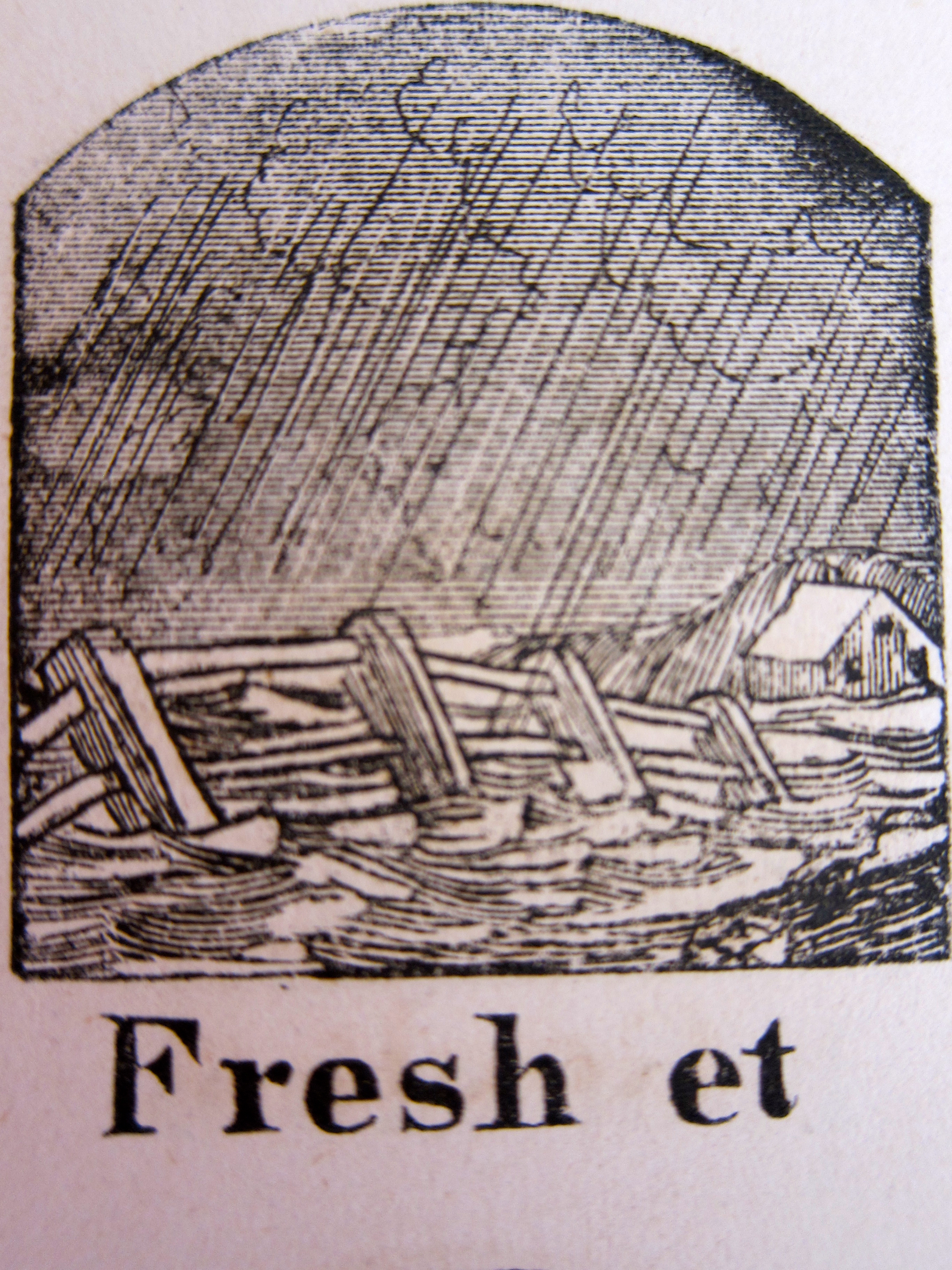
The Nor’easter continued.  The Queset Brook, which ran behind the Ames compound, the Shovel Shop Pond and other local bodies of water threatened to overflow under the deluge of rain. The water came down “poringly” and, according to Old Oliver, “it raind about all day.”* To use a word that is not often encountered in the 21st century, a freshet was imminent.

A freshet is a sudden overflow of a creek or stream brought on by a heavy rain and/or the sudden melting of snow. It was a potential hazard that people who lived near waterways worried about every spring, and on this day the fears of such folks in Easton came close to being realized.

The water rose “the highest that has been known for years,” threatening to flood the hoe and knife shops. The men, led by Oakes Ames, responded quickly to adjust the wooden planks at the site of the dams on the pond. Local historians Dwight MacKerron and Frank Mennino corrected this editor’s initial misinterpretation that raising planks meant lifting machinery off the floor, the latter suggesting instead that:

“raising the planks referred to actually allowing water to leave the ponds under a controlled flow via a secondary sluiceway that was employed in most dams just for that purpose. In the case of the hoe shop there was a man made canal that would serve that purpose. It takes pressure off the dam, and might avert a catastrophic failure which would certainly have severe consequences.”

Sydney Packard may have been the man who came to assist Oakes. He was a 40 year-old father of eight and long-time employee of O. Ames & Sons.  Some twenty years later, Packard would be one of the pallbearers at the funeral of Oakes Ames.

So far in 1852, the Ames family had endured first fire and now flood, and their troubles were not over.

Thank you, Dwight MacKerron and Frank Mennino for your input on the workings of waterways of North Easton.