September 7, 1851


Ames Home and Office, North Easton, Massachusetts ca. 1852 - 1862

Ames Home and Office, North Easton, Massachusetts
ca. 1852 – 1862

*

Sunday 7th  Have been to meeting all day  Mother

Mrs Stevens & I went to Mr Whitwells at

intermission Mrs Whitwell made a cup of tea

for us, brought mother home with us from meeting

at night  Mr Ames & I called at Mr Swains

Mr & Mrs Peckham are to leave tomorrow for

Taunton & the children & Mrs Metcalf  Thursday

The weather is very warm  Gave Mrs Stevens

some cuff pins it being her birth day.

Despite today’s heat, Evelina and her guest Mrs Stevens, and others of the Ames family, presumably, attended both morning and afternoon sessions of church. When the last service was over, they carried Evelina’s 79-year-old mother, Hannah Lothrop Gilmore, to North Easton to stay for a few days.

An important transition was taking place this week at the shovel works.  John Peckham, former clerk, and his family were leaving for Taunton.  His place in the Counting Office was being taken by John Swain, whom Oakes and Evelina went to visit late in the day.  Swain and his wife, Ann Meader Swain, probably hailed from Nantucket.  They had connections in North Easton, but the move to a new abode was still a big change for the young couple. Oakes, with his wide-armed jocularity and Evelina with her easy, approachable manners, must have made the Swains feel welcome.  Over the years, their friendship would solidify.

Many decades later, when Ann Swain was the only one of the foursome still alive, she told historian and minister William Chaffin about the special relationship between John Swain and Oakes Ames:

“…[H]er husband had his regular salary supplemented by an addition from Mr. Ames. Mr. Swain did more or less work for him, besides the regular office work when he was head clerk. Mr. Ames was not very methodical and his transactions for the day in Boston, jotted down in a notebook rather hastily, would sometimes be in a tangle when he came to the office in the evening (office work in those days always going on in the evening), and he would say to Mr. Swain, ‘Come, John, you help me straighten out these things.’ In common with all the persons who served him Mr. Swain had a strong affection for Mr. Ames.”**


*Ames Homestead with Counting Office on far left.  Residence demolished in 1951.

**William Chaffin, Oakes Ames, private publication                                   


September 6, 1851

shopping

Sat Sept 6th  Alson brought Mrs Stevens before we

were up this morning left his carriage here

while he went to Boston.  We went into Olivers

& passed the afternoon with Mrs Latham & Mrs W & Mrs

Mitchell I called on Mrs Peckham while the others

went to Mr Manly’s garden  Mr Ames brought home

some cuff pins for Alsons wife & Mrs Stevens

Evelina was probably pleased today to lapse back into a sociable, summer agenda.  Family friend Mrs. Stevens arrived at dawn, it would seem, delivered by Evelina’s brother Alson Gilmore on his way into Boston. The two women later went next door to call on Sarah Lothrop Ames and were joined by sisters-in-law Sarah Ames Witherell and Harriett Ames Mitchell and the former’s houseguest, Mrs. Latham.  Chat, chat, chat.

As they had done occasionally throughout the summer, many of the women went up to look at the flowers in Edwin Manley’s garden. The blooms they saw would be among the last for this year.  Evelina eschewed that walk (or ride) and went instead to call on Susan Peckham, wife of John Peckham, clerk for the shovel company.  The Peckhams were about to move, so perhaps Evelina went to see what help she could be, or to say goodbye. Susan Peckham must have been packing things up, a chore that would have made Evelina, who was lately familiar with the bustle of departure, feel right at home.

Oakes Ames spent the day in Boston, as he did almost every Saturday.  He went on business for the shovel company, often returning with orders or payments.  Just as often, he carried out particular errands for his wife.  Yet it’s not clear whether she or he or both, perhaps, suggested the purchase of cuff pins (perhaps what we call cuff links) for Mrs. Stevens and Henrietta Williams Gilmore.  Both women had birthdays around this time.

September 4, 1851

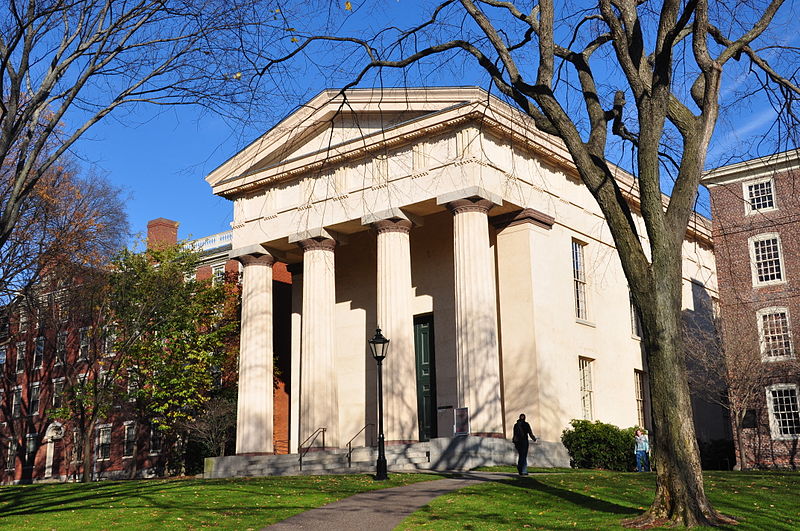
800px-Manning_Hall,_Brown_University,_Providence,_Rhode_Island_-_20091108

*

Thurs Sept 4th  This morning Orinthia left for Maine

& Pauline for Roxbury in the stage.  Mr Ames &

Oliver via Mansfield to Providence.  Oliver is

delighted with the idea of going to school & I am

sure he will improve his time  It seems

very lonely to day I have taken the bedstead down from

the boys chamber to clean it swept the parlour & washed

most all the windows in the lower part of the house both sides

Guests and family departed the Ames compound in North Easton today. Schoolteacher Orinthia Foss left to return to Maine, probably to Leeds where her parents and two younger siblings lived.  Houseguest Pauline Dean, left, too, taking the stage with Orinthia as far as Roxbury. Her final destination was unknown.  The most noteworthy departure, however, was that of 20-year-old Oliver Ames, middle son of Oakes and Evelina.  He was going to college.

Oakes Ames, after having resisted giving his son a college education, had evidently made a decision to let Oliver go. Father and son traveled together to Providence.  Perhaps Oakes helped his son find his living quarters, perhaps he explored the campus at Brown in an attempt to know it for himself, if he didn’t know it already. Sarah Lothrop Ames’s brother from Detroit, George Van Ness Lothrop, had once attended the school; Oakes and Oliver must have known that.

Established in 1764, Brown was the third oldest college in New England. Manning Hall, the neoclassical building shown in the photograph above, was the newest building on campus. No doubt it was a building that Oliver went into often, for it held both the library and the chapel. The president of the college at the time was Francis Wayland, a Baptist minister, who was stern but beloved and progressive.

As Evelina noted, Oliver was immensely pleased to be going to Brown, and she, in turn, seemed pleased for him. She was confident that he would study hard and do well.  Her pride didn’t protect her from feeling
“very lonely” today, though.  Choring was the only antidote she could imagine to liven up the quieter house.


Manning Hall, Brown University, Providence, Rhode Island

August 20, 1851

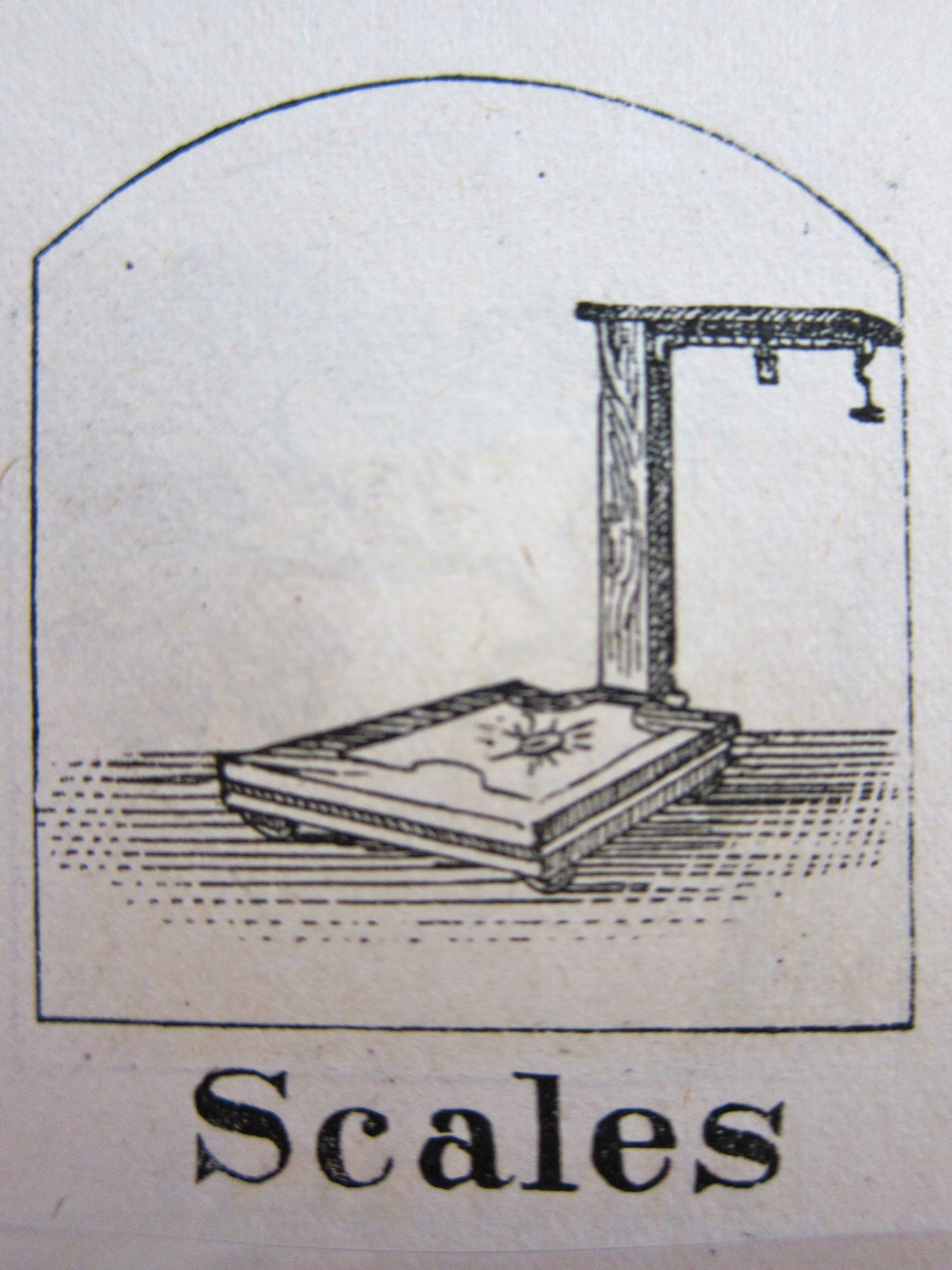
Scales

Weds 20th Aug  Rachel, Lavinia and Augusta Pool spent

the day here  Mr Ames and Augustus went to Boston

Pauline Dean came to night in the stage

appears the same as she did when she left

Went to the store & was weighed  148 lbs

called at the factory to see Edwin work and he came to

tea  Mr Whitwell called while we were gone

Not shy, Evelina stepped on the scale at the company store.  Fully clothed in the voluminous fashion of the day, she weighed 148 pounds. Given that her dress was full-skirted and worn over a chemise, undersleeves and petticoats, and that she wore a bonnet and most likely kept her hose and shoes on, her actual weight was probably several pounds less than she reported.  She likely weighed closer to 140.

Evelina missed a visit from Reverend Whitwell today, as she was out and about with young female company.  Two nieces, Lavinia Gilmore and Rachel Gilmore Pool, came over with Rachel’s sister-in-law, Augusta Pool.  They were ages 19, 21, and 22, respectively. They visited the store, shopped, perhaps, and watched their aunt get weighed. Perhaps they got weighed themselves. It might have been a lively time as they chatted and moved back and forth.

From the store the group traipsed to the shovel factory to watch Evelina’s nephew and Lavinia and Rachel’s brother, Edwin Williams Gilmore, work – an unusual visit to say the least, and one that could only have been accomplished in the company of the boss’s wife. What did the workmen think?

Edwin, nearly 23, would not work at the shovel shop for long. By 1854 he would be manufacturing hinges along with business partners Oakes and Oliver Ames Jr., whom he would eventually buy out. All that was in his future; today he would join his sisters and their friend Augusta for tea at his aunt’s.

August 18, 1851

Churn

Monday Aug 18th  Jane washed this morning and had Ellen

to assist so I sat down quite early to sewing

cut out a chimise for Ellen to make

This afternoon went to Mr Whitwells to tea

Mr Ames was going to Bridgewater and I

rode there with him.  Called at Mr Harveys

to try to get some butter but she had none

to spare.  Hurried home expecting Pauline she did

not come  Mr & Mrs George Lothrop came to Olivers 

The new servant, Ellen, helped Jane McHanna with the laundry today. Evelina stayed out of the way and concentrated on her sewing, setting work aside for Ellen to do later. She needed another chemise.

In the afternoon Evelina went to the Whitwells’ for tea.  She had just been there the day before during the intermission between church services. Today Oakes accompanied her and the two went on from there to Bridgewater.  Evelina was hoping to buy some butter from a Mr or Mrs Harvey, but had no luck. Evidently no longer producing butter herself, she’s had to travel this summer to find it. Oakes, meanwhile, was on his way to Bridgewater on shovel business – or Whig politics.

Not yet alluded to in Evelina’s diary is the illness of one of Sarah Lothrop Ames’s brothers, Dewitt Clinton Lothrop. Clinton, as he was known, was deathly ill with typhus fever. Another Lothrop brother, George Van Ness Lothrop and his wife, Almira Strong Lothrop, had come back to town from Detroit on Clinton’s account.


August 14, 1851

IMG_2478

Thursday 14th  Worked about house awhile and then went

to sewing & fixing some work for Ellen cut a 

chimise for self &c. Charles Mitchell brought

Sister Harriet and Johnny from Bridgewater

Harriet has gone back to attend a party 

at Robbins pond tomorrow.  We all have an

invitation but I think I had best not go though

it would give me pleasure

Evelina put out some fabric today for the new girl, Ellen, to cut into pattern pieces. She noted that her sister-in-law, Harriett Ames Mitchell, came over briefly from Bridgewater with her middle child, John Ames Mitchell, but soon went back to prepare for a party.

Although his birthday went unmentioned in the diary, Frank Morton Ames, the third child of Evelina and Oakes Ames, turned 18 today. Taking his place in a patriarchal society behind two bright older brothers, Frank had to vie for recognition almost from the beginning. Like Oakes Angier and Oliver (3), Frank attended local and boarding school, in the latter case Andover, and had just completed his schooling the year before Evelina took up her diary.

Unlike Oakes Angier and Oliver (3), Frank was a troublemaker “who needed more discipline.”  According to historian William Chaffin, Frank and a friend once sneaked out of their respective homes, took a horse and buggy to a dance in Canton, and returned “very late.” When Oakes Ames learned about it, he and the other father, William S. Andrews, took their sons down to the shop where they “were horsewhipped in the presence of the workmen.”  As Chaffin notes, “Discipline was apt to be severe in those days.”*

One of the pleasures of Frank’s life was his participation in the local militia, a company of which was formed in 1852.  Again he had to stand behind a brother, in this case Oliver (3), who was made captain while he was appointed quartermaster, but eventually Frank made major. He resigned that position in 1860, by which time he was married and living in Canton.  Neither he nor his brothers served in the Civil War.

Frank would go on to have checkered success in several fields away from the shovel factory. With his brothers, he worked to rebuild his father’s reputation.  Despite the severity of treatment he had experienced from his father, he remained devoted to Oakes’s memory.

* William Chaffin, “Oakes Ames 1804-1873”, private publication


August 4, 1851

9999008697-l

[No entry]

Evelina made no entry today in her diary, for reasons we’ll never know.  Too hot? Too cross? Too busy? Too much laundry? We can only guess.

Instead of commentary, we’ve posted an image of the Ames family tree familiar to many Ames descendants, especially those who own copies of Winthrop Ames’s 1937 family history, The Ames Family of Easton, which includes a fold-out version of this illustration.  The tree features the lineage of the two Ames brothers who stayed in North Easton: Oakes and Oliver Jr., but doesn’t include the other sons and daughters of Old Oliver and Susannah who also produced issue: Horatio, William Leonard, Sarah Witherell and Harriett Mitchell.

Some readers have asked for clarification on who was who within the family. What follows is a list of the children and grandchildren of Old Oliver and Susannah.  More information about this group and their descendants can be found in a detailed family geneaology produced by William Motley Ames and Chilton Mosely Ames in the late 1980s.

Old Oliver and Susannah’s children and their children in birth order:

Oakes Ames and Evelina Gilmore Ames had five children:

Oakes Angier, Oliver (3), Frank Morton, Henry Gilmore (d. young) and Susan Eveline Ames

Horatio Ames and Sally Hewes Ames had three children:

Susan Angier, Horatio Jr., and Gustavus Ames

Oliver Jr. and Sarah Lothrop Ames had two children:

Frederick Lothrop and Helen Angier Ames

William Leonard Ames and Amelia Hall Ames had seven children:

William Leonard Jr., Angier, Oliver, John Hall, Amelia Hall, Fisher, and Herbert M. Ames

William Leonard Ames and Anna Pratt Hines had one child:

Oakes Keene Ames

Sarah Angier Ames and Nathaniel Witherell, Jr. had three children:

George Oliver, Sarah Emily, and Channing Witherell (d. young)

Harriett Ames and Asa Mitchell had three children:

Frank Ames, John Ames, and Anna Mitchell

Two other children of Old Oliver and Susannah, Angier Ames and John Ames, died without issue.

July 30, 1851

mUF4Adnn5IAX7hTvTfWXQXg

*

Wedns 30 July  Went to Boston with Cate & waggon had

a fine ride got to Mr Orrs about ten, went out

shopping untill dinner time  After dinner took Mrs

Orr with us to Mt Auburn and we rode & walked most

all over the grounds & went into the chapel  As we were

going through Brookline we stoped at the reservoir

and saw some fine situations in & about Brookline

Finally, Evelina got to go into Boston, a trip she had been trying to make for days now. She and Oakes rode into town in a wagon behind his horse Cate.  They trotted up today’s Route 138, past farms, fields and woods, through Stoughton, along Canton, into Milton and on into the city, approaching it by way of Washington Street. It was “a fine ride.”

After a little shopping and midday dinner with the Orrs, Evelina, Oakes and Melinda Orr drove to Mt. Auburn Cemetery, a new-style burial ground on the Cambridge side of the Charles River. Fashioned somewhat after the Pere Lachaise Cemetery in Paris, the twenty-year old cemetery had been the brain child of, among others, a Boston physician named Jacob Bigelow who felt that the practice of burying the dead under and right next to churches and meeting houses was unhealthy.  With the encouragement of the Massachusetts Horticultural Society and a designation of 70 acres from the Massachusetts legislature, Mt. Auburn Cemetery was created.

By carriage and on foot, Oakes, Evelina and their friend Melinda were able to go “most all over the grounds,” seeing paths, plantings, monuments and the Bigelow Chapel. They saw other landscapes of greater Boston today as well, including the brand new Brookline Reservoir.

*Pilgrim’s Path, Mt. Auburn Cemetery, 1851.


July 29, 1851

HD_Boston1851Z.preview-1

*

Tues 29 July  Mr Ames Susan & self were going to Boston

to day but it rains pouringly.  I am glad to see

it rain hard so that we know what to do about

going  I do not feel as disappointed as I did last 

week when it cleared off so pleasant  Have been

sewing and mending

Another trip to Boston called off by weather. Not only were Evelina’s plans put aside, but Old Oliver’s plans must have been challenged, too.  Haying had begun the day before and the rain not only obviated any further haying today, but also endangered the hay that had already been cut.

Evelina experienced an odd satisfaction today, pleased that the weather proved to be as bad as she had anticipated because it justified her choice not to go to town. Perhaps she wasn’t pleased so much as vindicated. As she had done last week, she turned to sewing and mending to fill the time that otherwise would have been spent in Boston.  Oakes Ames, meanwhile, presumably went on into the city to conduct business with various store owners who sold Ames shovels.

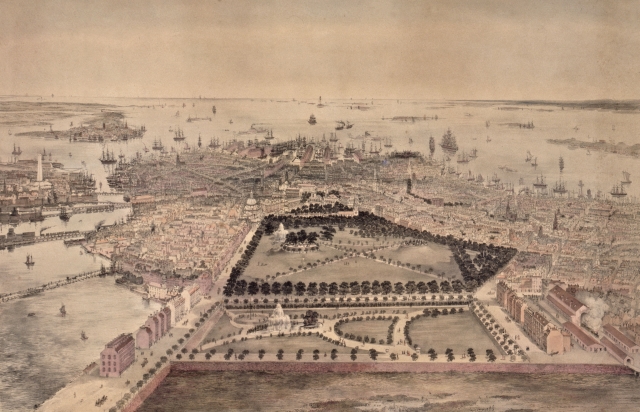
As the illustration above shows, Boston at this time had a much smaller perimeter than the city we know today. Back Bay was still a small bay of water, and the line of trees at the bottom of the illustration formed the western edge of the city, along the line that is now Arlington Street. The filling in of the water that would create the Back Bay grid of streets wouldn’t begin for another five or six years.

* Birds-eye view of Boston, 1851 


July 28, 1851

Bookcase

Monday July 28th  Was about house as usual this 

morning and have been mending some and fixing

some of Susans clothes  Oakes & Oliver (3) are

having a book case put up in their room by

Ira Ford  They have almost got books enough to

fill it  Julia is to work for Mrs Witherell

making her a purple morning dress

A young carpenter named Ira Ford built a bookcase at the Ames house today in the bedroom of Oakes Angier and Oliver (3).  The boys had acquired schoolbooks and other “books enough” and needed a place to store them all.

Like their mother and unlike their father, the Ames sons like to read. The middle son, Oliver (3), in particular, cherished reading. According to an unnamed eulogist in a memorial volume published in 1895,  Oliver (3) built up quite a collection of books in his lifetime: “In the company of books he found an absorbing pleasure, and to the library which he had begun to collect in his early age he made in later years large additions of rare and valuable volumes.”* After Oliver (3)’s demise, those books that weren’t kept by his family were auctioned off at Sotheby’s.


*Anonymous, Oliver Ames Memorial, ca. 1895, p. 38