December 8, 1851


381-1233891708GdW7


Dec 8th Monday.  Another unpleasant windy day

and we could not put our clothes out

Alson came after Mother this afternoon

and it has cleared off quite pleasant.  he is

better but is not able to work yet.  I have been

cutting out some cotton flannel for Jane to work on

last week she worked for herself.  It is three

weeks since she has been able to work much

Another Monday morning with weather too “unpleasant” to hang the wash out to dry. It rained in the morning, and “took the snow all of[f]” according to Old Oliver. The newest servant, Mary, possibly with the help of the still-recovering Jane McHanna, must have resorted to hanging wet articles over various registers around the house to dry.

Besides the weather being crummy, Evelina’s husband, Oakes, was still away; her brother Alson, though improved, couldn’t yet work his farm; her servant, Jane McHanna, hadn’t fully recovered from an illness of three weeks running and she, herself, was coming down with a cold. Evelina’s week was off to a poor start; she must have been anxious by this time to have her husband return home. On the bright side – perhaps – she saw her mother, Hannah Lothrop Gilmore, return to the family farm, where the elderly woman was always the most comfortable.

The weather “cleared off” in the afternoon, bringing back the sunshine. Did the full moon that night cheer Evelina up with its wintry light or keep her awake worrying about various domestic aggravations?


December 4, 1851

Clerk

Dec 4th  Thursday.  Returned from Boston to night

Have got the greater part of the things

I wanted.  could not suit myself in all.

Mother spent yesterday with Augustus & to day

at Mr Torreys returned here this evening

Left Mr Orrs this morning did not dine there

it takes so much time  Julia is at home

It is three weeks [entry ends here]


After seeing her husband off on his business trip to New York, Evelina spent yesterday and today shopping in Boston. She seemed satisfied with her purchases, though she confessed that she “could not suit myself in all.” Was she buying cloth or ribbon or other fashion accessories, or decorative items for the refurbished parlor, or foodstuffs for the pantry? It was early December, a time in our own culture when we modern folks are apt to be out (or online) shopping for Christmas presents. Evelina may have been buying Christmas gifts for her family, although that is unlikely, as the Ameses barely recognized Christmas, let alone celebrated it.

Although public opinion in New England was changing, a poor opinion of Christmas prevailed among the Yankees of Evelina’s generation, and certainly of Old Oliver’s. It was based on a Puritan tradition that considered Christmas as “an emblem of popery.”  Yankees “were strongly influenced by the traditions of Calvinism and the routine of the established Congregational church, honoring a certain stoicism, hard work, and stern independence.”  Instead of Christmas, “Thanksgiving was the most important day of the year.”* That would change.

But Evelina must have caught the train back to Stoughton, or the stage home to Easton, empty-handed of the kind of Christmas plunder that her favorite author, Charles Dickens, so famously described.


*Jane Nylander, “Our Own Snug Fireside,” 1993, New Haven, p. 8


December 3, 1851


railnet1850

Dec 3d  Wednesday.  Mr Ames started for New York by

way of Boston.  I went to Boston with him dined

at Mr Orrs  Melinda went for Selina and

she passed the night there with me.  I was very

busy shopping all day  In the evening Mr & Mrs

Norris  Selina & self played cards  Past eleven

when we retired.  Mr & Mrs Byram were there


As Old Oliver wrote at one point in his journal, “Oakes went to New York the 3rd of this month to settle up our accounts.”  With his natural bonhomie and sharp talent, Oakes was the best salesman on the Ames team.  On this trip, he would be away for eight days, delivering invoices, collecting payments, checking on inventory and bringing new orders back home.

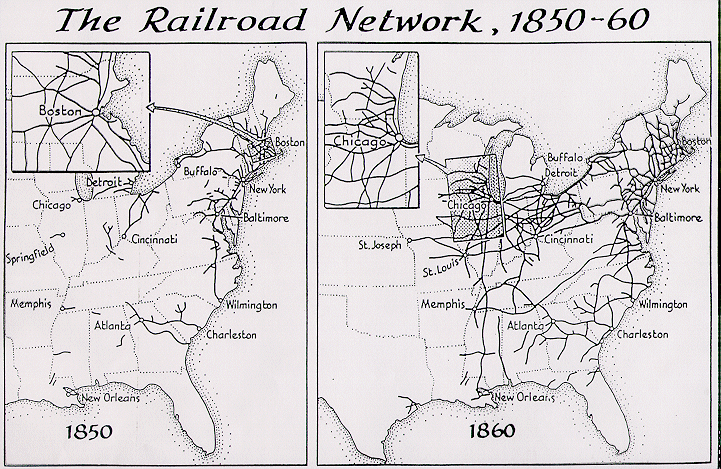
Evelina accompanied her husband into Boston, where they stopped for midday dinner at the Orrs’ before Oakes boarded his train. He would have traveled to New York by way of Springfield, or else taken the Old Colony line down to Fall River where steamboats picked up passengers to complete the trip to New York City.  Evelina, meanwhile, stayed in Boston to shop and enjoy a bit of socializing with the extended Orr family. She played cards past her bedtime.

Back in Easton, shovel making and farm work went on as usual.  Old Oliver, as always, noted the weather: “this was a fair day wind north west + cold. ”  He added that  “we kild 4 hogs to day everage wate 356 lb sold to the workmen at 7 cents a pound those we sent to boston sold for 7 ¼ cents”.  He sold some of the fresh pork to his workmen, probably through the Ames store, and sent the surplus to Boston to be sold.


November 27, 1851

Turkey


Nov 27  Thanksgiving day we have passed in the other

part of the house.  Our sons & Helen went this evening

to a ball in Canton  Father Mrs Witherell Mr Ames &

self had a game of cards.  Mr & Mrs H Lothrop

A[u]gustus & wife Cyrus & Sarah Lothrop

spent the day at Olivers

In 1844, Lydia Maria Child, a Massachusetts mother, author and abolitionist, published the original six verses of a poem about Thanksgiving. The poem was put to music, and verses were added or modified over time. We know it, and everyone sitting around the Ames’s dinner table would have known it:


The New-England Boy’s Song About Thanksgiving Day
Over the river, and through the wood,
To Grandfather’s house we go;
the horse knows the way to carry the sleigh
through the white and drifted snow.
Over the river, and through the wood,
to Grandfather’s house away!
We would not stop for doll or top,
for ’tis Thanksgiving Day.
Over the river, and through the wood—
oh, how the wind does blow!
It stings the toes and bites the nose
as over the ground we go.
Over the river, and through the wood—
and straight through the barnyard gate,
We seem to go extremely slow,
it is so hard to wait!
Over the river, and through the wood—
When Grandmother sees us come,
She will say, “O, dear, the children are here,
bring a pie for everyone.”
Over the river, and through the wood—
now Grandmother’s cap I spy!
Hurrah for the fun! Is the pudding done?
Hurrah for the pumpkin pie!

– Lydia Maria Child


Happy Thanksgiving, everyone.

November 25, 1851


kitchen

*

Tues Nov 25th  Mary has done the ironing to day except

the fine clothes and they look much better than usual

Jane is rather better to day and has washed the dishes

and assisted some about the housework.  I have made a

dickey for Mr Ames. Passed the afternoon at Father Ames

with Mr & Mrs Swain & Mrs Meader  Mrs S Ames,

Fred & Helen came home to night

Family members began to gather in anticipation of Thanksgiving. Fred and Helen Ames came home from their respective schools in Cambridge and Boston, adding animation to the quieter house next door.  Surely their parents, Sarah Lothrop and Oliver Ames, Jr., were pleased to see them.  Oliver (3), away at school in Providence, was getting ready for his travel home.

No one was making merry yet, however.  Everyone still had work to do. The new girl, Mary, did some ironing, evidently better than Jane McHanna usually did.  Jane herself, still recovering from an illness that had laid her low for almost ten days, was able to wash dishes and help out a bit. Evelina, after supervising Mary and Jane, was finally freed up to sew and socialize.  She was in a happier state of mind.

The men of the family were working as well.  While Oakes, Oliver Jr, Oakes Angier, and Frank Morton were at the shovel shop, Old Oliver and some of his men began “a building an ice hous.”**

“About sunsett,” it began to snow.


*Image of a mid-19th century kitchen, Courtesy of http://www.victorianpassage.com

**Oliver Ames, Journal, Courtesy of Stonehill College Archives, Tofias Collection


November 23, 1851

1850-shawl2

*

Sunday Nov 23d  Jane with Michaels sister got the

breakfast this morning but after breakfast Jane 

went to bed  I could not go to church this morning

Augustus came home at noon and brought Mr

Davidson  Mrs Meader Hannah & self went

back with him  This evening sat with my shawl

& bonnet on from 6 to 8 Oclock waiting for Mr

Ames to go to Mr Swains and then took them off did not go


For the second time this month, Oakes Ames forgot to take his wife somewhere. On this occasion, they had planned to visit Ann and John Swain.  Evelina had missed the morning meeting and although they had company at noon, and she made it to the afternoon service, she was still eager to get out and socialize. As night fell, she put on her “shawl & bonnet” and waited for her husband to pick her up. He didn’t show. She “did not go.”

Evelina had been disappointed two weeks earlier when Oakes had forgotten her, but the tone of her diary entry on that day had been tolerant. This time, she was likely less forgiving. Once Oakes finally walked in the door, more than two hours late, Evelina must have let him have it. Surely she got mad. Surely they argued.

Oakes’s excuse would’ve been that he’d been off electioneering, just like the last time he forgot to fetch his wife.  The next day was another town meeting and, in anticipation, he’d obviously gotten sidetracked, probably with friends. At least Evelina could be certain that he hadn’t been out drinking; Oakes was a teetotaler. But she would have been left to wonder what the outcome would be of her husband’s absorption into politics, and how it might alter their relationship.

Jane McHanna, meanwhile, was still sick.  Evelina was not having a great week.

*Image courtesy of wwwVictoriana.com


November 15, 1851


SUGARLOF

1851

Sat Nov 15th  Another day I have been about house all

day, this morning helped the gardener weigh out

a box of sugar that we bought in Boston

got my bags of cloth of different kinds

in order in the shed chamber  It has been

very stormy all day Mr Ames and Oliver Jr

in Boston Oliver went yesterday He looked 

at carriages but did not purchase one

Bridget gone to housekeeping

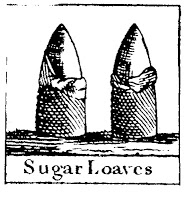
At the rate Evelina used sugar in her fruit preserves, she needed many loaves of it. Unable to purchase it at the family store in the village, she bought what they needed in Boston at Faneuil Hall.  On this day, she appeared to be breaking at least part of a sugar loaf into usable bits for her kitchen.  The family gardener helped her, perhaps because the sugar loaf was so heavy to hold.

Sugar wasn’t the only commodity that Boston had to offer.  Evelina’s husband, Oakes, and his brother, Oliver Ames Jr., had gone to the city, the latter in search of a new carriage. He – or they – didn’t purchase anything, just looked.  Oliver Jr. would have been very careful about the cost and quality of such a big item.  Both men would have admired the various coaches, chaises, gigs and traps they must have seen.

It’s worth noting that Evelina reveals today where she kept her “bags of cloth,” when not working on them: in the shed. As she organized them today, folding cloth and perhaps tossing any textiles that couldn’t be used, she would have heard steady rain on the roof.


November 13, 1851

Drum


Thursday Nov 13th  Have been cleaning the draws in

the beaureaus and have papered the closet beside

the fire place and painted some boxes &c

Ellen Meader […] has been making Susan a visit

this afternoon  The Stoughton band have been

in the neighborhood this evening. They marched 

and played up as far as the house and back to the

school house.  Went to Mr Swains and had coffee &c &c

Mr Ames has been to Boston

Stoughton, Massachusetts, has a wonderful musical legacy, most famously the Old Stoughton Musical Society, a choral group that has been active since 1786. Known in its first hundred-twenty years simply as the Stoughton Musical Society, some of its members referred to it as the “Grand Club”*. When it celebrated its centennial in 1886, Lt. Governor Oliver Ames and Governor George D. Robinson were two notable attendees at a celebratory concert. Oliver (3) was very fond of music; he even took singing lessons in his youth. He must have enjoyed the musical evening.

The long and revered history of the Old Stoughton Musical Society sheds no light on the existence of a Stoughton marching band, however. Evelina’s entry may be the only known mention – at least to date – of such a band.  On this day in 1851 it marched and played instruments through the village of North Easton, presumably after the factory had closed for the day. Why did it stop at the Ames’s house? What was the occasion? Surely the music it played was a welcome change from the usual clanging and hammering that emanated from the shovel shop.

Other than this pleasant interlude, Evelina’s day was ordinary.  While her daughter Susie had a friend over, Evelina cleaned, papered and painted.  Later in the day – perhaps as she accompanied little Ellen Meader home – she had “coffee &c &c” at the home of Ann and John H. Swain.  Oakes Ames spent the day in Boston.


Mary Swan Jones, The One Hundredth Anniversary Celebration, 1886


November 10, 1851

255px-George_Sewall_Boutwell_by_Southworth_&_Hawes,_c1851_restored

George S. Boutwell, Governor of Massachusetts, 1850 – 1852

Daguerreotype by Southworth & Hawes, circa 1851


Monday Nov 10th  Election day and the whigs have got

whiped and look rather down.  It has been very

stormy.  Our new horse came home sick from town

meeting.  Oakes A, Mr Barrows & Augustus went to Taunton

this evening to carry & get the news.  Jane came home

from Mansfield to night.  Bridget is better to day

she has done the housework and I have cleaned

the shed chamber &c &c  Passed the evening at Olivers

There were full-bore politics in Massachusetts today, with the Whigs getting “whiped,” much to the disappointment of the Ames men and others. The politics of the era were untenable as the country cantered toward civil war. The Fugitive Slave Act and the Compromise of 1850, a misguided legislative expression of an unsustainable gulf between north and south, had resulted in upheaval and disarray among the existing political parties.

According to George S. Boutwell, then governor of Massachusetts, the Whigs – a pro-business, market-oriented group – had fallen into two camps over slavery: the Conscience Whigs and the Cotton Whigs.* The Conscience Whigs generally supported, and many eventually became, Free-Soilers (those who opposed the extension of slavery into new states or territories), while the Cotton Whigs held with the pro-slavery policies of the south. By 1855, a new Republican Party had risen from the ashes of the old Whigs, bringing along a few disenchanted Democrats and advocating many of the issues that Conscience Whigs had stood for. Oakes and Oliver Ames, Jr. became Republicans.

Although less well known today than fellow Massachusetts politician Charles Sumner, George Boutwell would go on to have a distinguished career, one that often involved interaction with the Ames brothers. A crackerjack lawyer by profession, an abolitionist by passion, he spent most of his life as a statesman. Besides being governor, he was, over time, the first head of the Internal Revenue Service, a member of the U.S. House of Representatives and the U.S. Senate, and Secretary of the Treasury under President Grant.  While in Congress, he would spearhead the impeachment of Andrew Johnson.

Also while in Congress, Boutwell would be approached by Oakes Ames to buy shares in the Union Pacific but, according to several period sources, he would turn the offer down because he thought it a poor investment. He left Congress in 1869 to serve as Secretary of the Treasury, a position he held during the Credit Mobilier scandal in 1873.  Ten years later, at the dedication of the Oakes Ames Memorial Hall in North Easton, Boutwell would speak in memory of Oakes, describing him as “tolerant of hostility, forgetful of injuries, and persistent in his friendships.”**

All this was ahead for the Ames men, Boutwell, and the nation.

*George S. Boutwell, Reminiscences of Sixty Years of Public Affairs, 1900

**Oakes Ames, A Memoir, 1883


November 9, 1851

Nurse


Sunday Nov 9th  Did not go to meeting to day on account of

Bridgets being sick.  Expected Mr Ames home at noon to carry

me this afternoon but he went off electioneering and 

forgot all about it.  This evening have been to Mrs

Swains with Mr Ames & Susan  Her nurse is there

and her brothers wife and daughter of about Susans

age  Mr & Mrs Meader returned home about a week since


Not only did Oakes Ames stop in Canton for a Whig meeting on Saturday, but he spent Sunday afternoon “electioneering” and forgot to go home at noon to take Evelina to church for the afternoon service.  In personal terms, this was not an auspicious beginning to his political career, but it was certainly indicative of the wholeheartedness and zeal with which he approached politics.  If Oakes and Evelina had, in fact, reached an understanding about his getting into politics – about which we can only conjecture – we have to wonder if that understanding had already been violated.  Yet Evelina’s diary is not particularly dispirited; she writes matter-of-factly and without obvious annoyance.  Perhaps she already understood and forgave her husband’s capacity for preoccupation.

After missing church in the morning because of a sick servant and in the afternoon because of an absent-minded husband, Evelina must have been pleased at last to go out in the evening. She, Oakes and their daughter Susie paid a call on Ann and John Swain, a younger couple who were relatively new in town.  New parents, their infant son was being tended by a nurse, while two relatives, the last remainders of a crowd who had arrived to tend at the birth, were still visiting.  Ellen Meader, a little girl about Susie’s age, was there with her mother, Sarah Bliss Meader, wife of Ann Swain’s brother, Reuben Meader.