October 4, 1851

Pick

Oct 4th Sat.  Preserved 25 pounds of peaches and 16 lbs

barbaries & about 23 lbs Apples with them.  Have

been about sick all day  Expect I have taken

the nettlerash from Susan have been troubled

with it three or four days.  Called this afternoon

at Augustus find them quite comfortably settled

Harriet trimmed my Bonnet with the ribbon I

wore last fall  Charles Mitchell came to see Mrs Mitchell


Evelina hadn’t felt very well for several days and began to feel even worse today. She believed she had “taken the nettlerash from Susan,” meaning that she now had hives, just as her daughter had had a week earlier. It made her feel “about sick” yet she stayed upright and worked in the kitchen most of the day. The fruit they had picked or gathered from friends and family wouldn’t keep, so the cooking had to get done.

In the kitchen, Evelina, probably with significant help from Jane McHanna, put up 64 pounds of fruit. She didn’t make jam, which would have consisted of cooked fruit pulp, nor did she make jelly, which would have been made from fruit juice.  She made preserves, which in this instance were pared peaches and apples, the latter mixed with barberries, that were placed whole or in chunks in sugar – lots of sugar – and then boiled down. And because “ingredients in […] loaf sugar are not always very clean,”* most cookbooks of the day strongly urged that the sugar be clarified.

Mrs. Cornelius, in her 1846 The Young Housekeeper’s Friend,* noted that “[t]he chief art in making nice preserves, and such as will keep, consists in the proper preparation of the syrup.  All sugars are better for being clarified.”* Mary Tyler Peabody Mann, more than ten years later in her cookbook, Christianity in the Kitchen, agreed with the necessity of clarifying the sugar The process was labor intensive; even with the help of Jane McHanna, Evelina would have had hours of work if she followed Mrs. Mann’s “receipt”:

“Put half a pint of water to every pound of sugar.  Stir in the white of an egg for every five pounds of sugar, and let it boil; when it rises, put in half a teacup of water and let it boil again, and repeat this process two or three times.  Set the kettle aside for fifteen minutes, then take the scum from the top.  Pout off the syrup; wash the kettle, and put in the fruit you wish to preserve.”**

After sitting at the kitchen table paring the fruit, or standing over the stove clarifying the sugar, or placing the fruit into the stoneware or glass jars, Evelina needed a break. She took a walk to the village to see her nephew Augustus and his family. Even if she wasn’t feeling well, the fresh air must have felt good after the heat and bustle of the kitchen.


Mary Hooker Cornelius, The Young Housekeeper’s Friend, 1846

** Mary Peabody Mann, Christianity in the Kitchen, 1858

September 29, 1851

330px-Open_drawers_-_Garments_for_girls

Monday Sept 29  Cut out three prs of cotton Drawers

for self for Ellen to make & have done some

sewing  Augustus came with his family about

4 Oclock are going to move into a part of Mr

Torreys house  Hector & Susan Orr came to

the other part of the house this afternoon.  Susan

will stop awhile  Not very pleasant has rained some

Rain arrived but the day, according to Old Oliver, was “pritty warm.” The wet weather and her cold must have kept Evelina indoors.  She may not have felt well, but as long as she could sit up, she would have found something useful to do.  Sewing some underwear for herself was the mundane chore waiting in her workbasket. Meanwhile, Jane McHanna, the family servant, washed the weekly laundry, perhaps doing her trick of letting the rain do the rinsing. She would have been challenged to figure out how to dry it, though.

Visitors arrived in the other part of the house; the Orrs, a family with whom the Ameses had been connected since early days in Bridgewater, came to visit. Susan Orr, a spinster, had known Oakes Ames when he was a baby. Today she and Hector – her brother, perhaps? – came to see Old Oliver and Sarah Ames Witherell.

On Evelina’s side of the family, nephew Alson “Augustus” Gilmore, his wife Hannah and their two sons, toddler Eddie and infant Willie, began to move into temporary quarters at Col. John Torrey’s building in the village.  Eventually, they would build a home, but for now they were going to rent.


September 22, 1851

OLYMPUS DIGITAL CAMERA

*

Mon Sept 22nd  This morning sat down to sewing and fixing some work

for Ellen cut the breadths for a bedquilt and was in 

hopes to have a quiet day & week to sew but it has 

not commenced very fair  About noon Susan was

complained of an itching & burning and on examination

I find her back was broken out in great blotches &

this evening she is completely covered & in great agony

A Mr Bronson is stopping here from Pennsylvania

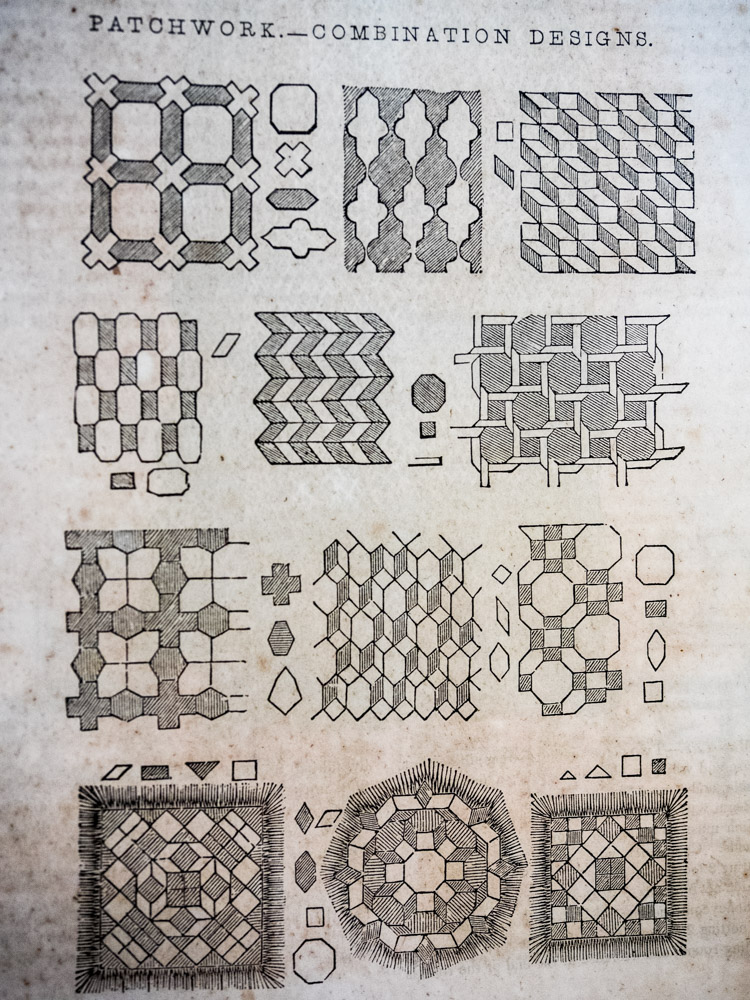
Monday morning at the Ames’s meant that after breakfast, Jane McHanna turned to doing laundry and Evelina, after doing dishes and other chores, sat down to sew.  She had in mind to make a quilt – perhaps she had liked one of the quilt designs featured in this month’s Godey’s Lady’s Magazine. She cut out some “breadths” of fabric and imagined she’d have most of the day to work on the project.

At midday, however, just at the time when dinner was usually put on table and the men returned from the shovel shop for the big meal of the day, nine-year old Susie reported not feeling well. Something on her back itched and burned. It got worse as the hours passed and by bedtime she was suffering. What was going on?

To complicate matters, the Ameses had a houseguest staying for the night, a Mr. Bronson who was most likely in town on shovel business.  How difficult it must have been for Evelina to give him proper attention and tend to her daughter at the same time. So much for sewing.

Quilt designs from Godey’s Lady’s Book, 1851

September 5, 1851

Pentax Digital Camera

*

Friday Sept 5th  Expected to be alone to day and was in

hopes to do some sewing but about ten Oclock

concluded to invite Mrs Latham (who came yesterday

to Father Ames,) to tea and all from the other part

of the house.  Jane made a great fuss about getting

tea having some short biscuit to make and I

got very nervous.  Mrs S Ames staid awhile but

went home to tea


The house on Main Street was relatively empty today.  Son Oliver had left for college and friends Pauline Dean and Orinthia Foss had departed as well.  Her husband Oakes and other sons, Oakes Angier and Frank Morton, were at work and little Susie was at school.  How quiet the house must have seemed, even with the sounds from the factory ringing from across the road. Evelina sat down in solitude to sew and found she wanted something more.

A little tea party was what was needed, she “concluded,” although her servant, Jane McHanna, evidently disagreed.  Jane probably had her own agenda of tidying up after yesterday’s whirlwind of departures and so “made a great fuss” about the extra work. Jane’s irritation ran counter to Evelina’s hopes, and some kind of verbal tussle must have ensued. No wonder that Sarah Lothrop Ames, who had come over from next door, didn’t stay around.

The party must have happened, however, else Evelina would have written otherwise. Jane prepared the meal. Late in the afternoon, family from the other part of the house and their guest, Mrs. Latham, were treated to tea and “short biscuit” and, perhaps, other refreshments.

Short bread or short biscuit or short cake – all names for the same, crumbly finger food – was a typical offering at tea parties, and simple enough to make that many cooks wouldn’t even need a recipe, or “receipt.” Using some of the butter that Evelina had bought just one week earlier, Jane McHanna would have followed a process similar to that described by Lydia Maria Child in her book The American Frugal Housewife:

“When people have to buy butter and lard, short cakes are not economical food. A half pint of flour will make a cake large enough to cover a common plate.  Rub in thoroughly a bit of shortening as big as a hen’s egg; put in a tea-spoonful of dissolved pearlash; wet it with cold water; knead it stiff enough to roll well, to bake on a plate, or in a spider.  It should bake as quick as it can, and not burn.  The first side should stand longer to the fire than the last.”


*http://britishfoodhistory.wordpress.com/2012/06/10/shortbread/


September 1, 1851

000100849[1]

*

Sept 1st Monday  Jane & Ellen washed and have done most

of the housework and I have been to work on Olivers

clothes have sewed pretty steady to day.  Pauline has

been sewing on a pr of Muslin undersleeves that

I gave her but has not finished them.  Mrs Stevens

covered some button and sewed them with Olivers vest

& mended the buttonholes


Sewing was “pretty steady” today as the date of her son Oliver (3)’s departure for college loomed nearer. Evelina was mending everything and making new items like collars and dickeys. She tried to mark Oliver’s clothes so that they wouldn’t get lost – a time-honored effort by many a mother when a child leaves for college. How did she mark the clothes, though, in those days before indelible ink markers?  There were certainly no “iron-ons” and probably no manufactured name-tags that would have been sewn in by hand, either.  Her most likely solution would have been to embroider Oliver’s initials or name on the inside or underside of each piece of apparel. That sounds like a lot of work.

Houseguest Pauline Dean accompanied Evelina and sewed some on a pair of new undersleeves while another guest, Mrs. Stevens, helped cover the buttons of a vest belonging to Oliver. Clothes must have been everywhere, as laundry was being washed while all this sewing went on. It was Monday, and Jane McHanna and another servant named Ellen had the stove going and the tubs full. The “fair day” and north east wind that Old Oliver noted in his journal would have helped dry the clothes.

Old Oliver also noted that he “went to Canton to day with Mr Clark + others to put in the stone bridges below the shop.” Can any of our local historians identify these bridges?  Are they still in place? The shop, which was originally built in 1847 to supplement the factory in North Easton, is no longer standing. The image above was taken circa 1965.

* Ames Shovel Shop on Bolivar Street, Canton, Canton Historical Society, from Arthur Krim’s Historical Buildings of Canton, Vol. II.

August 18, 1851

Churn

Monday Aug 18th  Jane washed this morning and had Ellen

to assist so I sat down quite early to sewing

cut out a chimise for Ellen to make

This afternoon went to Mr Whitwells to tea

Mr Ames was going to Bridgewater and I

rode there with him.  Called at Mr Harveys

to try to get some butter but she had none

to spare.  Hurried home expecting Pauline she did

not come  Mr & Mrs George Lothrop came to Olivers 

The new servant, Ellen, helped Jane McHanna with the laundry today. Evelina stayed out of the way and concentrated on her sewing, setting work aside for Ellen to do later. She needed another chemise.

In the afternoon Evelina went to the Whitwells’ for tea.  She had just been there the day before during the intermission between church services. Today Oakes accompanied her and the two went on from there to Bridgewater.  Evelina was hoping to buy some butter from a Mr or Mrs Harvey, but had no luck. Evidently no longer producing butter herself, she’s had to travel this summer to find it. Oakes, meanwhile, was on his way to Bridgewater on shovel business – or Whig politics.

Not yet alluded to in Evelina’s diary is the illness of one of Sarah Lothrop Ames’s brothers, Dewitt Clinton Lothrop. Clinton, as he was known, was deathly ill with typhus fever. Another Lothrop brother, George Van Ness Lothrop and his wife, Almira Strong Lothrop, had come back to town from Detroit on Clinton’s account.


August 11, 1851

220px-Brooklyn_Museum_-_The_Invalid_-_Louis_Lang_-_overall

*

Aug 11th Monday  Had a new girl come to day to assist some about

the house and help me sew.  Went to assist Mrs Holmes

found her sick abed and alone her aunt Clifford

left her as sick as she is. She must be an unfeeling

woman  Mr Holmes went to Canton with the team and

will try to get his mother for a few days. Julia Waters

did up the work this morning  This afternoon she has

been all alone with Willie  I made her bed for her at night

Harriet Holmes, Evelina’s neighbor, continued to be quite ill.  Evelina and others looked after her, including an aunt who departed her post before a new helper arrived, earning Evelina’s stern disapproval.  As Harriet had a toddler, Willie, to look after, the aunt leaving her alone was not only “unfeeling,” but negligent.

Help was on the way. Harriet’s husband, Bradford, drove a team – of oxen, most likely – to Canton to fetch his mother. Before they returned, Evelina made fresh the sickbed, as she had done on other nights. Harriet would be tended to.

And this morning, even as Jane McHanna wrestled with the weekly wash, a “new girl” entered the Ames household to help with the chores and the sewing. That must have brightened Evelina’s Monday.


* Louis Lang, The Invalid, 1870, oil on board, Brooklyn Museum of Art, Gift of Mrs. Walter deForest Johnson.


July 14, 1851

Knives

1851

July 14 Monday  Mr Norris left in the stage this

morning  Mr & Mrs Harris & Mrs Norris for

Bridgewater.  Jane has not done her washing as she

usually does but we have put the house in order

Scoured all the knives &c &c.  Have passed most 

of the afternoon in the other part of the house

the whole family took tea there

The Harrises and Norrises left this morning, releasing Evelina from her hostessing obligations. The house was in disarray; probably, one of the couples slept in a bed in the parlour, the other stayed who-knows-where.  Furniture had to be put back, linens stripped and so on.  Jane McHanna had so much to do in the aftermath of the houseguests that she couldn’t do the Monday washing.  That was unheard of.

Jane and Evelina picked up in the kitchen, too.  One of them scoured the knives. In 1851, knives were made of mild steel, typically high in iron. Stainless steel, which has an alloy of low iron and high chromium, had not yet been developed, and wouldn’t appear until the turn of the 20th century. Knives in the 19th century corroded easily and needed to be cleaned periodically, often by being rubbed with fine sand.  Evelina or Jane might have sharpened them, too.

In the afternoon, Evelina and her whole family had tea at her father-in-law’s, served by her sister-in-law Sarah Witherell.  After a weekend of catering to houseguests, being served tea must have been a pleasure.


July 7, 1851


large-003500

*

1851 July 7th  This morning being washing day had to do the

house work and see about the dinner  My finger

is still very tender and I find it difficult to sew

but I have cut of the skirt of my borage Delaine

for Harriet to make and this afternoon have been

working the sleeves to it  Expect Julia here tomorrow

It was Monday, so Jane McHanna washed and hung out the laundry while Evelina swept, dusted and cooked the midday dinner.  Her finger may still have been sore – what had she done to it? – but she did her chores.

She did some sewing, too, or at least she prepared to sew with Julia Mahoney, the dressmaker who was expected the next day.  She cut the cloth for the skirt of a new dress, no small task. The barege she used, as noted in a previous post, was an open weave wool, lightweight and popular at mid-century.

In 1851, dresses were styled with very full skirts, some with flounces, that required upwards of 25 yards of fabric. Knowing Evelina’s instinct for thrift, we may believe that she probably settled for fewer flounces and less material. Still, even the simpler dresses with all their parts – skirt, lining, bodice, sleeves, undersleeves, pocket, collar, and any decorative element such as piping, ribbon or fringe – consumed significant yardage.  Cutting out all the pieces took expertise and room to maneuver. Imagine the project spread out across the dining room table.

How did she convince her sister-in-law Harriett to help sew the skirt?

* Fashion plate from Godey’s Ladys Magazine, July 1851


June 30, 1851

photo

1851

June 30 Monday  Jane has been washing to day but I

have done but very little of any thing. having a

very sore finger & thumb it is quite painful

have to let out the matter quite often  It has been

quite painful since Friday.  It is a very warm

uncomfortable day  I have worked some in the 

flower garden

Today was another Monday, another washday ably managed by the Ames’s servant, Jane McHanna. Evelina, who usually undertook other household chores on a Monday, wasn’t up for choring. She had a bad infection on her thumb and finger that prevented her washing the breakfast dishes, sweeping, or helping to prepare dinner. She was in pain and somewhat handicapped.

Perhaps she had cut her hand, or had worked up a few blisters, or had a bad scrape.  She could have done something in the kitchen or garden, or while sewing the tough horsehair cover for the new lounge. However she hurt herself, a skin infection was nothing to make light of in 1851.  In that age before antibiotics, Evelina had few remedies at hand beyond keeping her hand clean and perhaps applying a homemade linament or poultice. Her wound was the kind of injury that could turn septic; that she was squeezing “the matter” – or pus – out of it shows that she was conscious of a certain level of risk.

And yet, she found a way to work in the garden, so she couldn’t have been too frightened.