April 26, 1852

ragged-robin

Ragged robin

Monday April 26

1852  Was about house and to work about the

garden all the forenoon  Mr Manly brought

me a Japan Quince Syringa P Lilac Compfre

Ragged robbin Cowslip Fleur de Luce &c  charged

90 cts.  Went this afternoon to Alsons with

Augustus & wife & her sister.  Came home

quite early and set out some plants that

I got there

Edwin Manley, Easton’s resident green thumb, brought Evelina her lilac bush this morning, along with a quince tree, some comfrey, ragged robin, cowslip and “fleur de luce,” which probably was Evelina’s spelling for fleur-de-lis, also known as  iris.  For less than a dollar, she acquired flora that promised to add fragrance and color to her garden. Later in the day she got more plants – for free, most likely – from her brother Alson Gilmore.

The countryside itself was still wanting in color at this mid-spring juncture, something Evelina and her fellow passengers might have noticed on their way to and from the Gilmore farm. Henry David Thoreau wrote about the pale fields and expectant woods in his journal on this date: “The landscape wears a subdued tone, quite soothing to the feelings; no glaring colors.”* Perhaps Evelina’s rush to add more vibrant colors to her yard would have jarred his sensibility.

Even with all the gardening, the day’s housework went on as usual with dusting, sweeping, dishes and laundry. Evelina and Jane McHanna both worked at various tasks, while Thoreau – not that many miles away – responded otherwise:  “It is a dull, rain dropping and threatening afternoon, inclining to drowsiness. I feel as if I could go to sleep under a hedge.”*

The two diarists reacted differently to the awakening pulse of spring.


**Henry David Thoreau, Journal

April 19, 1852

 March_2014_nor'easter_2014-03-26Satellite image of a Nor’easter

1852

April 19th Monday  It rained very fast all day and 

about noon the rain beat in the side lights 

of the entry, and parlour windows   had to take

back the carpet a little from our window put

dishes under the windows and caught a good

deal of water.  Have cut down my Verbenas

and Petunias fixed a skirt of a dress for

gardening

A powerful Nor’easter storm beat into New England this day.  Both Evelina and her father-in-law described the rain as “fast,” Oliver further elaborating that the rain came in sheets, “not in drops.”*  Evelina (and Jane McHanna, most likely) had to deal with water coming in through the side light panels on either side of the outside door. They scurried, too, to pull back the carpet from the windows and put dishes on the floor to catch some of the water beating into the house.

The wind howled and “[t]he storm continued all day , a part of the time pritty fast,” reported Old Oliver. Everyone stayed indoors, no doubt, yet Evelina reports cutting back some of her plants, which suggests outdoor work. That couldn’t have happened on a day such as this, however, so perhaps the verbenas and petunias had wintered-over in pots inside the house, and it was those that she cut down.

Gardening was on her mind, of that much we can be sure. She prepared a skirt to wear outside when she was in her flower beds, probably “repurposing” an old dress for the task. Her handwriting was rushed and incomplete when she wrote the last sentence of today’s entry; she inadvertently omitted to cross the “x” in fixed, leading this editor to conclude that she had “fired” a skirt.  Not so, thanks to a sharp reader who came up with the correct version.

Image courtesy of Wikipedia, April 18, 2015

April 14, 1852

Washing

1852

April 14th Wednesday  Jane washed yesterday and put

her clothes out to day […] and it is very pleasant and

most like spring of any day we have had.  Made two

toilet cushions and covers for them of plaid muslin

Mrs Sarah Ames brought in her work this afternoon

awhile and I put a bosom into a shirt for

Mr Ames.  Read this evening in Night & Morning

The rain and snow of the preceding two days had disrupted domestic routine, meaning that servant Jane McHanna washed the weekly laundry on Tuesday instead of Monday and hung clothes out today. Evelina didn’t seem to mind, given how “most like spring” the day turned out to be. She seemed to have recovered from having gone without much sleep the day before.

Sarah Lothrop Ames came over from next door and the two sisters-in-law sat and sewed. Evelina sewed a shirt front for her husband and made two toilet cushions. The word “toilet” in the nineteenth century referred to personal grooming, as in getting dressed or cleaning one’s teeth or sitting at a dressing table.  A toilet cushion, then, was most likely a seat for a stool or small chair for a bedroom or dressing area. Evelina made both the pillow itself and its cover of “plain muslin.”

Night and Morning was, presumably, a work of fiction. Evelina must have found it in one of the periodicals she liked to read, such as Gleason’s Pictorial, or in a book she or Oakes had purchased in Boston.  Any readers out there familiar with this work?


March 29, 1852

 d2a4da_a34883211bc64e72a561a89b7ee3091d.jpg_srz_299_239_75_22_0.50_1.20_0

Moreen Fabric*

1852

March 29 Monday.  Orinthia returned with us from meeting

yesterday  She helped Susan wash the dishes and

I cleaned the sitting room and afterwards sat down

to our sewing  Have new bound my moreen skirt

Orinthia and self went into Edwins this evening

had a pretty lively call making fun of Orinthia’s spelling

Evelina may have “had a pretty lively call making fun of Orinthia’s spelling,” today, but her own orthography was far from perfect. Neither woman, evidently, could have won a spelling bee – and Orinthia was a school teacher!  To be fair, however, spelling in the 19th century was not as standardized as it became later. Spelling has long been a fluid practice, actually, however often periodic efforts were made by different groups and individuals – Teddy Roosevelt among them – to reform and standardize it. So the two women would have had plenty of company with their wayward pens. Just consider the various ways that Old Oliver Ames spelled (or spelt) slate: sleight, slaight and slayt.

Presumably unworried about her own grammatical shortcomings, Evelina pursued her usual agenda for a Monday. She cleaned part of the downstairs while daughter, Susie, washed the breakfast dishes and servant, Jane McHanna, started the weekly laundry and prepared midday dinner. After Evelina had finished dusting, sweeping and tidying, she and guest Orinthia Foss, the poor speller, sat down to “our sewing”.

Evelina was working on a skirt of moreen, a ribbed fabric of cotton or wool that today serves more often for upholstery or curtains. In the 19th century, however, its stiffness lent itself to the voluminous skirts that defined the era. It would have been a thick, tough fabric to work on by hand. But Evelina was nothing if not an excellent needlewoman.

*Image courtesy of http://www.eatonhilltextiles.com


March 22, 1852

Sweep


1852

March 22  Monday  Have been sweeping dusting &

cleaning all day  Have put in order parlour

entries, parlour & sitting room chambers and back

& shed chamber, nearly dusk before I got through

Orinthia & Susan washed the dishes in the 

morning  Orinthia has written another two or three 

letters has not done much  beside  Ain’t she lazy?

It was Monday. Evelina spent her day “sweeping dusting & cleaning,” and Jane McHanna washed tubs of clothes and hung them out to dry, but “lazy” Orinthia only helped wash the breakfast dishes and wrote a couple of letters. In comparison to quiet, helpful Amelia Gilmore, whose visit Evelina had enjoyed, Orinthia Foss and her spirited but indolent company was a come-down.  We should remember that Orinthia was single and only in her early twenties (although in that era, some would have said she was already a spinster) while Amelia, a widow, was in her early thirties and Evelina, a matron, in her early forties. The age gap between Evelina and Orinthia was beginning to wear thin on Evelina’s part, and perhaps on Orinthia’s as well.

Spring had officially arrived two days earlier on March 20. No buds or blossoms were yet in evidence, however, and more snow had yet to fall. The industry that Evelina demonstrated today with her broom and dust rag suggests that she was rehearsing for spring cleaning, perhaps wanting to get it out of the way so that the moment anything came up in her flower beds, she’d be free to go outside and garden. Perhaps she looked at the still-frozen ground and imagined her flowers in full bloom. It was getting to be that time.


March 15, 1852


PENTAX Image


1852

March 15th Monday  Gave the sitting room & entry

a thourough sweeping & dusting and then

went to sewing.  Susan washed the dishes

Amelia & self carried our work into Edwins but did 

not stop to tea, are invited there tomorrow.  We called

at Mrs Bucks  She has 41 schollars and 5 or 6 boarders


After “considerable rain” over night, Monday broke “cloudy in the morning but fair + warm in the afternoon and in the evening there was some rain + it grew colder [.] Mr Arnold came to day to sleight the hammer shop”* Thus wrote Old Oliver.

After Sunday’s respite, work on the rebuilding of the shovel shops picked right back up.  A slate roof was going up on the hammer shop, thanks to the expertise of John Arnold, a local man who had done roofing for the Ameses before.  Old Oliver seemed pleased.

At the Ames home, Amelia Gilmore continued her visit with Evelina. Once the morning chores were complete, with Susie washing dishes and trusted Jane McHanna doing the laundry, and midday dinner consumed, Evelina and Amelia walked across the way to visit Augusta Pool Gilmore, carrying their sewing with them. They must have spent several hours there, but didn’t stay for tea. Instead they headed home, stopping off to see another neighbor, Polly Buck.  Evidently, Mrs. Buck was running a private school with day students and boarders. One imagines that the ruckus there might have been equivalent to the bustle of workers at the building site.


*Oliver Ames, Journal, Stonehill College Archives, Arnold Tofias Collection

February 23, 1852

Looking glass

Monday 23d Feb 1852  Worked about the house this forenoon

dusted the chambers and washed around the

windows &  doors.  Susan washed the dishes. Am

trying to have her learn to knit, improves some

but rather slowly  This afternoon have been mending

some and have put one new sleeve into my

blue & orange Delaine  The looking glass came

out from Boston to night

We might call it a mirror, but Evelina and most of her contemporaries called her new purchase a looking glass. (Think of “Through the Looking Glass and What Alice Found There,” Lewis Carroll’s 1871 sequel to his 1865 “Alice’s Adventures in Wonderland.”) Like the framed prints Evelina had recently bought for her walls, the looking glass was a fashionable piece of decor. She must have been tickled to have one hanging in her parlor.

New “methods of mass-producing large, flat panes of glass had been perfected and, by combining them with heatless, chemical-coating technologies,”* mirrors had become easy to manufacture – and affordable.  At mid-century they became stylish and ubiquitous, symbolic of the new taste and purchasing power of the middle class. In a home like Evelina’s which, 50 years earlier, might have boasted no more than a small, courting-type mirror, a big, new looking glass, hung on braided silk roping from molding above it, had become de rigeur.

Other than this exciting upgrade in the parlor, today was a Monday like any other. Jane McHanna did the laundry, Susie Ames washed the breakfast dishes, and Evelina took to her needlework.  She was teaching her daughter to knit.


*Wikipedia, Mirrors, accessed February 19, 2015.

February 16, 1852

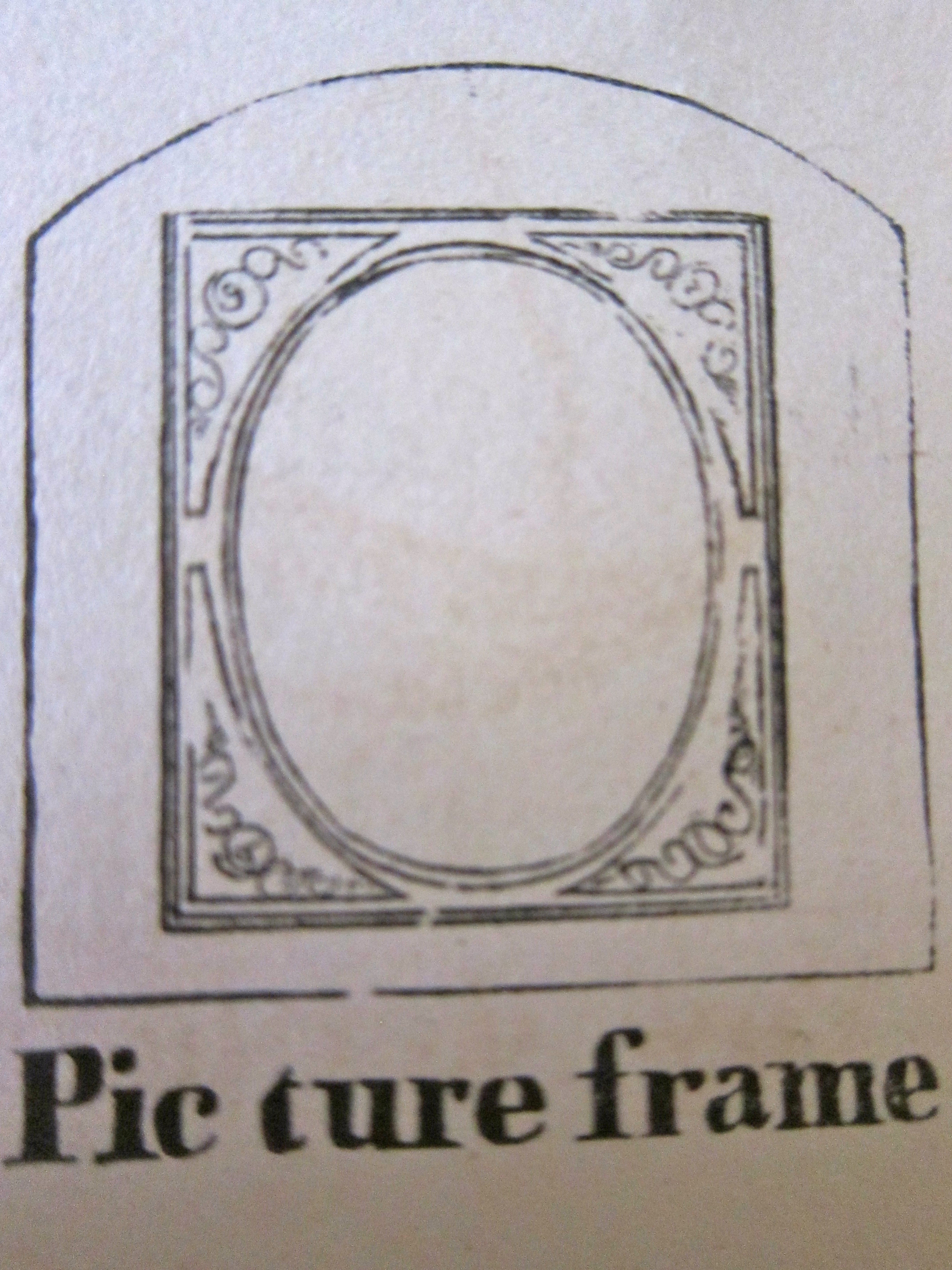
Picture frame

Monday Feb 16th

1852

Susan washed the dishes this morning and I was

at work about the house most of the forenoon

Mrs Mary Williams came about eleven Oclock and 

staid to dinner  Called into Olivers and Edwins

with her  She returned to Joshua C Wm about three

and went home in the stage  Oliver tried to get

the coloured engraving smooth in the frame but could 

not  Mended Oakes Angier a vest


The new week opened with the usual domestic arrangements: Jane McHanna doing laundry, Susie Ames washing dishes and Evelina choring “about the house” in the morning.  A visitor, Mary Williams, arrived and stayed for midday dinner, then departed mid-afternoon on the local stagecoach .

With her son Oliver’s help, Evelina finished hanging the prints she had bought the week before in Boston. The new pieces of art were quite au courant; etchings, lithographs, and engravings were appearing on parlor walls across the country.  New printing technology – the same that promoted the appearance of so many new periodicals and serial novels – made the production and distribution of art prints easy. The subject matters varied from historical (like the famous image by Emanuel Gottlieb Leutze of Washington Crossing the Delaware, first painted in 1851) to religious to geographical to sentimental.  They were decorative and affordable, and the middle class flocked to buy them.

Subject matter, of course, was important; Evelina had purchased one print about Halloween (or All Hallows Eve as it was known). The prints had to be attractive and look handsome on the wall. But the decorative frames that went around the art work counted, too, and “were often considered more important than the prints themselves.”* It’s too bad that Oliver was having difficulty making one new print fit properly in its frame.

* Pierre-Lin Renie, The Image on the Wall: Decoration in the Nineteenth Century Interior, Nineteenth Century Art Worldwide

February 9, 1852


Boston_art_club_design_wm_emerson

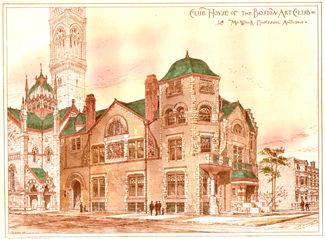
Architectural Rendering of Boston Art Club, ca. 1882

Feb 9th  Monday  Went to Boston with Oliver  spent

the forenoon in looking at pictures.  dined at

Mr Orrs.  Afternoon Mrs Stevens & Mrs Morse

went with us to look at pictures.  purchased 

two engravings one of them painted  returned to

Mr Orrs and spent the evening in playing 

cards  Very fine weather

Evelina’s boring Sunday in North Easton gave way to a few fun days of shopping in Boston. Leaving Jane McHanna to manage the house in her absence, she traveled into the city accompanied by her middle son, Oliver (3), the only son who wasn’t working. The two of them spent the day looking at “pictures” – prints and paintings, probably – and ended up buying two engravings. That one was “painted” meant that it had been hand-colored.

Where did they shop? At a gallery? At an artist’s studio? Amory Hall on Washington Street was one facility that accommodated artists at the time.Who was selling engravings in 1852? Readers, do you know?

It’s hardly arbitrary that Oliver (3) was the son who shopped for art with his mother. Besides being the only male in the family at liberty to take his mother into town, Oliver (3) loved art. He would collect paintings, prints and sculpture all through his life, in fact, especially after he and Anna C. Ray had married and built their large homes in North Easton and Boston. Before becoming governor, Oliver (3) traveled a great deal as a salesman for O. Ames and Sons and, in the process, bought art for himself at galleries in New York City and elsewhere. In the 1880s, he was also president of the Boston Art Club, an artists’ consortium begun in 1854 – 1855 that expanded to include wealthy patrons such as Oliver Ames.

February 6, 1852

Write

Feb 1852

Friday Feb 6  Jane has baked some mince to day of

meat that was left last week and has done

very well.  Cut out a shirt for Oliver to day

and intended to finish it tomorrow but this

afternoon Miss Foss came and Miss Burrell

from W Bridgewater  We called at Edwins

this evening  commenced raining about five

Domestic tranquility reigned today as Jane McHanna made some fine mincemeat and Evelina cut cloth for a shirt, until interrupted by the arrival of Orinthia Foss and her friend Miss Burrell. For Evelina, chores gave way to social intercourse.

Besides keeping a record of various domestic details such as her sewing, Evelina often lists in her daily diary entries the names of the friends and relatives who come to call – in this case, Orinthia Foss and Miss Burrell. She writes of the women with whom she spends time, in fact, more often than she is apt to describe interactions with her immediate family (unless, of course, her husband forgets to pick her up to go out on a social call.) She includes the names of female friends, including her sisters-in-law, as much if not more often than she mentions the names of her children. Her social life, as in “We called at Edwins this evening,” is terribly important to her. She narrates it to her diary in order to remember it and savor it. It doesn’t mean that she doesn’t care about her family; she does. But looking after her almost-grown children is not noteworthy.

Evelina’s diary is simple, even for the nineteenth century, when the “practice” of keeping a diary was “to record personal feelings and explore intellectual growth.”* Eveline doesn’t concern herself with external events the way Mary Chesnut of South Carolina did in her diary of the Civil War, nor does she describe or question the secondary status of women as other Bostonians such as Caroline Healey Dall did in her diary. The intellectual pursuits and considerations of the brilliant Margaret Fuller never interested her – it was beyond her ken.  Evelina was literate and engaged in her life, but in a diffident and unsophisticated way. She wrote in a manner that more closely resembled her father-in-law, Old Oliver; her brother-in-law, Oliver Ames, Jr.; and, eventually, her son, Oliver (3). She simply wrote down whom she saw and what she did.


Steven Stone, Making Sense of Letters and Diaries, http://www.historymatters.gmu.edu

Other resources for information about diaries in the nineteenth century:

Schlesinger Library, Harvard University, http://ocp.hul.harvard.edu/ww/diaries.html

http://www.victorianpassage.com/2007/02/19th_century_diaries_and_scrap.php