September 23, 1851

phototake-rm-hives_urticaria_skin_rash

*

Tues Sept 23d  Susan has passed a dreadful night has not slept

any at all and this morning we sent for the Doctor

and he pronounces it the nettle rash  She has suffered 

very much to day would not let me leave her for

one moment  Mr & Mrs Whitwell are spending the 

day at the other part of the house  Oakes A & Mrs

H Mitchell called there last evening and visited them

She called in to see Susan

Little Susie Ames was in agony.  She had nettle rash, a 19th century term for hives, an acute, raised rash that erupts from the skin in painful splotches. It can appear in many places on the body; Susie’s landed on her backside and spread from there. Known medically as urticaria, the condition is often symptomatic of an allergic reaction, but it can have viral or idiopathic origins, too. It’s hard to say what might have caused the nine-year old’s sudden breakout.

The poor girl’s skin itched, stung and burned, making her unable to rest or sleep without discomfort. Tending her daughter all night and day, Evelina didn’t get any rest, either, and the regular domestic pattern of the day was disrupted. A quick visit from Harriett Ames Mitchell must have been helpful, at least, in capturing Susie’s attention for a few minutes.

In the house next door, Sarah Lothrop Ames turned 39 years old today. Given the recent death of one of her brothers, it’s doubtful that any great fuss was made over the occasion. Sarah and her immediate family were probably still wearing some form of mourning apparel at this point.


*www.webmd.com


September 22, 1851

OLYMPUS DIGITAL CAMERA

*

Mon Sept 22nd  This morning sat down to sewing and fixing some work

for Ellen cut the breadths for a bedquilt and was in 

hopes to have a quiet day & week to sew but it has 

not commenced very fair  About noon Susan was

complained of an itching & burning and on examination

I find her back was broken out in great blotches &

this evening she is completely covered & in great agony

A Mr Bronson is stopping here from Pennsylvania

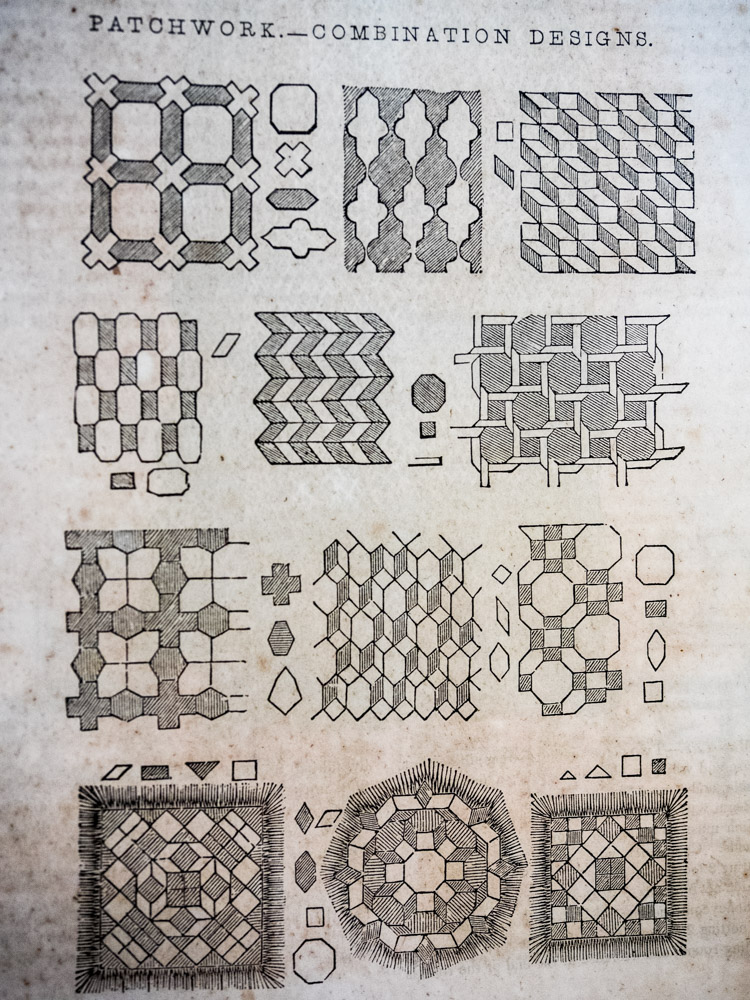
Monday morning at the Ames’s meant that after breakfast, Jane McHanna turned to doing laundry and Evelina, after doing dishes and other chores, sat down to sew.  She had in mind to make a quilt – perhaps she had liked one of the quilt designs featured in this month’s Godey’s Lady’s Magazine. She cut out some “breadths” of fabric and imagined she’d have most of the day to work on the project.

At midday, however, just at the time when dinner was usually put on table and the men returned from the shovel shop for the big meal of the day, nine-year old Susie reported not feeling well. Something on her back itched and burned. It got worse as the hours passed and by bedtime she was suffering. What was going on?

To complicate matters, the Ameses had a houseguest staying for the night, a Mr. Bronson who was most likely in town on shovel business.  How difficult it must have been for Evelina to give him proper attention and tend to her daughter at the same time. So much for sewing.

Quilt designs from Godey’s Lady’s Book, 1851

August 26, 1851


Abbott H. Thayer, Angel, 1887, oil Smithsonian American Art Museum Gift of John Gellatly

Abbott H. Thayer, Angel, 1887, oil
Smithsonian American Art Museum
Gift of John Gellatly


Tues Aug 26th  Clinton Lothrop died about ten Oclock

last night  Has been sick a long time with

the Typhus fever  Mrs Witherell & I made the

shroud for him  Mrs Mitchell went to Taunton

to get Bonnets &c for Mrs Lothrop

Rebecca White came after Pauline this morning

Alson here to Dinner and tea is drawing stones for

Edwins cellar.  Oakes A and Frank returned this evening


Dewitt Clinton Lothrop finally died.  He had been suffering from typhus, “an acute infectious disease caused by the parasite Rickettsia prowazekii, transmitted by lice and fleas [,and] marked by high fever, stupor alternating with delirium, intense headache and dark red rash.”* It’s not the same disease as typhoid fever, although the two conditions have some similarities. Clinton, as he was known, had probably been bitten by a flea.

One of nine sons of Howard and Sally Lothrop, Clinton was a brother of Sarah Lothrop Ames. While most of his surviving brothers had moved away from Easton in pursuit of their own lives, Clinton was the duty son who had stayed home with his parents. Only 26 years old and married with two small sons, he had tended the family farm.

Evelina and Sarah Witherell quickly prepared a shroud for the body, while Harriett Mitchell rode off to Taunton to find mourning clothes for the young widow, Elizabeth Howard Lothrop (or for the mother, Sally Williams Lothrop.) That no one had purchased the mourning clothes before now suggests that, despite the probability of death, everyone had hoped that Clinton would recover.

It was a busy day for Evelina.  Besides helping sew the shroud, she saw her friend Pauline Dean depart to visit elsewhere in Easton and welcomed her brother Alson to midday dinner. Alson was working nearby, helping his son, Edwin Williams Gilmore, build a house.  Jane McHanna washed clothes, and she and Evelina probably continued to set the house to rights after a weekend of guests. Oakes Angier and Frank Morton returned home from their fishing trip.

* Craig Thornber, Glossary of Medical Terms Used in the 18th and 19th Centuries, http://www.thornber.net

August 19, 1851

4gbhistory


*

Tues 19th Aug  Sat down quite early to fix some work for

Ellen, about 11 Oclock Mrs Norris and a Mr Young from

Bridgewater came  Dined here and left about three

they wanted the boys to go Fishing Thursday but Clinton Lothrop

is not expected to live through the day and they

thought it best to defer going untill Monday

Mrs Witherell & Mitchell & myself went into

school this afternoon  Very warm

Melinda Orr Norris and a Mr. Young had midday dinner with the Ameses, during which they invited the Ames sons to go fishing. The boys accepted but deferred the trip to the following week.  Clinton Lothrop, their Aunt Sarah Lothrop Ames’s younger brother, was deathly ill and they wanted to wait until after his anticipated passing.

It was a hot summer day, with no such thing as air conditioning or window fans. In their full-skirted dresses, the Ames women surely were hot as they chored around the house or sat with visitors. They possibly opened their parlor windows to let in some air, but would have let in the insects, too, if they did so.  “Wove wire” had appeared here and there on the market as an alternative to horsehair weaves, but wouldn’t be commonplace until the Civil War. Around 1861, Gilbert & Bennet, a sieve-making firm in Georgetown, Connecticut, lost its southern customers and began to manufacture window screens as a way to use its surplus wire mesh cloth. Window screens took off. Before then, how did people cope?

Evelina and her sisters-in-law, Sarah Witherell and Harriett Mitchell, left the closed air of their homes and went to the local school house in the afternoon. Evelina doesn’t explain the purpose of the trip. Surely the hot sun beat down on them outdoors, but their bonnets kept their heads protected, at least.

* Gilbert & Bennet’s Red Mill on the Norwalk River where woven wire cloth was first developed as a commercial substitute for horsehair. Photo from historyofredding.com.  

August 18, 1851

Churn

Monday Aug 18th  Jane washed this morning and had Ellen

to assist so I sat down quite early to sewing

cut out a chimise for Ellen to make

This afternoon went to Mr Whitwells to tea

Mr Ames was going to Bridgewater and I

rode there with him.  Called at Mr Harveys

to try to get some butter but she had none

to spare.  Hurried home expecting Pauline she did

not come  Mr & Mrs George Lothrop came to Olivers 

The new servant, Ellen, helped Jane McHanna with the laundry today. Evelina stayed out of the way and concentrated on her sewing, setting work aside for Ellen to do later. She needed another chemise.

In the afternoon Evelina went to the Whitwells’ for tea.  She had just been there the day before during the intermission between church services. Today Oakes accompanied her and the two went on from there to Bridgewater.  Evelina was hoping to buy some butter from a Mr or Mrs Harvey, but had no luck. Evidently no longer producing butter herself, she’s had to travel this summer to find it. Oakes, meanwhile, was on his way to Bridgewater on shovel business – or Whig politics.

Not yet alluded to in Evelina’s diary is the illness of one of Sarah Lothrop Ames’s brothers, Dewitt Clinton Lothrop. Clinton, as he was known, was deathly ill with typhus fever. Another Lothrop brother, George Van Ness Lothrop and his wife, Almira Strong Lothrop, had come back to town from Detroit on Clinton’s account.


August 13, 1851

OLYMPUS DIGITAL CAMERA

Wednesday 13th  Went to Mrs Holmes early this morning to

make her bed & tie her hair and was there most

of the forenoon.  Passed the afternoon at Major

Seba Howards with Mrs S Ames.  Met a Mr & Miss

Howard from Philadelphia two Miss Tolmans from

New Bedford & Henrietta & Mrs Lewis Keith.  Mr & Miss

Howard are very pleasant.  Had an introduction

to Mr Brett

First thing after breakfast, Evelina went to see Harriet Holmes, a neighbor who was seriously ill.  As she had done on other days, she made Harriet’s bed and tied up her hair. She spent the morning there, probably giving others in the household – specifically Harriet’s mother-in-law, Mrs. Holmes – some time off.  Presumably Mrs. Holmes or her son, Bradford, had kept watch the night before.

Everyone’s vigilance was rewarded, as Harriet Holmes began to improve. Whatever it was that had made her sick began to abate. This would be the last visit that Evelina made to the house or, at least, the last one she made note of. Harriet would recover.

Evelina must have been relieved. She was certainly optimistic enough to set aside her care-giving and dedicate the afternoon to socializing.  She and her sister-in-law, Sarah Lothrop Ames, called on Major Seba Howard and his wife, Eleutheria. There they were introduced to several guests, some of whom were “very pleasant.”  The afternoon was a much needed change of pace after the worry of the past several days.


August 12, 1851

Write


Tues Aug 12th  Mrs Thompson & Mrs Holmes his mother are at Mrs Holmes

and I did not stop long this morning but about

three they sent for me to come as quick as I could

She was much worse but by the time I got there

she was better and I stoped untill night & left

her very comfortable.  came home & wrote a letter

to Abby Eaton for her to come there

Harriet Holmes had been bedridden for a week with an acute, unnamed illness.  She was sick enough to require regular care by friends and neighbors, including, most recently, her mother-in-law, Mrs. Holmes, who was brought over from Canton.  Mrs. Holmes, along with a Mrs. Thompson, became worried enough about Harriet’s condition to send for Evelina around three o’clock..

Evelina responded quickly, it would appear, but the crisis was over by the time she got to the Holmes’s. She stayed, however, to be certain that Harriet was, indeed, better.  She returned home after dark and wrote to someone – another relative, perhaps – named Abby Eaton to come and help.

Evelina, Bradford Holmes, and others – with the exception yesterday of an “unfeeling” aunt – had all acted as carefully and expeditiously as possible in tending to Harriet. Mr. Holmes drove a team of oxen to fetch help for his wife and Evelina wrote a letter to summon a relative, which was the best they could do. Their options were slow and terribly limited.

Today we see medical care, especially emergency care, in terms of how quickly a condition may be addressed, or how many minutes it takes for help to arrive. In 1851, it was a matter of hours,even days sometimes, before help could arrive.  How skilled the help was and how effective the treatment was another big question. In Harriet Holmes’s case, no one tending her was professionally trained. They were caring but powerless. Harriet Holmes would get better, or she wouldn’t; modern medicine and first responders would have nothing to do with the outcome.

August 11, 1851

220px-Brooklyn_Museum_-_The_Invalid_-_Louis_Lang_-_overall

*

Aug 11th Monday  Had a new girl come to day to assist some about

the house and help me sew.  Went to assist Mrs Holmes

found her sick abed and alone her aunt Clifford

left her as sick as she is. She must be an unfeeling

woman  Mr Holmes went to Canton with the team and

will try to get his mother for a few days. Julia Waters

did up the work this morning  This afternoon she has

been all alone with Willie  I made her bed for her at night

Harriet Holmes, Evelina’s neighbor, continued to be quite ill.  Evelina and others looked after her, including an aunt who departed her post before a new helper arrived, earning Evelina’s stern disapproval.  As Harriet had a toddler, Willie, to look after, the aunt leaving her alone was not only “unfeeling,” but negligent.

Help was on the way. Harriet’s husband, Bradford, drove a team – of oxen, most likely – to Canton to fetch his mother. Before they returned, Evelina made fresh the sickbed, as she had done on other nights. Harriet would be tended to.

And this morning, even as Jane McHanna wrestled with the weekly wash, a “new girl” entered the Ames household to help with the chores and the sewing. That must have brightened Evelina’s Monday.


* Louis Lang, The Invalid, 1870, oil on board, Brooklyn Museum of Art, Gift of Mrs. Walter deForest Johnson.


August 9, 1851

Early-Tornado-Drawing_GrazulisBook


*

Aug 9th Sat  Was mending most of the forenoon after doing

my chamber work  This afternoon Helen & I have

been to Mothers found her quite sick with a cold

so that she could not speak aloud.  Called for

Orinthia to carry her with us but she did not go

Brought her home with us at night  Just as we 

got to Mr Howards there came up a tempest &

we stoped untill it was over

Helen Angier Ames, aged 14, accompanied her Aunt Evelina this afternoon to the Gilmore farm, perhaps to see Evelina’s niece, Lavinia Gilmore, aged 19. The two young women were friends. The schoolteacher, Orinthia Foss, was invited to go along as well but declined. Instead, she joined Evelina and Helen on their return trip.

As she often did, Evelina went to visit her mother and family at the farm where she grew up. Hannah Lothrop Gilmore, aged 79, lived most of the time with her son Alson. She was usually in good health, but today she was “quite sick” with a summer cold and laryngitis.  Illness seemed to be all around Evelina in these dog days of summer.

On their ride home, the women encountered a storm violent enough to make them stop off at the Howards’ house. The outburst was, in fact, part of a squall line that produced a tornado in Hartford, Connecticut.  A “tempest,” Evelina called it, using a word that nowadays isn’t often heard in American English.  Modern usage might describe the storm less poetically as a “weather event.”

*U.S. Tornado Early History, http://www.ustornadoes.com  

August 8, 1851

SE004034small

1851

Aug 8th Friday  My teeth are very sore to day and I feel about

sick and did not go into Mr Holmes very early

Went about ten Oclock and made her bed and

fixed her hair  Went in evening and found

Mrs Witherell making her bed  Mrs Witherell

has had her parlour painted a[nd] papered she

is very much dissatisfied with the way the paper

is put on and talks of having it scraped off

The aftereffects of the dental care that Evelina received yesterday from Dr. Washburn made for a slow and unpleasant start to her day.  By mid-morning, however, she was out and about. She went to the neighbor’s to check on the ailing Harriet Holmes.  She went back at night, too, and found her sister-in-law Sarah Witherell in attendance.  Both women took time to arrange Harriet’s bed linens, perhaps removing them for cleaning.

Sarah Witherell had done some painting and papering in her parlor with which she was unhappy.  She would have had to get permission and funding from her father, Old Oliver, for the project.  We see from this that Old Oliver was capable of spending money for decoration, perhaps especially if his daughter requested it. How he took the news that the decorating would have to be redone isn’t recorded, however!

Evelina was so preoccupied today that she may not have noticed that the haying was finally over.  Old Oliver announced yesterday that it had been“a midling good hay day. […] we got in the last of our hay to day – we have had bad weather for haying this year + have bin a long time about it”