April 7, 1852

images-2

Five Dollar Gold Piece, 1850

1852

April 7th  Mother is 80 years old this day and notwithstanding

the snow banks have been down to see her and made

her a present of a five dollar gold piece.  She is

not very smart to day but is generaly very well and

capable for one of her years.  Orinthia Abby & Augusta

went with me and we have had a very pleasant visit

Augustus stoped the evening here  Helen came

home this afternoon with her father.

Evelina’s mother, Hannah Lothrop Gilmore, turned 80 years old. She was the grandmother of Oakes Angier, Oliver (3), Frank Morton and Susan Eveline Ames – among other grandchildren –  and first cousin-once-removed of Sarah Lothrop Ames. She was born in Bridgewater in 1772, the fifth child and only daughter of Daniel and Hannah (Howard) Lothrop.  Her mother died soon after she was born and her father remarried two times more and had six additional children.

In 1789, at age 17, Hannah married Joshua Gilmore of Easton. They had a large family, too, producing eight children, of whom Evelina was seventh. By this 80th birthday in 1852, Hannah was a widow with only three offspring still alive. As we have seen, she lived on a farm with a son, Alson Gilmore, but often visited her daughter, Evelina.

Beyond these genealogical facts, little is known of the life of Hannah Lothrop Gilmore. When she was barely twenty, however, and already a mother of her first baby, John, she walked on a trail one day with her husband in an area of Easton known at the Great Cedar Swamp. Town historian William Chaffin recorded the tale:

“There was then no road through Cedar Swamp. Trees were however felled, and on these by hard work pedestrians at certain seasons could pick their way through from Easton to Raynham, or return.

“In 1792 […] Raynham had petitioned the Court of General Sessions for Bristol County to require Easton to build a road through the swamp to connect the two towns. The advantages of such a road were obvious. But Easton stood aghast at the prospect of incurring the expense of building a causeway such a distance and in such depths of mire.  The difficulty is illustrated by the fact that as Joshua Gilmore was going on the footpath through the swamp one day with his wife, carrying a little child in his arms, Mrs. Gilmore was speaking of the difficulty of the passage, and her husband replied that some day the child would ride through the swamp in a carriage; and the idea struck her as so essentially preposterous that she had a hearty laugh over it. However, the Court of Sessions did not, it would seem, share her skepticism, for it ordered Easton to construct the road.”*

The road, known then as the Turnpike Road or Street, was built, and Hannah Gilmore lived to ride it in a carriage.

*William L. Chaffin, History of Easton, Massachusetts, 1886, pp. 454-455

February 7, 1852

dickens12_2084187b


Charles Dickens, ca. 1852

(1812 – 1870)


1852  Sat  Feb 7th  Orinthia Miss Burill Susan & self called this

morning on Mrs J Howard, Whitwell & E Howards

left Susan at Mr Howards, came home with Frank

from a sing this evening.  Abby Augusta & Helen were

here awhile this afternoon  Helen went out to Bridgewater

last night and came up with Mr & Mrs James Mitchell this

forenoon  Orinthia went home about five and this

evening we have been into Olivers.  Mr Mitchell returned at nine.


This was a non-stop sociable Saturday for Evelina; she, her daughter Susan, dear companion Orinthia Foss, and another young schoolteacher, Miss Burrell, made calls all morning long. In the afternoon, she entertained three of her nieces and in the evening, visited next door at Oliver Jr and Sarah Lothrop Ames’s house. Chat, chat, chat.

In the larger world of letters, Charles Dickens turned 40 years old today. Even at mid-career, he was known as “The Inimitable,” so great was his talent, so voracious his readers. Evelina loved his work and benefited from his prolificacy.

By this point in Dickens’ life, among the books he had already published were The Pickwick Papers, Nicholas Nickleby, various Christmas novellas including A Christmas Carol, Dombey and Son, and David Copperfield, which Evelina had read the previous year. At this time he was composing Bleak House which, like most of his novels, was published in serial form over many months. Its first episode would come out in March, 1852, and run through September, 1853.

Still waiting to be born were future classics such as Hard Times (which targeted Unitarianism, among other entities), Great Expectations, A Tale of Two Cities, Our Mutual Friend – and more. Dickens wrote articles, made speeches, toured, and even acted. He was a high-profile tour de force with a fertile imagination and a thirst for success. Ralph Waldo Emerson, who heard Dickens speak in Boston, compared the author’s ability to “a fearful locomotive to which he is bound and can never be free from it nor set to rest.”*

*Ralph Waldo Emerson, quoted in Annie Field’s diary, 1868.


January 27, 1852

TMM03FOOD10_a_237278c

1852

Jan 27  Tuesday.  Mrs S Ames & Frederick were to dinner  had a roast

goose.  This afternoon Mr & Mrs Whitwell, Mr & Mrs

John Howard & Miss Jarvis    Mrs Witherell Augustus

& Hannah came this evening    Frederick went after the

ladies. Oliver & George carried them all home this

evening.  Baked some tarts in the other house stove

Have sewed but very little  Mr Wm Brown was also here.

Quite a sociable day for the Ameses, full of company.  Midday dinner was attended by Sarah Lothrop Ames and her son Frederick. (The absence of Oliver Jr. and Helen Angier Ames suggests that the former might have been away on business while the latter had returned to school.) Fred, like Oliver (3), was home from the Ivy League; their conversation at the dinner table probably provided some fresh subject matter. Perhaps they entertained family members with a modified description of life on campus.

Evelina served a roast goose (that Jane McHanna had cooked), a dish that normally denoted a special occasion such as Christmas or New Year’s. Were they serving it in anticipation of Oliver (3)’s 21st birthday, or was it just a whim? Either way, serving roast goose on an odd weekday signified wealth behind the larder.

Sarah Josepha Hale offered a recipe for roast goose in her popular household guide, The Good Housekeeper, suggesting that it be stuffed and roasted on a spit over a “brisk” fire for at least two hours. Otherwise, she had a qualified opinion of the dish:

“Geese seem to bear the same relationship to poultry that pork does to the flesh of other domestic quadrupeds; that is, the flesh of goose is not suitable for, or agreeable to, the very delicate in constitution. One reason doubtless is, that it is the fashion to bring it to table very rare done; a detestable mode!”*

Mrs. Hale would likely have approved of the baked tarts, however, that Evelina served for tea later in the day to the Whitwells and others.  It’s a happy note that Sarah Witherell ventured over at the very end of the day; she must have been feeling better after the extraction of her teeth some days back.  She was comfortable enough to let Evelina’s nephew Augustus and his wife Hannah see her face, which had been swollen for days.


*Sarah Josepha Hale, The Housekeeper’s Guide, 1841, p. 52


January 10, 1852

Oakes_Ames_-_Brady-Handy

 Portrait of Oakes Ames by Matthew Brady 

1852

Jan 10th Saturday  Mr Whitwell & Ames have not met again

to day  Mr W called just as Augusta Helen Susan

& self were in the sleigh to take a ride  We have

called at mothers  Mr Horace & John Pool, Edwin

& wife here to tea  Swept the parlor this morning

and put the house in order partially frosted a loaf of cake

for Augusta having made one of hers carried the frosting

over and made her a call while heating it

The boys presented their Father a gold pen & pencil

Oakes Ames turned 48 years old today, as did the local Unitarian minister, William Whitwell.  Last year and again this year, Evelina was unsuccessful in getting the two men together to celebrate. Oakes Angier and Frank Morton gave their father a gold pen and pencil to mark the occasion, a fine gesture.

As Oakes closed in on the half-century mark, he presumably began to look beyond the confines of the work he and his brother Oliver Jr. did for the shovel company. The next generation, in fact, was being groomed to run O. Ames & Sons; Oakes Angier, as eldest son of the eldest son, was on deck to superintend the company whenever Oakes and Oliver Jr. decided to step down. He was learning every aspect of the manufacturing process. Oliver (3) and Fred Ames were at college, Oliver presumably honing the skills he would need to take over his father’s role in managing sales, while Fred was on a path to being the financial clerk or CFO we might say today. Frank Morton Ames was learning a variety of skills, too, although he was seen more as a spare man waiting to step in should his cousin or either older brother fail somehow.

What could Oakes do with his tremendous talent and energy? Clearly, the roiling politics of the day interested him. By 1860, his gregarious nature, quick comprehension and thirsty ambition led him to accept the nomination and election to Massachusetts Governor Andrew’s Council as representative from Bristol County. Two years later, by “a large popular vote,”* Oakes Ames was then elected to the Thirty-Eighth U. S. Congress, where he would serve for four terms.

In 1872, according to circumspect historian, Reverend William L. Chaffin, Oakes “declined a renomination.”* He died in May, 1873, shortly after the conclusion of Credit Mobilier, a national political scandal for which many held Oakes culpable. At the time, his natural candor and fearlessness worked against him and he was unable to dodge the political manuevering that placed most of the blame on him. That same brave honesty, coupled today with calmer, historical perspective, has since served to cast Oakes Ames in a better light.

William L. Chaffin, History of Easton, Massachusetts, 1886, p. 654


January 9, 1852

Cake

1852 Friday Jan 9th

[…]Have had about 30 here this evening and

quite a pleasant time though the weather not

pleasant.  Lavinia came here with Augustus last

night and we ladies have had a nice time making

cake and getting ready for them  Helen & Lavinia

made the bed in the front chamber to suit themselves

Oakes and Evelina Ames hosted a wedding reception at their house for newlyweds Edwin and Augusta Pool Gilmore, attended by members of the extended Gilmore and Pool families who traveled through inclement weather to get there. The celebration, complete with cake and tea – but no wine – was “quite a pleasant time.” What a special occasion for a cold, dark time of year.

The preparations for the party had been fun, too.  Lavinia Gilmore, sister of the groom, had been driven back to Evelina’s, carried by her brother Augustus Gilmore, to help with the cake. More cake! Helen Angier Ames had walked over from next door, again. The two young unmarried women had a sleep-over at their Aunt Evelina’s.

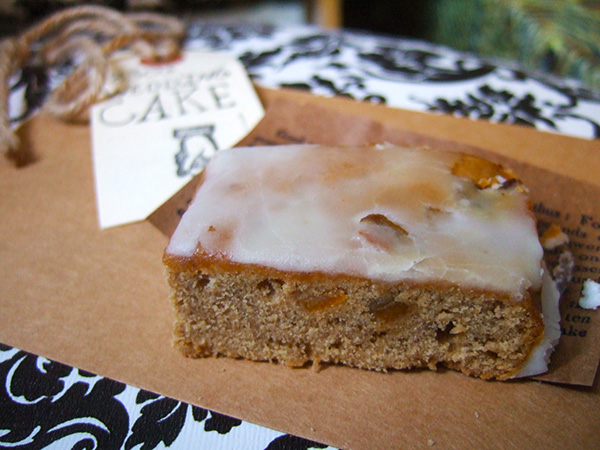
What might the cake have been made of? Sarah Josepha Hale offers up quite a recipe for a wedding cake in her 1841 The Good Housekeeper:

Take two pounds and a half of dried and sifted flour, allow the same quantity of fresh butter washed with rose water, two pounds of finely pounded loaf sugar, three pounds of cleaned and dried currants, one pound of raisins stoned, one nutmeg grated, half a pound of sweetmeats cut small, a quarter pound of blanched almonds pounded with a little rose water, and twenty eggs, the yolks and whites separately beaten.  

The butter must be beaten by hand till it becomes like cream; then add the sugar, and by degrees the eggs; after these, the rest of the ingredients, mixing in at last the currants, with nearly a tea-cupful of rose or orange flower water.  This mixture must be beaten together rather more than half an hour, then put into a cake-pan, which has previously been buttered and lined with buttered paper; fill it rather more than three quarters full.  It should be baked in a moderate oven for three hours, and then cooled gradually, by at first letting it stand some time at the mouth of the oven.

If you fear the bottom of the cake may burn, put the pan on a plate with saw-dust between.”*

*Sarah Josepha Hale, The Good Housekeeper, 1841, p. 100

January 7, 1852

weddinga_cake1

*

/52

Wednesday Jan 7th

Heat the brick oven baked a loaf

of brown bread two loaves of fruit cake for

Augusta & mince pies  A & L were at Edwins

this forenoon. This afternoon have sewed for me on 

Susans dress.  I have been making frosting for

the cake  Helen has been in and the girls have had

a nice time over it  Frank carried them home


Augusta Pool and Lavinia Gilmore were once again helping Lavinia’s Aunt Evelina. Helen Angier Ames, too, came over from next door, and the young maidens had “a nice time over it.” They did a little sewing for Evelina – that must have pleased her – and helped prepare frosting for Augusta’s wedding cake, which Evelina had kindly undertaken to make, along with all the regular baking she was doing for her family. Augusta was to be married the next day to Evelina’s nephew, Edwin Williams Gilmore.

If the women were following the instructions of Sarah Josepha Hale, they would have made “Iceing for Cakes,” according to the following instructions:

Beat the whites of four eggs to a stiff foam, and add gradually three quarters of a pound of the best double-refined loaf sugar, pounded and sifted; mix in the juice of half a lemon, or a tea-spoonful of rose water.  Beat the mixture till very light and white; place the cake before the fire, pour over the iceing, and smooth over the top and sides with the back of a spoon.”**

When it got late, Frank Morton Ames took Augusta and Cousin Lavinia back to their respective families in the countryside. The light of a full moon guided them along in a sleigh over snow that was “now about a futt deep.”***

* Image of 19th century wedding cake courtesy of http://www.fourpoundsflour.com

**Sarah Josepha Hale, The Good Housekeeper, 1841, p. 101

***Journal of Oliver Ames, Courtesy of Stonehill College Archives


January 2, 1852

Tea


1852

Jan 2d Friday  Seated myself quite early this morning to work

on Susans hood & finished item about ten Oclock

then ripped my old blue hood and washed the

lining & turned the outside have got it nearly done

We all went into the other part of the house to tea

Mr & Mrs Oliver & Helen there  Frank has a sore

ankle as [sic] does not go to the shop  Dr Swan called there

to see Helen & left Jane some medicine

The family gathered for tea today in “the other part of the house,” meaning that Evelina, Oakes, and their children, Oakes Angier, Frank and Susan went into the southern half of the shared house where Old Oliver and his widowed daughter, Sarah Witherell, lived with her two children, George and Emily. Joining them was the family next door: Oliver Ames, Jr, his wife Sarah and their daughter, Helen Angier Ames, who made an appearance despite being home from school with a cold. Other than missing Oliver (3) and Frederick Lothrop, the sons who were off at college, the group was a normal configuration for a gathering at the homestead.

Evelina’s grandson, Winthrop Ames, would one day describe such a family gathering from less than a decade later, by which time daughters-in-law and grandchildren had arrived:

“Supper, always called Tea, at seven, was the sociable occasion. It usually consisted of cold meats, hot biscuits, preserves and cakes – an easy menu to expand for unexpected guests.  Every week at least, and usually oftener, one household would invite the others and their visitors to tea; and the whole Ames family might assemble, even infant children being brought along and tucked into bed upstairs.  Fifteen or twenty was not at all an unusual gathering.”*

The family was as tightly-knit as any of Evelina’s knitted worsted hoods.

One other note about today’s entry: Dr. Swan left some medicine off for Jane McHanna, the servant, who had been ailing for much of the fall and winter. What did she suffer from?

* Winthrop Ames, The Ames Family of Easton, Massachusetts, privately printed, 1937, p.128


December 23, 1851

4-currier-ives-winter-scene-granger


Tuesday Dec 23  Julia has been here to day to make Susans cotton

& wool Delaine  I have not sewed much with her

was choring about the house most all the forenoon

painted over some boxes for Mr Scott to grain.  made

the skirt & cuffs to Susans dress then went to knitting

on my hood which I commenced last evening.  Julia

cut and made and gathered the skirt and basted 

it on to the waist, the sleeves are not made


Old Oliver’s wintry weather report for this day suggests a scene worthy of Currier & Ives:”[T]his was a cloudy day + a verry little fine snow. wind north west it cleard of[f] about sunsett. what snow fell to day + last night was 1 ½ inch.” The countryside was covered with snow, appropriate enough for the first full day of winter.  And winter was a season much illustrated by the 19th century printmakers, Nathaniel Currier and James Ives.  Working out of New York, the firm produced enormously popular hand-colored lithographs of mostly American scenes. Currier began the prints in 1835 and was joined by Ives, who had been the firm’s bookkeeper, in 1856. The men soon developed a stable of artists and produced prints through the rest of the 19th century and into the early 20th. Evelina would have been familiar with Currier & Ives images, in the same way that many mid-20th century Americans were familiar with the illustrations of Norman Rockwell. The images were everywhere.

Many, if not most, Currier & Ives prints were scenes of the outdoors. On this day at the Ames’s, however, the action was all indoors, as the women chored, painted, sewed and knitted. Dressmaker Julia Mahoney was at the house to sew a wool dress for nine-year-old Susan Ames. That a child Susie’s age was having a dress made by a “professional” rather than her own mother was certainly a sign of the Ames’s wealth. Helen Ames, Susie’s fifteen-year-old cousin next door, often had her dresses made by Julia. Evelina was keeping up with her sister-in-law, Sarah Lothrop Ames, in providing the best for her daughter.


November 29, 1851

frontcover_500

Nov 29th  Sat.  This forenoon have been mending

Olivers (3) clothes and putting them in order to 

carry back Monday.  Have been with Oliver

to spend the afternoon at Mothers. Came

home by Mr Lothrops to bring Sarah Lothrop

Fred & Helen home  Alson has been quite 

unwell a week or more & is not able to work

Evelina was enjoying the company of her middle son, Oliver (3), today. Like many a modern child, he had brought his clothes home from college to be put “in order” (but not washed – it wasn’t laundry day.) Evelina mended what she could and then the two of them rode south to visit old Mrs. Gilmore and the family on the farm. They found that Alson Gilmore, Evelina’s brother, had been “quite unwell.” He was evidently bed-ridden, which suggests that their Thanksgiving had been less celebratory than the Ames’s.

Unlike the shovel laborers in the village, Alson did work that didn’t follow a schedule set by a bell.  He labored according to the demands of the season, weather and livestock. How had he managed to run his farm this past week when he was too ill to work? Most likely his fifteen-year-old son, Francis, took over responsibility for any livestock. And if the Gilmores had any dairy cows, it was typically the women of the house – in this case, daughter Lavinia or wife Henrietta – who would typically have done the milking. Because it was November, and after the harvest, there was otherwise not much work that demanded attention.

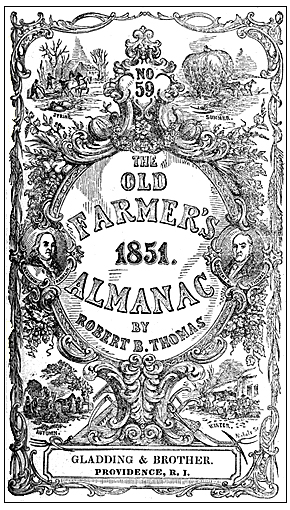
The Old Farmer’s Almanac, seen above, would have been full of advice for Alson and other farmers. We don’t know if Alson consulted it. (Like Old Oliver Ames, he might have consulted instead an agricultural newspaper called The Massachusetts Ploughman.)  The almanac was just featuring its new “Four Seasons” cover, first used in October of 1851 and still in use in 2014. It was designed by Hammatt Billings, a Boston architect and artist who also did the original illustrations for Uncle Tom’s Cabin, and engraved by Henry Nichols of Cambridge, who name appears on the lower right.  The editor was Robert B. Thomas, whose portrait is featured on the right side of the cover, opposite Benjamin Franklin.

November 27, 1851

Turkey


Nov 27  Thanksgiving day we have passed in the other

part of the house.  Our sons & Helen went this evening

to a ball in Canton  Father Mrs Witherell Mr Ames &

self had a game of cards.  Mr & Mrs H Lothrop

A[u]gustus & wife Cyrus & Sarah Lothrop

spent the day at Olivers

In 1844, Lydia Maria Child, a Massachusetts mother, author and abolitionist, published the original six verses of a poem about Thanksgiving. The poem was put to music, and verses were added or modified over time. We know it, and everyone sitting around the Ames’s dinner table would have known it:


The New-England Boy’s Song About Thanksgiving Day
Over the river, and through the wood,
To Grandfather’s house we go;
the horse knows the way to carry the sleigh
through the white and drifted snow.
Over the river, and through the wood,
to Grandfather’s house away!
We would not stop for doll or top,
for ’tis Thanksgiving Day.
Over the river, and through the wood—
oh, how the wind does blow!
It stings the toes and bites the nose
as over the ground we go.
Over the river, and through the wood—
and straight through the barnyard gate,
We seem to go extremely slow,
it is so hard to wait!
Over the river, and through the wood—
When Grandmother sees us come,
She will say, “O, dear, the children are here,
bring a pie for everyone.”
Over the river, and through the wood—
now Grandmother’s cap I spy!
Hurrah for the fun! Is the pudding done?
Hurrah for the pumpkin pie!

– Lydia Maria Child


Happy Thanksgiving, everyone.