July 1, 1851

P1010044-4

*

Tues July 1st  Worked in the garden a long while

this forenoon weeding & transplanting.

This afternoon trimmed Susan a straw and

horsehair bonnet that I purchased at Boston

Sat  Asa & Charles Mitchell came to 

the other part of the house this morning

Charles left this afternoon  I have not seen

Asa as yet

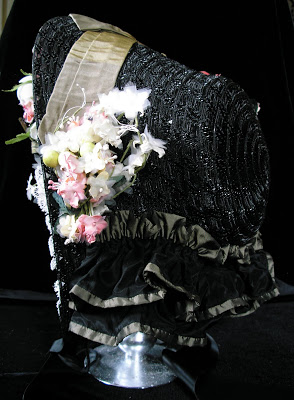
The wound on Evelina’s finger and thumb seemed better today; she spent most of her morning in the flower garden and, after dinner, trimmed a new bonnet for her daughter, Susan.  Straw bonnets were worn in the summer, naturally, and horsehair was a reinforcing fabric that could be used year round. Evelina had to be an expert by now on using horsehair, so adding ribbon or cloth flowers to it would be pretty easy for her, even with a sore hand.

Old Oliver, who seldom took note of the comings and goings of his children or his in-laws, reported in his journal that “Asa Mitchell came here to day from Sharon Pennsylvania.”  Asa was the husband of his youngest daughter, Harriett, who had been staying in Easton and Bridgewater by herself with her three children since the middle of April.  Asa worked in coal, an occupation that seemed to lead him – and his family – around western Pennsylvania and northern Ohio.

Evelina took note of Asa’s arrival; her curiosity was almost palpable as she awaited her turn to see him.  He and his brother Charles visited with Old Oliver and Sarah Witherell first thing.  What did they discuss?

* Horsehair and straw bonnet, modern construction from 1860s design; blog.historicalfashions.com, June 12, 2010, “Couture Historique” by Lindsey Slaugh

June 27, 1851

weedy flower bed

*

June 27 Friday  John left here this morning

Worked a long time in the garden

this morning for the weeds were very plenty

afterwards finished picking over the hair and

a long job it has been.  This afternoon put the hair

into the hair cloth cover and just commenced tying

it when Mrs Clark and Mrs Stetson came from

Sharon and of course had to leave it and go

into the other house house to see them. Mother & I stoped to tea

Pigweed, thistle, crabgrass, and purslane: Such weeds – and more – are the collective bane of the flower gardener. Evelina tackled some of them this morning as she addressed the “very plenty” weeds that were pushing into her flower beds. Perhaps she ruminated about her brother John and his short visit while her fingers dug into the soil.

After midday dinner she turned to her sewing, as usual, going right to her haircloth slipcover project, but abandoned it with alacrity when an opportunity for socializing turned up.  “Had to leave it and go..” she noted, when two friends from nearby Sharon arrived next door.  She and her mother, Hannah Lothrop Gilmore, went over for tea.

Frank Ames Mitchell, a nephew of Oakes and Evelina, turned ten years old today.  One of two grandsons of Old Oliver named Frank (the other being Frank Morton Ames,) he was the eldest son of Oakes’ sister, Harriett Ames Mitchell. He, his mother, and two younger siblings were living temporarily in Bridgewater while their father, Asa Mitchell, was working in coal in western Pennsylvania.

Our knowledge about Frank Mitchell is limited, as he never married or had any known issue. We do know that he was the only Ames grandson to fight in the Civil War.  He served in both the 44th and the 56th Massachusetts Regiments, and ultimately made captain.  In 1864, he was wounded at Cold Harbor.  Hospitalized in Washington DC, where his mother rushed to his side, he eventually recovered but remained in indifferent health for the rest of his life.

After the war, Frank bought a plantation in Tallullah, Louisiana, an effort that was underwritten and ultimately bought out by his Uncle Oliver Ames, Jr.  Family records show that Frank subsequently depended on financial support from his cousin Fred Ames. The remainder of his life consisted of traveling from one healthful climate or resort to another in search of good health.


* A modern flower garden, full of weeds, from canoecorner.blogspot

June 17, 1851

DSCF1590small

1851 June 17th  Worked untill about nine Oclock in

the flower garden  Then cut the tick to the mattress

a[nd] basted it ready to make  Jane was ironing and 

I assisted about dinner  After dinner made three button

holes in Mrs S Ames dress.  Went to Mr

Wm Reeds to tea with Mr Ames, Oliver & wife

Mrs W, Mitchell & Mr & Mrs Whitwell & Alson & wife


Gardening, sewing, ironing and cooking made up today’s housework at the Ames’s home on Main Street.  Buttonholes, too, which could be challenging, were a particular specialty of Evelina; many people brought her their buttonholes.  The fact that Sarah Lothrop Ames took her buttonholes to Evelina rather than to a hired dressmaker underscores Evelina’s talent in this department.

William and Abigail Reed must have enjoyed Evelina’s company on Sunday between services, for they invited her back to a small tea party.  The whole Ames family was invited, in fact, and then some. Minus Old Oliver, and the young people, naturally, siblings Oakes, Oliver Jr., Sarah Witherell, and Harriett Mitchell, with wives Evelina and Sarah Ames, gathered at the old professor’s home for a “cuppa.” Reverend William Whitwell and his wife, Eliza, went too, as did Alson and Henrietta Gilmore. That was a good crowd for a 19th century parlor.

Tea was generally the most sociable meal of the day.


June 11, 1851

images

June [11]  Wednesday  Mended

Oakes Angiers coat put on new

buttons  Then made the button holes in 

the waist of Mrs Sarah Ames dress. Cooked

a calfs head for dinner  This afternoon

about three Mrs Witherell, Mitchell & Miss

Eaton & self went to call on Mrs Whitwell.

Called at Mr Wm Reeds  Mrs Reed was from

home.  Called at Dr Swans.  Bridget here.

A[u]ugustus gone to Boston.


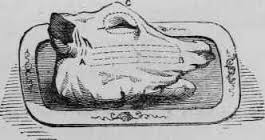
Evelina’s activities today were quintessentially nineteenth-century.  She mended her son’s coat, made button holes for her sister-in-law, rode out in the carriage with her other sisters-in-law to call on the parson’s wife, and served a calf’s head for dinner.

Perhaps there is a reader out there who has been served calf’s head, or cooked it.  Most 19th century cook books carried a “receipt” for it, right next to recipes for calf’s feet, sheep’s head, and roasted sweetbreads.  Calf’s head could be roasted or boiled; the recipe below from Mary Peabody Mann’s 1858 Christianity in the Kitchen opts for the latter.  What follows is not for the squeamish:

To Dress a Calf’s Head

Soak the head for ten minutes in lukewarm water, powder it well with rosin, dip it into a large quantity of scalding water, and holding it by the ear, scrape off the hair with the back of a knife.  When clean, take out the eyes, cut out the tongue, remove the jawbone with teeth, saw lengthwise through the skull without injuring the brains, which must be carefully taken out, and put for a few hours into lukewarm water, to disgorge, [that is, to rinse out the blood.]

Make a stock by putting into the brazing pan two or three carrots and onions, six cloves, a pint of cream, a bouquet of parsley, thyme, and bay-leaves, and after stirring this together for twenty minutes over the fire, add a pint of water.  When this is warm, mix a quarter of a pound of flour with a gallon of water, slice a lemon, add a quarter of a pound of salt, and lay the calf’s head into the stock.  Let it be entirely covered, else the uncovered part will have a dark look, and simmer it gently till it is tender.


June 10, 1851

url

June 10th 

Tuesday  Worked all the forenoon and part of the afternoon

weeding the flowers.  Got some Petunias at Mr Savages

The gardener has been to work in my flower

garden most all day weeding and fixing the

beds, has made them wider  This afternoon have

been mending Franks & Olivers pants

Mrs Witherell & Mitchell & Miss Eaton walked

up to Edwins garden.  Abby & Miss Smith called

Bridget ONeil here to work to day


The weather was fine enough that sisters Sarah Ames Witherell and Harriett Ames Mitchell took a long walk north toward Stoughton with their houseguest, Miss Eaton. They headed to Edwin Manley’s garden, a much-visited spot, to see what he had growing. Being on foot, it’s doubtful that they purchased anything to bring home. They may have ordered something to be delivered, however.

In the morning, Evelina went out to look at flowers, too, at the nearby home of William Savage, a shovelworker, and brought home some petunias.  Petunias, a great garden favorite in the latter half of the nineteenth century, originated in South America, appeared in Europe by 1800, but had only recently become available in the United States. Petunias were still so exotic, in fact, that they didn’t appear in the list of annuals in Breck’s Book of Flowers, published in Boston in 1851. How did Mr. Savage come upon them?

The Ames’s new gardener, who had been with the family for almost a month, weeded the flower beds today and worked at making them wider. Evelina’s parlor garden was becoming more and more ambitious. And for some reason, Bridget O’Neil, a servant, worked at Evelina’s today. She had been working next door at Oliver and Sarah Lothrop Ames’ house.  Where was Jane McHanna?

June 7, 1851

images-1

1851

June 7th Saturday  We have had a powerful

rain all day  Orinthia & self have been sitting

sewing most of the time  Orinthia has made a

pair of overalls for Frank  I have trimmed &

lined or rather Harriet trimmed the bonnet

and I feel very well satisfied about it.  The

school did not keep to day or yesterday

Susan has turned a sheet  Horatio Ames Jr &

Mr Scoval came to father Ames.  Mr Ames

brought a lobster that weighed 15 lbs.


No gardening today, but it wasn’t a bad day, despite the rain.  Evelina and Orinthia got to visit for hours over sewing, Oakes Ames brought home lobster – a big lobster – from Boston and, best of all, Evelina was finally “very well satisfied” about her bonnet.

Harriett Ames Mitchell visited, too, and trimmed Evelina’s bonnet. She might have used ribbons or cloth flowers or even a feather or two to adorn the summer headdress. Nine-year old Susie sewed as well.  Either the bad weather kept her indoors, or her mother finally made good on her threat from a few weeks ago to make Susan play less and learn to sew.  Susie “turned a sheet,” which means she did some hemming.

Old Oliver had a rare visit from one of his grandsons, Horatio Ames, Jr., who must have travelled up from Connecticut with a Mr. Scoval.  Horatio Jr. was a first cousin to Oakes Angier, Oliver (3), Frank Morton, and Susan.  The eldest son of Horatio and Sally Hewes Ames, and a recent student at Rensselaer Polytechnic Institute, he would prove to have a difficult life.  Closer to his mother than to his father, he was incensed when his parents divorced. According to some sources, he actually tried to kill his father during an argument in 1856.* His father, who was no saint himself, described his eldest son as “the worst hardened villain I have ever seen.”*

Still, Horatio Jr. was family, and Old Oliver welcomed him to his home more than once over the course of Evelina’s diary.


*John Mortimer, Zerah Colburn: The Spirit of Darkness, 2005

June 6, 1851

images

*

1851

June 6 Friday  Worked in the garden an hour or two this morning

mended some cotton stockings swept & dusted &c

About three or four Oclock went with Olivers wife

& Mrs Mitchell to North Bridgewater called at

Mr Summers to take Frank Mitchell home & at Mrs

Carrs & Susan Copelands to get my bonnet  The bonnet

is done well  When I returned home found Orinthia

here.  Jane Howard brought her up. 

At last, a bonnet to take home and trim.  Evelina was clearly pleased.  She picked it up in North Bridgewater (today’s Brockton) with her sisters-in-law Sarah Lothrop Ames and Harriett Ames Mitchell.  The ladies retrieved Harriett’s eldest son, Frank Ames Mitchell, in the process. Not yet ten years old, whom had he been visiting?

Otherwise, Evelina’s day was full of quotidian activities: mending, sweeping, dusting. Nothing out of the ordinary popped up in the domestic department. Gardening, too, continued. On this day, Evelina may have planted the asters she picked up yesterday at the Howards’, compliments of a Howard daughter, Louisa.

Joseph Breck in his Breck’s Book of Flowers, 1851, admired the China Aster: “The varieties are now very numerous, and possess exceeding beauty, some of them being almost as large as a small Dahlia, and much more graceful.”

Breck warned against letting the asters “degenerate in to inferior flowers,” and recommended sowing the seeds in May, “in patches,” and transplanting them to “a bed well prepared the last of June.” It may be that Evelina was transplanting the seedlings a little early.  Time would tell.

* Image from edenbrothers.com


June 5, 1851

e_gg_hook_organ2-291x440

*

1851

June 5th Thursday  To day I have been to Mothers, stoped at Orinthias

school and staid about an hour, left Susan there

and got to Mothers about noon.  Met A Augustus & wife

and her sister Elizabeth, John Pool & wife.  On my way

home stoped to Miss Louisa Howards & got some Asters

and at the meeting house to hear Elizabeth Clark play

Met Oliver & wife & Harriet, Mr Clark and

two daughters  A beautiful pleasant day


Several Ameses gathered this afternoon with others for a concert at the meeting house. Presumably, the new organ was featured again, played this time by a more proficient organist than Mr. Rotch from a few Sundays ago. Miss Elizabeth Clark, daughter of Daniel and Elvira Clark and barely 19 years old, treated the listeners to a recital. The Clarks were Unitarians, and Daniel was a capable carpenter who did occasional work for the Ames family. Elizabeth was evidently a fine pianist.

The new organ was possibly made by E. G. and G. Hook of Boston, whose factory was later in Weston, Massachusetts. Known by 1885 as Hook and Hastings, their firm was prominent in the 19th century in the production of church organs. Their first concert hall organ, no longer extant, was installed in the Tremont Temple across from the Boston Common. Their largest was placed in Boston’s Cathedral of the Holy Cross.  More common were smaller organs such as the one in the illustration that were installed in more modest meeting houses, like the Easton one used by the Unitarians in 1851.

The occasion for this particular recital is unknown, and how it came to be held on a weekday afternoon is also a puzzle.  It made sense to the townspeople, however, who turned out in full for the occasion.

*E. G. and G. Hook organ, Boston, Mass., circa 1848.  Athol Historical Society

May 31, 1851

IMG_0004

*

1851

May 31st Saturday  This morning baked in Mrs Witherells oven

brown bread & cake  Mrs S Ames went to Boston

Returned to night with Harriet & a Miss Eaton

from Pittsburgh.  Miss Linscot Orinthia & I […]

have been walking & riding about all day.  have

been to all the shops, ponds, Mr Manley & Claps

flower gardens, & called at Mr Torreys

It has been a beautiful day, rather cold.  A A not here

gone to Boston

Evelina used her sister-in-law’s brick oven early this morning and afterwards ventured outside to enjoy the “beautiful day” with her young house guests. She gave them the standard tour of much that North Easton offered: shovel shops, large ponds, full streams, two farms with extensive flower gardens, and a stop at Col. John Torrey’s, in the village. The latter was probably a sociable occasion that included tea with Abby Torrey.

Sarah Lothrop Ames, meanwhile, went into Boston for the day and returned with Harriett Ames Mitchell and a friend from Pittsburgh, where Harriett had lately been living. There was still no sign of Harriett’s husband, Asa Mitchell, who was, presumably, yet in Pennsylvania on business. Oakes Ames would have been in Boston today, too, perhaps with Augustus Gilmore.

The Ames boys wouldn’t have been pleasuring about – they were at the shovel shops, working.

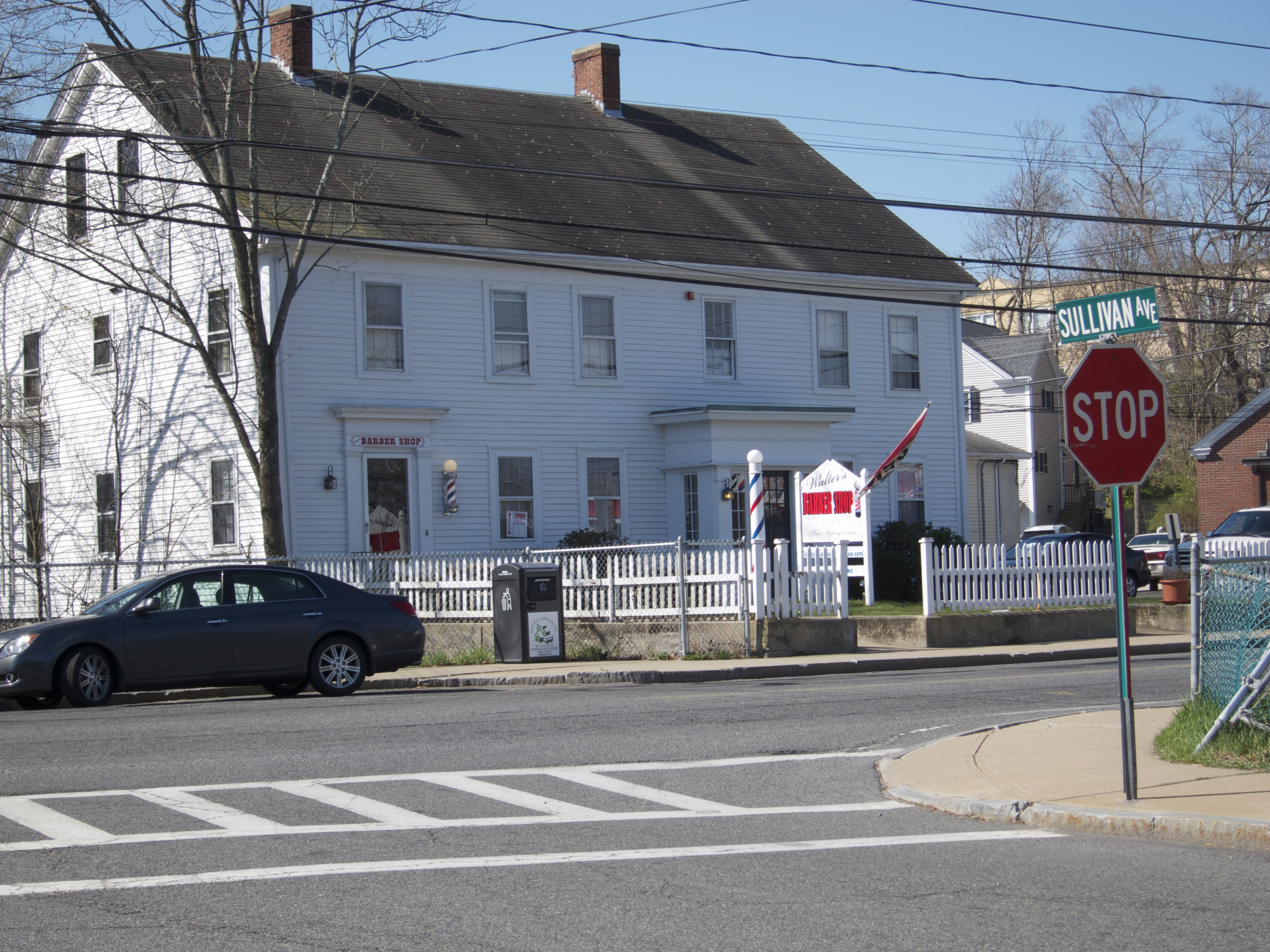
* Building in modern-day North Easton that once belonged to Col. John Torrey


May 22, 1851

stock-footage-senior-women-planting-a-flower

1851

Thursday May 22d  The first thing after breakfast set out

a plant that Orinthia sent me last night.  Then

went to work in the sitting room taking up the 

carpet cleaning the closets &c  have finished cleaning

the room and the carpet partly down.  Aunt Orr

& Harriet, James Mitchell came to visit Mrs

Witherell about two Oclock and I left my work to

see them  Quite pleasant

Ordinarily, Evelina was tired and listless after a day in Boston, but not today. Orinthia Foss sent her a plant, a sweet token of friendship and thanks, and “the first thing” Evelina did was head to the garden to plant it. Before doing her chores! The plant meant a lot to her and the gesture from her young friend buoyed the day.

Carpet cleaning, closet cleaning, &c, &c, as Evelina would say, took up the morning and some of the afternoon. Guests arrived in the other part of the house, making a welcome interruption from housework.

The Orrs and Mitchells were old connections from Bridgewater, and their families had long been intertwined with the Ameses. Some of the earliest Ameses had settled in Bridgewater and, as a young man, Old Oliver had lived there. As we’ve noted before, Evelina boarded with one branch of the Orr family whenever she stayed over in Boston.  Aunt Orr was probably Susan Orr, a close friend who could remember when Oakes Ames was a baby.

There were many Mitchells in Bridgewater. James Mitchell, who ended up as a merchant in Philadelphia, was one of them.  He was married to a woman from Belfast, Maine named Harriett Lavinia Angier (possibly a distant relative in the Angier line.) He and his wife didn’t appear often in the Ames written records, but they were among the few non-family members who, years after this, would attend the funeral of Horatio Ames.  Perhaps James Mitchell and Horatio Ames had been friends growing up.

Mrs. James Mitchell’s married name was Harriett Angier Mitchell, almost the same as Harriett Ames Mitchell, Oakes’s youngest sister who was married to Asa Mitchell. The Harriett who accompanied James Mitchell today was most likely his wife, not Oakes’s sister. Confusing to us, certainly, but straightforward to them. Otherwise, a pleasant day in all respects.