February 15, 1852

 lilliam_wald2

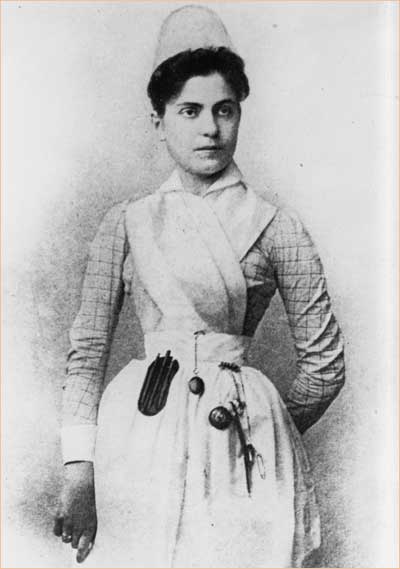
Nursing uniform from the late 19th c.*

1852

Sunday Feb 15th  Have been to church and at

noon went to Mr Baileys to see sister Amelia

who is nursing there  Mother went with me

Have been reading since meeting  Edwin & wife came

in to spend the evening but Mr Ames & self were

just going to Mr Swains and they would not let 

us stop for them so they went to Augustus  Had a 

pleasant call or rather visit at Mr Swains  came away

about nine Oclock  Very pleasant

The sun came out today, so despite it being “pritty cold,”** the Ames family went to church. During the intermission between morning and afternoon services, Evelina and her elderly mother, Hannah Lothrop Gilmore, rode out to visit Amelia Gilmore.  Amelia was the widow of Evelina’s brother, Joshua Gilmore, Jr. Joshua had died three years earlier, at age 35, leaving Amelia with two sons to raise.

In order to support herself and her boys, Amelia hired out as a nurse.  In this instance, she was looking after a Mr. Bailey, who must have lived near the Unitarian church. He may have lived alone, been ill and needed paid help; otherwise the convention of the day would have meant his female relatives looked after him. When Amelia wasn’t working, she and her youngest son, Samuel, lived with the Alger family near the Gilmore farm. The older son, Charles, had hired out somewhere but would soon come to reside with his uncle Alson Gilmore.

In 1852, nursing was not a formal profession.  Women (nursing was considered the exclusive province of women at the time) undertook nursing because they needed to work and this was one of very few avenues open to them. They based their protocol on personal experience in caring for ill members of their own families. There were no training programs or certification venues available, in no small part because there were so few hospitals. People were cared for at home. It would take the Crimean War in Europe and the Civil War in the U.S. to change attitudes and formalize medical care.

*Courtesy of http://www.nursinglink.monster.com

**Oliver Ames, Journal, Stonehill College Archives, Arnold Tofias Collection

 

February 2, 1852

grhog

1852

Monday Feb 2d  Worked about house untill about twelve

and went into Olivers to dine with my whole family

and mother.  Alson came this afternoon & carried

mother home.  All took tea at Olivers.  Mrs S Ames

Oliver Fred & self passed the evening at Mr Swain

Worked some on flannel skirt this afternoon […]

carried Susans stocking to Mr Swains.


We know about February 2; it’s Groundhog’s Day.  In 1852, it was no such thing, at least not in New England. In the Pennsylvania Dutch communities of the mid-Atlantic states, however, some folks had begun to claim that the behavior of a groundhog on this date could prognosticate the weather for the remainder of the winter. This practice was first formally celebrated in 1887, in Punxsutawny, Pennsylvania, and continues today.

More common for this date was the celebration of Candlemas, a holy day in the Christian Church that honored the presentation by Mary of Jesus at the temple. Roman Catholics called it the fourth Joyful Mystery of the Rosary. Unitarians had no name for it because Unitarians, like some other Protestant sects, didn’t acknowledge ecclesiastical feast days.

Yet there was a saying regarding this time of year that New England farmers – Old Oliver, a Unitarian, included – would have been familiar with:

“Half your wood and half your hay, You should have on Candlemas Day”

Candlemas falls between winter solstice and vernal equinox. It’s a day that turns the corner on winter, and heads for spring. It’s a day to take stock and hope you have enough wood left to keep warm and enough hay remaining to feed your animals for the rest of the winter.


January 30, 1852

Chess

Jan 1852

Jan 30th  Friday  Have commenced making a flannel

skirt for self & finished Susans dark print apron.

Mother [and] self passed the afternoon at Edwins.  Mr

Ames came to tea. Mrs S Ames called there with Mrs

Holmes. Mrs Witherell and the others returned to 

night  She has not her teeth but is to send for them

Oliver & Fred went to James Mitchell and called at

several other places  had a fine time Oliver played

chess with Judge Mitchell

Oliver Ames (3), Evelina’s middle son and a future governor of Massachusetts, was still home from college, as was his first cousin, Frederick Lothrop Ames.  The two young men were having “a fine time” on their winter break.  Chess was just one of the games they might have played to while away the dark evenings, another being whist.

Chess had been around for centuries, having first developed in India and the Islamic world.  It had evolved over time; dark and light squares on a chessboard were first introduced in the 10th century, for instance, rules for a stalemate or draw in the 15th, and so on.

By the nineteenth century, chess was really coming into its own.  In 1802, one J. Humphreys published a book called Chess Made Easy.  In 1830, the first known female chess player was acknowledged (though probably not encouraged.)  The first international chess tournament was held in London in 1851, won by Adolf Anderssen, and in 1852, the year we find Oliver Ames (3) playing the game on a winter’s night in Bridgewater, Massachusetts, sandglasses were first used to time a game.

Before the decade was finished, an American prodigy name Paul Morphy came to fame, winning nearly every game he played and defeating most of the older expert players. In the United States, a chess “epidemic” was born.

January 26, 1852


IMG_0371

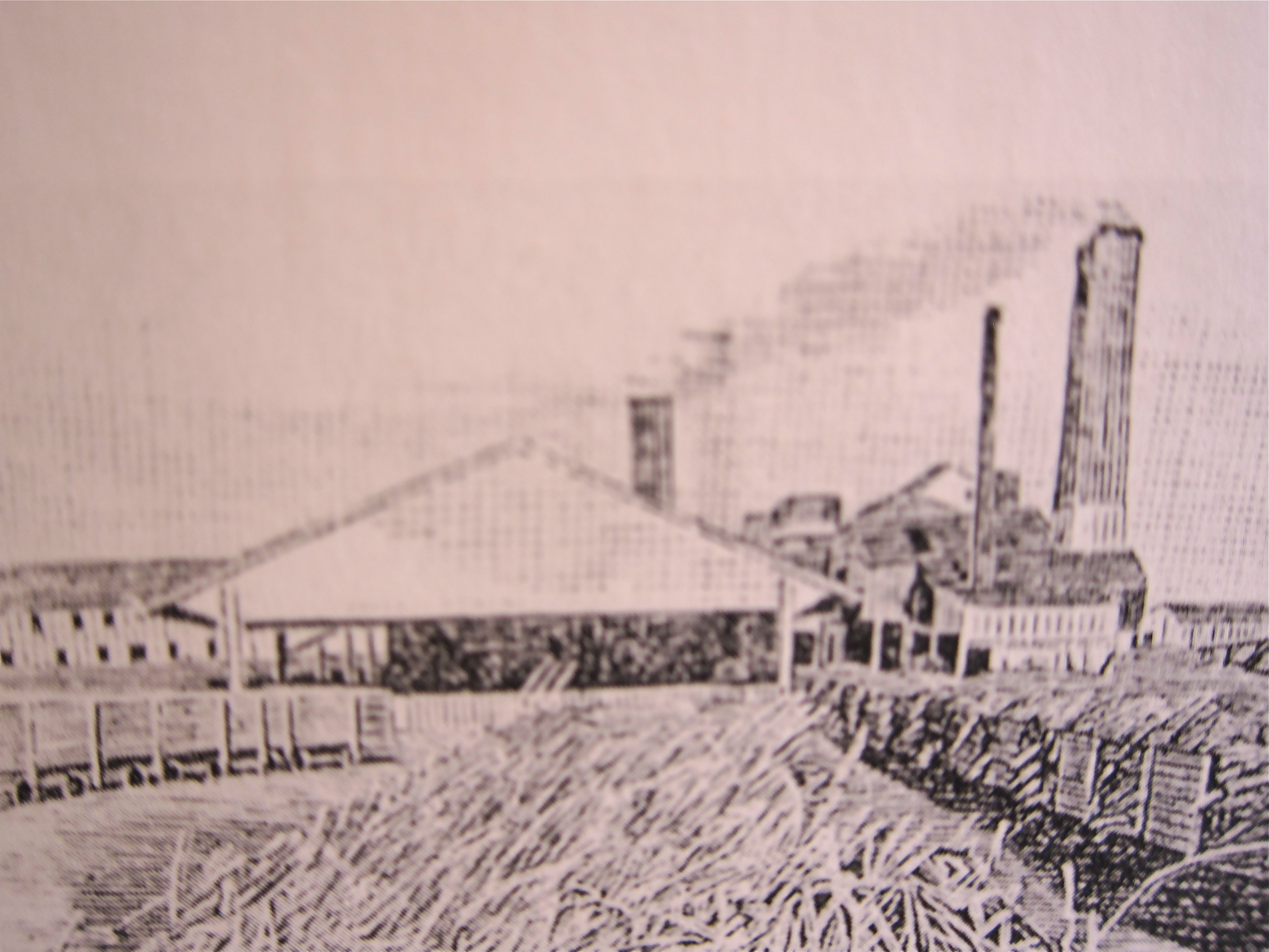
Ames Plantation, Jefferson Parish, Louisiana, ca. 1880’s

Jan 26/51 (sic)

Monday   commenced making Susan a flannel skirt

Mother & self went into Edwins with our work and staid

about 3 hours came home to tea.  Evening Augustus

Hannah and Mrs Witherell were here Oliver Jr

and Oakes A went to Mr Whitwells expecting to meet

Willard L there.  It has been a beautiful day.  Mrs Buck

and Sarah called at Edwins while we were there and

were very polite

It was Monday, which meant that Evelina probably did a little housework this morning before picking up her sewing. As usual, Jane McHanna managed the Monday washing and Evelina didn’t need to paint or fix or oversee anything but the flannel skirt she was making for her daughter. After midday dinner, she and her elderly mother, Hannah Lothrop Gilmore, walked to the home of Edwin Gilmore and sat with his bride, Augusta Pool Gilmore, each of them tending to their sewing. It seemed quiet on the home front.

In another decade, it would be anything but quiet – at least across most of the country.  The United States would be in the first upheavals of an impending civil war. “The Great Rebellion,” they would call it. On this particular day in January, 1861, Louisiana would secede from the Union, the sixth of eleven states to do so. When the war ended in 1865, the Confederacy defeated, Louisiana and her sister states would ultimately be accepted back into the Union through the arduous and hotly political process known as Reconstruction.

In another two decades, the economies of the southern states would still be struggling, enabling many northerners to acquire cheap land and cast-off businesses. In 1873, the three Ames brothers – Oakes Angier, Oliver (3) and Frank Morton – would purchase two old plantations, Estelle and South Side in Jefferson Parish, Louisiana, right across the Mississippi from New Orleans. On 13,000 acres, they would grow and refine sugar. The business ran until the start of the 20th century, overseen eventually by one of Frank’s sons. The property, which”stretched for more than one mile on the river and ran about eight miles deep”* was eventually sold.  Today that land comprises much of the city of Marrero, Louisiana. Little is left of the Ames influence except an eponymous boulevard running through the city’s center.


* Betsy Swanson, Historic Jefferson Parish: From Shore to Shore, p. 97.


January 25, 1852

Ice

1852

Jan 25  Sunday  Have had a lovely day although it is somewhat

cold.  The first pleasant sabbath we have had for

a long while  We have all been to church except

Mrs Witherell who still stays at home on account

of her teeth being out. Mother came with us

from church to night. We have had fine sleighing

for a long time  Mr Whitwell gave us a fine 

sermon this afternoon

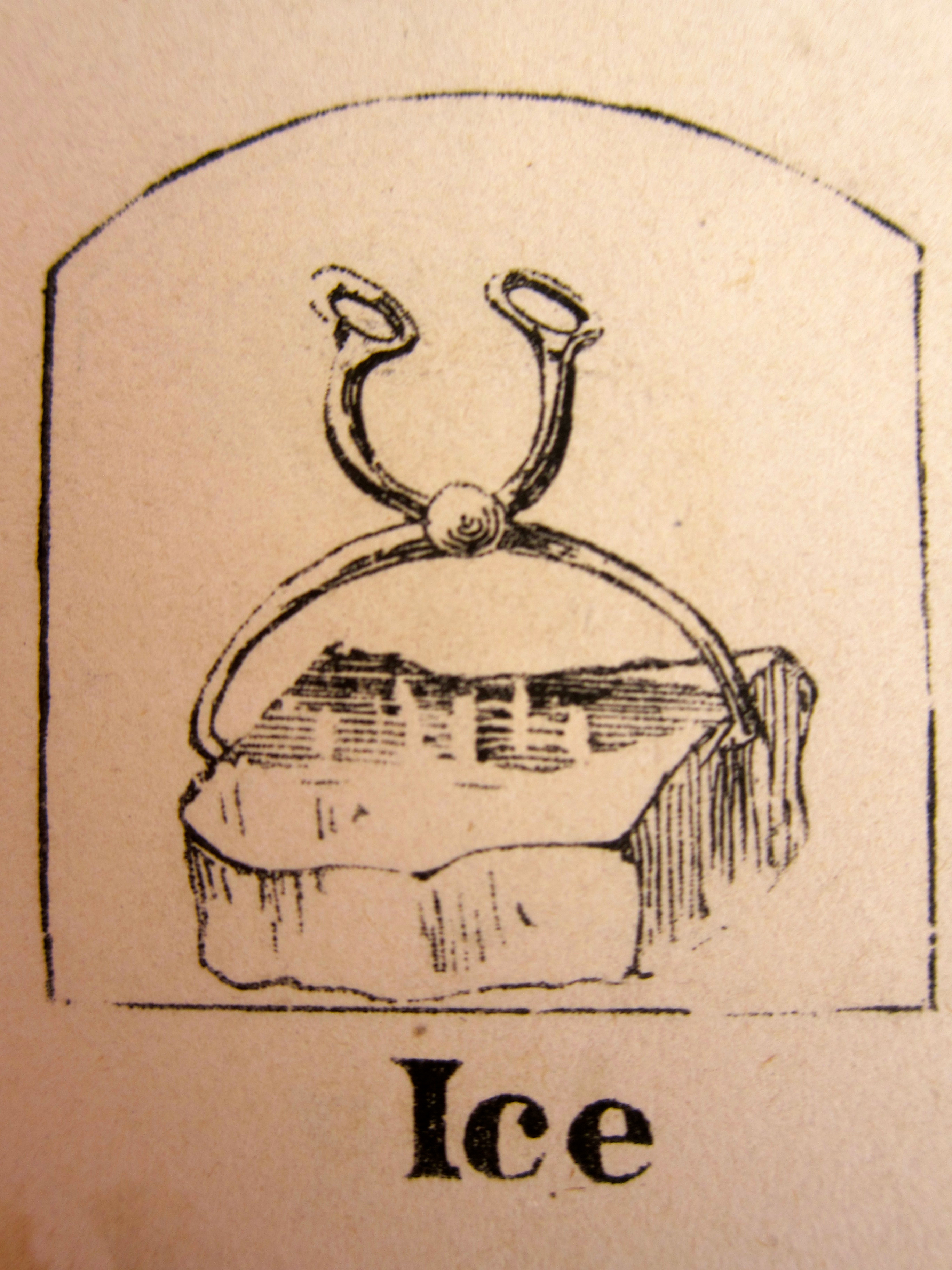
Old Oliver, too, appreciated today’s weather: “this is a fair pleasant day wind south west + thaws some   it is the first fair Sunday we had for a long time…” He also noted with satisfaction that “we began to fill our new ice hous yesterday,”* much of it with the ice that his grandsons Oliver (3) and Fred Ames had harvested on Friday.

The ice house was built right next to the pond** from which the ice was harvested. It was probably lined with sawdust for insulation; when the ice was removed, block by block, the sawdust absorbed some of the moisture and kept the building cool.  Even if the temperature outside rose, the temperature inside stayed relatively low. The ice was crucial to the storage and preservation of food in those days before refrigeration.

Today’s fair weather enticed everyone to church except Sarah Ames Witherell, who preferred to remain somewhat hidden while she recovered from recent dentistry.  The group drove the sleigh (or sleighs) to the meeting house, which was a couple of miles south of their family compound. Evelina sat in the family pew and enjoyed herself; she always liked hearing what Reverend Whitwell had to say.  She and her family brought her mother, Hannah Lothrop Gilmore, home for a visit.

*Oliver Ames, Journal, Stonehill College Archives, Arnold Tofias Collection

** Thanks to information from James Carlino, Dwight MacKerron and John Ames, we believe the ice pond in question may be Monte Pond, on the north side of Elm Street, just east of Rte. 138 in the northeastern corner of Easton. John also remembers an ice house next to French Pond on Union Street, also just east of Rte. 138, north of and parallel to Elm Street.  He bought some old ice tools there in the 1970s that he used in making sculpture.

January 3, 1852

OLYMPUS DIGITAL CAMERA

*

1852

Jan 3d Saturday 

Finished my old hood and ripped Susans

old one & washed the lining and have partly quilted

it once again  Have spent all the afternoon in 

mending Franks shop coat.  Sewed this evening

untill nearly ten have not read at all

Mrs Witherell received news last night that her

father Witherell is not expected to live and she has gone

to see him.

Three-and-a-half years earlier, Sarah Ames Witherell had lost her husband, Nathaniel Witherell, Jr.  Now, she had the sad duty of traveling to Boston to say goodbye to her husband’s father, Nathaniel Witherell, Sr. Someone must have written a letter to tell her he was ill and, ever dutiful, Sarah Witherell responded quickly to the news.  Off she went.

Better news was that today was the birthday of one of Evelina’s many nieces, Mary “Melvina” (or “Malvina” as Evelina spelled it) Torrey. The youngest daughter of Evelina’s late older sister, Hannah Howard Gilmore Torrey, Melvina turned 11. Her father was Col. John Torrey, a high-profile personage in North Easton, of whom Evelina often writes. Melvina and her sister, Abby Torrey, were great favorites of Evelina; Melvina is the niece to whom Evelina gave a bloomer hat the previous summer.

In another ten years, Melvina would marry an older man, Sanford Blake Strout, who also lived in the village of North Easton, on Center Street. She would bear two sons, Byron Howard Strout and Havilen Torrey Strout.


Illustration from Godey’s Lady’s Magazine, 1851


December 25, 1851

Turnstile


Dec 25th Thursday  The Irish are expecting to have a great

time to day Jane went to the meeting house about

eight but the priest did not come she stoped an

hour. Carried my knitting into Olivers awhile this

forenoon. This afternoon have been to mothers

with Mr Ames & Frank as they were going to West

Bridgewater.  Finished knitting the front & back of

my hood  Made a present to Lavinia of Turnpike Dividend $800

Christmas Day! But as Evelina points out, the Irish Catholics in town would be celebrating, but the Ames family wouldn’t. Jane McHanna left the house to attend a Christmas mass for which, unfortunately, the priest was either late or didn’t show up at all.  Jane returned home to prepare dinner. Evelina, meanwhile, visited Sarah Lothrop Ames next door, knitting in hand.

After dinner Evelina rode along with her husband and youngest son as they went on an errand to West Bridgewater.  They dropped her off to see her mother at the family farm. There may have been some recognition of the holiday in this gesture, although Evelina makes no mention of gift-giving, with one significant exception. Evelina gave an $800 dividend to her niece Lavinia Gilmore.

The dividend came, somehow, from proceeds from the Taunton and South Boston Turnpike, a road that had run through part of Easton since the early 1800s, between “‘Taunton Green, so called, to the Blue Hill Turnpike,'” according to town historian William Chaffin.* Its origin was controversial and involved a long-standing disagreement with the Town of Raynham, but its impact on the Gilmore family was generally positive, as various Gilmores, including Evelina’s father and brother, served as toll-gate keepers. As Chaffin points out, however, “[t]he toll-gate naturally became unpopular.” It was closed in October of 1851.

How Evelina came to possess $800 from the road is unclear. Was this a regular dividend that Evelina received, or was the family compensated for the road’s discontinuance? That Evelina passed this money on to her niece, however, is a clear demonstration that for all her economical instincts, Evelina was capable of great generosity.


*William L. Chaffin, History of Easton, Mass, 1866, pp. 454 – 458.

December 8, 1851


381-1233891708GdW7


Dec 8th Monday.  Another unpleasant windy day

and we could not put our clothes out

Alson came after Mother this afternoon

and it has cleared off quite pleasant.  he is

better but is not able to work yet.  I have been

cutting out some cotton flannel for Jane to work on

last week she worked for herself.  It is three

weeks since she has been able to work much

Another Monday morning with weather too “unpleasant” to hang the wash out to dry. It rained in the morning, and “took the snow all of[f]” according to Old Oliver. The newest servant, Mary, possibly with the help of the still-recovering Jane McHanna, must have resorted to hanging wet articles over various registers around the house to dry.

Besides the weather being crummy, Evelina’s husband, Oakes, was still away; her brother Alson, though improved, couldn’t yet work his farm; her servant, Jane McHanna, hadn’t fully recovered from an illness of three weeks running and she, herself, was coming down with a cold. Evelina’s week was off to a poor start; she must have been anxious by this time to have her husband return home. On the bright side – perhaps – she saw her mother, Hannah Lothrop Gilmore, return to the family farm, where the elderly woman was always the most comfortable.

The weather “cleared off” in the afternoon, bringing back the sunshine. Did the full moon that night cheer Evelina up with its wintry light or keep her awake worrying about various domestic aggravations?


December 1, 1851

20130117__anchor-ice~p1

*

Dec 1st Monday.  Oliver left again this morning

for Brown University.  Jane was able to do the 

housework this morning & Mary has washed

I have been sewing with Mother  Gave the

furnace up to Ann this morning  It has been 

so windy that we could not dry our clothes

Jane has starched the fine clothes to have

them ready to Iron tomorrow  Cold room all day


It’s not surprising that Evelina got Sarah Witherell’s servant, young Ann Orel, to start the coal furnace this morning, for it was a chore she disliked and the weather was so cold that there was no fooling around with getting heat into the house.  Old Oliver reported that “this was a fair day wind verry high from the north west + cold – a verry disagreeable day to be out in – there was an anchor frost this morning”

Anchor frost is a term for “a frost which causes ice to form along the bed of a running stream […] An anchorfrost can only occur when the temperature of the running water and the bed over which it flows is below freezing point. When this is the case, the rapidity of the stream is sometimes sufficient to prevent the swifter upper current congealing, while the lower current, which moves more slowly on account of the friction, becomes frozen to the bed.” *  Old Oliver knew all about running water and was probably not happy to see anchor ice forming in the Queset.

*Image of anchor ice, courtesy of The Aspen Times

** Arthur Benoni Evans, Leicestershire Words, Phrases, and Proverbs, Volume 11, English Dialect Society, 1881.


November 29, 1851

frontcover_500

Nov 29th  Sat.  This forenoon have been mending

Olivers (3) clothes and putting them in order to 

carry back Monday.  Have been with Oliver

to spend the afternoon at Mothers. Came

home by Mr Lothrops to bring Sarah Lothrop

Fred & Helen home  Alson has been quite 

unwell a week or more & is not able to work

Evelina was enjoying the company of her middle son, Oliver (3), today. Like many a modern child, he had brought his clothes home from college to be put “in order” (but not washed – it wasn’t laundry day.) Evelina mended what she could and then the two of them rode south to visit old Mrs. Gilmore and the family on the farm. They found that Alson Gilmore, Evelina’s brother, had been “quite unwell.” He was evidently bed-ridden, which suggests that their Thanksgiving had been less celebratory than the Ames’s.

Unlike the shovel laborers in the village, Alson did work that didn’t follow a schedule set by a bell.  He labored according to the demands of the season, weather and livestock. How had he managed to run his farm this past week when he was too ill to work? Most likely his fifteen-year-old son, Francis, took over responsibility for any livestock. And if the Gilmores had any dairy cows, it was typically the women of the house – in this case, daughter Lavinia or wife Henrietta – who would typically have done the milking. Because it was November, and after the harvest, there was otherwise not much work that demanded attention.

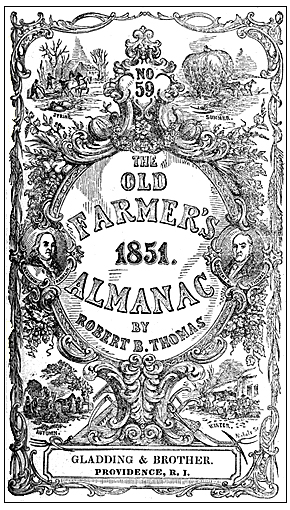
The Old Farmer’s Almanac, seen above, would have been full of advice for Alson and other farmers. We don’t know if Alson consulted it. (Like Old Oliver Ames, he might have consulted instead an agricultural newspaper called The Massachusetts Ploughman.)  The almanac was just featuring its new “Four Seasons” cover, first used in October of 1851 and still in use in 2014. It was designed by Hammatt Billings, a Boston architect and artist who also did the original illustrations for Uncle Tom’s Cabin, and engraved by Henry Nichols of Cambridge, who name appears on the lower right.  The editor was Robert B. Thomas, whose portrait is featured on the right side of the cover, opposite Benjamin Franklin.