September 15, 1851

Peach

Monday Sept 15th  Mrs Stevens & I made our plan

to go to North Bridgewater this afternoon but

could not get a horse in season  Augustus

rode up to his house with us and we brought

Miss Eddy home with us.  Called at Mr Reeds

and got some peaches.  Mr & Mrs Whitwell

called before we went away Ruth & Louisa

Swan called at the other part of the house

Plans to go to North Bridgewater had to be cancelled today when Evelina couldn’t get a horse in time, or “in season,” as she says. The morning hours had been spent on housework and laundry, certainly, and the planned trip to Bridgewater must have been a sweet incentive to get the choring done.  No doubt Evelina and Mrs Stevens were disappointed not to go.

Evelina and Mrs. Stevens did get to call on Evelina’s nephew, Alson Augustus Gilmore and his wife, Hannah Lincoln Gilmore.  Hannah had recently given birth to her second son, Willie, and might well have welcomed the company. The women also secured some peaches at one of the Reeds’ homes, no doubt with plans to make some preserves. Reverend William Whitwell and his wife Eliza called on them and two of Dr. Caleb Swan’s offspring, Ruth and Louisa, called to see Sarah Witherell.  Ruth was about to be married. The social comings and goings of summer continued despite the light frost overnight, a sure sign of approaching autumn.

July 25, 1851

Wine glass

Friday 25th July  Was expecting to go to Boston with

Mr Ames & Susan in the wagon but it was

misty & cloudy and we gave up going.  It cleared

up very pleasant about nine  I pick[ed] some 

currants for some wine.  Jane strained them

About ten Oclock Augustus carried me up to

see his new heir, found mother & babe comfortable

Evelina was disappointed not to travel into Boston today; the possibility of bad weather put her off the jaunt. However, she got to see William Gilmore, her new great-nephew.  Her niece-in-law, Hannah Lincoln Gilmore, and the baby seemed to be doing well, which must have been a relief. In an era when childbirth could be dangerous for mother and infant, Hannah and Willie were doing fine.

But what was going on in the kitchen at the Ames house? Evelina and servant Jane McHanna were making wine from the currants off the bushes in the back yard. Why did they do this? Alcohol was never served at the Ames house. As Sarah Josepha Hale, author of The Good Housekeeper, a popular cook book, stated emphatically, “t]here is one rule for drinks which no woman should violate – never make any preparation of which alcohol forms a part for family use!”

Yet here was alcohol being prepared in Evelina’s own kitchen.  Rather than being made to be served as a beverage, however, it was being prepared for culinary and medicinal purposes and, for such cases, it was evidently permissible. In cooking, wine or cider could be used as a preservative in mincemeat pies, for instance.  An even more viable use was as medicine for the sick.  In Little Women, Mr. March stores away some wine bottles for his invalid daughter, Beth. In Evelina’s kitchen, the homemade wine would probably be served to someone who became ill and needed a tonic. A drink called wine whey, made from strained wine and milk, was a common treatment for fever and other ailments. Wine had its uses; distilled liquors did not.

* Sarah Josepha Hale, The Good Housekeeper, 1841


July 21, 1851

Baby

1851

July 21st Monday  Worked about house all the forenoon 

This afternoon have been to work on the

lounge.  Put some tufts on the side of the

matress & nailed some haircloth on the inside 

of the lounge  Augustus has another son

born to day  He called here about four

Oclock to tell me the news.


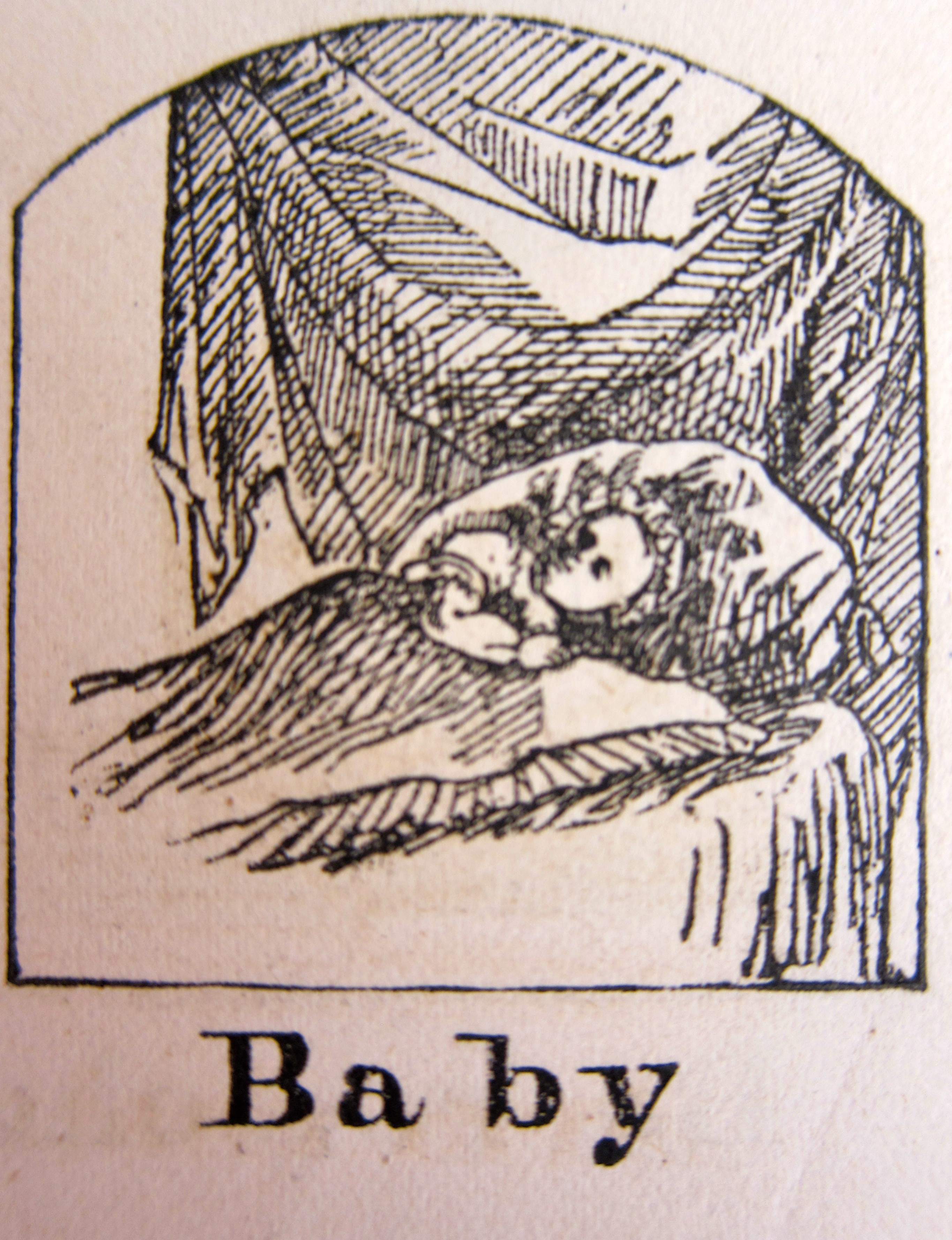
Hannah Lincoln Gilmore, wife of Alson Augustus Gilmore, gave birth today to her second child, a baby boy soon to be known as Willie. This was good news.

We shouldn’t be surprised that Evelina noted only the arrival of the little boy and said nothing of Hannah’s labor and delivery. Most middle- and upper-class people at that period would have avoided explicitly describing childbirth. At most, if mentioned in public, the delivery would have been referred to simply as the mother’s “sickness.” Elizabeth Cady Stanton, describing the easy birth of her fourth child in 1851, wrote “I was sick but a few hours.”*

Most women, especially in small towns and the countryside, delivered their babies with the help of a midwife, who was often assisted by female relatives; this was still true in Easton.  A new trend, however, especially in urban areas among the wealthier population, was to request the attendance of a physician at delivery. As a modern historian notes, “Fear of pain, permanent injury, or death, willingness to defer to the demands of fashion, the belief that birth posed special dangers to affluent, well-bred women, and the availability of doctors, private nurses, and new medical technology all contributed to changing attitudes.”*  Doctors began to appear bedside as women – especially rich women – gave birth.

We don’t know if Hannah got through her “illness” with the help of a physician. But as reported by her husband Augustus,  she and little Willie were resting by the end of the day.


*Sylvia D Hoffert, Private Matters: American Attitudes toward Childbearing and Infant Nurture in the Urban North, 1800 – 1860, Chicago, 1989, p. 69 and 63

June 5, 1851

e_gg_hook_organ2-291x440

*

1851

June 5th Thursday  To day I have been to Mothers, stoped at Orinthias

school and staid about an hour, left Susan there

and got to Mothers about noon.  Met A Augustus & wife

and her sister Elizabeth, John Pool & wife.  On my way

home stoped to Miss Louisa Howards & got some Asters

and at the meeting house to hear Elizabeth Clark play

Met Oliver & wife & Harriet, Mr Clark and

two daughters  A beautiful pleasant day


Several Ameses gathered this afternoon with others for a concert at the meeting house. Presumably, the new organ was featured again, played this time by a more proficient organist than Mr. Rotch from a few Sundays ago. Miss Elizabeth Clark, daughter of Daniel and Elvira Clark and barely 19 years old, treated the listeners to a recital. The Clarks were Unitarians, and Daniel was a capable carpenter who did occasional work for the Ames family. Elizabeth was evidently a fine pianist.

The new organ was possibly made by E. G. and G. Hook of Boston, whose factory was later in Weston, Massachusetts. Known by 1885 as Hook and Hastings, their firm was prominent in the 19th century in the production of church organs. Their first concert hall organ, no longer extant, was installed in the Tremont Temple across from the Boston Common. Their largest was placed in Boston’s Cathedral of the Holy Cross.  More common were smaller organs such as the one in the illustration that were installed in more modest meeting houses, like the Easton one used by the Unitarians in 1851.

The occasion for this particular recital is unknown, and how it came to be held on a weekday afternoon is also a puzzle.  It made sense to the townspeople, however, who turned out in full for the occasion.

*E. G. and G. Hook organ, Boston, Mass., circa 1848.  Athol Historical Society

May 26, 1851

maternity_5

Monday May 26  After washing the dishes this morning sit

down to work on the carpet for the sitting

room chamber and had but just got seated

when Augustus & wife & her brother & wife from

east Boston came. Hannah staid here while 

the others went to the shop  They left about 

ten Oclock.  Have put the carpet down and 

room ready for the new bedstead.  School commenced


Housework and laundry, presumably, went on as usual today except for a social interruption in the morning.  Augustus Gilmore and his wife, Hannah, stopped in with Mr. and Mrs. Lincoln, Hannah’s brother and his wife. Evelina described them as coming from East Boston, although Hannah had grown up in Hingham. After some brief socializing with his aunt, Augustus took his in-laws across the street to show them the shovel factory.

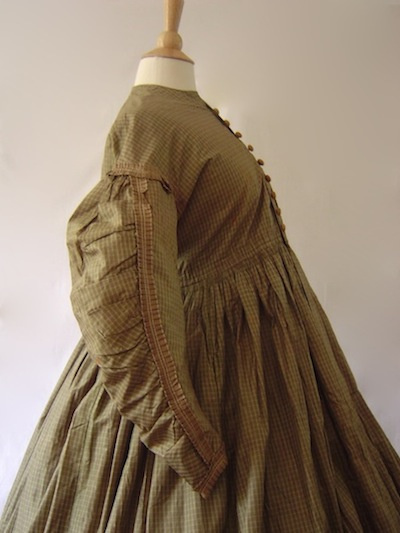
Hannah Gilmore didn’t accompany her husband, probably because she was about seven months pregnant. She and Evelina sat together in the parlor or sitting room, perhaps using the opportunity to discuss female matters, perhaps not. Such conversations were not considered polite, but surely two mothers together in a room could share information without being intrusive or indelicate. Given that Hannah was already the mother of a two-year old boy, Eddie, Evelina may have shared some tips on raising sons. Certainly, Evelina was a woman to whom younger women turned for advice and companionship.

The day must have been a fine one; school recommenced, carriages were out and about and, most exciting of all, Old Oliver reported that he “began to plant our corn.”  It was a time to sow.


February 19, 1851

Farm

Feb 19  Wednesday  A[u]gustus & wife came this morning in

the stage  We had our breakfast about six Oclock

and I had my morning work most done

We went to Mr Torreys to make a call met Alson

and Lavinia coming.  Alson went back to the poor

farm & Lavinia went with us to Mr Ts  Alson came

here to tea.  Augustus has engaged Mr Torreys

tenement if he concludes to take it   Beautiful weather.

Breakfast at six a.m., at work by seven.  That was the way it was done in the small industrial town of North Easton. By the time Augustus and Hannah Lincoln Gilmore arrived, the men of the house were at the factory and Evelina had washed the dishes, dusted the parlor and instructed Jane McHanna on the menu for dinner and  tea, probably adding additional directions on finishing up the ironing or some other piece of housework.

Off she went, then, to the home of her old brother-in-law, Col. John Torrey, with their mutual nephew, Augustus, only to meet her brother (and Augustus’s father,) Alson Gilmore, en route.  Alson had brought one of his daughters, Lavinia Eveline Gilmore, into town for a visit with the Ameses.  Evelina was fond of her niece, so the visit promised to be pleasant.

Alson soon drove off.  Evelina said he was headed to the “poor farm,” which may have been a jest expressing her opinion of the old family place or perhaps an expression of concern over the economics of the Gilmore homestead.  Or Alson may actually have been on an errand to an Almshouse located in the center of Easton*, near the church that the family attended.  Perhaps Alson was in search of temporary laborers for his farm, although why he would need help in the middle of winter is questionable.  Maybe he had an official role in its oversight.

Many towns had poor houses where the indigent lived; Worcester, Massachusetts established one in the late 1830s in alarmed response to a rising influx of immigrants.  Some citizens were afraid of the diseases that immigrants might be bringing with them, so part of the impetus for setting up a poor farm or poor house or Almshouse, as they were also known, was to establish a discrete site for new arrivals, pending further inspection.

Incidentally, today was an anniversary that probably went unnoticed in the Ames family.  On this date in 1810, a baby named Angier Ames was born.  He was the fourth son of Old Oliver and Susanna Angier Ames, coming along after Oliver Jr. and before William Leonard.  He only lived to be fifteen months old, dying in the summer of 1811 of an unrecorded cause.  Old Oliver wrote no record of this child; did he think of him on this day, some forty years later?

*A shout-out to Frank Mennino, Curator of the Easton Historical Society, for his capable sleuthing about the “poor farm.”  As he pointed out to me, the Almshouse can be identified on an 1855 map of the town. Thank you, Frank!

February 4, 1851

Governor Oliver Ames (Feb. 4, 1831 - Oct. 22, 1895)

Governor Oliver Ames

Tues Feb 4  Had my morning work done about nine Oclock just

as A A Gilmore & wife came to pass the day.  About eleven

we called to see Simeon Randalls house.  This afternoon

called at Mr Torreys and at Mr Peckhams.  While

we were at tea Mr Torrey called to talk about letting his

house to Augustus.  Received a letter from O Foss.

Passed this evening with Sarah W in the other part

of the house finished another pair pantletts  Pleasant

Evelina’s nephew, Alson “Augustus” Gilmore, and his wife, Hannah Lincoln Gilmore, came to North Easton today to search for a house to rent.  A young couple with one child, Eddie, they were expecting a second child in July, although they may not have shared that information with their aunt.  Even if they had, she would never have spoken of it.  The increasingly prim culture of the day forbid it, but the high rate of infant mortality, too, caused many expectant parents and their relatives to downplay “the blessed event.”  Evelina carried Augustus and Hannah around to look at available properties.

Although Evelina doesn’t mention it, today is the birthday of her middle son.  Oliver Ames (3) turned 20 today.  Like his older brother, Oakes Angier, and his younger brother, Frank Morton, Oliver worked at the shovel shop, learning the business in the expectation that he would one day help run the company.  He had attended school at Leicester Academy and had hoped to go on to college, as his cousin Fred Ames was planning to do, but his father had insisted that he return home to work. Oakes Ames was no fan of formal education, having despised learning in his own youth.

The eldest son, Oakes Angier, naturally stood first in line to superintend the shovel business, but Oliver (3), would be a partner. Like his father, he was ultimately slated to travel as the company’s salesman.  Third son Frank, on the other hand, would be given an auxiliary administrative position in a related family-owned business, the Kinsley Iron Works Company in Canton.

But on this day, those occupations were in the future, as was Oliver (3)’s more memorable service as Governor of Massachusetts from 1886 to 1889. On this birthday, he was a brand-new twenty year old who worked hard all day, read alot, and enjoyed attending “sings”.