October 7, 1852

elm-yellows


Oct 7th Thursday  Have been cutting out some shirts

for bosoms.  Catharine Murphy has made

four window curtains for my front chamber

Mrs Witherell Mrs S Ames & self passed the

afternoon & evening at Mr Swains  Mr Ames 

came to tea and Oliver rode down after us and 

stopt awhile Mr & Mrs Meader are there &

Ellen Meader  Augustus wife went to Boston


There was quite a bit of socializing today, prompted in part by good weather. “[T]he 7th was a fair pleasant day + verry warm,” noted Old Oliver Ames. Henry David Thoreau, some 40 miles to Oliver’s north, was more discursive about the sunshine:

I sit on Poplar Hill. It is a warm Indian-summerish afternoon. The sun comes out of clouds, and lights up and warms the whole scene. It is perfect autumn. I see a hundred smokes arising through the yellow elm-tops in the village, where the villagers are preparing for tea. It is the mellowing year. The sunshine harmonizes with the imbrowned and fiery foliage.**

The elm trees such as the ones that Thoreau mentions would also have been seen by Old Oliver. In fact, they would have been seen across the state and beyond. Once upon a time, American Elms were ubiquitous in the United States.They were tall trees with a wine-glass profile and a graceful green canopy. In the 20th century, however, most of them were wiped out by Dutch Elm disease. The existence of “Elm Streets” in communities around the country attests to the fact that elms were once as common as maples or pines. As Thoreau suggests, many a small town lived under their shade.

*Oliver Ames, Journal, Stonehill College Archives, Arnold Tofias Collection

**Henry David Thoreau, Journal, courtesy of http://hdt.typepad.com/henrys_blog


October 2, 1852

doc-2-dakotapaul

Oct 2d Saturday  Have had quite a party this after 

noon  Mrs Norris, Mrs Mower, Miss Foss, Linscott

& Lavinia here to dine & Hannah Augusta Abby

& Malvina here to tea  Carried Augusta out to

ride the first that she has been out for a long time

We have been to the shops and making calls

and I have done no sewing to day  Mrs Mower

went home with Lavinia  Made my peach preserves

Mr Ames came home from New York


Friends of Evelina descended on the house today, some for dinner and some for tea. Carriages full of females trotted along Main Street, coming or going to the Ames residence. Evelina’s friend, Orinthia Foss and her fellow school teacher, Frances Linscott, came from Bridgewater and spent the night. Niece Lavinia Gilmore arrived to help with house guests Melinda Norris and Louisa Mower, the latter from Maine. At tea time, Evelina’s sister-in-law Hannah Lincoln Gilmore and two nieces, Abby and Melvina Torrey, joined the group. For the second time this week, many women filled the parlor. We might imagine that Evelina was really enjoying herself.

What did the men of the family do to cope with all the socializing? Join the crowd or disappear into the office next door? What must Oakes Ames have thought when he walked in, home from his business trip?

Augusta Pool Gilmore, who had been ailing for many weeks now, was on the mend. She, too, came for tea and later was taken out for a drive. Like yesterday, the weather was mild and sunny and Augusta must have felt reborn to finally get out of her sick room and back with the living.

Even with a big midday meal and many for tea, the servants – and perhaps Evelina herself – still managed to put up some peach preserves. What a busy kitchen!


September 30, 1852

Spiced-Butternut-Squash-Pie-450

Squash Pie*

Thursday Sept 30th  Have swept the parlour

and Catharine has swept the chambers

and we have baked squash and apple pies

in the brick oven.  Hannah Welch came

last night and has done part of the ironing

to day.  this evening she heard her sister

was sick and she has left and gone back 

to Lynn.  Mrs Lincoln called with Hannah


Life at the Ames house returned to normal after yesterday’s meeting of the Sewing Circle. Evelina and a servant, Catharine Middleton, swept and tidied up while a new servant, Hannah Welch, tended to the ironing. Hannah would leave abruptly however, never to return, making her one-day employment the shortest on Evelina’s growing list of departed servants.

The household carried on. Today was a baking day, back in the capacious brick oven that Evelina shared with her sister-in-law, Sarah Ames Witherell, in the other part of the house. Squash and apple pies were on the menu, naturally, both being part of the fall harvest. Squash pies were as routine as pumpkin pies; every contemporary cookbook offered a recipe. Sarah Josepha Hale, though critical of pies in general as being too rich, allowed that they were acceptable in the colder months “because then we can bear a rich concentrated diet, better than during hot weather.”** Her recipe:

Pare, take out the seeds and stew the squash until very soft and dry. Strain or rub it through a sieve or colander. Mix this with good milk till it is thick with batter: sweeten it with sugar.  Allow three eggs to a quart of milk, beat the eggs well, add them to the squash, and season with rose water, cinnamon, nutmeg, or whatever spices you like. Line a pie-plate with crust, fill and bake about an hour.**

The rich pies probably hit the spot with the family. Certainly, the timing was perfect because on this night, “there was a pritty havy frost.”*** Fall had arrived.


*Image courtesy of  www.lostrecipesfound.com

**Sarah Josepha Hale, The Good Housekeeper, 1841, pp. 81-82

***Oliver Ames, Journal, Stonehill College Archives, Arnold Tofias Collection

September 14, 1852

Grapes

Tuesday Sept 14th  Alson came this forenoon and carried

mother home  I have ironed 13 fine shirts made

grape jelly and have been hard at work all

day  Mr Torrey came and staid a long while

talking over the news of the neighborhood

Mrs Stevens & self called on Augustus & wife and

went over [to] Mr Carrs where they have commenced

mowing  Mr Torrey & Abby were away, door fastened

New carriage & Buggy chaise came to night


Evelina didn’t stop moving today. She saw her mother depart for home, ironed a baker’s dozen of shirts, made grape jelly, did her usual picking up around the house, entertained guests, and paid a call on her nephew and others. It’s hard to imagine that her kitchen could accommodate the ironing of white shirts and the boiling of purple jelly at the same time, yet we read that this was so.

We readers should also note that for once, it’s Evelina, and not her father-in-law, who tells us that there is mowing going on in the neighborhood. The men were working quickly, one imagines, as “there was Some frost last night.”* Officially, it was still summer, but winter was on the far horizon, and preparations were underway.

And there was new equipage! A carriage and a buggy or chaise arrived. Who had just bought them?  Old Oliver?  Oakes or Oliver, Jr., or one of the sons, or all of the above? How, exactly, might the ownership of the vehicles have worked?


*Oliver Ames, Journal, Stonehill College Archives, Arnold Tofias Collection


September 10, 1852

Conductor

Friday Sept 10th  Mother Mrs Stevens Susan & self rode to

the shops this morning.  Mother seemed as delighted

as a child  we called on Mrs Shepherd also invited 

her to come here Saturday  Have passed the

afternoon at Mr Torreys Augustus & wife were

there  Mr Torrey very sociable & clever

Oakes A returned home from Burlington yesterday

and is looking much better

Oakes Angier Ames returned to Easton today, looking healthier than when he had left three weeks earlier. Family members would have hoped that the 23-year-old had recovered from his lung ailment in the fresh air of Vermont, that his indisposition hadn’t proved to be consumption. No doubt, he hoped that, too.

Another male relative also arrived in town; although not traveling together, both men must have arrived by train at Boston, then Stoughton or Taunton, and then traveled by carriage to North Easton. William Leonard Ames “came here from Minesota the 10th,”* bringing with him his five-year old son, Angier Ames. He had left his wife back in St. Paul with their older son, William Leonard Ames Jr., and their youngest child, Oliver Ames. William visited Easton periodically and always stayed with his father. He and Oakes Ames did not get on well, as we have seen before, and we can perhaps infer from Evelina’s failure to mention his arrival that she wasn’t keen on William, either.

With her friend Mrs. Stevens in tow, Evelina took her mother and daughter out on a number of calls. Her mother enjoyed the ride around the new shop, and all seemed to enjoy an afternoon visiting Col. John Torrey in the village. He was a widower of Evelina’s late older sister, Hannah. Evelina seemed to be planning a special tea for the following day, perhaps in honor of Mrs. Stevens.


*Oliver Ames, Journal, Stonehill College Archives, Arnold Tofias Collection

September 6, 1852


OLYMPUS DIGITAL CAMERA

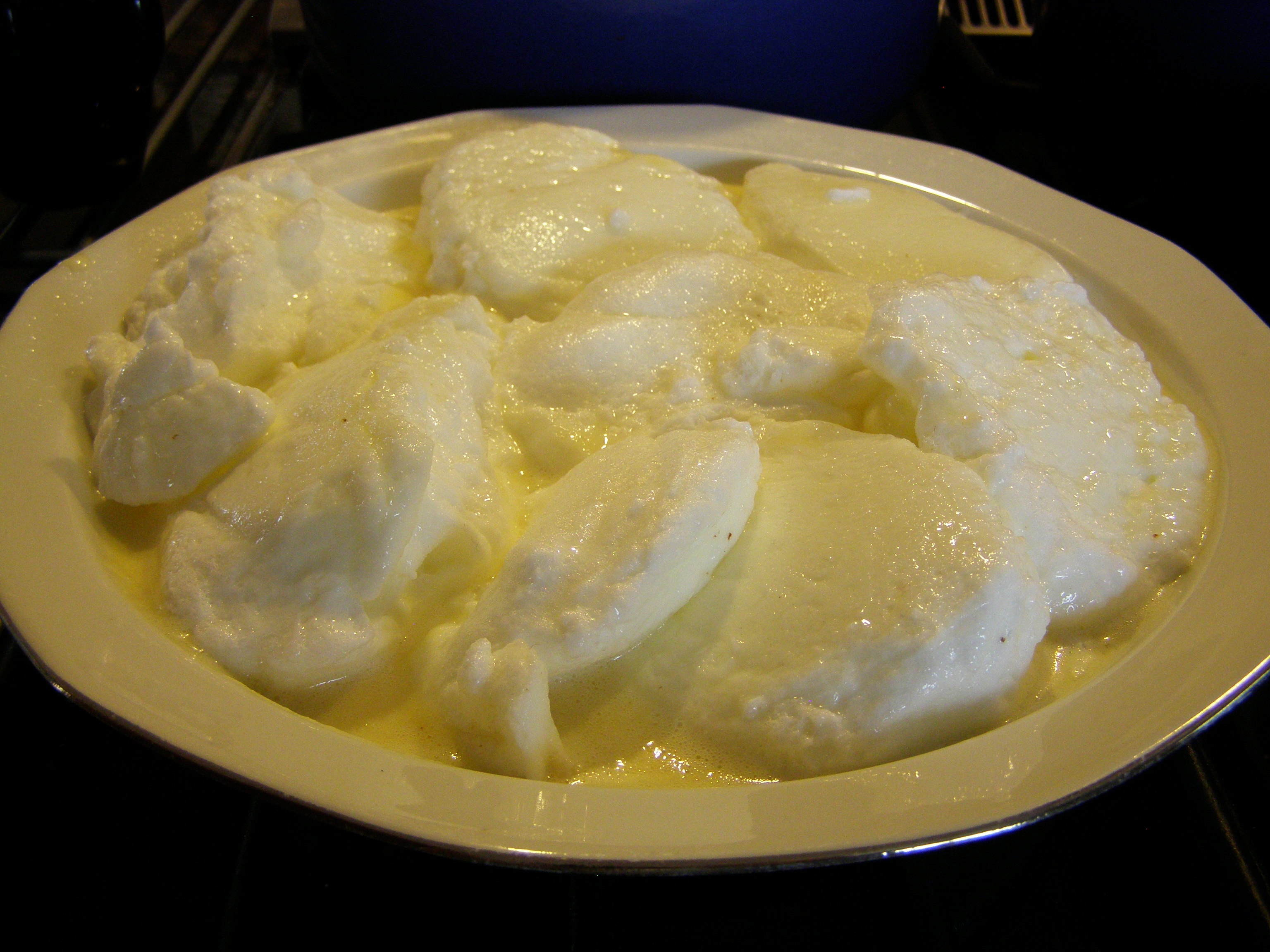
Floating Island


Monday Sept 6th  Hannah & Catharine washed

and I had to be about house most of the 

forenoon  made floating island &c &c Mr

Plymton & another man here from Walpole

to dine  Sewed some on shirts  Called

with Mrs S Ames & Mrs Stevens on Abby &

Hannah.  Called on Mrs Wales Sampson Holmes &c


“Oeufs a la Neige” is the French name for this lovely dessert, but Americans took their floating island from its Italian name, “Ile flottante.” Whatever one might call it, the basic recipe for the soft custard filled with floating ovals of poached meringue requires milk or cream and eggs.  It would have been a special occasion for Evelina to serve it, which suggests that she wanted to impress the gentlemen from Walpole who came to dinner. It also tells us that she had eggs to spare in her kitchen, which was unusual.

Recipes for this dish are varied, as one might expect. One 19th century “receipt,” printed in the 1870’s in Godey’s Lady’s Book of Receipts and Household Hints*,  tells us that making the dish was quite time consuming, especially when we remember that all that beating, stirring and frothing was done by hand.

Take six eggs, separate them; beat the yolks, and stir into a quart of milk; sweeten to taste; flavor with lemon or nutmeg. Put this mixture in a pan. Put some water in a saucepan, and set it on fire. When boiling, put in your pan, which ought to be half immersed. Keep stirring it until the custard gets thick, which will be in about thirty minutes. Whip the whites of the eggs to a strong froth. When the custard is done, put into a deep dish, and heap the frothed eggs upon it. Serve cold.*

No doubt Evelina’s dessert was a success at the dinner table. She could spend the afternoon in peace of mind, sewing and socializing. She, her sister-in-law, Sarah Lothrop Ames, and her guest, Mrs. Stevens, made a number of calls.

* Godey’s Lady’s Book of Receipts and Household Hints, 1870s, Recorded by Sarah Annie Frost, p. 237


August 20, 1852

1024px-1879_CV_map_only

Map of the Central Vermont Railroad, circa 1879

1852

Friday Aug 20th  Left Bellows Falls at 1/2 past 7 and

arrived at Burlington about two. Went

to Mrs Stetsons found the house shut up

At the house opposite they told us she had

gone to Mrs Mills and went there and had

some dinner and all went to Mrs Stetsons to

tea  Mrs S Ames Fred & Helen stopt at Pittsford

Willie Gilmore died this afternoon

Evelina would not learn of it for several days, but her young great-nephew, William Lincoln Gilmore, died today of dysentery. (She added the information later.) Barely a year old, Willie had been ill for several weeks, and Evelina had visited his parents, Augustus and Hannah Gilmore, a few times before she left North Easton. His death was sad news.

Not knowing about it, however, and full of her own worry for her own son, Evelina was open to the journey she and other family members were on. By way of the Vermont Central Railroad, presumably, she, Oakes Angier, and Almira Ames traveled another 100+ miles today from Bellows Falls to Burlington, Vermont, while Sarah Lothrop Ames and her two children, Fred and Helen, got off at Pittsford. Although the map in the illustration above dates from 1879, the line itself was first developed in the 1840’s.

Burlington was Oakes Angier’s destination, the place where he would stay for several weeks to rest and, it was hoped, recuperate from his pulmonary illness. The threesome spent the night with Mrs. Stetson, a friend of the family.

July 8, 1852


IMG_7790

1852

July 8th Thursday  This forenoon cut out a night dress

from Mrs Ames pattern and was busy in my 

chamber made some cake & ginger snaps and 

baked them in Mrs Witherells oven  This

afternoon Mrs Witherell S Ames & A Ames were

here & Helen & Emily  The gentlemen came to 

tea  Mrs Augustus Gilmore passed the evening

This was a hot day for baking, but Evelina nonetheless made “cake & ginger snaps” in her sister-in-law’s brick oven. No doubt she served some of the goodies later in the day when the Ames clan gathered for tea. There didn’t seem to be any special occasion for the tea, except that a cousin, Almira Ames, was visiting. Rather, it was perhaps Evelina’s turn to entertain the family. As Evelina’s grandson, Winthrop Ames, later pointed out, “[e]very week at least, and usually oftener, one household would invite the others and their visitors to tea; and the whole Ames family might assemble…”*

Ginger snaps were pretty standard fare at such occasions. Evelina baked them regularly. In recipes from that time, they’re often referred to as hard gingerbread. Sarah Josepha Hale includes a “receipt” for them in The Good Housekeeper from 1841:

Rub a half a pound of butter into a pound of flour; then rub in half a pound of sugar, two table-spoonfuls of ginger, and a spoonful of rose water; work it well; roll out, and bake in flat pans in a moderate oven. It will take about half an hour to bake. This gingerbread will keep good some time.**


Winthrop Ames, The Ames Family of Easton, Massachusetts, 1937, p. 128

**  Sarah Josepha Hale, The Good Housekeeper, 1841, p, 99


July 3, 1852


500

Catharine Hayward Copeland Ames and Frank Morton Ames*


July 3d Sat  Was about house the greater part of the 

forenoon.  Made cake Mrs Ames Tumbler rule

After dinner helped do up the work for Hannah

to go to Bridgewater afterwards mending Susans

dresses.  Was expecting Augustus wife here & Orinthia

but they did not come.  About 5 Oclock went

into Mrs Witherells & stoped to tea.  Frank has

gone a ride to Middleboro with Cate Copeland

The bad news today was that “this was a fair cold day wind verry high a verry bad day to git in hay.”** Evelina’s father-in-law, Old Oliver, was clearly not pleased with this year’s haymaking, at least not to date. Not enough rain in the beginning to have the hay grow well and, today, too much cold wind to bring it in properly.

The regular news today included mending and baking. Evelina evidently tried a new cake recipe, using the “Tumbler rule” that she got from Mrs. Ames – probably Almira Ames, who was visiting. A tumbler was a common word for a drinking glass, which suggests that at least one of the cake’s ingredients – flour, perhaps – was measured by filling a tumbler.  Hard to say, but it must have been fun to try a new recipe for an old standard.

We get a peek into the family’s future with Evelina’s notation that her 18-year-old son, Frank Morton, went “a ride” with a girl named Cate Copeland. Cate was Catharine Hayward Copeland, daughter of Hiram Copeland, a farmer, and his wife Lurana – and a future daughter-in-law to Evelina. Cate was all of 15, but not too young to be of interest to Frank. Four years later, the couple would marry. Over the course of their lives together, in North Easton, Canton, and Boston, they would produce seven children, six of whom would survive to adulthood.

* Image of Catharine Hayward Copeland Ames and Frank Morton Ames courtesy of ancestry.com

**Oliver Ames, Journal, Stonehill College Archives, Arnold Tofias Collection


July 2, 1852

VN-24.3L


Friday July 2d  Sewed on Susans clothes & new strung

her coral necklace then went to transplanting

moss pinks and work untill noon  The gardener

has hoed & weeded my flower garden  This afternoon 

went into school with Mrs Witherell.  Mr Brown & Miss 

Clark have closed  The school appeared well.

After school went into Edwins to tea  Augustus

& wife were there came home & made a boquet of flowers


The day was sunny and windy and Evelina took advantage of practically the whole morning to work in her flower beds. She transplanted flowers with relative ease because a hired gardener had “hoed and weeded” everything for her. Wasn’t she lucky! Plus she had blossoms enough at the end of the day to arrange a “boquet” for the house.

Evelina also did some sewing for her daughter. Of particular interest is that Evelina restrung a coral necklace belonging to the girl. Susie was fortunate to own such a necklace; coral was a popular gemstone, and had been for centuries. It was colorful, exotic and could hold a high polish. By this era in fashion, such a necklace was usually sold as part of a set, suggesting that Susie may have owned a pair of coral earrings or a brooch as well. Earrings had increased in popularity as hair styles were lifted off the ears to expose the lobes, but Susie seems a little young to wear a set. Perhaps not. Having jewelry to wear was, obviously, a sign of wealth and status.

Yet Susie was still a schoolgirl, coral necklace or no, and this afternoon, school let out for summer. Susie and her cousin, Emily Witherell, were free of lessons for the time being, and they were probably happy about it. Evelina and Sarah Witherell went to the school, perhaps to get a report from the teachers or simply to acknowledge the occasion with their daughters and bring them home.