January 27, 1852

TMM03FOOD10_a_237278c

1852

Jan 27  Tuesday.  Mrs S Ames & Frederick were to dinner  had a roast

goose.  This afternoon Mr & Mrs Whitwell, Mr & Mrs

John Howard & Miss Jarvis    Mrs Witherell Augustus

& Hannah came this evening    Frederick went after the

ladies. Oliver & George carried them all home this

evening.  Baked some tarts in the other house stove

Have sewed but very little  Mr Wm Brown was also here.

Quite a sociable day for the Ameses, full of company.  Midday dinner was attended by Sarah Lothrop Ames and her son Frederick. (The absence of Oliver Jr. and Helen Angier Ames suggests that the former might have been away on business while the latter had returned to school.) Fred, like Oliver (3), was home from the Ivy League; their conversation at the dinner table probably provided some fresh subject matter. Perhaps they entertained family members with a modified description of life on campus.

Evelina served a roast goose (that Jane McHanna had cooked), a dish that normally denoted a special occasion such as Christmas or New Year’s. Were they serving it in anticipation of Oliver (3)’s 21st birthday, or was it just a whim? Either way, serving roast goose on an odd weekday signified wealth behind the larder.

Sarah Josepha Hale offered a recipe for roast goose in her popular household guide, The Good Housekeeper, suggesting that it be stuffed and roasted on a spit over a “brisk” fire for at least two hours. Otherwise, she had a qualified opinion of the dish:

“Geese seem to bear the same relationship to poultry that pork does to the flesh of other domestic quadrupeds; that is, the flesh of goose is not suitable for, or agreeable to, the very delicate in constitution. One reason doubtless is, that it is the fashion to bring it to table very rare done; a detestable mode!”*

Mrs. Hale would likely have approved of the baked tarts, however, that Evelina served for tea later in the day to the Whitwells and others.  It’s a happy note that Sarah Witherell ventured over at the very end of the day; she must have been feeling better after the extraction of her teeth some days back.  She was comfortable enough to let Evelina’s nephew Augustus and his wife Hannah see her face, which had been swollen for days.


*Sarah Josepha Hale, The Housekeeper’s Guide, 1841, p. 52


January 13, 1852

images-1


Jan 13 Tuesday  Have not done much work to day

can scarcely tell what I have been doing  Have

been trying to fix Susan some work to learn her to sew

Have got out an apron and commenced a stocking

for her to knit.  This afternoon called on Mrs Richards

Holmes, Torrey Savage & Hannah  Spent the evening with

Augustus and wife at Olivers.  Mrs Witherell been to Dr Washburns

& had her teeth out.  Mrs S Ames George & Emily went with her.  Father

& Oliver dined here & the others when they came back from Bridgewater

This was not Sarah Witherell’s best week. Limping from a bad burn on her foot, she kept an appointment with a dentist, Dr. Nahum Washburn, to have her teeth pulled. Dr. Washburn had his office in Bridgewater, in an historic building known as “the Tory House.”  It was the same office that Evelina had been to several months earlier to have her own teeth worked on.

Modern historian Jack Larkin has noted that “[h]undreds of thousands of Americans had at least some of their teeth badly rotted, a source of chronic pain and foul breath to many, with extraction its only cure […] Dentistry, which most rural American physicians practiced, was by far the most effective form of surgery; extraction was a decisive and relatively safe procedure (although infection always posed some risk).”*

While Sarah Witherell suffered today, her family united to support her. Her children and sister-in-law accompanied her to the dentist’s office.  Evelina (with Jane McHanna in the kitchen, of course) fed the entire family, which made for twelve around the dining table. Old Oliver, whose midday meal was usually prepared by Sarah Witherell, came over from the other part of the house. The Ameses from next door were there, too. Everyone came together for Sarah Witherell.

Evelina managed to socialize today, too.  She called on various friends and relatives around town, perhaps sharing the news of poor Sarah’s painful dentistry.


*Jack Lardin, The Reshaping of Everyday Life, 1988, pp. 92 – 93

January 6, 1852


OLYMPUS DIGITAL CAMERAOLYMPUS DIGITAL CAMERA

Augusta Pool                                       Lavinia Gilmore
                    

1852

Tues Jan 6 th

A heavy snow storm commenced about

10 Oclock  Mrs Witherell & her children have been

to the funeral in a waggon had a hard time getting

home.  Augusta and Lavinia have been at Edwins

house getting it in order for housekeeping.  This

evening have helped me stone raisons for cake  Edwin

came with them to tea

The bad weather continued, bringing snow that Sarah Witherell and her children, George and Emily, had to fight their way through as they returned from a funeral in a wagon. As Sarah Witherell’s father, Old Oliver, noted, it “snowd all day and in the evening. it was a damp snow and fell level.

Evelina was safe inside, out of the weather. With her were her 19-year-old niece, Lavinia Gilmore, and Augusta Pool, a 22-year-old who was about to marry Lavinia’s brother, Edwin. The two young women had been at Edwin’s house for much of the day, “getting it in order.” How exciting, and perhaps a little scary, for Augusta to be getting married and moving into a new house in the village of North Easton.  She had always lived out in the country, not far from the Gilmore farm, which is how she got to know Edwin.  In fact, Augusta’s older brother, John Pool, was married to Rachael Gilmore, Lavinia and Edwin’s older sister. They would be double-siblings-in-law. (There must be a more official word for the relationship when a brother and sister from one family marry a sister and brother, respectively, from another family.)

When they finished today’s work at Augusta’s new home, the two girls walked over to Evelina’s to help her stone raisins for the wedding cake.  Evelina may have put the raisins in a little warm water to plump them up before popping the seeds out.  Edwin, groom-to-be, joined the women and the rest of the family for tea once the men all arrived home from work.


* Photographs courtesy of The Easton Historical Society, with thanks to Frank Mennino, curator


January 2, 1852

Tea


1852

Jan 2d Friday  Seated myself quite early this morning to work

on Susans hood & finished item about ten Oclock

then ripped my old blue hood and washed the

lining & turned the outside have got it nearly done

We all went into the other part of the house to tea

Mr & Mrs Oliver & Helen there  Frank has a sore

ankle as [sic] does not go to the shop  Dr Swan called there

to see Helen & left Jane some medicine

The family gathered for tea today in “the other part of the house,” meaning that Evelina, Oakes, and their children, Oakes Angier, Frank and Susan went into the southern half of the shared house where Old Oliver and his widowed daughter, Sarah Witherell, lived with her two children, George and Emily. Joining them was the family next door: Oliver Ames, Jr, his wife Sarah and their daughter, Helen Angier Ames, who made an appearance despite being home from school with a cold. Other than missing Oliver (3) and Frederick Lothrop, the sons who were off at college, the group was a normal configuration for a gathering at the homestead.

Evelina’s grandson, Winthrop Ames, would one day describe such a family gathering from less than a decade later, by which time daughters-in-law and grandchildren had arrived:

“Supper, always called Tea, at seven, was the sociable occasion. It usually consisted of cold meats, hot biscuits, preserves and cakes – an easy menu to expand for unexpected guests.  Every week at least, and usually oftener, one household would invite the others and their visitors to tea; and the whole Ames family might assemble, even infant children being brought along and tucked into bed upstairs.  Fifteen or twenty was not at all an unusual gathering.”*

The family was as tightly-knit as any of Evelina’s knitted worsted hoods.

One other note about today’s entry: Dr. Swan left some medicine off for Jane McHanna, the servant, who had been ailing for much of the fall and winter. What did she suffer from?

* Winthrop Ames, The Ames Family of Easton, Massachusetts, privately printed, 1937, p.128


November 26, 1851

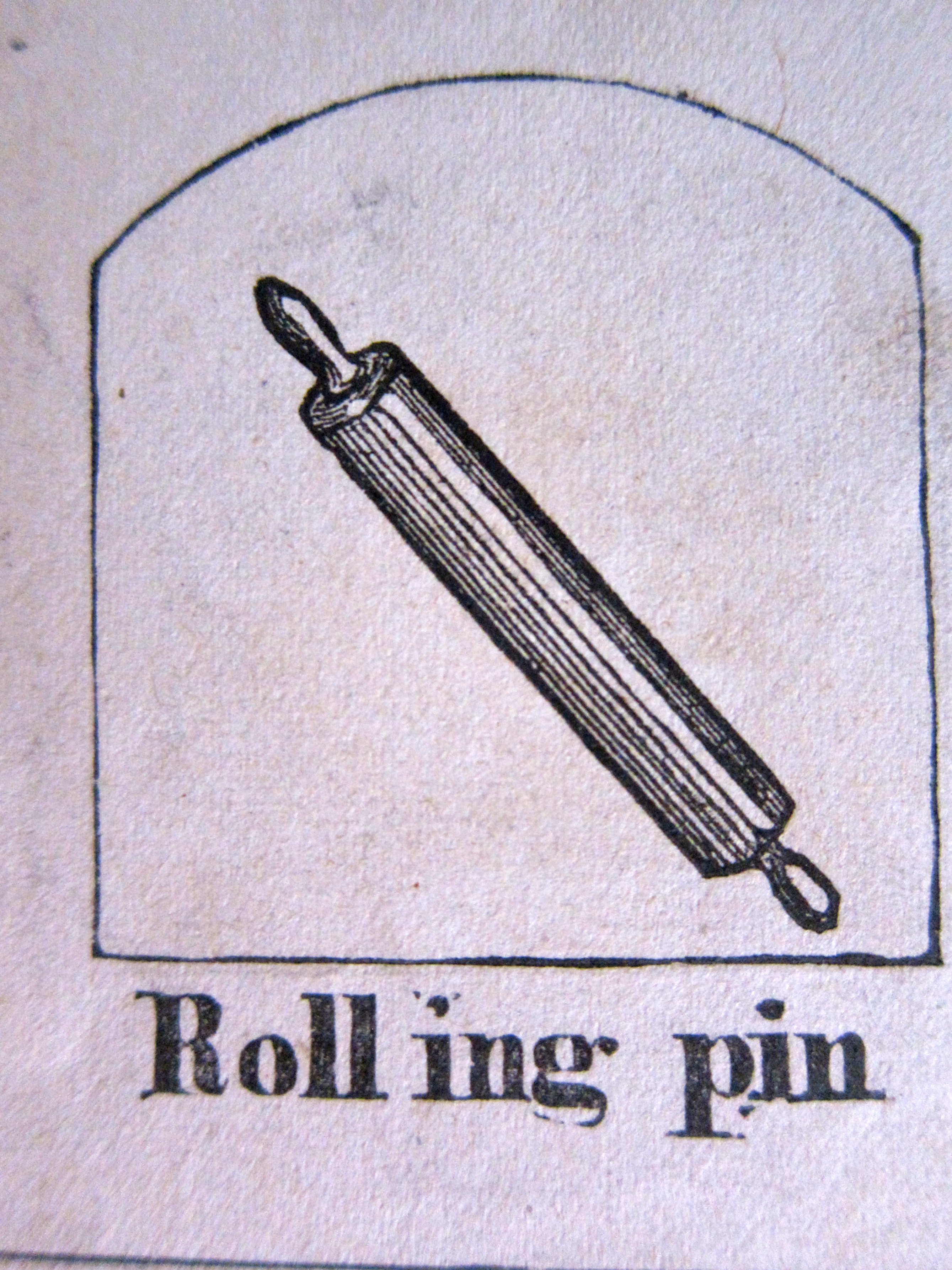
Rolling pin

Wedns Nov 26th  Have heat the brick oven three times

to day  Made Squash mince & apple pies

fruit & plain cake & seed cakes  did not

get the last oven in untill about four Oclock

Jane has assisted some about the work  Dr Swan

came to see her says she must exercise but

must not work hard  Oliver came home in the stage

The kitchen was humming today. Evelina baked pies and cakes to feed her family, now back at the full complement of six at table, as Oliver (3) arrived home from college for the holiday. She baked pies and maybe some side dishes to take to the other part of the house, where they would have Thanksgiving dinner the next day with Old Oliver, Sarah Witherell, and Sarah’s children, George and Emily. Jane McHanna “assisted some,” but was still sick enough to have a visit from the doctor – this time, the Ames’s personal physician, Caleb Swan.

In 1851, Thanksgiving was not yet a national holiday. That would happen in 1863, after lobbying by the indefatigable Sarah Josepha Hale convinced Abraham Lincoln to make an institution of a feast that was already celebrated in many – but not all – states. Although the country was suffering from the shock and carnage of a civil war, Lincoln saw good in the idea of a day of gratitude for “fruitful fields and healthful skies”** and, by Executive Order, proclaimed the last Thursday in November as a national Day of Thanksgiving, in perpetuity.

The tradition of Thanksgiving evolved from the Puritan practice of holding days of thanksgiving or fasting, according to immediate need. The Puritans were inclined to see God’s influence in every part of their daily lives. When they were good, God would reward them. When they were bad, He would punish them. Depending on how things were going, their ministers were either making sure to thank God or beg for help. In the 17th century, a local congregation could call for a day of thanksgiving or a day of fasting on its own. As time went on, the practice became more formal and by the 19th century, governors, at least in New England, would call for a day of fasting in the spring (before the planting) and a day of thanksgiving in the autumn (after the harvest). In 1851, this was still how it was done.

Toward the end of the 19th century, as immigration began to influence and de-homogenize American culture, some of the old guard became concerned. Like many an established group, its members wanted to preserve their culture and honor traditions such as Thanksgiving.  The fourth Thursday in November became more than just a feast of gratitude with family members. It became a post-Civil War symbol of America’s beginning, an annual celebration that would help new immigrants understand how the country was first settled by white Europeans. Teaching about the holiday in schools became a priority and thus, for more than a century, an account of a first Thanksgiving feast between the Pilgrims and the Indians has become an indelible, if occasionally controversial, feature of American history.

For Evelina and her family, Thanksgiving was the most important holiday of the year. They would celebrate it with Yankee gusto, which generally meant a gathering of family and a fine feast followed by a game of cards for the old folks and perhaps a dance for the young people.

* A wealth of information about Thanksgiving can be found in “Thanksgiving: A Biography” by James W. Baker, New Hampshire, 2009. 

** Abraham Lincoln, A Proclamation, October 3, 1863

November 7, 1851

330px-Quince


Friday Nov 7th  Mr Bartlett left in the stage this morning

and George & Mrs Witherell went to Boston I have made

13 lbs Quince preserve 4 lbs jelly and a lot of marmalade

and painted my leaf for the table and it has

kept me busy all day.  Jane went to Mansfield

yesterday with Mrs H & Ames. Bridget is here yet

was taken with a bad pain in her stomach this

evening & sent for her husband & Dr Wales

Mr. Bartlett of Maine departed the house this morning, and Sarah Ames Witherell rode into Boston with her fourteen-year old son, George Oliver Witherell. Her guests, too, had departed, and she was free to go into town.

Without assistance from servants Jane McHanna, who was away, or Bridget O’Neil, who was sick, Evelina stood over her stove today turning at least a peck of quinces into preserves, jelly and marmalade. The store of fruit would be an important addition to the Ames’s dinner table over the winter.  A period recipe for making quince preserves, from The Young Housekeeper’s Friend; Or, A Guide to Domestic Economy and Comfort reminds us of the challenges 19th century cooks faced when preserving food:

“Weigh a pound of best sugar for a pound of fruit, pared and cored.  Boil the fruit in water until it becomes so soft that care is necessary in taking it out. Drain the pieces a little as you take them from the water, and lay them into a jar […] Stone jars will do very well, but if glass is used, it is easy to see whether fermentation commences, without opening them.  Quinces done in this way are very elegant, about the color of oranges, and probably will not need scalding to keep them as long as you wish.  If any tendency to fermentation appears, as may be the case by the following May or June, set the jar (if it is in stone) into the oven after bread has been baked, and the quince will become a beautiful light red, and will keep almost any length of time.” *

Quince is a fruit that we Americans don’t see much of in the 21st century, but it was commonly used in the 19th.  A poor eating fruit, too sour to consume raw, it was high in pectin and kept well, once cooked.  In fact, quince was one of the earliest fruits to be made into marmalade; the word marmalade derives from marmelo, the Portuguese word for quince.**


Mrs. Cornelius, The Young Housekeeper’s Friend; Or, A Guide to Domestic Economy and Comfort, New York, 1845.

** “Quince,” Wikipedia, November 5, 2014


October 7, 1851

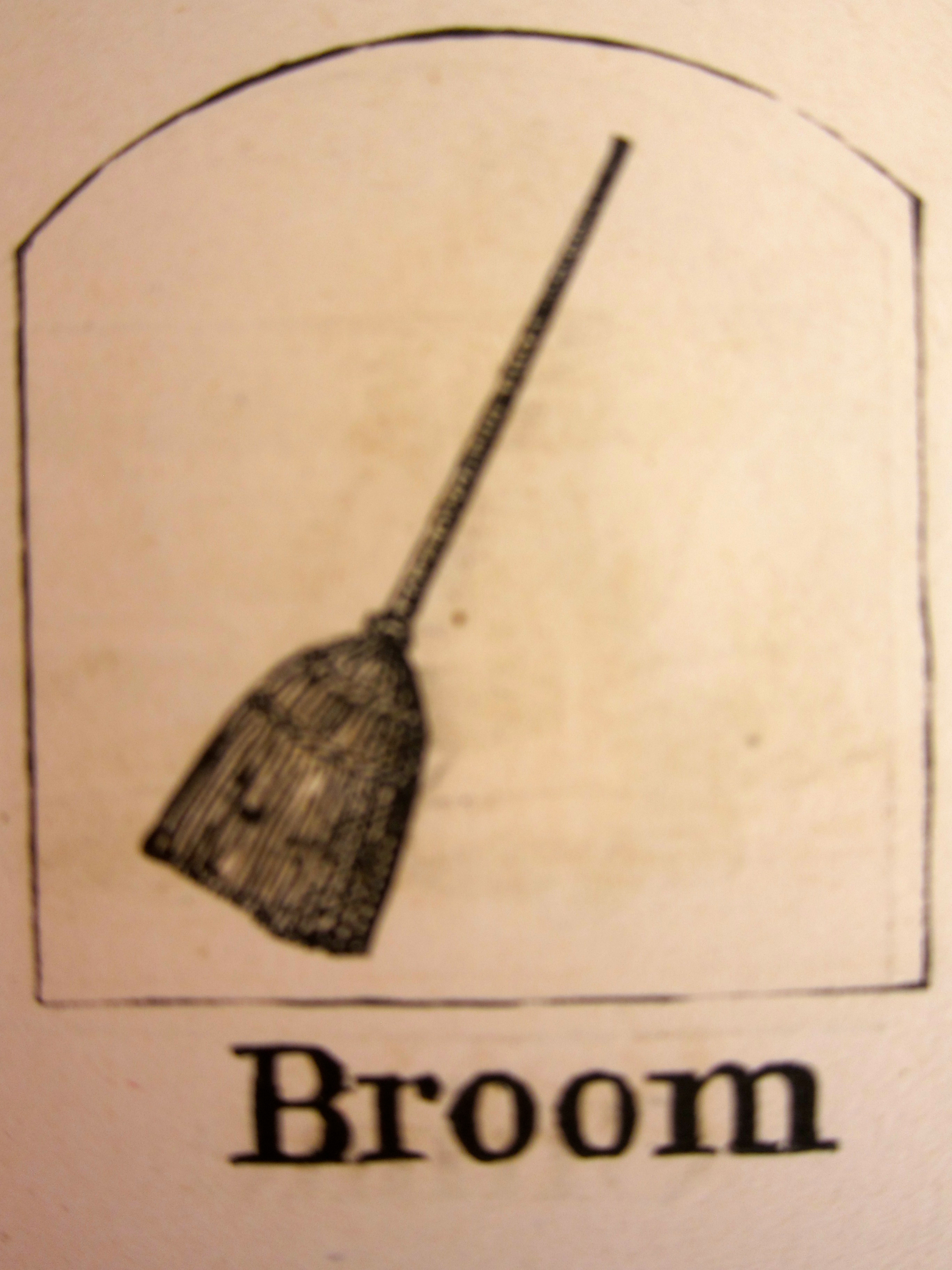
Broom

Tuesday Oct 7th  Have been at work on the dark french

print  This forenoon swept the chambers and put Franks

chamber in order that he left.  Carried my work

into the other part of the house while  My humour

troubles me so that I can scarcely sit still.  Was quite 

sick awhile this evening  We have had very cold

weather for the season for a number of days


Whatever powdered medicine Dr. Swan gave Evelina on Sunday wasn’t working. Her “humour” troubled her all day and she was especially ill in the evening. Her nettlerash made her uncomfortable and sick. With some asperity, she noted the recent “very cold weather,” which wouldn’t have helped her frame of mind.  It’s interesting to note that her father-in-law, Old Oliver described this very same day as “a fair warm day wind northerly part of the day + southerly part of the day.” It’s likely that Evelina’s perception was colored by her overwhelming personal discomfort.

Does any reader think Evelina that might be suffering from shingles?

Nonetheless, she kept busy.  She swept the house and tidied up after her youngest son, Frank. She sat down to sew, though must have found it difficult to concentrate when her skin itched and burned.  She went into the other part of the house, where Miss Susan Orr, an elderly friend (or relative?) from Bridgewater was visiting. No doubt she sought conversation to take her mind off of her own troubles. Perhaps she wished her nephew, George Oliver Witherell, a happy birthday. He turned 14 on this date.


July 10, 1851

IMG_1031

July 10th  Baked in the brick oven this morning

Cassander Gilmore engaged to come here to

day but did not  Mrs Horatio Ames Mrs Witherell

Mitchell and their children father Gustavus &c &c

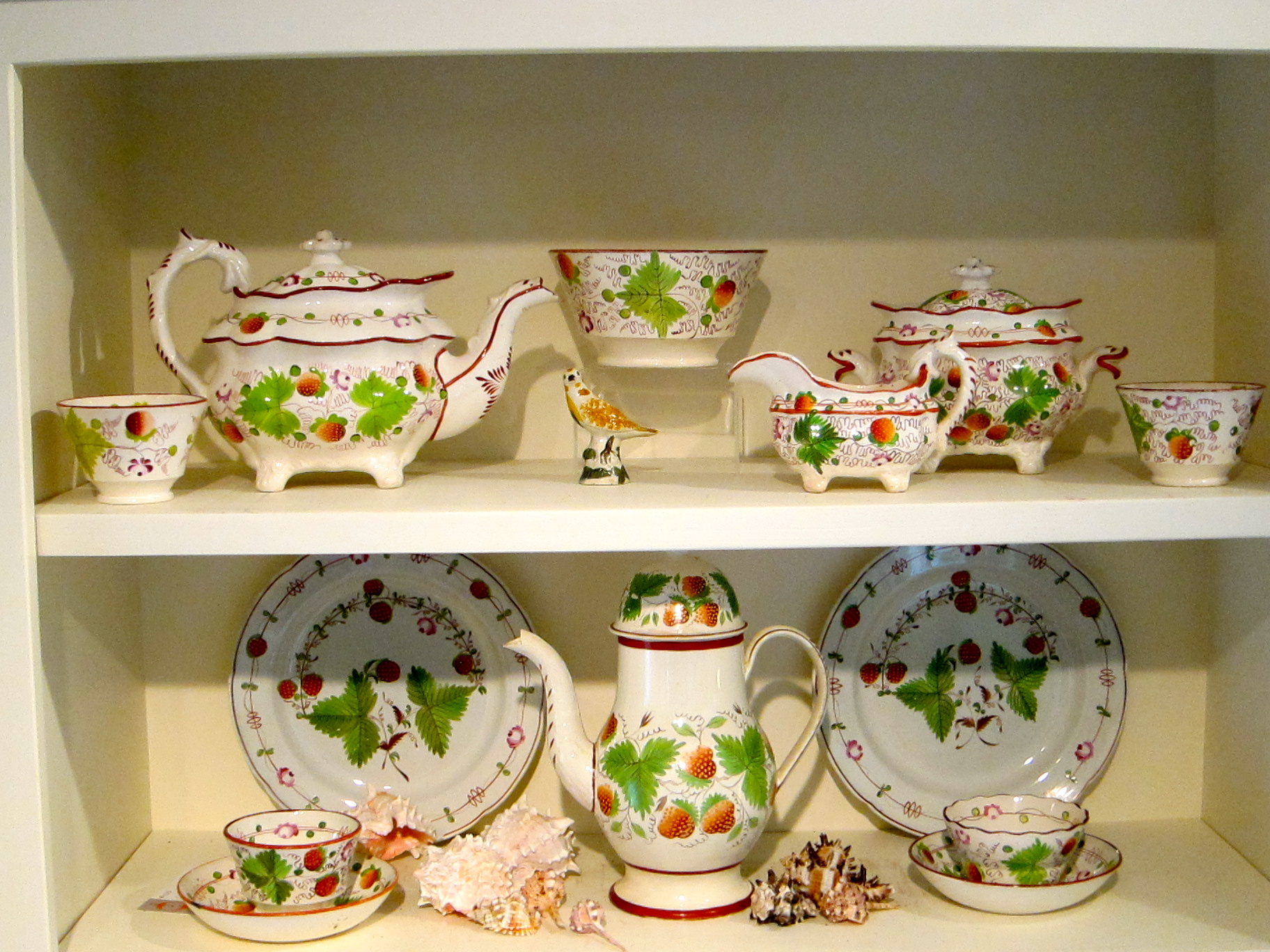
were here to tea.  Had strawberries from 

Mr King, his last picking.  This afternoon

finished my dress  Alson called

Evelina was quite busy today.  She baked, probably making the usual bread, ginger snaps and a pantry’s worth of pies. Although she doesn’t specify what kind, this was the time of year for rhubarb and her pies may have been made of the very fruit she grew in her back yard. She culled through the last of the available local strawberries, too; there would be no more this season.

Much of this kitchen work was preparation for afternoon tea, which was served to a raft of Ames relatives.  Sally Hewes Ames, Horatio’s wife, was there with her son, Gustavus, along with the Witherells and Father Ames from the other part of the house.  Sister-in-law Harriett Ames Mitchell and her three children were there.  Where was Harriett’s husband, Asa Mitchell? Presumably Oakes, Susie and her three older brothers were at table, too.

When she did get out of the cook room, Evelina finally finished sewing her new dress, and had a visit from her brother, Alson Gilmore.

February 20, 1851


images-1

Feb 20th  Thursday  This morning sat down to sewing quite

early with Lavinia.  worked for Susan and she

sewed some with us  Sent George after Mr & Mrs

Whitwell about one Oclock.  Mr Whitwell attended 

the funeral of James Wells child  Commenced 

raining quite hard & this evening is very dark

The boys & Lavinia & Susan have gone to the 

dancing school at Lothrop Hall

The Thursday evening assemblies, or dancing school, continued. On this occasion, Oakes Angier, Oliver (3) and Frank Morton took their cousin, Lavinia Gilmore, and little sister, Susie, with them.  How exciting for Susan to go along to watch the young men and women dance; probably exciting for Lavinia, too.  She was at the marriageable age of nineteen and, in the manner of the day, was probably hoping to marry soon.  Getting off the farm for a week to stay with her aunt Evelina in the village of North Easton was an opportunity to socialize and perhaps meet someone special.  Did anyone ask her to dance?  Did her male cousins watch out for her?  Did she like what she wore?

Elsewhere in Easton life was not so light-hearted.  Reverend Whitwell officiated at a funeral for the infant son of James and Celia Wells.  James and his brother John, for whom the little boy was named, worked at the shovel factory.  They were originally from Maine.

And, being February, the weather took a dive for the worse.  The young people’s ride home from Lothrop Hall must have been disagreeably wet.  Mr. and Mrs. Whitwell, who had evidently stayed for tea after the funeral, were unable to get home and had to spend the night at the Ames’s house. Young George Witherell was spared the challenge of carrying them back to the parsonage in the dark, windy downpour.

February 12, 1851

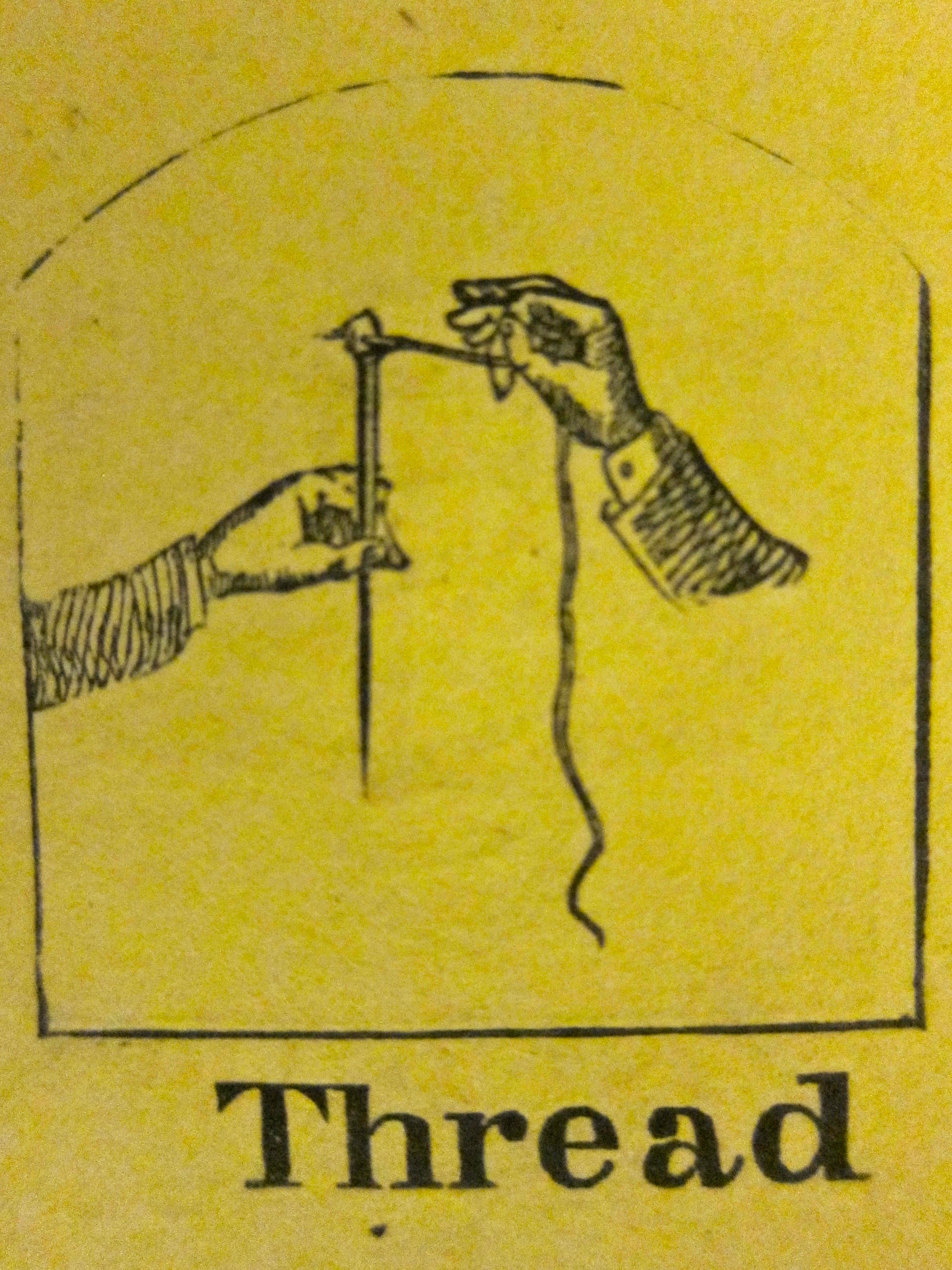
Thread

1851

Feb 12th This was the day for the sewing circle & what a crowded

house! Not one here except Mr Whitwell and our own

families  Father Ames came in to tea & Sarah W

George, Emily & Oliver & wife  Poldens boy was buried

to day  Isabell & Ann went to the funeral & took tea

with Jane after they came back.  I prepared enough

for 40 and think it is very provoking to have none

 of the members  It is a delightful day.  Letter from Miss Foss

No one came to Evelina’s party.

“Very provoking,” indeed.  Mortifying, even, that not a single member of the Sewing Circle attended today’s meeting, unless you count Reverend Whitwell.  All the preparations, the baking, the cleaning, the spools of thread from Boston, all in vain.

Evelina took the rejection with a lacing of humor: “What a crowded house!”  Although disappointed and upset, she must have been grateful for the way the Ames clan filed in to partake of the feast. From Old Oliver (who almost never came to tea) and all three Witherells to Oliver Jr and Sarah Lothrop Ames to her own children and husband, presumably, the family closed ranks around her and filled her parlor with warm bodies.  Even the Irish servant girls on their way home from a wake partook of the spread of food – in the kitchen with Jane McHanna, of course.

So what happened?  Evelina said the day was delightful but her father-in-law, a dependable chronicler of the daily weather, described “the going” that day as “rough + bad” even though the weather itself was “fair”.  After days of terrible weather that had swung from rain to ice and back again, some of the absentee members probably couldn’t drive their wagons out of their own yards.  Bad roads might account for some, if not all, of the truancy.

Nevertheless, the incident raises questions about Evelina’s popularity and social standing.  She was married to one of the most important men in town, and she and Oakes enjoyed the friendship of many.  Is it possible that some of the women in the Unitarian Circle resented her, or felt themselves superior to her?  Where were the women she had grown up with? Were they jealous of her? Did she fail socially in comparison to her sisters-in-law, each whom had a more refined upbringing? Sarah Ames and Sarah Witherell never failed to attract a lively turnout for their Sewing Circles.

All these possibilities must have swirled in her mind.  The true test would come when the Sewing Circle met again at Evelina’s, many months from this day, this awkward day that Evelina surely hoped to forget.