August 20, 1851

Scales

Weds 20th Aug  Rachel, Lavinia and Augusta Pool spent

the day here  Mr Ames and Augustus went to Boston

Pauline Dean came to night in the stage

appears the same as she did when she left

Went to the store & was weighed  148 lbs

called at the factory to see Edwin work and he came to

tea  Mr Whitwell called while we were gone

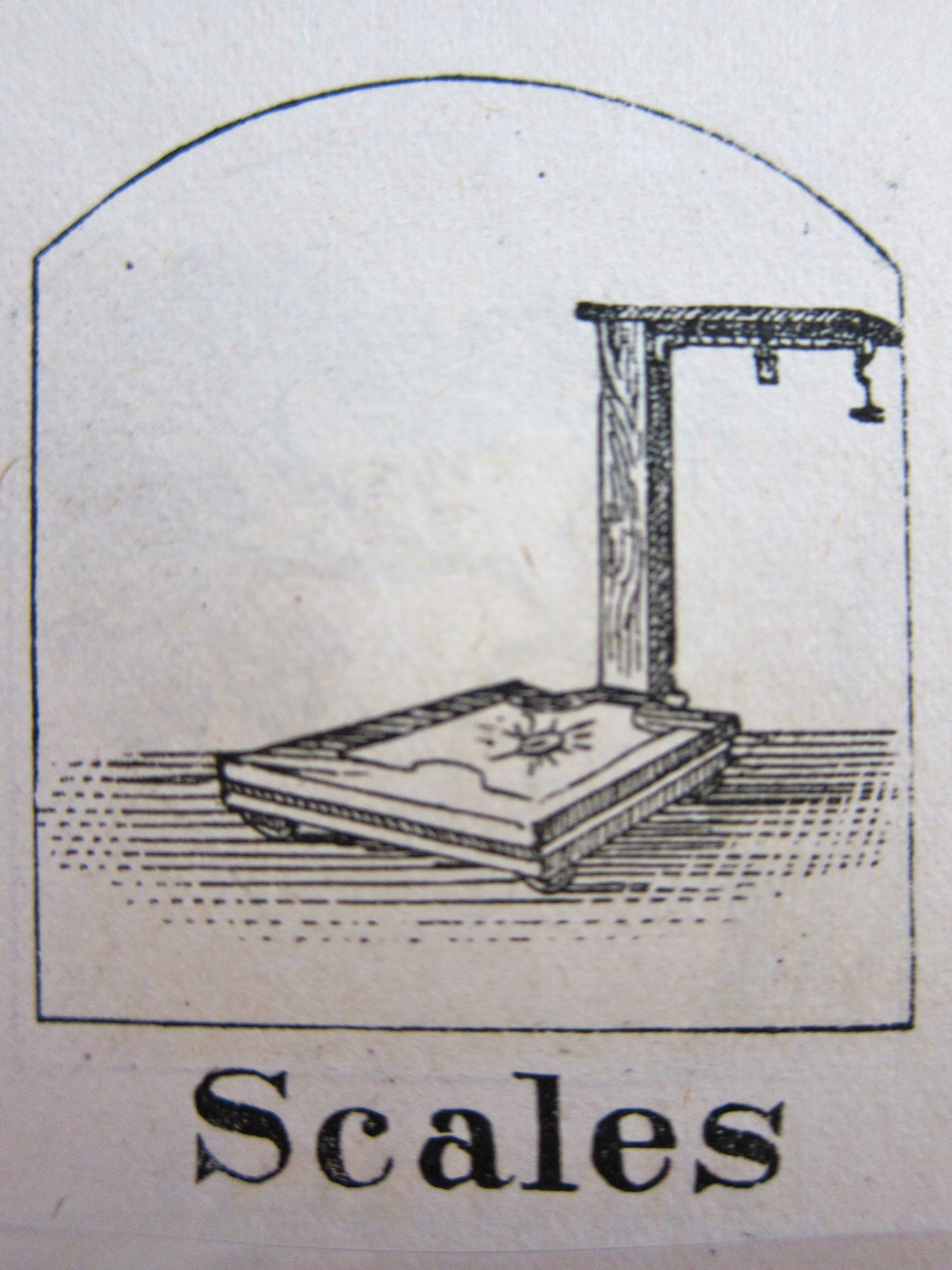
Not shy, Evelina stepped on the scale at the company store.  Fully clothed in the voluminous fashion of the day, she weighed 148 pounds. Given that her dress was full-skirted and worn over a chemise, undersleeves and petticoats, and that she wore a bonnet and most likely kept her hose and shoes on, her actual weight was probably several pounds less than she reported.  She likely weighed closer to 140.

Evelina missed a visit from Reverend Whitwell today, as she was out and about with young female company.  Two nieces, Lavinia Gilmore and Rachel Gilmore Pool, came over with Rachel’s sister-in-law, Augusta Pool.  They were ages 19, 21, and 22, respectively. They visited the store, shopped, perhaps, and watched their aunt get weighed. Perhaps they got weighed themselves. It might have been a lively time as they chatted and moved back and forth.

From the store the group traipsed to the shovel factory to watch Evelina’s nephew and Lavinia and Rachel’s brother, Edwin Williams Gilmore, work – an unusual visit to say the least, and one that could only have been accomplished in the company of the boss’s wife. What did the workmen think?

Edwin, nearly 23, would not work at the shovel shop for long. By 1854 he would be manufacturing hinges along with business partners Oakes and Oliver Ames Jr., whom he would eventually buy out. All that was in his future; today he would join his sisters and their friend Augusta for tea at his aunt’s.

August 18, 1851

Churn

Monday Aug 18th  Jane washed this morning and had Ellen

to assist so I sat down quite early to sewing

cut out a chimise for Ellen to make

This afternoon went to Mr Whitwells to tea

Mr Ames was going to Bridgewater and I

rode there with him.  Called at Mr Harveys

to try to get some butter but she had none

to spare.  Hurried home expecting Pauline she did

not come  Mr & Mrs George Lothrop came to Olivers 

The new servant, Ellen, helped Jane McHanna with the laundry today. Evelina stayed out of the way and concentrated on her sewing, setting work aside for Ellen to do later. She needed another chemise.

In the afternoon Evelina went to the Whitwells’ for tea.  She had just been there the day before during the intermission between church services. Today Oakes accompanied her and the two went on from there to Bridgewater.  Evelina was hoping to buy some butter from a Mr or Mrs Harvey, but had no luck. Evidently no longer producing butter herself, she’s had to travel this summer to find it. Oakes, meanwhile, was on his way to Bridgewater on shovel business – or Whig politics.

Not yet alluded to in Evelina’s diary is the illness of one of Sarah Lothrop Ames’s brothers, Dewitt Clinton Lothrop. Clinton, as he was known, was deathly ill with typhus fever. Another Lothrop brother, George Van Ness Lothrop and his wife, Almira Strong Lothrop, had come back to town from Detroit on Clinton’s account.


August 11, 1851

220px-Brooklyn_Museum_-_The_Invalid_-_Louis_Lang_-_overall

*

Aug 11th Monday  Had a new girl come to day to assist some about

the house and help me sew.  Went to assist Mrs Holmes

found her sick abed and alone her aunt Clifford

left her as sick as she is. She must be an unfeeling

woman  Mr Holmes went to Canton with the team and

will try to get his mother for a few days. Julia Waters

did up the work this morning  This afternoon she has

been all alone with Willie  I made her bed for her at night

Harriet Holmes, Evelina’s neighbor, continued to be quite ill.  Evelina and others looked after her, including an aunt who departed her post before a new helper arrived, earning Evelina’s stern disapproval.  As Harriet had a toddler, Willie, to look after, the aunt leaving her alone was not only “unfeeling,” but negligent.

Help was on the way. Harriet’s husband, Bradford, drove a team – of oxen, most likely – to Canton to fetch his mother. Before they returned, Evelina made fresh the sickbed, as she had done on other nights. Harriet would be tended to.

And this morning, even as Jane McHanna wrestled with the weekly wash, a “new girl” entered the Ames household to help with the chores and the sewing. That must have brightened Evelina’s Monday.


* Louis Lang, The Invalid, 1870, oil on board, Brooklyn Museum of Art, Gift of Mrs. Walter deForest Johnson.


August 7, 1851

Teeth


Aug 7th Thursday  Have been to Bridgewater to day

to have my teeth fixed  Dr Washburn kept me there

untill past twelve and then said he should have to heat

up the teeth which take an hour and half.

Left them with him and went to Mr Harris’ and 

returned at night for them.  Oliver was with me

we called at Mr J Mitchells.  Mrs Mitchell & sister

Harriet had gone to Marshfield

It says a great deal about 19th century dentistry that the illustration above, made for a spelling book, used an image of dentures to depict the word “teeth.”  In 1851, false teeth were the norm for most adults. Dental hygiene was primitive and regular care by professionals unavailable. Although brushes for teeth were around, toothpaste didn’t come in until the 20th century.  Those who could afford to pay a dentist usually ended up with false teeth. So it was for Evelina, who had dentures, or at least several false teeth that she had to leave at the dentist’s today to be fixed. Her son, Oliver (3) accompanied her.

Nahum Washburn was the Ames family’s dentist.  A graduate of Dartmouth College, he was trained in homeopathy but preferred dentistry.  He had an office in Bridgewater from 1840 to 1883.

Washburn cared about the pain that his patients had to go through and developed a machine to reduce their discomfort when he worked on their mouths.  In 1859, he obtained a patent for a

“DENTAL APPARATUS FOR RELIEF OF PAIN WHILE OPERATING”

a contraption that was “a combination of dental forceps…with [an] electro-magnetic mechanism…so that the electrical current or currents [could] be made to flow through the nerve or nerves of the tooth, or the jaw or flesh immediately contiguous…in order to benumb the same and render such more or less insensible to pain during the performance of the dental operations. ” *

Doesn’t sound all that painless.


*Journal of the Franklin Institute, Volume 69, Philadelphia, p.165


July 26, 1851

SE003586small

Saturday July 26th  This day is very pleasant and we should

have had fine weather to be in Boston  Mr

Ames has gone as usual  I feel quite disappointed

that we did not go but I presume it is for the 

best  The school does not keep to day & […Susan]

is sewing some but she does not like it & I fear

she will never learn at this rate

Stuck at home when she had planned to be in Boston, Evelina was clearly sorry to have misjudged the weather and missed the trip. Oakes was in town and she wasn’t, and she had little choice but to turn to her sewing.  She coped with her disappointment by handing it over to providence and accepting the change of plans as “for the best.” God knew better than she did.

Susan Ames was possibly less philosophical about the change of plans.  Her mother put her to work sewing, for which Susie had neither inclination nor aptitude.  In an era when society decreed that a “woman who does not know how to sew is as deficient in her education as a man who cannot write,”* Susie was expected to acquire at least the fundamentals of needle and thread whether she liked it or not.

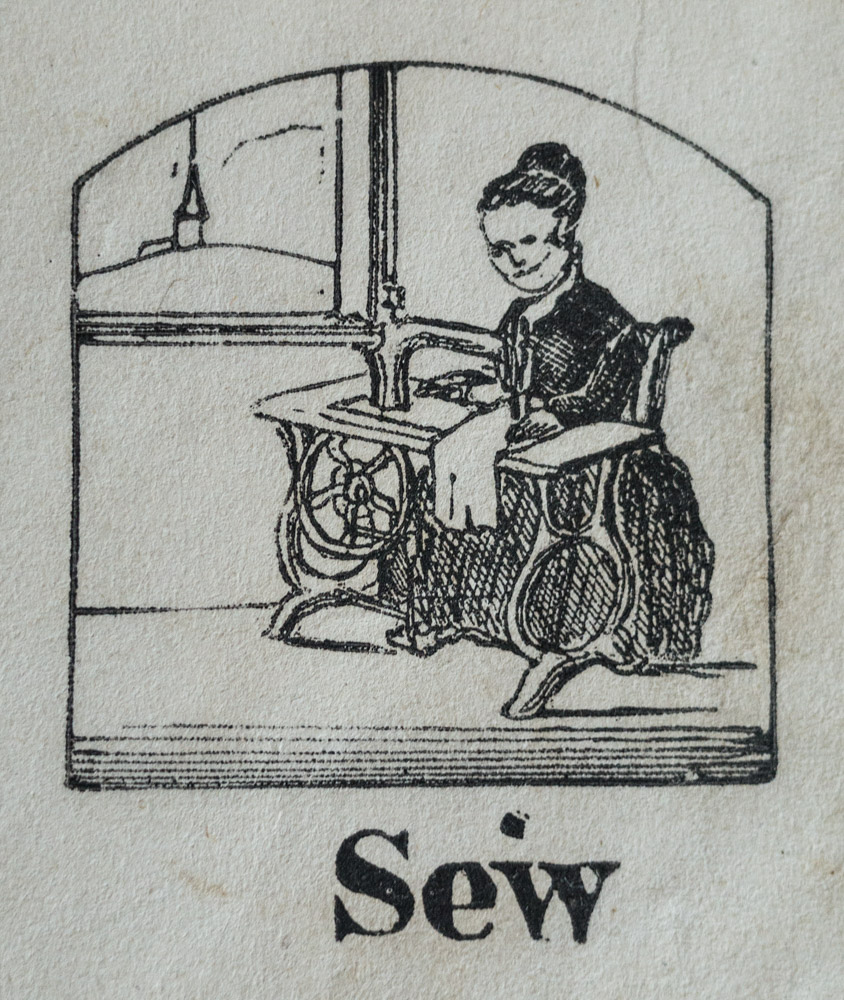
Neither Susan nor her mother could know that mechanical machines for sewing would soon be introduced that would obviate hand-sewing. The illustration above, from 1877, a quarter-century later, suggests how readily the sewing machine would replace hand-sewing and how quickly the production of clothing would become an industry.  Although bespoke clothing would never disappear, and many women for personal or economic reasons would continue to sew their own clothes, ready-to-wear clothing would become more and more available in Susie’s lifetime. No one in the Ames sitting room could envision that development on this sunny summer Saturday ten years before the Civil War.


* Eliza Ware Farrar, The Young Lady’s Friend, Boston, 1836 (from Judith Sumner, American Household Botany, Portland, Oregon, 2004)


July 23, 1851

7505761_119709544472

*

Wednesday July 23  Have been sewing before noon to day working on

different articles among the rest have made

Susan a pair of short cuffs of cambric

trimed with a wide insertion and edging

Aaron Hobart & Charles Mitchell came to the other part

of the house & dined When they returned Mrs Witherell

Mitchell, Mrs S Ames & self went to Mr James Mitchells to tea

Met Mr & Mrs Judge Mitchell Mrs & Miss Hyde & Aunt Orr there

Sewing was in the forefront of Evelina’s activities lately while gardening seemed to disappear.  Perhaps the heat and the weeding were too much, perhaps her favorite blooms had gone by and she had lost interest. Then, too, she simply may have neglected to record the time she did spend in the flower beds. Whatever the cause, Evelina was back indoors in the mornings, needle in hand.

Her social life, always a little more active in the summer, continued to thrive. She noted that Charles Mitchell, younger brother-in-law of Harriett Mitchell, and Aaron Hobart dined with Old Oliver and Sarah Witherell. This entry is the first mention of the Hobarts, a family that would become intimately involved with the Ameses in the future.  Aaron was the eldest son and namesake of Judge Hobart, a former congressman, and his wife Maria, who lived in East Bridgewater. Recently returned from working in New Orleans, Aaron became “actively identified” with the local Carver Cotton Gin Company**. His youngest sister, Catherine, was at school with Helen Angier Ames in Dorchester.

It was to East Bridgewater that the ladies went today for tea. Evelina and her sisters-in-law met with Judge Nahum Mitchell, also a former congressman and a contemporary of Old Oliver, his wife Nabby, and others.  The Mitchells were related to the Orr family, and one of their daughters (Mary Orr Mitchell Ames) was married to an Ames cousin in Springfield. Needless to say, many of the long-established families in southeastern Massachusetts had intermarried over time and thus were related in long-distance ways.

*Judge Nahum Mitchell
** Plymouth County Massachusetts Archives


July 22, 1851

OLYMPUS DIGITAL CAMERA


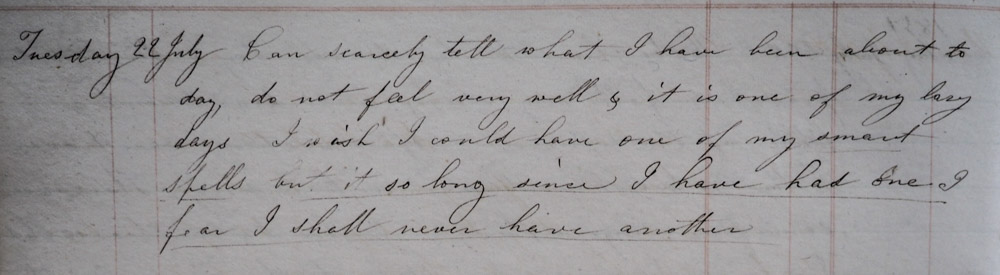
Tuesday 22 July  Can scarcely tell what I have been about to

day, do not feel very well & it is one of my lazy

days  I wish I could have one of my smart 

spells but it [is] so long since I have had one I

fear I shall never have another

Evelina Ames didn’t have a very good day.  She was, apparently, suffering from some disagreeable lethargy, whose origin is tough to pinpoint.  She hadn’t been sick or overtired (that she mentioned, at any rate), but something had occasioned a dull day in her mind. Perhaps the weather was insufferable, or she was under the influence of “change of life,” or she hadn’t been sleeping well. Perhaps all of the above.

Her handwriting today is no different from other entries in her diary.  In fact, it’s quite typical. Evelina wrote neatly, without flourish and with a uniform slant to the right.  Her punctuation, as usual, was variable and informal. The only abnormal feature of the entry today is that she underlined part of the last sentence.  She put more energy into that underlining than she put into the wording of the entry.  She was cross.

July 17, 1851

imgres


1851

July 17  Mother & myself have had a very quiet forenoon

Some expected Cassander Gilmore here but they

have set so many times that Im thinking they will 

not come at all.  About 4 Oclock I went to N. Bridge

water with Mrs Sarah Ames & Mrs Mitchell to carry

Fred to the cars for Cambridge to be examined for

the Sophomore year

Cassander Gilmore, the relative who was mentioned as a “no-show” visitor today, was a prominent shoe manufacturer in Raynham, Massachusetts.  His failed visit was incidental to the bigger news of the day: Frederick Lothrop Ames’s departure for Cambridge.

Barely sixteen years old, Fred Ames visited Harvard College today “to be examined” for acceptance. He had just completed a year (or more) at Phillips Exeter Academy and, despite his young age, was seeking entrance to college.  Harvard was the place for just such a bright fellow.

Fred seemed both prepared and motivated for college, and his parents, Sarah Lothrop Ames and Oliver Ames Jr., supported the idea of higher education for him, perhaps for a variety of reasons. This was an age, according to Henry Adams, when parents “began sending their children to Harvard for the sake of its social advantages.”* Sarah and Oliver Jr. were ambitious for their only son, but the question remains why they – or he – requested entry for the sophomore rather than the freshman year.

With his future riding on the examination ahead of him, Fred must have been at least a little anxious about the trip. His mother and  Aunts Evelina and Harriett may have sensed some apprehension on his part, and tried to bolster his spirits as they rode along to the train station in North Bridgewater. They may also have simply been exercising their right to behave as many fond relatives behave when their young ones leave for school: with overt affection. Fred may have been relieved, actually, to wave goodbye to them at the depot.

* Ronald Story, The Forging of an Aristocracy: Harvard and the Boston Upper Class, 1800-1870, Wesleyan University Press, 1980.


June 25, 1851

14 Fanny Palmer (American artist, 1812-1876) Published by N Currier American Farm Scenes 3 1853

*

1851

June 25th Wednesday  Worked awhile in the garden and 

then sit down to sewing with mother

After dinner Francis came after mother […]

John & wife and Miss Wait (Otis Howards lady)

arrived there about nine  I went home with

mother and Mr Ames came after me Had

a very pleasant visit  By what they say I 

should judge the west point students had rather

a hard time


Beyond today’s normal work load of gardening and sewing lay a very special event. Evelina traveled south to the family farm where she had grown up, something she often did.  The farm was now owned and worked by her older brother, Alson; it was there that her mother usually resided.  But today, another brother, John, came to visit and joined her there.  The three siblings, John, Alson, and Evelina, were the only survivors of a brood of eight. It was a rare family reunion for them and their mother.

Most historical accounts place John and his wife, Huldah Alger Gilmore, in South Leeds, Maine.  This was probably accurate, as no evidence exists otherwise. Gilmore is not an uncommon name, however, and the postmaster John Gilmore in Leeds, Maine may not be Evelina’s brother.  Evelina’s reference to a discussion about West Point suggests a possibility that John and his wife could have lived there.

Regardless, Evelina seemed very happy to see her two brothers.  Her husband, Oakes, came along eventually to see his in-laws and fetch his wife back home to North Easton.

* Currier & Ives, Farm Yard, ca. 1853


June 21, 1851

1687-Illustration_from_Theosophie_and_Alchemie-Michael_Maier_and_Johann_Theodor_de_Bry-300x282

21 June Saturday  Early this morning Mrs. Seba Howard

brought Orinthia up and found me in the

garden weeding. We worked there an hour or two

and then went to sewing.  Orinthia on her dress

and I on the hair cloth.  Harriet came and sat

with us awhile in the afternoon and while she

was in I worked on the sleeves to my plaid stone

colour borage  Orinthia called on Abby   Pleasant

Weeding continued to be the dominant occupation of Evelina’s early morning hours. On this Saturday morning her young friend, Orinthia Foss, arrived for the day and immediately stepped to the garden to help weed. Orinthia was carried up from the southern part of town by a contemporary of Evelina named Eleutheria Howard, wife of Major Seba Howard.

Today was summer solstice, the official start of summer and the high water mark of daylight; the women probably would have enjoyed being outside in the garden all day long, but sewing and other duties called. Each woman had a dress she was working on, and Evelina was still piecing together a horsehair cover for her new lounge. Just as they had sat on so many days during the late winter, so the two sat today, on chairs near the windows for light, with folds of cloth in their laps. Harriett Ames Mitchell, Evelina’s sister-in-law, joined them in the afternoon.

Later in the day Orinthia went to call on Abby Torrey, Evelina’s niece who lived right in the village of North Easton.