November 27, 1851

Turkey


Nov 27  Thanksgiving day we have passed in the other

part of the house.  Our sons & Helen went this evening

to a ball in Canton  Father Mrs Witherell Mr Ames &

self had a game of cards.  Mr & Mrs H Lothrop

A[u]gustus & wife Cyrus & Sarah Lothrop

spent the day at Olivers

In 1844, Lydia Maria Child, a Massachusetts mother, author and abolitionist, published the original six verses of a poem about Thanksgiving. The poem was put to music, and verses were added or modified over time. We know it, and everyone sitting around the Ames’s dinner table would have known it:


The New-England Boy’s Song About Thanksgiving Day
Over the river, and through the wood,
To Grandfather’s house we go;
the horse knows the way to carry the sleigh
through the white and drifted snow.
Over the river, and through the wood,
to Grandfather’s house away!
We would not stop for doll or top,
for ’tis Thanksgiving Day.
Over the river, and through the wood—
oh, how the wind does blow!
It stings the toes and bites the nose
as over the ground we go.
Over the river, and through the wood—
and straight through the barnyard gate,
We seem to go extremely slow,
it is so hard to wait!
Over the river, and through the wood—
When Grandmother sees us come,
She will say, “O, dear, the children are here,
bring a pie for everyone.”
Over the river, and through the wood—
now Grandmother’s cap I spy!
Hurrah for the fun! Is the pudding done?
Hurrah for the pumpkin pie!

– Lydia Maria Child


Happy Thanksgiving, everyone.

November 23, 1851

1850-shawl2

*

Sunday Nov 23d  Jane with Michaels sister got the

breakfast this morning but after breakfast Jane 

went to bed  I could not go to church this morning

Augustus came home at noon and brought Mr

Davidson  Mrs Meader Hannah & self went

back with him  This evening sat with my shawl

& bonnet on from 6 to 8 Oclock waiting for Mr

Ames to go to Mr Swains and then took them off did not go


For the second time this month, Oakes Ames forgot to take his wife somewhere. On this occasion, they had planned to visit Ann and John Swain.  Evelina had missed the morning meeting and although they had company at noon, and she made it to the afternoon service, she was still eager to get out and socialize. As night fell, she put on her “shawl & bonnet” and waited for her husband to pick her up. He didn’t show. She “did not go.”

Evelina had been disappointed two weeks earlier when Oakes had forgotten her, but the tone of her diary entry on that day had been tolerant. This time, she was likely less forgiving. Once Oakes finally walked in the door, more than two hours late, Evelina must have let him have it. Surely she got mad. Surely they argued.

Oakes’s excuse would’ve been that he’d been off electioneering, just like the last time he forgot to fetch his wife.  The next day was another town meeting and, in anticipation, he’d obviously gotten sidetracked, probably with friends. At least Evelina could be certain that he hadn’t been out drinking; Oakes was a teetotaler. But she would have been left to wonder what the outcome would be of her husband’s absorption into politics, and how it might alter their relationship.

Jane McHanna, meanwhile, was still sick.  Evelina was not having a great week.

*Image courtesy of wwwVictoriana.com


November 17, 1851

Hoof

Monday Nov 17th  Jane has not been at all well to day

but she has done the washing and went to

bed early in the evening  I did the housework

to day and was about all this forenoon  This

afternoon have been to Mr Nahum Williams

with Mrs S Ames  Mr Seth Williams died

Friday night and is to be buried tomorrow at

ten Oclock.  We drive the new horse for the first.


The stalwart Jane McHanna, now the only house servant at the Ames’s, did the Monday washing today despite feeling not “at all well.” By evening she was in bed. Evelina picked up the slack and did the rest of the housework herself, something she was fully capable of doing.

Despite the extra choring that she did, Evelina and her sister-in-law, Sarah Lothrop Ames, found time to ride out of the village to call on Nahum and Amanda Williams.  Nahum, who lived in Furnace Village, was most likely the son of the Seth Williams who had just died. As was customary, the Ames wives helped tend the dead, the dying, and their families in their community.

A little more than twenty years later, on September 1, 1873, Nahum Williams himself died, and Sarah Lothrop Ames and her husband, Oliver Ames, Jr. along with her brother, George Van Ness Lothrop and his wife, Almira Strong Lothrop, would attend his funeral. Clearly, Nahum had a long-standing relationship with the Lothrop family, if not the Ameses, too.

November 12, 1851

IcePond-732701

*

Wedns Nov 12th  Painted the closets in the sitting

room chamber which with other things has taken

me most of the day.  Susan has passed the 

afternoon at Mr Swains  Mr Whitwell called

this afternoon. I felt very sorry to stop my work as

I was very much engaged at the time  Have not

sewed at all to day  This evening have felt too much

fatigued


According to Old Oliver, “this was a fair cold day wind north west. the factory pond was frozen over this morning”  It was a good day to stay indoors, which Evelina did.  She still hadn’t completed all the refurbishments on the house, so she spent the day painting the shelves in the closet in the sitting room; the shelves in the parlor were already finished.  By evening, she was “too fatigued” even to sew.

Daughter Susie spent the day at the home of Ann and John Swain, perhaps playing with Ann’s niece, Ellen Meader.  Reverend William Whitwell braved the north west wind and paid a call on Evelina.  Much as she liked him and admired his Sunday sermons, she was less than pleased to set aside her painting for his visit.

And “the factory pond” – probably Shovel Shop Pond – had skim ice, at least, all the way across it.  What did that do to shovel production?  How did the dams, flumes, and wheels work when the water began to ice up?


*Photo courtesy of Kenneth Aisawa, http://www.theboundsofcognition.blogspot.com

November 9, 1851

Nurse


Sunday Nov 9th  Did not go to meeting to day on account of

Bridgets being sick.  Expected Mr Ames home at noon to carry

me this afternoon but he went off electioneering and 

forgot all about it.  This evening have been to Mrs

Swains with Mr Ames & Susan  Her nurse is there

and her brothers wife and daughter of about Susans

age  Mr & Mrs Meader returned home about a week since


Not only did Oakes Ames stop in Canton for a Whig meeting on Saturday, but he spent Sunday afternoon “electioneering” and forgot to go home at noon to take Evelina to church for the afternoon service.  In personal terms, this was not an auspicious beginning to his political career, but it was certainly indicative of the wholeheartedness and zeal with which he approached politics.  If Oakes and Evelina had, in fact, reached an understanding about his getting into politics – about which we can only conjecture – we have to wonder if that understanding had already been violated.  Yet Evelina’s diary is not particularly dispirited; she writes matter-of-factly and without obvious annoyance.  Perhaps she already understood and forgave her husband’s capacity for preoccupation.

After missing church in the morning because of a sick servant and in the afternoon because of an absent-minded husband, Evelina must have been pleased at last to go out in the evening. She, Oakes and their daughter Susie paid a call on Ann and John Swain, a younger couple who were relatively new in town.  New parents, their infant son was being tended by a nurse, while two relatives, the last remainders of a crowd who had arrived to tend at the birth, were still visiting.  Ellen Meader, a little girl about Susie’s age, was there with her mother, Sarah Bliss Meader, wife of Ann Swain’s brother, Reuben Meader.

October 30, 1851

Closet

1851

Thursday Oct 30th  Mr Scott finished papering the 

parlour this morning and has painted some drawers

to be grained, and has drawn some of the windows

in the parlour  I have been doing a little of every

thing but cannot tell what.  Have got the carpet

down in the sitting room and the dishes into the

closet and we begin to look more comfortable


The redecorating of the downstairs began to wind down and the house became “more comfortable.” Getting the sitting room back in order was a big deal, for that was Evelina’s main domain for her daily sewing. It was her office, so to speak, more so than the kitchen.  She surely had missed her sewing routine while the house was disordered.

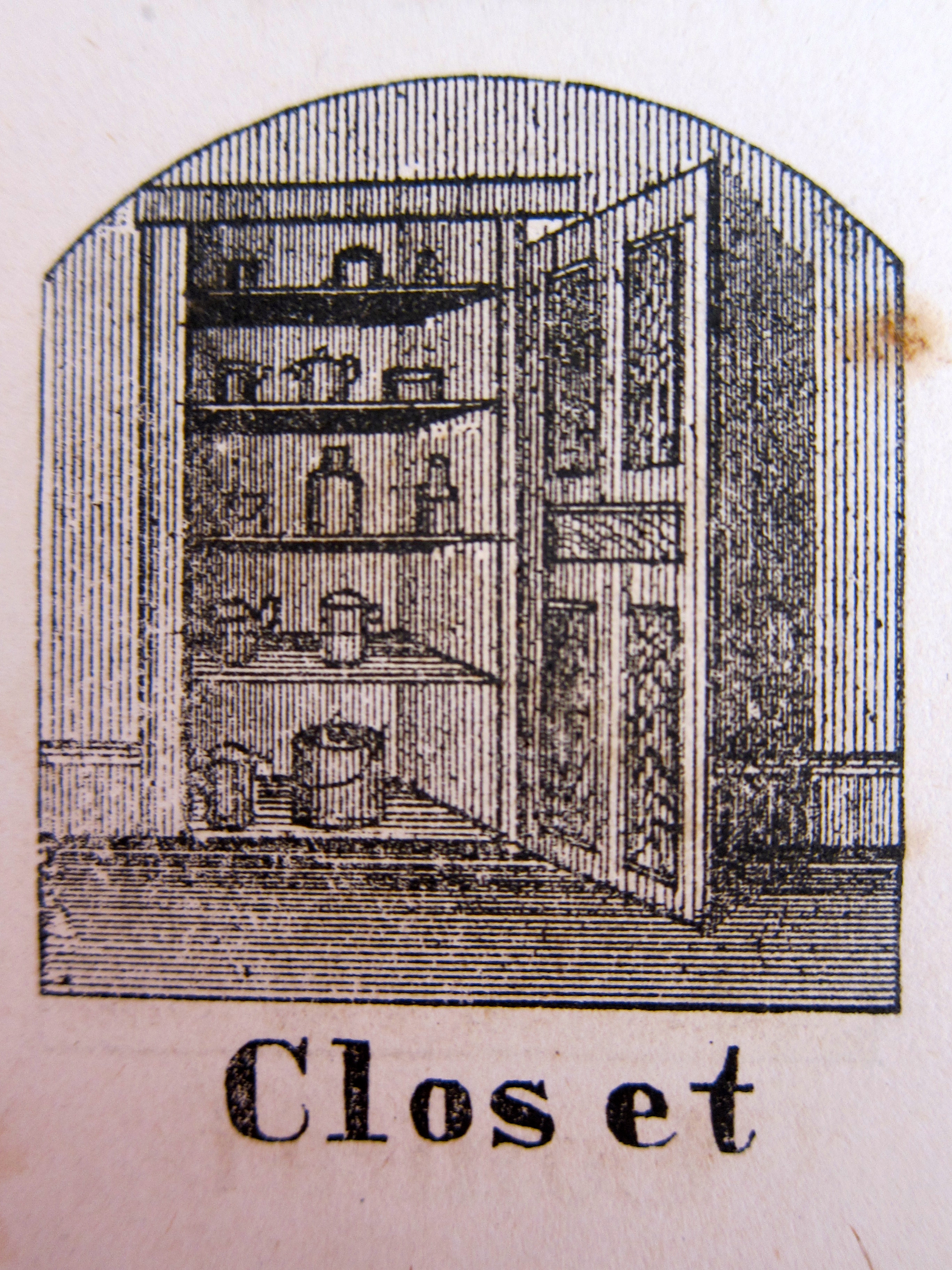
Putting the dishes back into the sitting room closet was also an accomplishment.  Jane Nylander, modern historian of 19th century domestic life, has written of the role of that closet:

“In most substantial households, parlors, sitting rooms, and dining rooms were furnished with a closet in which were stored cups and saucers, decanters of wines, glassware, and loaves of rich fruitcake, which was prized for its lasting quality as well as its flavor.  The shelves of these closets were grooved so that the small serving plates called ‘twifflers’ could be stood against the back wall and make a handsome show when the door was opened. ”  Twifflers – great name! – were about 9 1/2″ in diameter.

While Evelina set her house to rights, her father-in-law was busy about the factory. “began to work on the Flyaway Dam to day I went to Bridgewater + caried Clark + Keith to help Mr Phillips about fixing th bellows”** What had happened to the bellows? They were key to the manufacturing process.


*Jane Nylander, Our Own Snug Fireside, New York, 1993,  pp. 236 – 237.

**Oliver Ames Journal, Courtesy of Stonehill College Archives


October 29, 1851

1157676_l

*

Wednesday Oct 29.  I have been what I call puttering

about house most all day and have accomplished

but very little.  papered the fireboard and pasted

the loose places in Franks chamber  Mr Scott

has painted the sitting room & closet

Mrs Hubbel & Ames came from New York this morning

H O A Orr came for Susan this afternoon  Mr

Walton is there. Mrs Holmes and Abby called

Mr Ames came home from Boston to night

Many comings and goings in North Easton today, under a cloudy sky.  Almira Ames, widow of George, an Ames cousin, arrived from New York with a Mrs. Hubbel in tow. They came for a visit with the obliging Sarah Witherell and Old Oliver Ames in the other part of the house.

Susan Orr, meanwhile, who had been staying with Sarah Witherell and her father for almost a month, was picked up this afternoon by her brother, Hector Oakes Orr. Susan, age 53, and Hector, age 51, were first cousins of Sarah Witherell and her siblings on the Angier side of the family.  Susan and Hector were two of five children of Susanna Angier Ames’s sister, Mary and her husband, Dr. Hector Orr, of Bridgewater. Their shared grandparents were Oakes and Susanna (Howard) Angier.

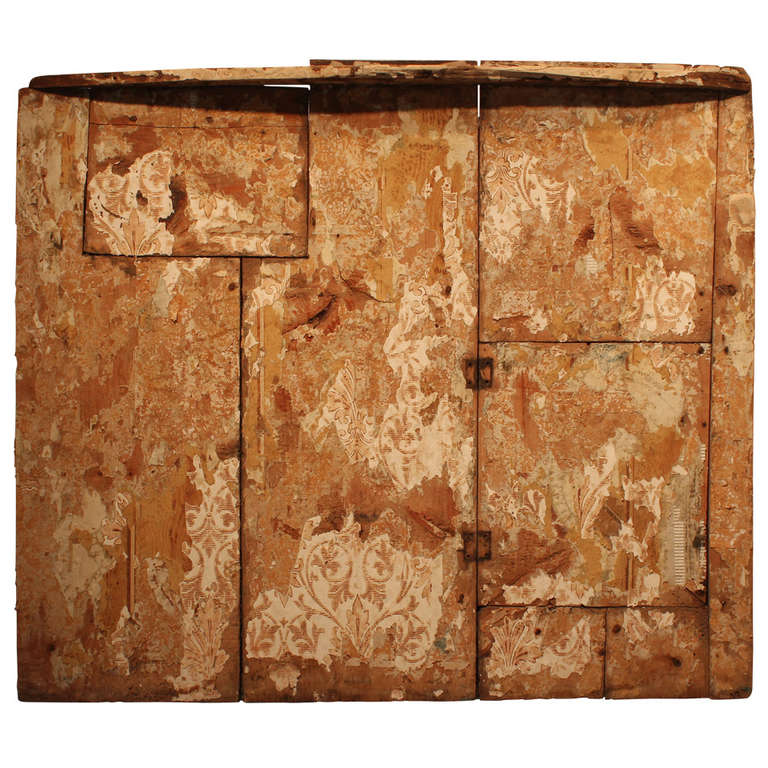
Evelina’s niece on the Gilmore side, Abigail Williams Torrey, paid a call with Harriet Holmes (the neighbor who had been so ill back in August). A Mr. Walton floated somewhere in the picture; Evelina’s inclusion of his name is a bit vague. And chugging along in the background of the various calls was Mr. Scott painting the woodwork in the sitting room. Evelina concentrated on papering a fireboard when she wasn’t attending to the influx of visitors. For readers who don’t have fireplaces, a fireboard was a piece of wood, textile or ironwork fitted to the opening of a fireplace for periods when the fireplace wasn’t being used.  Fireboards made from wood, most common in the countryside, were often decorated with wallpaper or painting.


* 19th century papered fireboard, Pennsylvania, courtesy of 1stdibs.com.


October 28, 1851

fig7

*

Tuesday Oct 28.  Have been assisting Mr Scott about papering

again to day and have painted over some things

and places about the house. Finished papering the

sitting room and little entry just after dinner

Hannah called with Eddy a few moments

Mr Ames is still in Boston passed last

night there.  I spent the evening in the other

part of the house.


Yesterday’s unseasonable snow storm departed and left behind “a fair day**”  Evelina seemed not to notice the difference, focused as she was on the repapering and repainting of the downstairs of her part of the house. She was helping with the actual papering. Her husband, Oakes, was away in Boston, so her only responsibility was making sure that meals were on the table for sons Oakes Angier and Frank Morton and daughter Susan Eveline, a task she typically delegated to her servants.

Hannah Lincoln Gilmore, who was married to Evelina’s nephew, Alson “Augustus” Gilmore, paid a call with her older son Eddy. Edward Alger Gilmore was a toddler who had fidgeted more than once in his great-aunt’s parlor. He was only two years old, and probably couldn’t yet pronounce his name.

Eddy’s middle name came from his maternal grandmother, Rachel Howard Alger (1802-1823), the first wife of Alson Gilmore and mother of Hannah’s husband, Augustus.  Rachel died less than a year after Augustus was born; Augustus couldn’t have remembered her, but he clearly wished to honor her by naming his own first-born after her. The Alger family was settled in Bridgewater, Taunton, and Easton, all descendants of a Thomas Alger in the 17th century. Both Evelina and Sarah Lothrop Ames were among the hundreds of descendants in the Thomas Alger line.


* Illustration in “Scientific American”, ca. 1880, of machine production of wallpaper, New York, Courtesy of National Park Service, http://www.cr.nps.gov/history/online_books/tpsd/wallpaper.

** Oliver Ames Journal, courtesy of Stonehill College Archives


October 20, 1851

Cheese

Monday 20th  Susan washed the dishes again this

morning and I took up the parlour carpet and cleared

the room  Mr Healy has taken out the door

where the closet used to be and getting it ready for

the masons  I have been to work getting of[f] the 

paper and to night feel quite lame.  Mr Smiley

has varnished the chairs that he painted last week

Received 6 cheeses and a tub of butter from Mrs Mower

The calendar may have said it was October, but the domestic commotion at the Ames’s suggested spring cleaning.  In order to redecorate, Evelina pulled up the carpet (which had been laid down in pieces), emptied the parlor of furniture, and spent the better part of the day scraping off the old wallpaper. A local carpenter, Henry R. Healy, was also in the house, removing a closet door and preparing a wall for masonry. Were they putting in a new fireplace?  A coal stove would be more likely. Further, another worker, Mr. Smiley, finished varnishing some chairs.  All this went on over and around the usual Monday washing of clothes by servant Jane McHanna.

Scraping wallpaper off of horsehair plaster is hard work and by night time, Evelina was smarting from the day’s exertion. She couldn’t have been unhappy, though. Much had been accomplished and, moreover, her housewifely self must have been pleased to add “6 cheeses and a tub of butter” to the larder.  Louisa J. Mower, a friend from Maine, sent the dairy items to her.  As gifts? As a purchase?

It was a day of accomplishment for Evelina.


October 2, 1851

9904548_1_l


*


Oct 2d Thursday  Helped Ellen quilt some this forenoon 

She seems to do pretty well at it

Mrs Elijah & Ellen Howard & Mrs Abba Leach

spend the day and evening in the other part

of the house  I was there at tea.  Oliver &

wife have been to her fathers  Mr Ames has been

to Boston   Lavinia Williams came in the stage

with him but he did not speak to her

Evelina and her servant, Ellen, worked on the new quilt this morning .  Evelina had set the quilt up in the sitting room using a frame that could be dismantled and stored. The frame would have had four wooden legs at the corners, such as those in the illustration above.  Long boards around which the quilt edge was wrapped would have been fastened into the corners, creating an adjustable rectangle on which the women could work.  When finished the pieces of wood would be stowed away until needed again.

In the other part of the house, Sarah Witherell welcomed Nancy Howard, her daughter Ellen Howard, and Mrs. Abba Leach for the day. The women made a social visit that lasted all day and into the evening. Did they bring any needlework or sewing with them, or was conversation the only occupation? Evelina dropped in for tea, but Sarah Lothrop Ames from next door didn’t join them. She and her husband Oliver Jr were calling on her parents, the Hon. Howard Lothrop and his wife Sally. The Lothrop family may still have been wrestling over how to manage the family farm since the death of Clinton Lothrop, Sarah’s younger brother.

From Boston, where he was probably collecting orders for shovels, Oakes Ames returned home on the stagecoach where he sat with an acquaintance of Evelina, Lavinia Williams.  Mrs. Williams was the wife of Cyrus Williams, a local farmer of some means. Evelina seemed surprised that Oakes and Lavinia didn’t converse en route.

Even as Evelina was looking back at the day’s small social exchanges, she was beginning to feel unwell, something she wouldn’t report for another few entries.